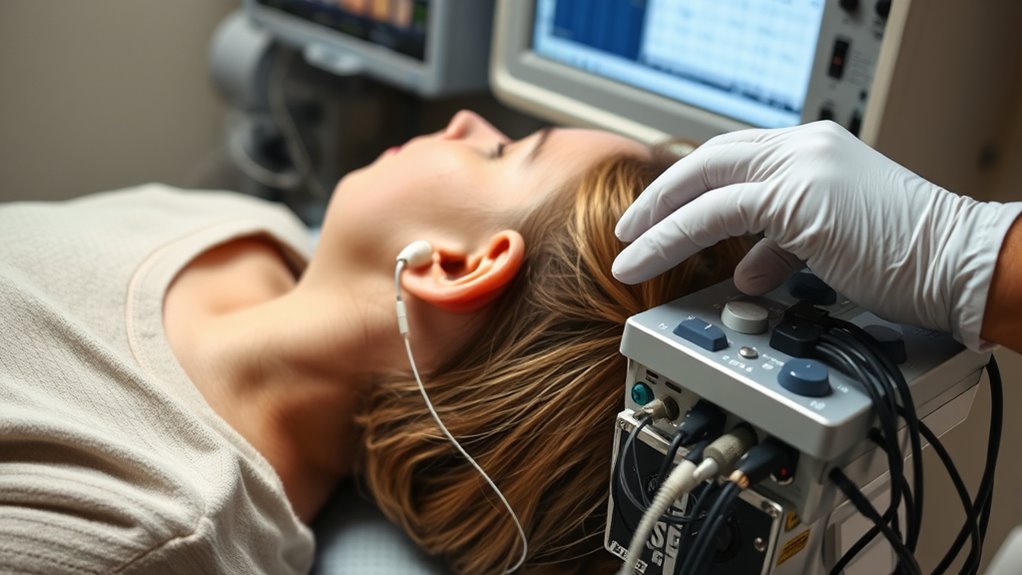

Auditory Brainstem Response (ABR) testing is a quick, painless procedure that checks how your hearing nerves and brainstem respond to sound stimuli. Small electrodes are placed on your scalp and near your ears to record electrical signals when you listen to clicking sounds or tone bursts. This test helps identify hearing problems and neural pathway issues, especially in infants or those who can’t communicate clearly. Continuing further will help you understand how ABR can pinpoint specific hearing concerns.

Get everyday helpers delivered free — and shop member deals
- Fast, free delivery on millions of items
- Access to Prime Big Deal Days deals on October 6–7
- Prime Video, Amazon Music and more included
Key Takeaways
- ABR testing is a non-invasive procedure that measures electrical responses of the auditory nerve and brainstem to sound stimuli.
- It uses electrodes on the scalp and near the ears to record waveforms indicating neural activity.
- The test helps diagnose hearing loss types and identify issues along the auditory neural pathway.
- It is particularly useful for infants and individuals unable to communicate effectively.
- Data from ABR waveforms support accurate diagnosis and guide appropriate treatment options.
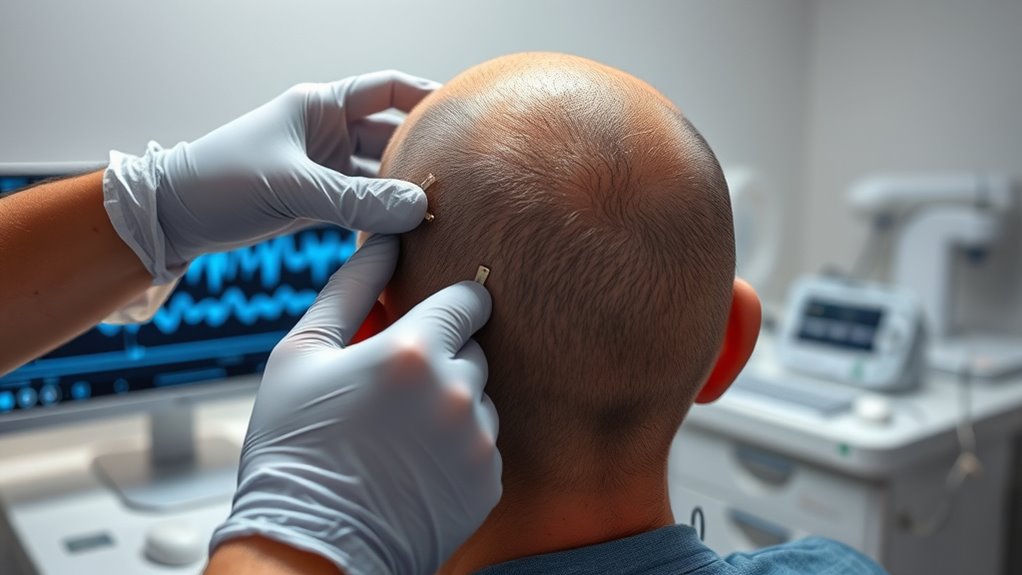
Auditory Brainstem Response (ABR) testing is a non-invasive procedure used to evaluate your hearing and the health of your auditory pathway. During the test, small electrodes are placed on your scalp and near your ears to pick up electrical signals generated by your auditory nerve and brainstem in response to sound stimuli. These signals help determine if the neural pathway responsible for hearing is functioning properly. If there’s any disruption along this pathway, it could contribute to hearing loss, and ABR testing provides a clear way to identify where the issue might be happening. This makes ABR especially useful for diagnosing hearing problems in infants or individuals who cannot communicate their hearing difficulties effectively.
When you undergo ABR testing, you’ll listen to a series of clicking sounds or tone bursts delivered through earphones. The electrodes record the electrical activity triggered by these sounds as they travel through your auditory system. The entire process is quick, usually taking less than an hour, and it’s pain-free. You might feel a little uncomfortable from the electrodes or the sounds, but there’s no risk involved. The data collected is then analyzed to produce waveforms representing neural activity at different points along the neural pathway. These waveforms help audiologists determine if your auditory nerve responds properly and if signals are reaching the brainstem as they should.
Recent research highlights the importance of AI Safety measures in ensuring the reliability of diagnostic tools like ABR, especially as AI integrations become more common in healthcare. If the ABR results show abnormal waveforms or delayed responses, it could indicate issues in your neural pathway, which might be linked to hearing loss. For example, a disrupted neural pathway can cause sensorineural hearing loss, where the problem lies in the inner ear or along the nerve itself. Identifying these issues early is vital because it guides treatment options and helps prevent further deterioration of hearing. Additionally, ABR testing can distinguish between different types of hearing loss, such as conductive (related to the outer or middle ear) versus sensorineural, by evaluating how well the neural pathway transmits sound signals.
As an affiliate, we earn on qualifying purchases.
Frequently Asked Questions
How Long Does an ABR Test Typically Take?
The test typically takes about 30 to 60 minutes, depending on your specific circumstances. During the procedure, you’ll sit or lie down while small electrodes are placed on your scalp and earlobes. The procedure length can vary based on factors like age and cooperation. Overall, you should plan for a session that’s roughly half an hour to an hour, including setup and rest time.
Is ABR Testing Suitable for Newborns and Infants?
You can confidently use ABR testing for newborns and infants during their screening and assessment. Imagine a tiny ear, delicate and still developing, as the test gently listens to their tiny brain’s responses to sounds. This non-invasive, safe procedure helps identify hearing issues early, ensuring timely intervention. ABR testing is specifically designed for this age group, making it an essential tool for newborn screening and infant assessment.
Can ABR Results Determine the Severity of Hearing Loss?
Yes, ABR results can help determine the severity of hearing loss by providing hearing loss classification. You can interpret the waveforms and thresholds to estimate how much hearing ability is affected. When you compare these results to an audiogram, you’ll see a clear correlation, allowing you to assess whether the hearing loss is mild, moderate, or severe. This helps guide appropriate intervention and management strategies.
Are There Any Risks or Side Effects Associated With ABR Testing?
Like a gentle breeze, ABR testing is safe and usually free of risks. You won’t experience side effects or concerns because it’s non-invasive, involving small electrodes and sound stimuli. While some might feel a little discomfort from the electrodes or noise, serious risks are rare. Overall, the procedure prioritizes your safety and comfort, making it a reliable way to assess hearing without significant concerns.
How Does ABR Testing Differ From Other Hearing Assessments?
You’ll find that ABR testing differs from other hearing assessments because it measures your neural pathway’s response to sound, rather than relying on behavioral responses. This makes it highly accurate, especially for infants or those unable to participate in traditional tests. Unlike pure-tone audiometry, ABR offers objective testing, providing precise data on your hearing ability and neural function, ensuring reliable results regardless of your cooperation level.
Conclusion
Think of auditory brainstem response testing like tuning a delicate instrument—you’re ensuring every note is heard clearly. I once met a parent whose child’s ABR test revealed hearing loss early enough for intervention, changing their life. Just as a skilled musician adjusts their instrument for perfect sound, ABR testing fine-tunes your understanding of hearing health. It’s a crucial step that helps you catch issues early, giving your loved ones the best chance to hear the world clearly.
Fall Picks
fall essentials
As an affiliate, we earn on qualifying purchases.