As a deafblind person, you combine technology and human support to navigate and connect with others smoothly. You might use devices like tactile maps, vibrations, or Braille displays to interpret surroundings and communicate. Human guides offer essential context, guidance, and emotional connection, making interactions more meaningful. This seamless blend helps you stay independent, understand your environment, and engage fully in daily life. Keep exploring, and you’ll discover how these tools work together to enhance your experience.

Get everyday helpers delivered free with Prime
- Fast, free delivery on millions of items
- Prime Video, Amazon Music and more included
- Member-only deals all year
Key Takeaways
- DeafBlind individuals use sensory substitution devices, like tactile maps and vibrations, combined with human guides for environmental awareness.
- Assistive technologies, such as braille displays and speech-to-text, facilitate communication alongside human support.
- Wearable devices alert users to obstacles and people through vibrations, complemented by human interpretation for context.
- Human support provides emotional connection and contextual understanding, enhancing the effectiveness of technological tools.
- Ongoing advancements in assistive tech aim to create seamless, natural interactions between DeafBlind users, technology, and human assistance.

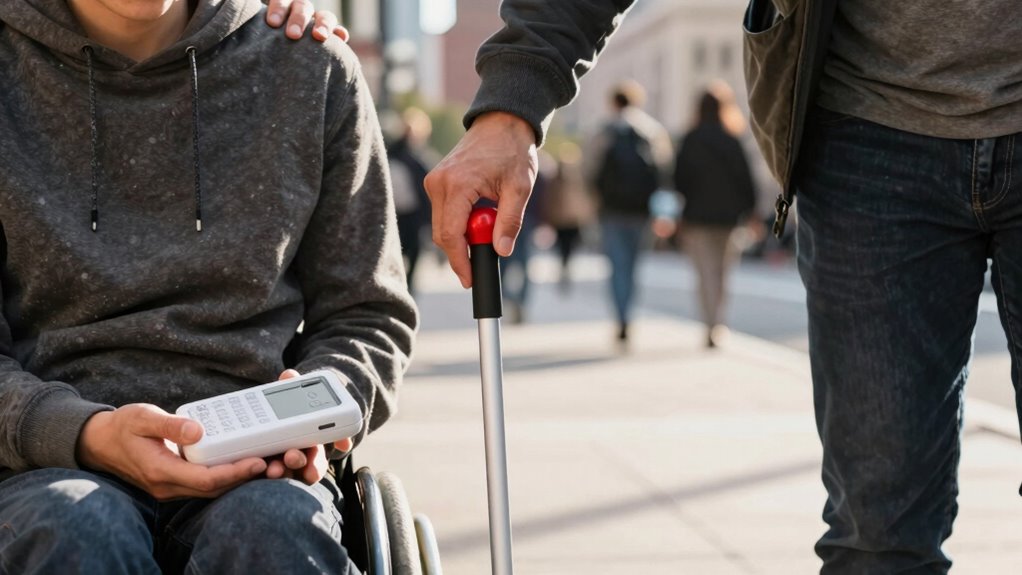
For many DeafBlind individuals, exploring the world requires a clever combination of advanced technology and human support, enabling greater independence and connection. To steer through their environment and communicate effectively, they often rely heavily on sensory substitution techniques. These methods involve transforming information typically received through one sense into another that remains accessible. For example, devices like tactile maps or vibrations can relay spatial information or alerts, giving you a way to perceive your surroundings beyond your remaining senses. These tools serve as a bridge, allowing you to interpret signals that would otherwise be inaccessible, making daily tasks more manageable and less isolating.
Sensory substitution transforms inaccessible signals into perceivable formats, fostering independence and connection for DeafBlind individuals.
Assistive communication plays a vital role in empowering DeafBlind individuals. Many depend on specialized devices that translate text or speech into tactile or visual formats they can perceive. For instance, braille displays connected to smartphones or computers enable you to read messages and access information seamlessly. Additionally, speech-to-text software can convert spoken words into written form, which you can then read via a braille device or a tactile output. These technologies work hand-in-hand with human support, such as interpreters or guide personnel, to facilitate more natural interactions. Human support guarantees that you’re not solely dependent on devices but also benefit from personalized, context-aware assistance that adapts to your specific needs.
The integration of sensory substitution and assistive communication technologies creates a dynamic support system that enhances your independence. For example, you might use a wearable device that vibrates to alert you to approaching people or obstacles, while a human guide provides contextual understanding and emotional connection. This combination allows you to experience your environment more fully, reducing feelings of isolation and increasing your confidence in steering through unfamiliar spaces. Additionally, these tools often work in real-time feedback, enabling quicker responses and smoother interactions, which are essential for daily activities, social engagement, and even emergencies. Real-time feedback is a crucial aspect of effective assistive technology, making interactions more natural and responsive. Moreover, ongoing research and development continue to improve these tools, making them more accessible and intuitive for users.
Furthermore, advancements in wearable technology are continually expanding the ways DeafBlind people can navigate and interpret their surroundings more intuitively. This progress is driven by ongoing research and development in sensory substitution techniques, which aim to provide even more seamless and intuitive support. Ultimately, the synergy of technology and human support transforms how you perceive and connect with the world. Sensory substitution breaks down barriers by translating inaccessible signals into perceivable formats, while assistive communication tools ensure you can express yourself and understand others clearly. Together, they create a supportive environment that fosters independence, social participation, and a richer experience of life’s everyday moments. As technology continues to advance, the potential for even more integrated, intuitive support grows, promising an increasingly connected world for DeafBlind individuals like you.
As an affiliate, we earn on qualifying purchases.
Frequently Asked Questions
How Do Deafblind Individuals Learn to Use New Technology Independently?
You learn to use new technology independently through sensory integration and guided training. You might start with tactile or vibrational feedback to understand device functions, gradually building confidence. Human support, like trainers or interpreters, helps you grasp new tools, while consistent practice fosters independent learning. Over time, you develop your skills, combining sensory input with hands-on experience, enabling you to navigate and operate technology confidently on your own.
What Are the Recent Advancements in Assistive Devices for Deafblind People?
Recent advancements in assistive devices include sensory substitution systems and tactile feedback technology. You can now experience more independence through devices that convert visual or auditory information into tactile signals, like vibrating wristbands or tactile maps. These tools help you interpret your environment more effectively, bridging sensory gaps. By integrating sensory substitution with tactile feedback, technology becomes more intuitive, empowering you to navigate and communicate with greater confidence.
How Do Cultural Differences Affect Support Strategies for Deafblind Individuals?
Cultural perceptions shape how you approach support accessibility for deafblind individuals, influencing whether communities emphasize independence, community, or family. These differences affect the types of support provided, the communication methods used, and the level of integration in daily life. You adapt strategies by respecting cultural values, fostering understanding, and tailoring resources, ensuring support aligns with each person’s background, preferences, and cultural context to maximize effectiveness and respect.
What Training Is Available for Caregivers Assisting Deafblind People With Technology?
You can access specialized training programs that focus on sensory integration and communication strategies for caregivers assisting deafblind individuals. These courses teach you how to effectively use adaptive technology, interpret sensory cues, and facilitate communication. Many organizations, such as the National DeafBlind Equipment Distribution Program, offer workshops, online modules, and hands-on practice to enhance your skills. This training helps you provide more effective, personalized support, fostering independence and improved quality of life for those you assist.
How Do Deafblind People Navigate Social Interactions Using Combined Support Methods?
You navigate social interactions by blending tactile communication and emotional support. You might feel a tap on your hand or arm to initiate contact, then use tactile sign language or vibrations to exchange messages. Human support provides reassurance and guidance, helping you interpret emotions and context. Technology, like Braille displays or haptic devices, complements this, ensuring you stay connected and engaged, fostering meaningful relationships despite sensory limitations.
Conclusion
As you navigate the world, remember that technology and human support are like the twin stars guiding a night traveler—each essential, shining brightly, yet together creating a path through darkness. Deafblind individuals harness this luminous constellation, blending innovation with compassion to forge independence and connection. In this dance of light and shadow, they transform obstacles into opportunities, proving that even in silence and darkness, the human spirit’s resilience shines like a steady, unwavering beacon.
Halloween Picks
halloween
As an affiliate, we earn on qualifying purchases.