
TL;DR
A 24-week study of 162 adults aged 65 and older with signs of mild cognitive impairment found that the resistance-training group scored slightly higher than a gentle-exercise group on two thinking tests. The trial did not establish whether those differences improve everyday function or reduce dementia risk.
A 24-week resistance-training program was associated with slightly higher scores on two thinking tests than gentle exercise among 162 adults aged 65 and older with signs of mild cognitive impairment, according to a trial reported in The Journal of Nutrition, Health and Aging. The study did not establish whether the modest test differences improve daily life or affect participants’ chances of developing dementia.

Get everyday helpers delivered free with Prime
- Fast, free delivery on millions of items
- Prime Video, Amazon Music and more included
- Member-only deals all year
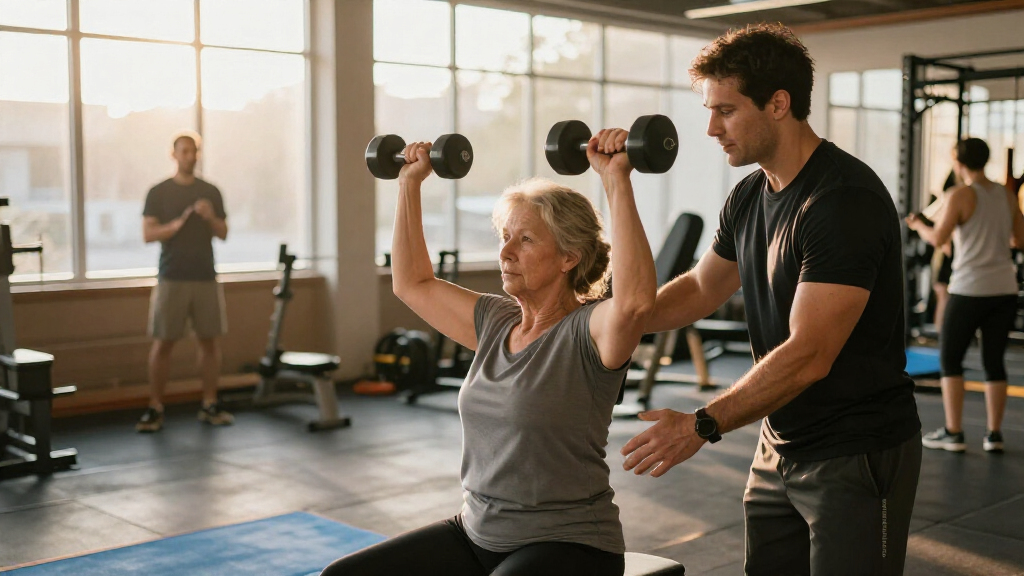
Researchers compared gentle exercise with a program in which participants worked their muscles against weights or their own body weight. Exercises became more difficult over time; during the second half of the program, some participants performed movements on foam pads and other unstable surfaces that added a balance challenge. The report describes the trial as randomized, assessor-blinded and sham-controlled.
At the end of the program, the resistance-training group performed slightly better on a test requiring participants to repeat a string of numbers immediately after hearing it and on a one-minute task naming words that begin with the letter A. The groups had similar results on a story-memory test, including when asked to recall details immediately and after half an hour.
The study involved people with probable mild cognitive impairment: greater difficulty with memory or thinking than is typical for their age, while still being able to manage most everyday tasks. The report does not provide enough information to conclude that training changed participants’ independence, confidence or clinical condition. Its findings concern performance on specific tests, not a demonstrated prevention or treatment effect.
What the Test Differences Show
The findings offer a measured reason to study strength exercise as part of research on thinking skills in older adults. Resistance training involves learning and repeating movements, coordinating muscles and, in this program, maintaining balance. Those activities may engage both physical and cognitive demands, but the trial tested the combined program against gentle exercise; it cannot show which part, if any, explains the test-score differences.
The results matter because cognitive test performance is not the same as functioning in everyday life. The report says it remains unclear whether the small advantages would help participants with tasks such as managing routines or living independently. Nor did the study establish an effect on dementia risk. Readers should treat the findings as evidence from one trial, not proof that resistance training prevents cognitive decline.
Products Worth Considering

Logitech MX Mechanical Mini for Mac Wireless Keyboard, Space Gray

Anker SOLIX C1000 Gen 2 Portable Power Station with 200W Solar Panel

DJI Mini 4K Drone with 4K UHD Camera
As an affiliate, we earn on qualifying purchases.
How the Training Was Designed
Resistance training asks muscles to work against a load, which can come from equipment or body weight. The report explains that people may become stronger before their muscles grow noticeably, partly because the brain and nerves improve how they activate muscles. Repeated practice can also help people adjust effort and sense their body position.
The trial’s balance challenges were added in the latter half of the 24-week program, but researchers compared the whole training program with gentle exercise. They therefore could not isolate the effect of unstable surfaces from other exercises or determine whether balance practice itself influenced the results.
The report also describes possible pathways under investigation, including changes related to blood pressure, insulin response, inflammation and substances released by contracting muscles. These are possible explanations, not mechanisms shown to account for the trial’s test results. Findings from other research on proteins associated with brain-cell function have varied, according to the report.
Daily Effects Remain Unknown
The reported differences were small, and the source does not specify whether they reached a threshold considered meaningful in daily life. It is also unclear how long any test-score differences might last after the program ended, whether participants changed their everyday activity, or whether similar results would apply to older adults without signs of mild cognitive impairment.
Because the intervention combined resistance exercises with balance challenges, the trial cannot identify the contribution of each component. The report also does not establish that training prevents dementia, improves confidence, or produces lasting changes in independence. Those outcomes would require direct measurement and further research.
Further Trials Must Test Everyday Outcomes
The study’s findings support further research that follows participants beyond the 24-week training period and measures whether changes carry over into daily activities. Trials could also compare resistance training with and without balance challenges to clarify which parts of a program are associated with any cognitive effects.
For now, the reported result is limited to small advantages on two specific tests in this group of older adults. The publication does not establish a dementia-prevention effect or provide a basis for treating cognitive impairment with exercise.
Key Questions
What did the resistance-training study find?
After 24 weeks, the resistance-training group scored slightly higher than the gentle-exercise group on an immediate number-repetition test and a one-minute word-generation test. The groups performed similarly on a story-memory task.
Did the study show that strength training prevents dementia?
No. The trial did not establish whether the program changes the chance of developing dementia. The report describes that as an open question.
Did participants become more independent or confident?
The reported findings do not establish changes in independence or confidence. Researchers measured performance on cognitive tests, and it remains unclear whether the small score differences affected everyday life.
Who took part in the trial?
The study included 162 adults aged 65 and older who showed signs of probable mild cognitive impairment. The program lasted 24 weeks and was compared with gentle exercise.
Did balance training account for the results?
The trial cannot answer that. Balance challenges were part of the resistance program, but researchers compared the full program with gentle exercise rather than testing balance training separately.
Source: medicalxpress.com