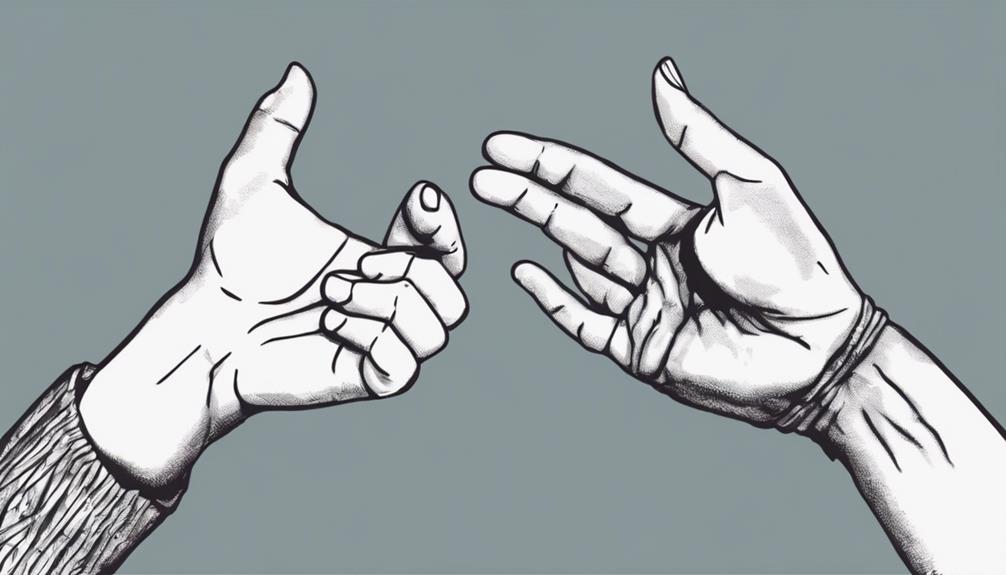
When we extend our arms gracefully to express gratitude in American Sign Language (ASL), we often ponder the best way to reciprocate the gesture.

Get everyday helpers delivered free with Prime
- Fast, free delivery on millions of items
- Prime Video, Amazon Music and more included
- Member-only deals all year
The art of saying 'You're Welcome' in sign language holds nuances and cultural significance that go beyond a mere acknowledgment.
Exploring the intricacies of this gesture can reveal layers of communication that enrich our interactions and foster deeper connections.
Let's unravel the layers of meaning behind this seemingly simple sign and discover the depth it adds to our conversations.
Key Takeaways
- Basic ASL sign involves palm up hand arc
- Polite gestures include nodding, eye contact, smiling
- Common variations: 'thank you' back, 'FINE'
- Non-manual signals: facial expressions, head movements, posture
American Sign Language learning kit
As an affiliate, we earn on qualifying purchases.
As an affiliate, we earn on qualifying purchases.
Basic ASL Sign for 'You're Welcome
When expressing gratitude in American Sign Language (ASL), the basic sign for 'you're welcome' involves extending our dominant hand palm up and gently moving it in a small arc. This sign is a fundamental gesture in ASL to acknowledge thanks and show politeness in interactions.
Using our dominant hand to make this sign isn't only a sign of respect but also a way to foster inclusive communication. Along with the hand motion, a simple nod or a warm smile can also convey the message of 'you're welcome' effectively in ASL.
By learning and practicing this sign, we can strengthen our ability to engage in polite interactions within the deaf and hard of hearing communities. Embracing the 'you're welcome' sign in ASL not only facilitates smoother communication but also cultivates a sense of unity and understanding among individuals from diverse backgrounds.
Let's continue to use this sign to promote kindness and inclusivity in our interactions.
Polite Gestures in ASL

Upon mastering the 'you're welcome' sign in ASL, individuals can expand their repertoire of polite gestures to enhance communication and foster inclusivity within the deaf and hard of hearing communities. Polite gestures play a crucial role in ASL interactions, promoting respect and understanding among individuals.
Here are three gestures that can further enrich your ASL communication:
- Nodding: In ASL, nodding is commonly used to indicate agreement or understanding during a conversation. It shows active participation and engagement in the discussion.
- Maintaining eye contact: Eye contact is essential in ASL communication as it conveys attentiveness and respect. By maintaining eye contact, you demonstrate your focus on the conversation and the person you're communicating with.
- Smiling: A genuine smile can convey warmth, friendliness, and positivity in ASL interactions. It helps create a welcoming and inclusive environment, fostering connections with others.
Incorporating these gestures alongside the 'you're welcome' sign can enhance your ASL communication skills and promote effective and respectful interactions within the deaf and hard of hearing communities. That's fine.
Common Variations of 'You're Welcome
Common variations of 'you're welcome' in sign language provide a nuanced way to express gratitude and acknowledgment in diverse interactions. These variations include signing 'thank you' back, using 'FINE' to indicate acceptance, or expressing 'oh it's nothing' or 'no problem'.
Additional options might involve signing 'it's nothing' or using a casual 'nah' in response to gratitude. The context in which you find yourself, whether formal or informal, can influence the choice of variation. Understanding the nuances of each variation can help convey sincerity and politeness effectively.
Non-Manual Signals in ASL

Non-manual signals in American Sign Language (ASL) play a vital role in conveying grammatical information through facial expressions, head movements, and body posture. These signals are key elements in ASL communication, enhancing the understanding and expression of messages. Here are some key points to consider about non-manual signals in ASL:
- Facial Expressions: ASL relies heavily on facial expressions to convey emotions, questions, emphasis, and other nuances that add depth to the signs being used.
- Head Movements: Head movements in ASL can indicate yes or no responses, directions, locations, and can even change the meaning of signs based on their placement and movement.
- Body Posture: The positioning and movement of the body play a crucial role in ASL grammar, helping to distinguish between different types of sentences, statements, and questions.
Understanding and incorporating these non-manual signals is essential for effective communication and fluency in American Sign Language.
Cultural Considerations in ASL
Considering the rich tapestry of cultural nuances within the Deaf community, it is imperative to approach the study and practice of American Sign Language with a deep respect for its unique linguistic and social conventions. When engaging with ASL, one must be mindful of the importance of facial expressions, body language, and eye contact in conveying meaning. These elements are integral to effective communication in ASL and play a significant role in understanding the nuances of the language. It is also crucial to recognize the diversity within the Deaf community, as sign language usage can vary among different groups. By appreciating the historical and cultural significance of ASL as a rich and vibrant language, we can foster inclusivity and cultural sensitivity in our interactions with Deaf individuals.
| Cultural Considerations in ASL | |
|---|---|
| Respect Language Norms | Appreciate Diversity |
| Understand Non-Verbal Cues | Embrace Historical Significance |
| Promote Inclusivity | Cultural Sensitivity |
Frequently Asked Questions
How Do You Do You Welcome in Sign Language?
When someone thanks us, we can respond by signing 'you're welcome' in American Sign Language. This sign involves extending our fingers and bringing our hand towards our chest.
It's a common way to acknowledge gratitude and show politeness. Using this sign helps promote good manners and enhances communication in sign language conversations.
Is There a Sign for Welcome?
Yes, there's a sign for 'welcome' in American Sign Language. It involves extending both hands outward with open palms, conveying invitation and warmth.
Incorporating this sign with 'thank you' creates the response 'you're welcome.' This creative combination allows for nuanced expressions of gratitude.
Learning these signs enhances communication, fostering understanding and connection in sign language interactions.
Is Your Welcome the Same as Thank You in Sign Language?
No, 'you're welcome' isn't the same as 'thank you' in sign language. While 'thank you' expresses gratitude, 'you're welcome' acknowledges the thanks and shows a willingness to help or offer.
Both signs are distinct and important for clear communication. It's essential to understand and use both signs effectively to enhance social interactions and foster gratitude within the deaf community.
How Do You Sign Thank You in Asl?
Sure!
In American Sign Language (ASL), the sign for 'thank you' involves placing an open hand near the chin and moving it forward in a gracious gesture. It's a common expression of gratitude in Deaf culture.
Learning this sign can enhance communication and show appreciation. It's a polite way to acknowledge and reciprocate gratitude.
Mastering this sign can lead to stronger relationships by expressing gratitude.
Conclusion
In conclusion, mastering the ASL sign for 'you're welcome' is a valuable skill that promotes kindness and effective communication. Just as a smile can brighten someone's day, a simple gesture in sign language can convey respect and gratitude.
Remember, in the world of sign language, actions truly speak louder than words. So, keep signing and spreading positivity wherever you go.
Fall Picks
fall essentials
As an affiliate, we earn on qualifying purchases.