Public spaces are challenging for your navigation because they often lack sensory-friendly features like tactile paving, accessible signage, or audio cues that match your needs. Overwhelming noise, crowd movement, and unpredictable environments make it harder to rely on touch and vibration. Limited support tools and insufficient staff training can leave you feeling disoriented and unsafe. But understanding these issues better can help you see how improvements could make your experience easier—if you keep exploring.

Get everyday helpers delivered free with Prime
- Fast, free delivery on millions of items
- Prime Video, Amazon Music and more included
- Member-only deals all year
Key Takeaways
- Lack of consistent tactile, braille, and auditory cues hampers environmental awareness for DeafBlind individuals.
- Inadequate infrastructure, such as tactile paving and accessible signage, impedes wayfinding.
- Environmental noise and crowd movement overwhelm sensory processing, causing disorientation.
- Limited assistive technology and infrastructure reduce effective navigation support.
- Insufficient training and support from staff increase safety risks and hinder independence.
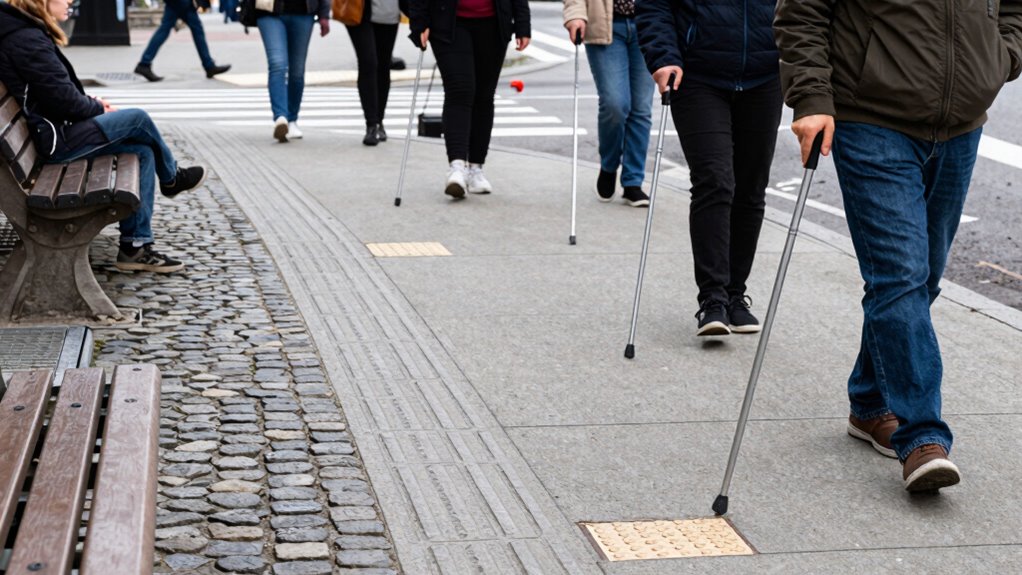
Finding their way through public spaces can be particularly challenging for DeafBlind individuals, who often face barriers that others may overlook. Exploring busy streets, crowded malls, or even simple crossings requires more than just awareness of the environment; it demands a finely tuned sense of sensory integration. Without clear visual cues or audible signals, you rely heavily on touch, vibration, and other sensory inputs to stay oriented. Public spaces are often designed with sighted and hearing individuals in mind, making it difficult for you to access information that others take for granted. This disconnect can lead to confusion, delays, and even safety risks. Additionally, the lack of consistent environmental infrastructure** such as tactile paving and accessible signage further hampers navigation. Assistive technology plays an essential role in helping you bridge these gaps. Devices like tactile maps, GPS systems designed specifically for DeafBlind users, and electronic travel aids provide crucial support. These tools translate environmental data into accessible formats—such as vibrations or tactile feedback—so you can interpret your surroundings effectively. For example, a GPS device with haptic feedback can alert you when to turn or warn you of upcoming obstacles, reducing your reliance on visual or auditory cues. But even with these advancements, public spaces often lack the consistent infrastructure needed to optimize assistive technology. Tactile paving, clear signage in braille, and audio signals that also include vibration or tactile options are not always available, making it harder for you to navigate confidently. Creating inclusive environments that accommodate diverse sensory needs requires thoughtful planning and design. Furthermore, training and awareness among staff and volunteers are often insufficient, which can further complicate your navigation experience. The environment itself must be designed with sensory integration in mind. Noise pollution, unpredictable crowd movements, and poorly marked pathways can overwhelm your senses and hinder your ability to process information efficiently. You need environments that support your unique sensory needs—spaces that combine tactile, visual, and vibratory cues seamlessly. Without this thoughtful design, you’re left piecing together fragmented information, which can be exhausting and risky. Moreover, public spaces often lack staff or volunteers trained to assist DeafBlind individuals appropriately. This adds another layer of difficulty, as you might not always have someone nearby to provide guidance or reassurance. Proper staff training can significantly improve the accessibility of public spaces, ensuring that assistance is available when needed. When infrastructure and human support fall short, you become more vulnerable to disorientation and accidents. Recognizing the importance of accessible design** in the environment is crucial for fostering independence and safety. Overall, the combination of sensory integration challenges and gaps in assistive technology infrastructure makes exploring public spaces a complex task for you. To improve this, inclusive design and increased awareness are essential, ensuring all individuals, regardless of sensory differences, can move through public spaces safely and independently.
tactile paving for public spaces
As an affiliate, we earn on qualifying purchases.
As an affiliate, we earn on qualifying purchases.
Frequently Asked Questions
How Do Deafblind Individuals Typically Navigate Unfamiliar Public Spaces?
You navigate unfamiliar public spaces by relying on sensory integration and tactile mapping. You use your sense of touch to feel your environment, often with the help of a cane or guide dog, to detect obstacles and landmarks. Tactile maps help you understand the layout, while combining auditory cues with touch allows you to orient yourself. This active process helps you move confidently despite the challenges of unfamiliar settings.
What Specific Environmental Factors Most Hinder Deafblind Navigation?
Environmental obstacles and sensory deprivation most hinder your navigation in public spaces. Large crowds, unpredictable sounds, and uneven surfaces block your path and limit your awareness. Lack of tactile cues or clear guide paths leaves you unsure of your surroundings. Distractions and poor lighting further reduce your ability to detect obstacles. These factors combine to create a confusing environment, making it difficult for you to move confidently and safely through unfamiliar areas.
Are There Existing Technologies That Assist Deafblind Navigation Effectively?
You’re in luck—there are technologies that help deafblind navigation, making it less of a tall order. Tactile maps provide physical cues, while assistive audio devices deliver real-time information. These tools work together to bridge communication gaps, giving you a better sense of your surroundings. Though no solution is perfect, combining tactile and audio tech gets you closer to independence, proving that where there’s a will, there’s a way.
How Do Public Space Designs Consider Deafblind Accessibility?
Public space designs consider deafblind accessibility by focusing on sensory integration, ensuring multiple senses are engaged for navigation. Tactile signage plays a vital role, allowing you to feel and interpret directions easily. Designers incorporate textured surfaces, raised symbols, and Braille, enabling you to access information through touch. These thoughtful features help you navigate confidently, fostering independence and inclusivity in public environments.
What Training Is Available to Help Deafblind People Navigate Public Areas?
You can access training programs that focus on sensory adaptation and community awareness to help you navigate public areas. These programs often include tactile and auditory skills, teaching you how to interpret environmental cues. Community awareness initiatives also foster understanding and support from the public, making navigation easier. Participating in workshops or working with mobility specialists can boost your confidence and independence in various public settings.
Conclusion
Finding your way through public spaces as a deafblind person is like trying to find your way through a maze with no map—you need clear, accessible cues to guide you. When spaces lack tactile paths, auditory signals, or clear signage, it becomes even harder. Your awareness and efforts matter in making these spaces more inclusive. Together, we can break down barriers, turning confusion into confidence, and ensuring everyone can find their way just as easily as finding a familiar friend in a crowd.
Halloween Picks
halloween
As an affiliate, we earn on qualifying purchases.