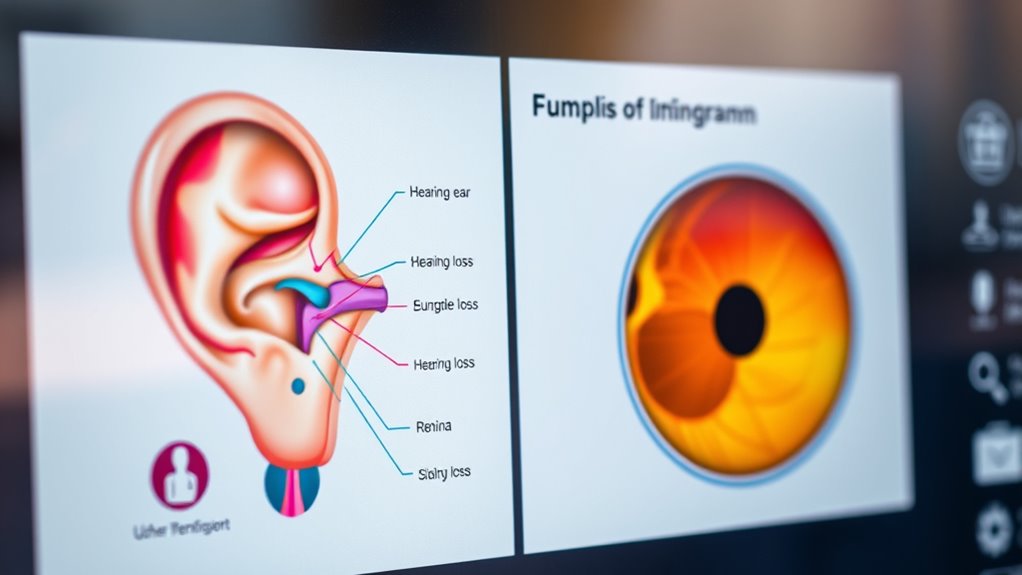

Usher syndrome has three main types, each with different severity and onset. You may experience hearing loss from birth, which is common in all types, but vision loss tends to worsen over time. Type 1 is the most severe, leading to profound deafness and early balance issues. Type 2 involves moderate hearing loss and later vision problems, while Type 3 has variable hearing loss and a gradual vision decline. To understand how these factors affect you, keep exploring more details.
Key Takeaways
- Usher syndrome has three main types (I, II, III), distinguished by severity and age of onset of hearing and vision loss.
- Type I involves profound congenital deafness and early-onset severe vision loss due to retinitis pigmentosa.
- Type II features moderate hearing loss from birth with later onset of progressive vision impairment.
- Type III presents with progressive hearing loss and variable vision decline, often starting in adolescence or adulthood.
- Symptoms typically include night blindness, tunnel vision, and deafness, progressing over years.
Usher syndrome is a rare genetic disorder that causes both hearing loss and progressive vision loss. As you navigate this condition, understanding its genetic inheritance can help you grasp why it occurs and what to expect. Usher syndrome is inherited in an autosomal recessive pattern, meaning both parents carry a copy of the mutated gene, even if they don’t show symptoms themselves. When you inherit these faulty genes from both parents, you develop the syndrome. This genetic inheritance plays a pivotal role in the way the disease manifests, influencing the severity and progression of your symptoms. If you have a family history of Usher syndrome, talking to a genetic counselor can give you a clearer picture of your risks and help you plan for the future.
The hallmark of Usher syndrome is vision impairment, which worsens over time. Initially, you might notice trouble seeing in dim light or difficulty adapting to darkness—symptoms that are often linked to a condition called night blindness. As the syndrome progresses, your peripheral vision diminishes, leading to tunnel vision, where your field of sight narrows. This gradual loss of vision is due to a degenerative process affecting the retina, specifically the light-sensitive cells known as rods and cones. The severity and onset of vision impairment can vary depending on the type of Usher syndrome you have, but generally, it worsens over years, considerably impacting daily activities like reading, driving, or recognizing faces. Early diagnosis and regular eye exams are essential to managing your vision health. Low vision aids, adaptive technologies, and orientation and mobility training can help you maintain independence despite the vision challenges. Advances in retinal research continue to offer hope for future treatments that may slow or halt the progression of vision loss.
The interplay between genetic inheritance and vision impairment in Usher syndrome underscores how interconnected your genetic makeup is with your sensory health. While the hearing loss is often congenital, meaning present from birth, the vision loss tends to develop progressively during your teenage years or early adulthood. This combination can be overwhelming, but knowing that your condition is rooted in genetic inheritance offers some reassurance—research is ongoing to better understand the genetics behind Usher syndrome and develop targeted treatments. If you’re diagnosed, working with a team of specialists, including audiologists, ophthalmologists, and genetic counselors, can help you create a comprehensive care plan. By understanding the genetic foundations and the nature of your vision impairment, you can better prepare for the challenges ahead and explore options that improve your quality of life.

BLEWAY Bump Dots for Visually Impaired 165 Pcs Combo Pack(Red,Yellow,Black,White) – Low Vision Aids Braille Stickers Raised Tactile Dots for Elderly, Blind
TACTILE IDENTIFICATION:A boon for individuals with visual impairments such as low vision, glaucoma, blindness, and macular degeneration! This…
As an affiliate, we earn on qualifying purchases.
As an affiliate, we earn on qualifying purchases.
Frequently Asked Questions
Can Usher Syndrome Be Diagnosed Before Symptoms Appear?
Yes, you can detect Usher syndrome early through genetic testing before symptoms appear. Early detection is essential because it allows you to plan and manage potential vision and hearing issues proactively. If you have a family history, genetic testing can identify the associated gene mutations, providing you with valuable information ahead of symptoms. This proactive approach helps you seek early interventions and support to improve quality of life.
Are There Any Effective Treatments to Slow Usher Syndrome Progression?
Ironically, trying to slow Ushers’s progression feels like chasing shadows. While no cure exists, gene therapy offers hope by targeting the faulty genes, and assistive devices can improve your quality of life. These tools don’t stop the progression but can help you adapt and maintain independence longer. Continual research is promising, so staying informed and proactive gives you the best chance to manage this condition effectively.
Is Usher Syndrome Inherited From Both Parents or Just One?
You inherit Usher syndrome through genetic inheritance, typically from both parents, although sometimes only one parent’s genetic mutation causes it. It’s an autosomal recessive condition, meaning you need two copies of the mutated gene—one from each parent—to develop the syndrome. If only one parent passes down the mutation, you’re a carrier but usually won’t show symptoms. Your parental genetics play an essential role in determining whether you have Usher syndrome.
What Support Options Are Available for Individuals With Usher Syndrome?
Think of support options as a guiding lighthouse in a foggy night. You have access to support groups where you can share experiences and find understanding. Assistive technology acts as a beacon of independence, offering tools like hearing aids and visual aids. These resources empower you to navigate daily life confidently, connecting you to a community and technology that brighten your path and help you face challenges with resilience.
Does Usher Syndrome Affect Life Expectancy Significantly?
You might wonder if Usher syndrome affects life expectancy. While it can lead to vision and hearing loss, early diagnosis and management, including genetic counseling, help improve your quality of life. With proper support, many individuals live normal or near-normal lifespans. Staying proactive about health, treatments, and adapting to changes can markedly enhance your overall well-being and longevity despite the challenges posed by Usher syndrome.

Audien Atom One OTC Hearing Aids – Wireless, Rechargeable, and Comfortable | Clear Sound in a Small, Discreet Design for Seniors & Adults with Hearing Loss
Hear What Matters Most: Hearing isn’t one-size-fits-all. That’s why our adjustable frequency system lets you personalize your sound…
As an affiliate, we earn on qualifying purchases.
As an affiliate, we earn on qualifying purchases.
Conclusion
While you might fear losing your sight, remember that early diagnosis and support can make a difference. Usher syndrome’s dual challenges—vision and hearing loss—highlight the stark contrast between what you see and what you hear. Yet, this juxtaposition also offers hope: with advancements in technology and awareness, you can navigate these obstacles more confidently. Embrace the journey, knowing that understanding and intervention can help you find clarity amid the shadows.

Partners in O&M: Supporting Orientation and Mobility for Students Who Are Visually Impaired
As an affiliate, we earn on qualifying purchases.
As an affiliate, we earn on qualifying purchases.

NoIR Blue Blocker Sunglasses, Lightweight Glasses with Full UV Protection, Wrap-around Design for Macular Degeneration, Corneal Pathology and Retinitis Pigmentosa, 533_54
RELIEF FOR MULTIPLE EYE CONDITIONS – Recommended for individuals with corneal pathology, macular degeneration, and retinitis pigmentosa. These…
As an affiliate, we earn on qualifying purchases.
As an affiliate, we earn on qualifying purchases.