
If you have unilateral hearing loss, CROS and BiCROS devices can markedly improve your hearing experience. They help you become more aware of sounds from all directions, boost speech understanding in noisy environments, and reduce frustration in social settings. CROS is ideal if one ear has complete loss, while BiCROS works well if there’s residual hearing in the affected ear. To discover how these solutions could help you, keep exploring their features and benefits.
Key Takeaways
- Individuals with unilateral hearing loss in one ear and normal hearing in the other benefit from CROS and BiCROS systems.
- CROS devices are suitable for those with complete hearing loss in one ear, enhancing sound awareness from that side.
- BiCROS systems benefit users with residual hearing in the impaired ear, providing both amplification and sound transfer.
- Users seeking improved speech understanding in noisy environments and better spatial perception find these systems advantageous.
- People wanting discreet, customizable solutions that seamlessly integrate with digital devices gain improved connectivity and listening experience.

If you have hearing loss in one ear, CROS and BiCROS hearing systems can markedly improve your ability to hear and understand sounds. These innovative solutions leverage advanced hearing aid technology to direct sound from your impaired ear to your better ear, helping you stay connected with your environment. Whether you’re in a noisy restaurant or trying to follow a conversation across the room, these devices enhance your overall hearing experience by providing better awareness of sounds from all directions.
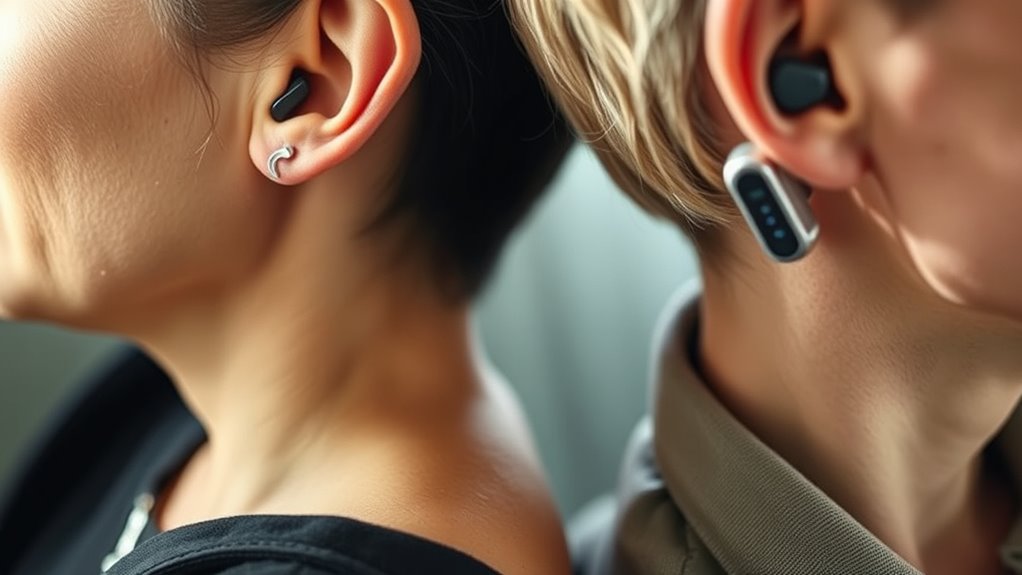
With CROS systems, sound from your non-hearing side is picked up by a tiny microphone and transmitted wirelessly to your functioning ear. This setup allows you to perceive sounds that would otherwise be completely missed, greatly boosting your spatial awareness. BiCROS systems take this a step further by combining the features of CROS with amplification for your better-hearing ear. This means that not only do you receive sounds from your impaired side, but the device also amplifies sounds in your good ear, improving speech comprehension even in challenging listening environments.
CROS and BiCROS systems boost sound awareness and speech understanding for unilateral hearing loss.
The key to these systems’ effectiveness lies in their sophisticated hearing aid technology. Modern CROS and BiCROS devices are equipped with features like noise reduction, directional microphones, and feedback cancellation. These features work together to filter out background noise and focus on speech, making conversations clearer and easier to follow. As a result, your ability to understand speech improves, reducing the frustration often associated with unilateral hearing loss.
Choosing the right system depends on your specific hearing needs. If you have complete hearing loss in one ear but normal hearing in the other, a CROS device can be a game-changer. It ensures you’re not at a disadvantage when it comes to localizing sounds or understanding speech coming from the side of your impaired ear. If you have some residual hearing in your affected ear, a BiCROS system can combine sound transfer and amplification, maximizing your hearing potential.
These systems are discreet, comfortable, and customizable to fit your lifestyle. With ongoing improvements in hearing aid technology, CROS and BiCROS devices now offer seamless integration with smartphones and other digital devices. This integration allows you to control settings easily and stay connected to your environment. Additionally, research into hearing aid technology continues to advance, making these devices more effective and accessible than ever. Ultimately, if you want to improve your hearing ability and enhance speech comprehension, exploring CROS or BiCROS options might be the solution you need to regain confidence in everyday conversations.

Audien Atom One OTC Hearing Aids – Wireless, Rechargeable, and Comfortable | Clear Sound in a Small, Discreet Design for Seniors & Adults with Hearing Loss
Hear What Matters Most: Hearing isn’t one-size-fits-all. That’s why our adjustable frequency system lets you personalize your sound…
As an affiliate, we earn on qualifying purchases.
As an affiliate, we earn on qualifying purchases.
Frequently Asked Questions
How Do CROS and Bicros Devices Compare to Cochlear Implants?
CROS and BiCROS devices offer better sound awareness and are more durable than cochlear implants, but they don’t restore hearing like implants do. Cochlear implants directly stimulate the auditory nerve, providing a more natural sound quality for users with profound hearing loss. While CROS and BiCROS are simpler and less invasive, cochlear implants are ideal for those needing significant hearing improvement, despite their higher device complexity and potential maintenance.
Are CROS and Bicros Suitable for Children or Only Adults?
CROS and BiCROS devices are suitable for children, but developmental considerations play a key role. If a child has unilateral hearing loss, these devices can help improve sound localization and communication. However, you should consult an audiologist to evaluate the child’s specific needs and guarantee proper fitting. Early use may support speech and language development, but ongoing assessments are essential to adapt to your child’s growth and changing needs.
What Maintenance Is Required for CROS and Bicros Systems?
Think of maintenance like tending a garden; consistent care keeps things thriving. For CROS and BiCROS systems, you’ll need to check ear hygiene regularly to prevent infections and keep the devices clean. Battery management is vital—recharge or replace batteries as needed to guarantee peak performance. Keep your device’s surfaces clean and dry, and schedule periodic professional check-ups to maintain sound quality and comfort.
Can CROS and Bicros Be Used With Smartphone Connectivity?
Yes, CROS and BiCROS systems can often be used with smartphones through wireless streaming, but it depends on the device compatibility. Many modern systems support Bluetooth or other wireless connections, allowing you to stream audio directly from your smartphone. Check your specific CROS or BiCROS device’s compatibility features to guarantee seamless wireless streaming, so you can enjoy calls, music, and other audio easily.
How Long Does It Take to Adapt to Using CROS or Bicros Devices?
You might wonder how long the adaptation period will be when using CROS or BiCROS devices. Usually, it takes a few days to a few weeks for your user experience to improve as your brain adjusts to the new sounds. During this time, your senses sharpen, and you’ll notice a difference in hearing clarity. Stay patient—your brain is rewiring, and soon, you’ll enjoy clearer, more balanced hearing.

BATSTRKS Hearing Aids for Seniors Rechargeable Invisible Behind The Ear Design with 24H Battery DSP Noise Reduction OTC Hearing Aids for Mild to Moderate Hearing Loss Easy Volume Control Not Amplifiers (Grey)
Regain social confidence Ultra-lightweight behind-the-ear design , virtually invisible when worn.Say goodbye to awkward “Pardon?” moments. DSP intelligent…
As an affiliate, we earn on qualifying purchases.
As an affiliate, we earn on qualifying purchases.
Conclusion
Whether you choose CROS or BiCROS, you’re opening a door to clearer conversations and a brighter outlook. Think of these devices as your personal lighthouse, guiding you safely through the fog of hearing loss. They transform quiet shadows into vibrant soundscapes, allowing you to reconnect with the world around you. With each step, you’re reclaiming your voice and confidence, turning the tide in your favor. Your journey to better hearing is a voyage worth taking—embrace it with open ears and an hopeful heart.
Audien Atom One OTC Hearing Aids – Wireless, Rechargeable, and Comfortable | Clear Sound in a Small, Discreet Design for Seniors & Adults with Hearing Loss
Hear What Matters Most: Hearing isn’t one-size-fits-all. That’s why our adjustable frequency system lets you personalize your sound…
As an affiliate, we earn on qualifying purchases.
As an affiliate, we earn on qualifying purchases.

Flaygo Pro Hearing Aids for Seniors with Smart Noise Reduction (Not Amplifiers),Rechargeable Digital OTC with 32-Channel for Clear Sound, Super Mini Invisible & 7-Day Standby, UV Charging Case,Voice announcement
Ultra-clear Communication: Flaygo's newly developed Pro digital chip in its hearing aids uses 32 channels to process sound….
As an affiliate, we earn on qualifying purchases.
As an affiliate, we earn on qualifying purchases.