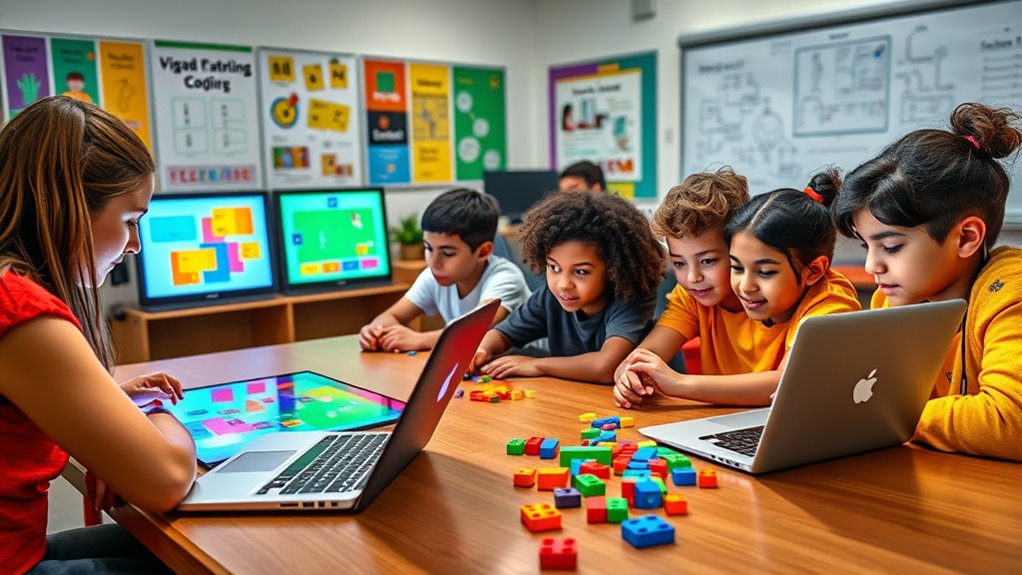

Teaching coding through visual programming languages makes learning more engaging and accessible. You’ll work with colorful, puzzle-like blocks that help you understand core concepts like sequencing, loops, and conditionals without worrying about syntax errors. This hands-on approach boosts your confidence and encourages experimentation, making coding less intimidating. The intuitive interface and step-by-step support help you build a strong foundation, and as you progress, you’ll discover how these tools set the stage for mastering advanced programming skills.
Key Takeaways
- Visual programming simplifies complex coding concepts, making programming accessible and engaging for beginners.
- It eliminates syntax errors, allowing learners to focus on logic, problem-solving, and core programming principles.
- Intuitive, drag-and-drop interfaces with visual cues support diverse learning styles and promote active experimentation.
- Visual languages serve as a foundation for transitioning learners to text-based coding, reinforcing long-term understanding.
- Gamified and interactive environments make coding education fun, motivating students to explore and develop computational skills.
Teaching coding through visual programming languages has become an increasingly popular approach to make programming more accessible and engaging. When you start using these tools, you’ll notice how they simplify complex concepts through block-based learning. Instead of typing lines of code, you manipulate colorful blocks that snap together like puzzle pieces. This method helps you focus on logic and problem-solving without getting bogged down by syntax errors. The visual aspect makes it easier to grasp fundamental programming principles, especially if you’re new to coding. These platforms feature beginner-friendly interfaces designed to reduce frustration and encourage exploration, making the learning process smoother and more enjoyable.
Visual programming tools simplify coding with colorful, puzzle-like blocks, making learning fun and accessible for beginners.
With block-based learning, you can see the immediate results of your work. For example, when you connect blocks to create a simple animation or game, you understand how different commands work together. This hands-on approach boosts your confidence because you don’t have to worry about the intricacies of language syntax. Instead, you learn by doing, experimenting with different block combinations to see what happens. The intuitive nature of these interfaces means you don’t need prior experience to get started. You can focus on understanding core concepts like sequencing, loops, and conditionals in a way that feels natural and accessible.
The beginner-friendly interfaces are designed to guide you through the learning process. They often include visual cues, tutorials, and hints that help you progress step by step. Some platforms even provide gamified experiences, turning coding into a fun challenge rather than a tedious task. As you become more comfortable, you can gradually move on to text-based programming languages, but the foundation built through block-based learning remains invaluable. It helps you develop a mental model of programming logic that transfers easily to more advanced languages later on.
Additionally, diverse learning styles are accommodated by these interfaces, making coding more inclusive and less intimidating for everyone. You’re not just following instructions—you’re actively designing and experimenting. This encourages a mindset of exploration, which is *essential* in learning programming. Plus, because the interfaces are typically drag-and-drop, you can focus on solving problems rather than struggling with complicated syntax. This approach caters to diverse learning styles, making coding more inclusive and less intimidating for everyone. Ultimately, by embracing block-based learning and beginner-friendly interfaces, you make the journey into programming more approachable, enjoyable, and effective for yourself or anyone you’re teaching.

Visual Basic 2026 Made Easy: A Complete Beginner-to-Advanced Tutorial in 35 Lessons
As an affiliate, we earn on qualifying purchases.
As an affiliate, we earn on qualifying purchases.
Frequently Asked Questions
How Do Visual Programming Languages Compare to Traditional Coding Languages?
When comparing visual programming languages to traditional coding, you’ll find that block-based learning simplifies complex concepts, making it easier to grasp. These languages are syntax free, allowing you to focus on logic without worrying about errors. While traditional coding offers more flexibility and control, visual languages are great for beginners, helping you quickly develop projects and build confidence before diving into more advanced, text-based programming.
What Are the Best Visual Programming Tools for Beginners?
Did you know that 85% of beginner coders find block-based programming more intuitive? For starters, tools like Scratch and Blockly use drag-and-drop interfaces, making coding accessible and engaging for learners. These visual programming tools simplify complex concepts, helping you build confidence quickly. As a beginner, you’ll appreciate how these platforms encourage experimentation and creativity, making learning to code both fun and effective.
Can Visual Programming Languages Prepare Students for Advanced Coding?
You might wonder if visual programming languages can prepare students for advanced coding. By engaging in block-based learning, you develop a strong conceptual understanding of programming logic and structures. This foundation helps you shift seamlessly to text-based coding, as many concepts remain consistent. Visual languages serve as a stepping stone, making complex ideas accessible and boosting your confidence for more advanced programming challenges ahead.
How Do Visual Languages Support Collaborative Coding Projects?
You can use visual programming languages to support collaborative workflows by enabling real-time editing, making teamwork seamless. These languages often feature intuitive interfaces that allow multiple users to modify projects simultaneously, fostering immediate feedback and coordination. This approach reduces misunderstandings and accelerates development. With visual languages, you and your team can work together more effectively, sharing ideas and making adjustments on the fly, which enhances overall collaboration and project success.
Are There Age Limitations for Learning Visual Programming Languages?
Ever wondered if age restrictions limit your learning? There’s generally no strict age limit for beginners interested in visual programming languages. These tools are designed for beginner accessibility, making coding approachable for kids and adults alike. Whether you’re young or old, you can start learning without feeling overwhelmed. Visual languages adapt to your pace, so everyone can develop coding skills, regardless of age, fostering confidence and creativity in all learners.

hand2mind Scratch Block-Based Coding Student Activity, Learn to Code, Computer Science and Programming for Kids, STEM Activities, STEM Classroom, Coding for Kids 8-12, Science Teacher Supplies
STEM PROJECTS FOR KIDS: A screen-free way to practice block-based coding! Unplug and explore coding with a hands-on…
As an affiliate, we earn on qualifying purchases.
As an affiliate, we earn on qualifying purchases.
Conclusion
By embracing visual programming languages, you make coding more accessible and engaging for learners. Studies show that students using visual tools improve their understanding of programming concepts by 40% compared to traditional methods. This approach not only simplifies complex ideas but also boosts confidence in beginners. So, if you want to inspire the next generation of coders, incorporating visual programming into your teaching can make a significant difference, turning challenges into exciting learning opportunities.

!False – Programmer Coding Code Coder Software T-Shirt
Programming Software Development design. Software: The cool Coding design is related to Coder and Code! It also relates…
As an affiliate, we earn on qualifying purchases.
As an affiliate, we earn on qualifying purchases.

Learning Resources Botley the Coding Robot – Code Games for Boys and Girls, Robotics for Kids, STEM Programming, Scientific Building Toys, Engineering Gift Set
SCREEN-FREE CODING – Introduce your child to programming fundamentals without the need for tablets or smartphones, eliminating screen…
As an affiliate, we earn on qualifying purchases.
As an affiliate, we earn on qualifying purchases.