
TL;DR
A Sixty and Me report based on interviews with people who experienced loss and other challenges identifies potential, choice and purpose as skills that can support living well through adversity. The piece presents resilience as something people can develop, while its examples are personal accounts rather than proof that these skills produce the same outcomes for everyone.
Sixty and Me has published a first-person report arguing that potential, choice and purpose can help people live well despite adversity. The author bases the framework on interviews with people who experienced challenges and losses, including disability, bereavement and a near-fatal stroke; the report presents these as lessons from personal stories, not as a clinical test or guarantee of recovery.

Get everyday helpers delivered free with Prime
- Fast, free delivery on millions of items
- Prime Video, Amazon Music and more included
- Member-only deals all year
The author says the interview project became a book, Living Well Despite Adversity: Inspiration for Finding Renewed, Meaning, and Joy in Your Life. The report’s central argument is that resilience is not necessarily a fixed personal trait: it describes resilience as a skill set people may build over time, comparing that development to strengthening a muscle.
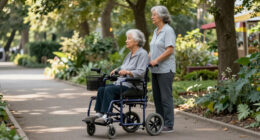
The first skill, potential, means resisting assumptions about what a person can or cannot do and looking for ways to adapt. The article quotes Gabriel Gordell, who traveled 3,000 miles in 99 days in a manual wheelchair. Gordell is quoted as saying, “It never crossed my mind that being in a wheelchair is bigger than me as a person.” The account illustrates the report’s point, but it does not establish what other people with disabilities can achieve or what support they may need.
The second skill is choice: the author says people may not control what happens to them, but can sometimes choose how to respond. The report quotes Sherri Mandell, who was grieving the murder of her son, Koby: “Each day I have to work to go on; each day I decide to live.” The third skill is purpose, or finding meaning and a reason to continue after a loss or major change. Julia Fox Garrison, described as having survived a near-fatal stroke at 37, is quoted saying: “What I need to do is impact someone in a positive way every single day.”
How the Three Skills May Help
The framework gives readers a way to think about coping that does not depend solely on waiting for circumstances to improve. Adaptation, response and meaning are the report’s practical themes: its examples suggest that people may find ways to pursue goals, make decisions and connect with others even while hardship remains.
That message may matter to people facing loss or major life changes, but the source is a personal essay built around interviews and observations. It does not compare outcomes, measure the effect of these skills, or show that a particular approach works for everyone. A person’s health, resources, support network and circumstances can shape what choices are available. The report is best read as a set of reflections, not a substitute for professional support or evidence that adversity can be overcome through mindset alone.
Products Worth Considering

Samsung 27-Inch Odyssey G5 QHD Gaming Monitor (G50F)

Anker SOLIX C300 Portable Power Station, 288Wh

Bose QuietComfort Ultra Earbuds (2nd Gen), Wireless Noise-Cancelling Earbuds, Black
As an affiliate, we earn on qualifying purchases.
The Report’s View of Happiness
The article challenges the familiar idea that happiness rises and falls in direct proportion to life circumstances. It describes how positive changes may bring an initial lift that fades as people adjust, and refers to a “hedonic set point” to explain a return toward a person’s usual level of wellbeing.
It also attributes a breakdown of influences on happiness to research by psychologist Sonja Lyubomirsky: 50% genetics or heredity, 10% circumstances and 40% intentional behavior, attitudes and beliefs. Those percentages are presented in the Sixty and Me article, but the supplied material does not provide a study citation, methods or qualifications. They should not be taken as a precise formula for an individual’s happiness. The report uses the figures to emphasize actions and attitudes, then develops its three skills from interviewees’ experiences.
“It never crossed my mind that being in a wheelchair is bigger than me as a person.”
— Gabriel Gordell, as quoted by Sixty and Me
Evidence Beyond Personal Stories
The supplied report does not state when it was published, provide details about how interviewees were selected, or cite research methods supporting the three-skill framework. It is therefore unclear how broadly the author’s observations apply. The article also does not establish that the happiness percentages it attributes to Lyubomirsky are a settled or universally applicable measure.
The stories are presented as individual experiences. They do not show that potential, choice and purpose will lead to the same results for others, or that people can control the effects of illness, disability, bereavement or other hardships. The report does not describe a specific intervention or assess its effects.
Applying the Ideas in Daily Life
The article closes by inviting readers to reflect on what helps them live through challenges, whether they believe they can still have a rich life amid pain, and how they build resilience. It does not announce a follow-up study, program or additional reporting. Readers seeking to apply the ideas can treat them as prompts for reflection; people facing serious distress or health concerns may wish to speak with a qualified professional or trusted support service.
Key Questions
What three skills does the report identify?
It names potential, choice and purpose. The author describes them as ways of thinking and acting that may help people respond to hardship.
What is the report based on?
The author says the framework grew from interviews with people who had experienced challenges and losses, and later informed a book. The supplied source does not give the interview count or selection method.
Does the article prove these skills improve wellbeing?
No. It offers personal stories and the author’s observations, not a controlled study or measured evidence that the skills produce a particular outcome.
What does the report mean by purpose?
It describes purpose as finding new meaning or a reason to keep going after a loss, difficulty or life transition. Garrison’s wish to positively affect someone each day is one example quoted in the article.
Source: sixtyandme.com