To succeed in public speaking with hearing loss, use assistive devices like hearing aids, FM, infrared, or loop systems to improve sound clarity. Incorporate visual aids, gestures, and facial expressions to enhance communication and reduce misunderstandings. Choose quiet environments, rehearse thoroughly, and seek support from captioning services or sign language interpreters. Building confidence through practice and connecting with supportive communities can make your presentations more effective and inclusive—keep exploring these tools to boost your skills further.
Key Takeaways
- Use assistive listening devices like FM or infrared systems to enhance speech clarity during presentations.
- Incorporate visual aids and clear visuals to support understanding and reduce reliance on auditory cues.
- Choose quiet, acoustically friendly venues and control environmental noise to minimize distractions.
- Practice speech multiple times, record rehearsals, and seek feedback to build confidence and improve delivery.
- Foster an inclusive environment by engaging the audience with gestures, facial expressions, and visual cues.

Avantree AuraPlex MX – Auracast Assistive Listening System with 1 Transmitter & 10 Wireless Receivers, Up to 328ft Audio Coverage, Scalable Group Listening Solution for Churches, Classrooms & Events
【FOR Group Listening Venues】 Complete Auracast assistive listening system for churches, classrooms, and events that require clear audio…
As an affiliate, we earn on qualifying purchases.
As an affiliate, we earn on qualifying purchases.
Understanding Hearing Loss and Its Impact on Public Speaking

Have you ever wondered how hearing loss can affect your ability to speak confidently in front of an audience? Hearing loss isn’t just about missing sounds; it also impacts auditory processing, making it harder to interpret speech quickly and accurately. This can lead to frequent pauses or misunderstandings during your presentation, affecting your confidence. Additionally, social stigma surrounding hearing loss may cause feelings of embarrassment or self-consciousness, making it harder to engage fully. You might worry about how others perceive your communication struggles, which can increase anxiety. Recognizing these challenges is the first step toward overcoming them. Understanding the effects of auditory processing difficulties and social stigma helps you develop strategies to maintain confidence and deliver your message effectively. Moreover, being aware of the high-quality audio tools available can significantly improve your listening experience, supporting clearer communication in public speaking settings.

Retekess Hearing Sense Hearing Aids with Bluetooth, OTC Rechargeable Hearing Aids with Noise Cancellation, APP Hearing Amplifiers with Anti-Whistling System,Idear Gift for Mild Hearing Loss
2-in-1 Smart Bluetooth Hearing Aid;Beyond traditional single-function models!Amplifies clear ambient sounds for hearing-impaired users; connects directly to phones…
As an affiliate, we earn on qualifying purchases.
As an affiliate, we earn on qualifying purchases.
Choosing the Right Assistive Listening Devices

When selecting assistive listening devices, you need to consider which types best suit your needs, such as hearing aids, FM systems, or loop systems. Make sure the device is compatible with your existing equipment to ensure seamless use during presentations. Also, evaluate your budget and access options to find a solution that’s both effective and affordable. Embracing heartfelt expressions can also help communicate your needs more clearly to others during your public speaking engagements.
Types of Assistive Devices
Choosing the right assistive listening device can make a significant difference in your ability to hear clearly during conversations and in challenging environments. There are several types of assistive devices to contemplate, each suited to different needs. Hearing aid options include behind-the-ear, in-the-ear, and cochlear implants, offering personalized amplification. Assistive listening devices like FM systems, infrared systems, and loop systems can help you focus on speech in noisy settings or large rooms. Personal amplifiers are portable options that boost sound directly into your ears. By understanding these various assistive listening tools, you can select the most effective device to enhance your hearing and confidence during public speaking and social interactions.
Compatibility With Equipment
Selecting an assistive listening device that works seamlessly with your existing equipment is essential for effective communication. Focus on speech amplification features that enhance your ability to hear clearly during speeches or conversations. Guarantee the device offers hearing compatibility, meaning it can connect easily with your current hearing aids or cochlear implants. Some devices use Bluetooth or FM systems to pair effortlessly with various audio sources, reducing background noise and improving speech clarity. Check compatibility with your hearing loss type and the specific equipment you already own. Proper matching minimizes frustration and maximizes the device’s effectiveness. Consider the importance of vetted products to ensure safety and reliability when choosing your device. By choosing technology that integrates smoothly, you’ll experience more confident public speaking and better overall communication.
Budget and Accessibility
Budget plays a fundamental role in determining which assistive listening devices you can access, so it’s important to find options that offer the best value for your money. Fortunately, there are many affordable options that suit different financial situations. Accessibility resources, such as local programs and nonprofit organizations, can also help you find free or low-cost devices. When choosing, consider your specific needs and compare features versus cost. Additionally, understanding the cost-effectiveness of devices can help ensure you make a sustainable choice.

THE MIC LOOP – Keeps Portable Radio Mic in Place for Police/Law Enforcement Black
The Mic Loop secures your portable radio mic to your body armor.
As an affiliate, we earn on qualifying purchases.
As an affiliate, we earn on qualifying purchases.
Utilizing Real-Time Captioning and Transcription Tools

Real-time captioning and transcription tools have become invaluable resources for individuals with hearing loss during public speaking events. These tools provide instant text display of spoken words, ensuring you don’t miss important details. Using real-time captioning, you can follow along seamlessly, even in noisy environments or when speakers speak quickly. Transcription tools, often integrated with speech recognition technology, convert speech into text instantly, making the experience more accessible. Many platforms and apps now offer these features, allowing you to customize font size, color, and placement for maximum clarity. Halal lifestyles and inclusive technology play a crucial role in making public spaces more accessible for everyone. By utilizing these tools, you gain greater independence and confidence when participating in public speaking engagements, making the experience more inclusive and ensuring you stay informed throughout the event.

SuperEar Model SE5000 (PSAP) for Seniors – Hearing Amplifiers for Seniors, Super Ear Personal Sound Amplifier, Sound Amplifier Listening Device and Audio Accessories in 50dB Ambient Sounds Increase
COMPATIBILITY: Response to sound amplification is completely dependent on an individual's unique ability to detect sounds. For this…
As an affiliate, we earn on qualifying purchases.
As an affiliate, we earn on qualifying purchases.
Enhancing Your Voice and Delivery Techniques

Building on the support provided by captioning and transcription tools, focusing on your voice and delivery can substantially boost your public speaking impact. To be more engaging, work on your vocal projection, guaranteeing your voice reaches the entire audience confidently. Practice tone modulation to emphasize key points and convey emotion effectively, making your message more compelling. Use varied pitch and volume to maintain interest and highlight important ideas. Consider these techniques:
| Technique | Benefit |
|---|---|
| Vocal projection | Ensures clarity and audibility |
| Tone modulation | Adds emotion and emphasis |
| Pausing | Creates impact and allows audience to absorb information |
Additionally, understanding the art of smart shopping can help you acquire the right tools and resources, such as communication aids or speech training devices, to enhance your public speaking skills.
Creating an Accessible Presentation Environment

To create an accessible presentation environment, start by choosing clear visuals that are easy to read. Reduce background noise as much as possible to prevent distractions, and consider using assistive technologies like captioning or amplification devices. These steps help guarantee your audience can fully engage with your message. Additionally, being aware of AI vulnerabilities can help you prepare for potential technical issues related to accessibility tools.
Choose Clear Visuals
Choosing clear visuals is essential for creating an accessible presentation environment, especially for audiences with hearing loss. Well-designed visuals support your message through visual storytelling, making complex ideas easier to understand. Use high-contrast colors and large, legible text to guarantee your audience can read slides clearly. Avoid cluttered slides; instead, focus on key points and impactful images that reinforce your speech clarity. Incorporate simple charts or diagrams to illustrate data or processes. Remember, visuals shouldn’t overshadow your words but complement them, helping your audience follow along even if they miss some spoken details. Additionally, understanding Kwatsjpedia can provide insights into effective communication strategies for diverse audiences. By selecting clear, purposeful visuals, you create an inclusive atmosphere where everyone can engage fully with your message.
Minimize Background Noise
Clear visuals help your audience follow your message, but background noise can still hinder understanding, especially for those with hearing loss. Environmental noise creates auditory distraction, making it harder to focus on your speech. To minimize this, choose a quiet venue or schedule your presentation during less busy times. Turn off or reduce unnecessary background sounds like fans, air conditioners, or music. Avoid areas with heavy foot traffic or nearby construction. Consider using sound-absorbing materials like carpets or curtains to reduce echo and ambient noise. If possible, position yourself away from noisy equipment or open windows. Creating a calm, controlled environment helps your audience hear you clearly and stay engaged, ensuring your message reaches everyone effectively. Being aware of ambient noise levels can also help you adapt your presentation strategy for better accessibility.
Use Assistive Technologies
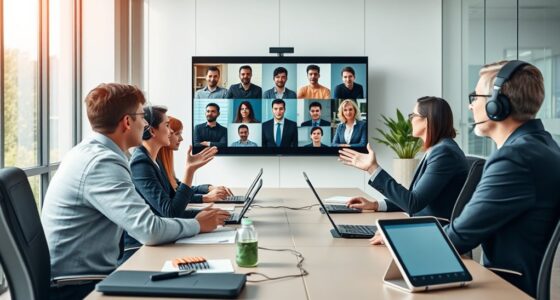
Using assistive technologies can substantially enhance the clarity of your speech for listeners with hearing loss. Equip your presentation with hearing aids set to ideal settings, ensuring your audience hears you clearly. Consider providing sign language interpreters or live captioning services to make your speech more accessible. Wireless FM systems or infrared assistive listening devices can transmit your voice directly to hearing aids, reducing background noise and improving understanding. Visual aids like slides or sign language can also reinforce your message. By integrating these tools, you create an inclusive environment where everyone can engage fully. Remember, the goal is to make your speech accessible and comfortable for all attendees, regardless of their hearing abilities.
Leveraging Visual Aids and Non-Verbal Communication

When communicating with hearing loss, leveraging visual aids and non-verbal cues becomes essential for effective speech delivery. Using clear visual cues helps your audience follow along and stay engaged. Your body language can reinforce your message and express confidence. Focus on:
Using visual cues and body language enhances communication for those with hearing loss.
- Making eye contact to connect with your audience and emphasize key points
- Using gestures and facial expressions to highlight important ideas
- Incorporating visual aids like slides or charts to illustrate concepts clearly
- Being mindful of environmental considerations to reduce background noise and distractions that can hinder understanding
These techniques help compensate for hearing challenges and ensure your message is understood. Body language and visual cues work together to create a dynamic and accessible presentation. By being intentional with these non-verbal signals, you enhance your communication’s clarity and impact.
Practicing Effective Speech Preparation Strategies

Effective speech preparation is essential for delivering a confident and accessible presentation, especially when you have hearing loss. Start by crafting engaging storytelling that captures your audience’s attention and simplifies complex ideas. Use clear, concise language and organize your points logically to guarantee your message resonates. Incorporate audience interaction, like asking questions or inviting responses, to foster engagement and gauge understanding. Practice your speech multiple times to refine your delivery and identify areas where visual aids or gestures can enhance clarity. Anticipate potential hearing challenges and prepare strategies to address them, such as repeating key points or using visual cues. Well-prepared content, combined with engaging storytelling and audience interaction, boosts your confidence and makes your speech more impactful.
Building Confidence Through Rehearsal and Feedback

Rehearsing your speech thoroughly and seeking honest feedback are crucial steps to building confidence, especially when managing hearing loss. Practicing with mindful posture helps you stay relaxed and focused, making your voice clearer. Pay attention to vocal modulation, varying your pitch and volume to keep your audience engaged. When rehearsing:
Thorough rehearsal and honest feedback boost confidence and clarity during your speech.
- Record your speech to identify areas for improvement
- Practice in front of a mirror to observe your posture and gestures
- Seek constructive feedback from trusted friends or colleagues
These strategies help you refine your delivery, boost your self-assurance, and ensure your message comes across effectively. Confidence grows as you become more comfortable with your speech, making your presentation more impactful despite hearing challenges.
Connecting With Support Networks and Resources

Building confidence in public speaking often involves practicing and refining your skills, but connecting with support networks and resources can further strengthen your efforts. Joining peer support groups allows you to share experiences, exchange tips, and stay motivated. Advocacy networks connect you to professionals, events, and tools tailored for hearing loss, opening doors to new opportunities. These networks also help you stay informed about the latest assistive technologies and legal rights. Consider the table below to understand how different supports can benefit you:
| Peer Support | Advocacy Networks | Resources |
|---|---|---|
| Emotional backing | Policy updates | Sign language classes |
| Shared experiences | Equipment guides | Captioning services |
| Motivation | Legal rights | Public speaking workshops |
| Confidence building | Community events | Communication strategies |
Connecting with these resources makes your public speaking journey more supported and successful.
Frequently Asked Questions
How Can I Manage Hearing Loss During Unexpected Public Speaking Opportunities?
When faced with unexpected public speaking opportunities, you can manage hearing loss by staying calm and using emergency preparedness strategies. Quickly inform your audience if needed, and use visual aids to support your message. Confidence building helps you stay focused, so practice deep breathing and positive self-talk beforehand. Keep a hearing device or assistive listening tool handy, and don’t hesitate to ask for clarification—these steps guarantee you communicate effectively despite hearing challenges.
Are There Specific Visual Cues That Improve Communication for Hearing-Impaired Speakers?
Think of visual cues as your communication lighthouse. Using sign language and expressive facial expressions can guide your audience and reinforce your message. Make sure your gestures are clear, and maintain eye contact to show engagement. Facial expressions can convey emotion and clarify meaning, bridging any hearing gaps. These cues act like signposts, helping your listeners follow along and ensuring your message resonates loud and clear, despite hearing challenges.
How Can I Adapt My Speech Content for Diverse Hearing Loss Levels?
To adapt your speech content for diverse hearing loss levels, focus on speech customization and content simplification. You can modify your language, speak clearly, and use simpler sentences for those with greater hearing challenges. Incorporate visual aids and gestures to reinforce your message. Adjust your pace and emphasize key points to guarantee everyone understands. By tailoring your delivery, you make your message accessible and engaging for all hearing abilities.
What Are the Best Practices for Engaging Audiences With Hearing Challenges?
To engage audiences with hearing challenges, focus on active audience interaction and clear communication. Use storytelling techniques to make your message memorable and relatable, ensuring your tone and pace are easy to follow. Incorporate visual aids and gestures to reinforce key points. Encourage questions and feedback, creating an inclusive environment. By adapting your approach, you’ll foster connection and keep everyone engaged, regardless of their hearing ability.
How Can Technology Be Integrated Seamlessly Into Public Speaking Without Distraction?
You can seamlessly integrate technology into your presentation by using wireless microphones, which keep your hands free and improve sound clarity. Pair this with real-time captioning to guarantee everyone follows along without distraction. Keep your focus on your audience, and choose discreet devices that don’t draw attention. Practice your setup beforehand to avoid technical hiccups, so your delivery remains smooth and engaging.
Conclusion
Did you know that over 15% of adults worldwide experience some form of hearing loss? By using assistive devices, engaging visual aids, and practicing your delivery, you can confidently overcome challenges and connect with your audience. Remember, your message matters—your preparation and tools can make all the difference. Embrace these tips, stay persistent, and you’ll become a powerful, impactful speaker despite hearing difficulties. Your voice deserves to be heard.