
Choosing an Android phone for hearing aid Bluetooth streaming is not just about the phone: the hearing aids must also support the kind of streaming and app control you need. My leading hearing-aid pick is the AuraLink for its stated Android compatibility and app features; the Vivtone Xpure is a simpler choice with an explicit Android 11.0-or-newer requirement and streaming battery details. If you are shopping for a phone-and-audio bundle, the Samsung Galaxy S25 FE package includes Galaxy Buds 3 FE, but those earbuds should not be mistaken for hearing aids.

Get everyday helpers delivered free with Prime
- Fast, free delivery on millions of items
- Prime Video, Amazon Music and more included
- Member-only deals all year
The tradeoff is between verified information and appealing feature claims. Some listings state Android support, while the Yeasound listing specifies iOS streaming, and not every product gives enough detail about direct audio streaming protocols or exact phone compatibility. I rank these options by how useful their supplied information is to an Android buyer, while treating unverified compatibility as a reason to check with the maker before purchase.
Complete the kit


Key Takeaways
- AuraLink explicitly lists Android app compatibility and adds IP68 protection, tinnitus masking, and a UV-sanitizing case; confirm its streaming behavior with your specific Android phone.
- Vivtone Xpure states compatibility with Android 11.0 and newer and lists phone-call and music streaming, but gives only three hours of streaming battery life.
- Samsung Galaxy S25 FE with Galaxy Buds 3 FE is the only actual Android phone in this group; its included earbuds are not a substitute for hearing aids.
- Yeasound RIC700 Plus lists Bluetooth streaming for iOS, making it a poor Android-first choice unless the seller confirms Android support.
- Diamond X1 offers app control and Bluetooth 5.3, but its supplied details do not explicitly confirm Android compatibility or describe a specific Android streaming protocol.



| android phones for hearing aid bluetooth streaming | Water resistance | Design |
|---|---|---|
| AuraLink Bluetooth Hearing Aid | IP68 | Receiver-in-Canal (RIC) |
| Vivtone Bluetooth Hearing Aids | — | Receiver-in-Canal |
| Samsung Galaxy S25 FE 128GB Un | Not water resistant | — |
| Diamond X1 Bluetooth Hearing A | IPX5 | — |
| Yeasound RIC700 Plus Hearing A | IPX8 | Receiver-in-Canal |
More Details on Our Top Picks
AuraLink Bluetooth Hearing Aids for Seniors Adults, App-Controlled, AI Noise Reduction, Bluetooth 5.4, Compatible with iOS & Android
AuraLink earns my top hearing-aid position because its listing directly names iOS and Android app compatibility, rather than relying on a generic Bluetooth claim. Its app offers personalization and tinnitus masking, while the IP68 rating and UV-sanitizing charging case add practical appeal for people who wear their devices throughout an active day. Compared with Vivtone, it claims a stronger set of environmental and care features, although Vivtone is clearer about its Android version requirement and streaming runtime.
The main uncertainty is that the supplied description does not specify a direct audio-streaming protocol, exact phone-call behavior, or a streaming battery figure. I would confirm those points with the maker for the exact Android handset in use. AuraLink is also limited to mild to moderate hearing loss, and its many app-based controls are less appealing to someone who wants a simple, phone-independent setup. The feature set puts it ahead for an Android buyer who wants customization, not for someone who needs the clearest published streaming details.
Pros:- Explicitly lists app compatibility with Android and iOS.
- IP68 water and dust resistance suits active daily wear.
- Offers app personalization, AI noise reduction, and tinnitus masking.
- Includes a UV-sanitizing charging case.
Cons:- Supplied details do not spell out direct phone and media streaming protocols or runtime.
- Designed for mild to moderate hearing loss only.
- Full customization depends on a smartphone.
Best for: Android users with mild to moderate hearing loss who want app-based fitting, noise reduction, and a durable hearing-aid design.
Not ideal for: People who need a clearly documented Android streaming protocol, do not want app-dependent controls, or have hearing loss outside the stated range.
- Hearing loss range:25–85 dB HL
- Bluetooth:Bluetooth 5.4
- App compatibility:iOS and Android
- Design:Receiver-in-Canal (RIC)
- Water resistance:IP68
- Listed features:AI noise reduction and tinnitus masking
- Charging case:UV sanitizing case
Our verdict“I would start with AuraLink for Android-friendly app control and durability, after confirming direct streaming support for the buyer’s phone.”
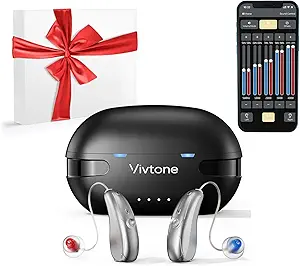
Vivtone Bluetooth Hearing Aids with APP Control for Precise Fitting, Phone Call & Music Streaming, Rechargeable OTC Hearing Aids for Seniors Adults Men Women
Vivtone Xpure is the most straightforward option here for shoppers who want an explicit Android baseline: the listing says its app works with Android 11.0 and newer. It also directly claims phone-call and music streaming, which is more helpful for this use case than the general Bluetooth wording supplied for Diamond X1. The RIC design, adjustable app settings, and multiple environment modes make it a practical pick for someone seeking both hearing support and everyday audio.
Its clearest drawback is the stated three-hour streaming battery life, despite up to 24 hours of audio use. Buyers who stream for long stretches should compare that figure carefully with AuraLink, whose supplied listing does not provide a streaming runtime but does add IP68 protection and tinnitus masking. Vivtone needs a compatible smartphone for app control, can struggle in extremely noisy settings, and has a charging case some users may find bulky. I would pick it over AuraLink when published Android requirements matter more than ruggedness or extra features.
Pros:- Lists Android 11.0 or newer compatibility for app control.
- Specifically claims phone-call and music streaming.
- Provides up to 24 hours of audio use and a 2.5-hour recharge time.
- Includes customizable settings and multiple environment modes.
Cons:- Streaming battery life is listed as three hours.
- The charging case may feel bulky.
- The description cautions that performance may fall in very noisy environments.
Best for: Android users running version 11.0 or newer who want an app-controlled RIC hearing aid with stated call and music streaming.
Not ideal for: Frequent long-session streamers, people using older Android versions, or buyers who prioritize a compact case and strong performance in very noisy places.
- Android compatibility:Android 11.0 or newer
- Other compatibility:iOS 12 or newer
- Design:Receiver-in-Canal
- Audio use:Up to 24 hours
- Streaming use:3 hours
- Recharge time:2.5 hours
- Standby time:1 week
- Streaming claims:Phone calls and music
Our verdict“Vivtone is my clearest fit for Android buyers who want stated OS requirements and direct call and music streaming, provided its streaming runtime suits their routine.”
Samsung Galaxy S25 FE 128GB Unlocked Smartphone with Galaxy Buds 3 FE (Jet Black)
This is the only listing in the group that is an Android smartphone, so it fills a different role from the four hearing aids. The Galaxy S25 FE is listed with 128GB of storage, 5G, an AMOLED/OLED display, and a 4,900mAh battery; the package adds Galaxy Buds 3 FE with active noise cancellation. For someone replacing a phone and also wanting wireless earbuds, that combination may be convenient. It does not, however, establish that the phone will stream to any of the hearing aids ranked above.
I place it below AuraLink and Vivtone for this particular roundup because the included Galaxy Buds 3 FE are earbuds, not hearing aids, and the supplied listing does not give hearing-aid compatibility details or Android audio accessibility specifics. A buyer who already owns compatible hearing aids may find the phone useful, but should verify pairing and streaming with the hearing-aid maker. Unlike the dedicated aids, this bundle cannot be treated as a hearing solution by itself; it is for the phone side of the setup, with a non-water-resistant body and a single SIM slot among its stated limitations.
Pros:- The only actual Android smartphone listed in this roundup.
- Includes 128GB storage and 5G connectivity.
- Large 4,900mAh battery with Super Fast Charging 2.0.
- Package includes Galaxy Buds 3 FE with active noise cancellation.
Cons:- Galaxy Buds 3 FE are consumer earbuds, not hearing aids.
- Supplied details do not confirm compatibility with the hearing aids in this roundup.
- The phone is listed as not water resistant and has a single SIM slot.
Best for: Someone who needs an Android handset and wants included wireless earbuds, while planning to confirm hearing-aid compatibility separately.
Not ideal for: Anyone looking for a hearing aid in the box or expecting the included Galaxy Buds to provide hearing-aid fitting and amplification.
- Operating system:Android
- Storage:128GB
- Network:5G
- Display:AMOLED/OLED
- Battery:4,900mAh
- Charging:Super Fast Charging 2.0
- Included audio:Galaxy Buds 3 FE
- Water resistance:Not water resistant
Our verdict“Choose this bundle for the Android phone itself, not as a complete hearing-aid streaming solution.”
Diamond X1 Bluetooth Hearing Aids for Seniors with Smartphone App – Noise Cancellation, Clear Sound & Easy to Use
Diamond X1 takes an earbud-style approach, with Bluetooth 5.3, app personalization, four sound modes, and a portable case. Its listed modes—indoor, conversation, restaurant, and commute—give buyers concrete ways to tailor listening rather than relying on a single setting. The up-to-12-hour charge and 36 hours with the case also look more practical for day-to-day listening than Vivtone’s stated three-hour streaming runtime, though the listings may be measuring different uses.
The Android fit is less certain than Vivtone’s: the description says smartphone app but does not explicitly name Android compatibility or explain whether calls and media stream directly to the aids. I would verify both with the seller before choosing it for Android streaming. Compared with AuraLink, Diamond X1 has more clearly listed sound modes and total case runtime, but lacks the supplied IP68 claim and is only IPX5 water resistant. It is intended for mild to moderate hearing loss, so its comfortable-looking earbud form should not be read as a fit for every hearing profile.
Pros:- Bluetooth 5.3 and smartphone app personalization.
- Four named sound modes for different settings.
- Up to 12 hours per charge and 36 hours with the case.
- Includes different-sized ear domes.
Cons:- Supplied details do not explicitly confirm Android app support or direct streaming behavior.
- Designed for mild to moderate hearing loss only.
- IPX5 protection is not full waterproofing.
Best for: Adults with mild to moderate hearing loss who prefer an earbud-style device and want selectable listening modes and a portable charging case.
Not ideal for: Android buyers who need confirmed app and direct streaming support, people with severe hearing loss, or anyone needing full waterproofing.
- Designed for:Mild to moderate hearing loss
- Bluetooth:Bluetooth 5.3
- Battery per charge:Up to 12 hours
- Battery with case:Up to 36 hours
- Water resistance:IPX5
- Sound modes:Indoor, conversation, restaurant, commute
- Included:Different-sized ear domes
Our verdict“Diamond X1 is appealing for its earbud form and listening modes, but I would buy it for Android streaming only after confirming compatibility.”
Yeasound RIC700 Plus Hearing Aids with AI Noise Reduction & Bluetooth
Yeasound RIC700 Plus offers a compact RIC design, AI noise reduction, app-based settings, and a stated IPX8 rating. The product information also gives unusually specific battery figures: 279 hours of support and 162 hours of streaming. Those figures may appeal to buyers who care about extended use, but the listing does not explain the conditions behind them, so I would ask the seller what those totals represent before comparing them directly with other products’ per-charge estimates.
The decisive issue for this guide is platform support: the supplied description says Bluetooth streaming is for iOS devices. That makes Yeasound a weaker Android choice than Vivtone, which names Android 11.0 or newer, and AuraLink, which lists Android app compatibility. Even though its noise processing and water resistance look attractive, I would not assume Android streaming works from a general Bluetooth label. It makes more sense for an iPhone user or an Android buyer who receives written confirmation from the manufacturer that their exact phone is supported.
Pros:- AI noise reduction and app-based customization.
- Discreet, lightweight RIC design.
- Lists IPX8 water resistance.
- Provides stated support and streaming battery totals.
Cons:- Bluetooth streaming is described as being for iOS devices.
- The listed battery totals are not explained as per-charge use or another measurement.
- Noise reduction may be less effective in very noisy surroundings.
Best for: Buyers who value a discreet RIC design and want the listed extended-use features, especially if they use iOS or have confirmed Android support.
Not ideal for: Android users seeking a clearly confirmed out-of-the-box streaming match, or anyone who needs simple, clearly explained battery figures.
- Design:Receiver-in-Canal
- Streaming compatibility stated:iOS devices
- Frequency response:Up to 8,000Hz
- Battery support listed:279 hours
- Streaming time listed:162 hours
- Weight:0.088 oz
- Water resistance:IPX8
- Processing speed:5.3ms
Our verdict“I would place Yeasound last for Android streaming unless the manufacturer confirms compatibility with the buyer’s exact phone.”

How We Picked
I ranked these five listings for the specific job of pairing Android phones with Bluetooth-streaming hearing aids, not for general phone quality or hearing-aid features alone. That means I gave the most weight to clearly stated Android app compatibility, explicit streaming claims, and practical details such as battery life, controls, and durability. A broad Bluetooth label is not the same as confirmation that a hearing aid can stream calls and media directly from a particular Android handset.
I also separated the one phone bundle from the four hearing-aid products. The Galaxy S25 FE package is a phone with consumer earbuds, while the other products are hearing aids; ranking them together requires explaining that distinction rather than treating them as interchangeable. I used only the supplied product information, so I do not infer support for Bluetooth LE Audio, ASHA, or any other protocol when a listing does not say so. Buyers should verify their phone model, Android version, hearing-aid app availability, and streaming compatibility with the manufacturer before ordering.
Finally, I considered who should skip each option. A product can have useful noise reduction or a durable design and still be a weak match for an Android streaming buyer if its platform support is unclear. That is why explicit compatibility and practical limits matter more here than a long feature list.
| android phones for hearing aid bluetooth streaming | Design | Water resistance |
|---|---|---|
| AuraLink Bluetooth Hearing Aid | Receiver-in-Canal (RIC) | IP68 |
| Vivtone Bluetooth Hearing Aids | Receiver-in-Canal | — |
| Samsung Galaxy S25 FE 128GB Un | — | Not water resistant |
| Diamond X1 Bluetooth Hearing A | — | IPX5 |
| Yeasound RIC700 Plus Hearing A | Receiver-in-Canal | IPX8 |
Factors to Consider When Choosing Android Phones For Hearing Aid Bluetooth Streaming
I would treat phone-to-hearing-aid streaming as a compatibility chain: the phone, Android version, hearing-aid hardware, app, and streaming method all have to work together. A Bluetooth label alone does not confirm that calls and media will stream directly to the aids.
Confirm Android and app support
Start with the exact phone model and Android version, then check that the hearing-aid companion app supports both. Vivtone states Android 11.0 or newer, while AuraLink names Android app compatibility without listing a minimum version. Diamond X1 only says smartphone app, and Yeasound’s supplied description points to iOS streaming. I would not treat those gaps as proof of incompatibility, but I would ask the manufacturer before buying.
Ask what Bluetooth streaming means
Some products use Bluetooth for app control, while others also stream calls and music directly. Vivtone explicitly lists phone calls and music streaming; Yeasound specifies streaming for iOS. The other listings do not provide equally clear protocol or phone-streaming details. Ask whether the aid streams audio directly from your specific Android phone, whether calls work in both directions, and whether an accessory is required. Do not assume Bluetooth 5.3 or 5.4 alone answers those questions.
Match battery claims to how you listen
Compare listening and streaming figures separately. Vivtone lists up to 24 hours of audio use but only three hours of streaming, so someone who streams much of the day should ask whether that runtime will meet their needs. Diamond X1 lists up to 12 hours per charge and 36 hours with its case, without separating streaming from other use. Yeasound gives large totals but does not explain their measurement basis. I would seek a clear streaming runtime per charge before relying on any headline figure.
Choose features for your daily surroundings
AuraLink pairs AI noise reduction with tinnitus masking and IP68 protection; Vivtone offers multiple environment modes, while Diamond X1 names indoor, conversation, restaurant, and commute settings. These features may help tailor use, but they do not promise clear speech in every noisy place. If water and dust resistance matters, compare the stated ratings and care instructions: AuraLink lists IP68, Diamond X1 IPX5, and Yeasound IPX8. Check warranty terms and cleaning guidance as well as the rating.
Keep hearing aids and earbuds distinct
The Samsung Galaxy S25 FE bundle is a phone with consumer earbuds, not a hearing-aid package. Its included Galaxy Buds 3 FE may suit ordinary listening, but the listing does not say they provide hearing-aid fitting or direct compatibility with the hearing aids here. If you already have hearing aids, verify their pairing behavior with the phone before purchase. If you need amplification or a fitted hearing solution, choose and assess the hearing aids separately.
Check suitability and fitting needs
A feature-rich app cannot replace a proper assessment of hearing needs. AuraLink and Diamond X1 state suitability for mild to moderate hearing loss, while the supplied Vivtone description does not state a hearing-loss range. Ask a hearing-care professional whether an OTC device is appropriate, especially if hearing loss is severe, sudden, one-sided, or accompanied by other symptoms. Also check return and support policies, how fitting adjustments are made, and whether you can manage essential functions without a smartphone.
Frequently Asked Questions
Will any Bluetooth hearing aid work with every Android phone?
No. Bluetooth support by itself does not guarantee app compatibility or direct call and media streaming. Phone model, Android version, hearing-aid software, and the streaming method can all affect pairing. I would confirm the exact phone and aid combination with the manufacturer before purchase, especially for Diamond X1 and Yeasound, where the supplied Android details are limited.
Which option here states Android compatibility most clearly?
Vivtone names Android 11.0 or newer for app control, and AuraLink explicitly lists Android compatibility for its app. Those statements make them easier to shortlist than products whose listings do not clearly identify Android support. They do not remove the need to check whether the particular phone can stream calls and media directly to the hearing aids.
Is the Samsung Galaxy S25 FE bundle a hearing-aid system?
No. The listing describes an Android phone bundled with Galaxy Buds 3 FE, which are consumer earbuds rather than hearing aids. The phone may be part of a hearing-aid setup, but the supplied information does not confirm compatibility with the hearing aids in this roundup. Verify pairing with the hearing-aid maker and do not rely on the included earbuds as a fitted hearing solution.
What should I ask before buying hearing aids for streaming?
Ask whether your exact Android phone and OS version are supported, whether calls and media stream directly, whether an accessory is needed, and how long the aids last during streaming. I would also check app availability, return terms, fitting support, and how the devices handle your hearing profile. These questions matter more than a Bluetooth version number by itself.
Which model is best for long streaming sessions?
The supplied information does not establish a definitive winner for long streaming sessions. Vivtone lists three hours of streaming, which may be limiting for some routines; Diamond X1 lists up to 12 hours per charge but does not specify streaming-only runtime. AuraLink does not provide a streaming runtime, and Yeasound’s large total is not explained. Ask each seller for comparable streaming hours per charge before deciding.
Conclusion
For an Android user who wants app customization and durable everyday hardware, I would begin with AuraLink, then confirm direct streaming with the exact phone. Choose Vivtone Xpure if explicit Android 11.0-or-newer support and stated call and music streaming matter most, and if its three-hour streaming estimate fits your routine. Pick the Galaxy S25 FE bundle only when you need the phone and understand that its included earbuds are not hearing aids. Diamond X1 suits buyers drawn to earbud styling and sound modes who can verify Android support; I would reserve Yeasound for iOS users or Android buyers with confirmed compatibility. Across all five, the safest decision is the one backed by a clear answer about your phone, app, and direct streaming needs.
Halloween Picks
halloween
As an affiliate, we earn on qualifying purchases.