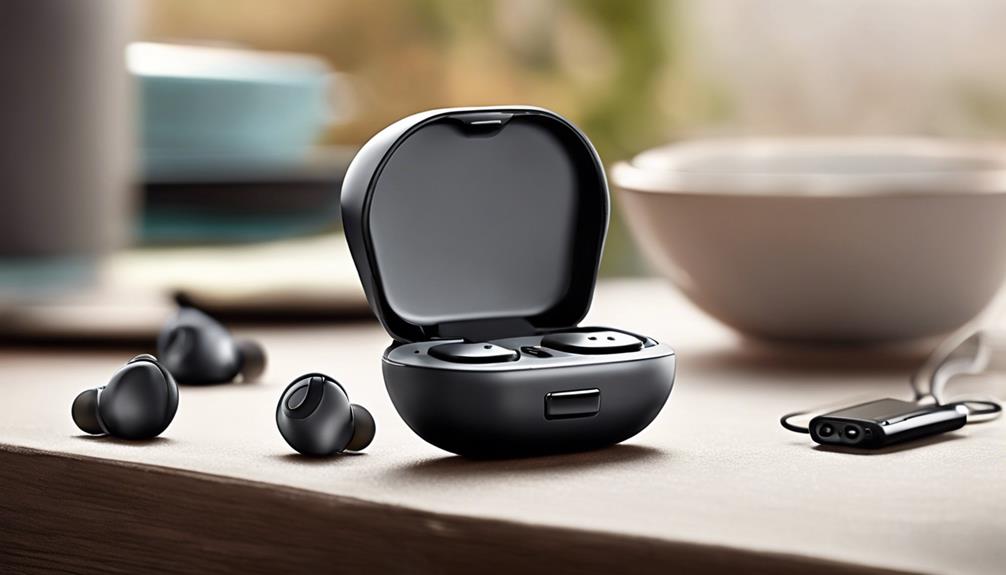

Assistive listening devices for hearing support can make speech easier to follow at home, in conversation, or at public events, but the right choice depends on where and how you listen. I name the Williams Sound Pocketalker 2.0 my best overall pick for its straightforward personal-listening approach, while the ConvoAssist stands out for dual wireless microphones and the Retekess TT119 for group settings such as church and events. The main tradeoffs are personal amplification versus a dedicated event system, simple controls versus extra features, and portability versus a more specialized setup. These devices amplify sound; they do not replace a hearing evaluation or prescription hearing aids. Read on for the full comparison and guidance on choosing for your listening needs.

Get everyday helpers delivered free with Prime
- Fast, free delivery on millions of items
- Prime Video, Amazon Music and more included
- Member-only deals all year
Complete the kit


Key Takeaways
The Pocketalker 2.0 earns the overall lead because it presents a simpler personal-listening option than multi-microphone or event-focused systems.
ConvoAssist separates itself with two wireless microphones and a rechargeable case, a configuration aimed at conversations where speakers may be in different positions.
The Retekess TT119 is the lineup’s specialized choice for church and events; it addresses a different problem from amplifiers meant for one-to-one listening.
Several Williams Sound and SuperEar models appear in this group, so buyers should compare the exact model and included listening accessories rather than assume the product names describe interchangeable setups.
Rechargeable and directional-microphone models favor convenience and focused listening, while simpler personal amplifiers may suit buyers who want fewer setup decisions.
| Williams Sound Pocketalker 2.0 Hearing Amplifier |  | Best for Simple, Senior-Friendly Use | Product type: Personal hearing amplifier | Intended user: Seniors | Listening accessory: Headphones included | VIEW ON AMAZON | See Our Full Breakdown |
| ConvoAssist™ Personal Sound Amplifier with Dual Wireless Microphones and Rechargeable Case |  | Best for Conversations Across a Room | Power source: Rechargeable lithium-polymer batteries | Battery life: Up to 8 hours per charge | Microphones: Two wireless clip-on microphones | VIEW ON AMAZON | See Our Full Breakdown |
| Williams Sound Pocketalker 2.0 Hearing Amplifier |  | Best for Adjustable One-to-One Listening | Batteries: 2 AAA batteries included | Control type: Button | Material: ABS/polycarbonate plastic | VIEW ON AMAZON | See Our Full Breakdown |
| Reizen Loud Ear 110dB Gain Personal Amplifier |  | Best Lightweight Belt-Clip Option | Sensitivity: 110 dB ±3 dB per mW | Frequency range: 20 Hz–20 kHz | Battery life: 48 hours | VIEW ON AMAZON | See Our Full Breakdown |
| Personal Sound Amplifier for Seniors with Voice Enhancement and Multiple Microphones | 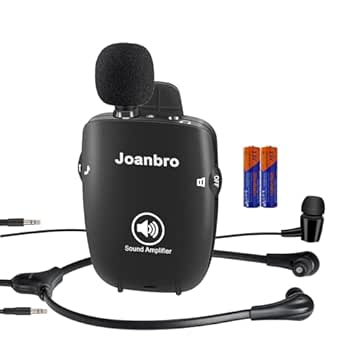 | Best for Changing Listening Setups | Gain: 50 dB | Total gain: 108 dB | Microphone types: 3: standard, extension-cable, and long-distance | VIEW ON AMAZON | See Our Full Breakdown |
| Hearing Amplifier for Seniors, Personal Sound Amplifier with Rechargeable Battery and Directional Microphone |  | Best for Long Rechargeable Runtime | Power source: Battery powered; rechargeable lithium-ion battery | Listed battery life: Up to 120 hours | Controls and sound features: One-dial operation, auto-gain control, directional noise-canceling microphone | VIEW ON AMAZON | See Our Full Breakdown |
| Williams Sound PockeTalker Ultra DUO Sound Amplifier with Headphone & Earbud |  | Best for One-on-One Conversations | Power source: Two AAA alkaline batteries; not included | Listed battery life: Up to 100 hours | Controls: External volume and tone controls | VIEW ON AMAZON | See Our Full Breakdown |
| Williams Sound Pocketalker Ultra Hearing Amplifier |  | Best for Simple Volume and Tone Adjustment | Power source: Battery powered; alkaline battery cell composition | Amplification: Up to 40 dB | Controls: Button controls for volume and tone | VIEW ON AMAZON | See Our Full Breakdown |
| SuperEar SE5000 Hearing Amplifier for Seniors |  | Best for Pocket-Sized Portability | Amplification: 50+ dB | Power source: One AAA battery | Listed battery life: Up to 30 hours with moderate to heavy use | VIEW ON AMAZON | See Our Full Breakdown |
| SuperEar SE7500 Hearing Amplifier for Seniors |  | Best for Extended AAA-Battery Runtime | Gain: 50+ dB | Power source: Two AAA batteries, included | Listed battery life: Up to 80 hours | VIEW ON AMAZON | See Our Full Breakdown |
| Rechargeable Hearing Amplifier with Headphone and Directional Microphone for Seniors |  | Best for Simple Personal Use | Power source: Battery powered; specs list AA batteries | Controls: Manual, one-knob operation | Special feature: Sound amplification | VIEW ON AMAZON | See Our Full Breakdown |
| Retekess TT119 Assistive Listening System for Church and Events |  | Best for Churches and Group Events | Connectivity: Auxiliary, FM, and wireless | Connector: 3.5 mm jack | Channels: 17 | VIEW ON AMAZON | See Our Full Breakdown |
| assistive listening devices for hearing impaired | Power source |
|---|---|
| Williams Sound Pocketalker 2.0 | — |
| ConvoAssist™ Personal Sound Am | Rechargeable lithium-polymer batteries |
| Williams Sound Pocketalker 2.0 | — |
| Reizen Loud Ear 110dB Gain Per | 2 AAA batteries |
| Personal Sound Amplifier for S | — |
| Hearing Amplifier for Seniors | Battery powered; rechargeable lithium-ion battery |
| Williams Sound PockeTalker Ult | Two AAA alkaline batteries; not included |
| Williams Sound Pocketalker Ult | Battery powered; alkaline battery cell composition |
| SuperEar SE5000 Hearing Amplif | One AAA battery |
| SuperEar SE7500 Hearing Amplif | Two AAA batteries, included |
| Rechargeable Hearing Amplifier | Battery powered; specs list AA batteries |
| Retekess TT119 Assistive Liste | — |
More Details on Our Top Picks
Williams Sound Pocketalker 2.0 Hearing Amplifier
I’d put this Pocketalker 2.0 near the top for buyers who want a straightforward way to amplify nearby speech without managing wireless microphones or multiple listening modes. Its simple operation suits seniors who value an uncomplicated setup, and the included year supply of batteries reduces the need to plan for replacements right away. Compared with the other Pocketalker 2.0 listing here, this version has less detail about controls and sound adjustment, so I can’t recommend it as confidently to someone who wants to fine-tune tone or volume. The tradeoff is simplicity over documented control: it may help with everyday conversation, but the supplied information doesn’t establish advanced noise handling or a specific listening range. Choose it for ease, not for extensive customization.
Pros:- Designed around straightforward use for seniors
- Amplifies nearby sound for conversation assistance
- Includes a year supply of batteries
- Headphones are included
Cons:- Detailed technical specifications and control options are not provided
- Offers fewer documented features than the other Pocketalker 2.0 listing
- Not presented as a substitute for a professionally fitted hearing aid
Best for: Older adults who want a basic personal amplifier for nearby conversation and prefer a simple setup with batteries included.
Not ideal for: Buyers who need documented tone controls, specific noise-reduction performance, or wireless microphones for listening at a distance.
- Product type:Personal hearing amplifier
- Intended user:Seniors
- Listening accessory:Headphones included
- Power:Batteries included
- Battery supply:One-year supply included
- Primary use:Amplified sound assistance
Our verdict“Choose this Pocketalker 2.0 if ease of use and included batteries matter more to you than detailed controls or advanced listening features.”
ConvoAssist™ Personal Sound Amplifier with Dual Wireless Microphones and Rechargeable Case
The ConvoAssist stands apart from the battery-powered Pocketalker 2.0 models by putting two wireless clip-on microphones at the center of the setup. That makes it a better fit when a listener needs to follow more than one speaker or hear a conversation from farther away; the listed range is up to 100 feet. Automatic pairing also removes some setup steps, while compatibility with existing headphones or earbuds gives buyers more choice than a system tied to one listening accessory. The rechargeable case and up to eight hours per charge suit portable daily use, though that runtime is shorter than an all-day solution may require. It also depends on headphones or earbuds, and the supplied details don’t specify noise-cancellation performance, so I’d favor it for speech pickup rather than challenging, noisy settings.
Pros:- Two wireless microphones can capture speech from two people
- Listed wireless listening range reaches up to 100 feet
- Automatic pairing reduces setup steps
- Rechargeable magnetic case supports portable charging
Cons:- Up to eight hours of use per charge may not cover a full day
- Requires headphones or earbuds for listening
- Noise-cancellation performance is not specified
Best for: People who struggle to follow conversations with multiple speakers or want to place a microphone near a speaker while listening through their own headphones.
Not ideal for: Listeners who need all-day operation without recharging, want a self-contained headphone system, or need clearly documented noise reduction for loud environments.
- Power source:Rechargeable lithium-polymer batteries
- Battery life:Up to 8 hours per charge
- Microphones:Two wireless clip-on microphones
- Connectivity:Wireless with automatic pairing
- Compatibility:Works with headphones or earbuds
- Wireless range:Up to 100 feet
- Weight:8 ounces
- Included accessories:Wired earbuds, USB charging cable, portable magnetic charging case
Our verdict“Pick ConvoAssist if flexible microphone placement and listening to two speakers matter more than long runtime or a fully self-contained design.”
Williams Sound Pocketalker 2.0 Hearing Amplifier
This Pocketalker 2.0 is the more clearly specified choice for buyers who want to adjust sound to suit their listening needs. Its volume and tone controls offer more personalization than the simpler B017WQK2LG Pocketalker listing, while a 3.5 mm jack provides a defined connection for compatible headphones. The description also says it amplifies nearby sound while reducing background noise, a useful aim for conversation in small groups, though no measured noise-reduction figure is supplied. At 0.09 kg, it is a light, portable option, but it runs on two AAA batteries rather than a rechargeable system like ConvoAssist. I’d choose it for one-to-one listening and hands-on adjustment; its stated small-group focus makes it less suited to following distant speakers or larger gatherings.
Pros:- Adjustable volume and tone allow personalized listening
- 3.5 mm audio jack supports compatible headphones
- Lightweight at 0.09 kg
- Includes a microphone and earbuds or headphones
Cons:- Requires two AAA batteries rather than rechargeable power
- Described for nearby conversations and small groups, not distant listening
- Noise reduction is described but not quantified
Best for: Listeners who want a lightweight, battery-powered amplifier with adjustable tone and volume for one-to-one conversations or small groups.
Not ideal for: People who need wireless remote microphones, rechargeable operation, or a system intended for larger gatherings and distant speech.
- Batteries:2 AAA batteries included
- Control type:Button
- Material:ABS/polycarbonate plastic
- Weight:0.09 kg
- Headphone connection:3.5 mm audio jack
- Sensitivity:104 dB
- Sound features:In-ear, noise control, sound isolation
- Included accessories:Microphone and earbuds or headphones
Our verdict“Choose this Pocketalker 2.0 over the simpler listed version if tone adjustment and a specified headphone connection are priorities.”
Reizen Loud Ear 110dB Gain Personal Amplifier
The Reizen Loud Ear is the most clearly pocketable choice in this group: it weighs 2.4 ounces, includes a belt clip, and runs on two AAA batteries. Its listed 110 dB ±3 dB per mW sensitivity and built-in microphone make it a straightforward pick for listeners who want portable amplification without the wireless pairing used by ConvoAssist. Reizen also lists sound pickup from as far as 100 feet, but that distance should not be confused with the dual remote-microphone arrangement in ConvoAssist, which lets a microphone be placed near a speaker. The main compromise is the single included earphone; buyers who prefer two-ear listening may need another accessory, and in-ear use may not suit everyone. Its battery life is listed as 48 hours, so expect battery changes rather than case-based recharging.
Pros:- Lightweight 2.4-ounce body with included belt clip
- Built-in microphone and adjustable volume
- Listed sensitivity of 110 dB ±3 dB per mW
- Includes two AAA batteries
Cons:- Only one earphone is included
- In-ear listening may not suit users who find earbuds uncomfortable
- Uses replaceable AAA batteries, with listed 48-hour battery life
Best for: People who want a lightweight, belt-clipped amplifier for portable listening and are comfortable using a single earphone.
Not ideal for: Listeners who need two-ear headphones, rechargeable power, or a remote microphone that can be placed near a distant speaker.
- Sensitivity:110 dB ±3 dB per mW
- Frequency range:20 Hz–20 kHz
- Battery life:48 hours
- Power source:2 AAA batteries
- Dimensions:2.5 in H × 1.75 in L × 0.75 in W
- Weight:2.4 ounces
- Included accessories:Single earphone and belt clip
Our verdict“Choose the Reizen if portability and a belt clip are more useful to you than ConvoAssist’s dual wireless microphones or rechargeable case.”
Personal Sound Amplifier for Seniors with Voice Enhancement and Multiple Microphones
Among the wired, battery-powered options here, this amplifier offers the broadest microphone selection: three microphone types include a standard mic, an extension-cable mic, and a long-distance mic. That flexibility gives it an edge over the single-microphone Pocketalker 2.0 listings when the listener may need to position the microphone differently for conversation, TV, or outdoor use. It also includes tone and volume controls, noise cancellation, and both headphones and earbuds, making it a versatile kit without ConvoAssist’s wireless microphones or rechargeable case. The tradeoff is a less streamlined setup: several microphone choices and controls may take time to learn, and the listed battery life is around 40 hours. Buyers also don’t get a stated weight, so portability is harder to compare directly with the lighter Reizen.
Pros:- Three microphone types support different listening situations
- Includes tone and volume controls
- Noise cancellation is listed as a feature
- Includes headphones, earbuds, extension cables, and a belt clip
Cons:- Multiple microphone options and controls may take time to learn
- Battery life is listed at around 40 hours
- Weight and specific dimensions are not provided
Best for: Seniors who switch between conversations, TV listening, and outdoor use and want multiple wired microphone placement options.
Not ideal for: Buyers who want wireless microphone placement, rechargeable operation, minimal controls, or a clearly stated device weight.
- Gain:50 dB
- Total gain:108 dB
- Microphone types:3: standard, extension-cable, and long-distance
- Batteries:2 AAA batteries included
- Noise cancellation:Yes
- Control type:Button
- Headphone type:In-ear, noise-isolating
- Included accessories:Headphones, earbuds, extension cables, belt clip
Our verdict“Choose this model over the simpler Pocketalker 2.0 if you want several wired microphone placements and can accept more setup choices.”
Hearing Amplifier for Seniors, Personal Sound Amplifier with Rechargeable Battery and Directional Microphone
The IROGER stands out for listeners who want a simple amplifier they can recharge rather than keep stocked with disposable batteries. Its stated up to 120-hour battery life is longer than the replaceable-battery runtime listed for the Williams Sound PockeTalker Ultra DUO, which may suit daily use at home or while traveling. Auto-gain control and a directional noise-canceling microphone are intended to make nearby speech easier to follow, while the one-dial operation keeps adjustments straightforward. Headphones and earbuds give buyers two ways to listen. The tradeoff is a basic feature set: there is no advanced sound customization, and the mostly plastic construction may be less robust than a buyer seeking a more durable unit would prefer. This is a personal amplifier, not a substitute for a hearing evaluation or prescription hearing aid.
Pros:- Rechargeable battery is listed for up to 120 hours of use.
- Directional microphone and auto-gain control are designed to favor nearby sound.
- One-dial operation keeps everyday adjustments simple.
- Includes both over-the-head headphones and earbuds.
Cons:- Does not offer advanced sound customization.
- Primarily plastic construction may be a concern for buyers prioritizing durability.
- Amplification alone may not meet the needs of people with severe hearing loss.
Best for: Older adults who want a straightforward, rechargeable personal amplifier for conversations and everyday listening, with headphones and earbuds included.
Not ideal for: Listeners who need detailed tone adjustments, advanced noise processing, or a device selected to address severe hearing loss.
- Power source:Battery powered; rechargeable lithium-ion battery
- Listed battery life:Up to 120 hours
- Controls and sound features:One-dial operation, auto-gain control, directional noise-canceling microphone
- Included listening accessories:Headphones and earbuds
- Dimensions:6 x 2.5 inches
- Weight:4.8 ounces
- Color:Matt-black and white
Our verdict“Choose the IROGER if long rechargeable runtime and simple controls matter more than extensive sound adjustments.”
Williams Sound PockeTalker Ultra DUO Sound Amplifier with Headphone & Earbud
The PockeTalker Ultra DUO is a conversation-focused choice: its removable microphone can be positioned near a speaker, which can help when nearby speech matters more than amplifying a whole room. External volume and tone controls also give it more adjustment than the IROGER’s described one-dial setup. It is suited to one-on-one talk, TV listening, and conversations in a car, and the included headphone and earbud options add flexibility. Its up to 100-hour runtime is substantial, but the unit uses two AAA batteries that are not included, unlike the rechargeable IROGER. The listing specifies no noise-control feature, so buyers should not assume it will filter background sound in busy settings. This is a personal listening aid, not a medical hearing aid or a solution for every degree of hearing loss.
Pros:- Removable microphone can be placed closer to the person speaking.
- Separate volume and tone controls offer useful sound adjustment.
- Listed battery life is up to 100 hours.
- Includes a headphone and an earbud listening option.
Cons:- Requires two AAA batteries, which are not included.
- The listing specifies no noise-control feature.
- Designed for personal listening and may not suit all hearing needs.
Best for: People who mainly need help following one-on-one conversations or TV and want separate volume and tone controls plus a removable microphone.
Not ideal for: Buyers who want rechargeable power, built-in noise control, or an amplifier designed to handle noisy group settings.
- Power source:Two AAA alkaline batteries; not included
- Listed battery life:Up to 100 hours
- Controls:External volume and tone controls
- Microphone:Removable microphone
- Included listening accessories:Headphone and earbud
- Compatible device:Television
- Listed audio sensitivity:110 dB
- Warranty duration:5 years
Our verdict“Pick the PockeTalker Ultra DUO for speaker-focused conversations and adjustable tone, provided replaceable batteries are acceptable.”
Williams Sound Pocketalker Ultra Hearing Amplifier
This Pocketalker Ultra suits listeners who want direct control over how much sound is amplified and its tone. The listed up to 40 dB amplification and straightforward volume and tone buttons make it a more adjustable pick than the IROGER’s one-dial design, while its body-worn format keeps the amplifier close at hand during conversations or TV listening. It is described for mild to moderate hearing needs, so it is not the choice here for severe impairment. Unlike the rechargeable IROGER, this model uses alkaline batteries, and the listing does not specify a battery runtime. It also should not be confused with a medical hearing aid: it amplifies sound rather than providing a personalized clinical fitting. Buyers should check the package details for the included accessories they need.
Pros:- Volume and tone controls allow more direct adjustment than a single-control design.
- Listed amplification reaches up to 40 dB.
- Portable body-worn format keeps the unit accessible during listening.
- Compatible with specified PockeTalker headphones, a single earbud, and neckloops.
Cons:- Not described as suitable for severe hearing impairment.
- Uses alkaline batteries rather than a rechargeable battery.
- The supplied product data does not state battery life.
Best for: People with mild to moderate hearing difficulty who want a portable, body-worn amplifier with separate volume and tone controls.
Not ideal for: People with severe hearing impairment or buyers who specifically want rechargeable power and a clearly stated long battery runtime.
- Power source:Battery powered; alkaline battery cell composition
- Amplification:Up to 40 dB
- Controls:Button controls for volume and tone
- Form:Body-worn
- Dimensions:3.38 x 2.23 inches
- Compatible listening accessories:PockeTalker HED021 Deluxe Headphones, PockeTalker EAR013 Single Earbud, and neckloops
- Materials:Microfiber and plastic
Our verdict“Choose this Pocketalker Ultra for basic, adjustable amplification for mild to moderate needs, not for severe loss or rechargeable convenience.”
SuperEar SE5000 Hearing Amplifier for Seniors
The SuperEar SE5000 is the compact, carry-along option in this group. Its pocket-sized body and belt clip make it easier to keep close for spontaneous conversations or occasional TV listening than a larger over-the-head setup. A tactile volume wheel is simple to adjust, and the swivel microphone lets the listener aim sound capture toward a conversation. The listed 50+ dB amplification is higher than the Pocketalker Ultra’s stated 40 dB, but that figure alone does not show how well a device will suit an individual’s hearing. The SE5000 runs for up to 30 hours on one AAA cell, shorter than the listed runtimes of the IROGER and PockeTalker Ultra DUO. It also does not connect directly to TVs or wireless devices, so it amplifies ambient sound rather than serving as a direct audio link.
Pros:- Compact form and belt clip support easy carrying.
- Tactile volume wheel is easy to locate and adjust.
- Includes stereo headphones and discreet earbuds.
- Swivel microphone can be aimed toward the sound source.
Cons:- Listed battery life is up to 30 hours, shorter than the IROGER and PockeTalker Ultra DUO listings.
- Uses one AAA battery rather than rechargeable power.
- Does not connect directly to TVs or wireless devices.
Best for: People who want a small amplifier with a belt clip for occasional conversations and ambient TV sound, using either headphones or earbuds.
Not ideal for: Buyers who need long runtimes between battery changes or direct wired or wireless connection to a TV or phone.
- Amplification:50+ dB
- Power source:One AAA battery
- Listed battery life:Up to 30 hours with moderate to heavy use
- Microphone:Swivel microphone
- Volume control:Tactile wheel
- Included listening accessories:Deluxe stereo headphones and discreet earbuds
- Other included accessories:Belt clip and disposable earpad covers
Our verdict“Choose the SE5000 if portability and a simple volume wheel matter more than extended battery life or direct device connections.”
SuperEar SE7500 Hearing Amplifier for Seniors
The SuperEar SE7500 takes the SE5000’s ambient-sound approach and gives it a longer listed runtime: up to 80 hours from two included AAA batteries, compared with the SE5000’s up to 30 hours from one AAA cell. That makes this a better fit for listeners who prefer replaceable batteries but want fewer changes. Its adjustable wheel offers straightforward volume control, while the redesigned microphone is intended to reduce noise from handling the unit. Headphones, earbuds, and a belt-clip case cover several everyday listening situations. The tradeoff is connectivity: like the SE5000, it is limited to wired listening and does not offer Bluetooth or wireless device connections. Its 50+ dB gain is a specification, not a guarantee of suitability for a particular hearing condition, and it is not a substitute for a clinical hearing assessment.
Pros:- Listed runtime is up to 80 hours on two AAA batteries.
- Batteries are included in the kit.
- Includes both earbuds and headphones, plus a belt-clip case.
- Redesigned microphone is intended to reduce carry noise.
Cons:- Listening is wired, with no Bluetooth or wireless connectivity.
- Requires two AAA batteries rather than rechargeable power.
- The stated gain does not establish suitability for an individual’s degree of hearing loss.
Best for: Listeners who want an ambient-sound amplifier with included wired listening options and longer stated runtime on replaceable batteries.
Not ideal for: People who need Bluetooth or wireless audio, rechargeable power, or a device selected for severe hearing loss.
- Gain:50+ dB
- Power source:Two AAA batteries, included
- Listed battery life:Up to 80 hours
- Volume control:Adjustable wheel
- Microphone:Redesigned microphone intended to reduce carry noise
- Included listening accessories:Earbuds and headphones
- Portability:Compact design with belt-clip case
Our verdict“Pick the SE7500 over the SE5000 if longer stated AAA-battery runtime and a carry case matter more than wireless listening.”
Rechargeable Hearing Amplifier with Headphone and Directional Microphone for Seniors
The iRoger is aimed at listeners who want a straightforward personal amplifier, not a venue-wide listening system. Its one-knob manual control keeps everyday adjustments simple, while the directional microphone is intended to emphasize nearby speech over surrounding noise. That makes it a more personal, portable choice than the Retekess TT119, which is built to distribute audio across churches, schools, and events rather than help one person follow conversation at home.
The listed battery details need a close look: the product description calls it rechargeable and claims up to 120 hours of use, but the specs also list AA batteries. Confirm the power arrangement before buying. Its limited noise-control features may also leave it less suited to busy settings than amplifiers with more microphone options. I’d choose it for uncomplicated listening, not advanced sound adjustment.
Pros:- One-knob operation makes power and volume adjustments simple.
- Directional microphone is designed to prioritize nearby speech.
- Compact 6-by-2.5-inch form is suitable for carrying while traveling.
- Product description claims up to 120 hours of use.
Cons:- Power information is inconsistent: the description says rechargeable, while the specs list AA batteries.
- Limited noise-control features may be a drawback in busy environments.
- No detailed information is provided about software updates.
Best for: Seniors or adults who want a compact personal amplifier with simple manual controls for conversation and everyday listening.
Not ideal for: Listeners who need advanced noise adjustment, detailed sound customization, or a clearly specified rechargeable power setup.
- Power source:Battery powered; specs list AA batteries
- Controls:Manual, one-knob operation
- Special feature:Sound amplification
- Microphone:Directional noise-canceling microphone, per product description
- Dimensions:6 × 2.5 inches
- Material:Plastic
- Style:All black
- Unit count:1
Our verdict“Choose the iRoger for portable, uncomplicated personal listening, but verify its battery setup before purchase.”
Retekess TT119 Assistive Listening System for Church and Events
The Retekess TT119 addresses a different listening problem from personal amplifiers such as the Williams Sound Pocketalker 2.0: it is designed to send a venue’s audio to listeners across a large space. Its stated wireless range of up to 300 meters and 17 channels can support larger gatherings or multiple audio feeds, while recording and stereo options add flexibility for event use. For a church or conference organizer, that system-level approach can serve more people than a one-to-one amplifier.
That reach comes with practical costs. At 3.86 kg and nearly 18 inches long, the unit is much less portable than a pocket amplifier, and the listing notes that setup can challenge non-technical users. It also calls for an external battery for the receiver. I’d favor the TT119 for a fixed venue with someone available to manage equipment, not for an individual seeking a grab-and-go aid.
Pros:- Stated wireless range of up to 300 meters suits large spaces.
- Seventeen channels can support multiple audio feeds or interpretation needs.
- Recording and stereo options add flexibility for event use.
- One-click operation and automatic pairing are listed as setup aids.
Cons:- The 3.86 kg unit is heavy and less convenient to transport.
- Receiver requires an external battery, according to the product information.
- Setup may be difficult for non-technical users.
Best for: Churches, schools, and conference organizers who need to distribute audio to listeners across a large venue, including multilingual sessions.
Not ideal for: Individuals seeking a lightweight personal listening aid or venues without staff comfortable setting up audio equipment.
- Connectivity:Auxiliary, FM, and wireless
- Connector:3.5 mm jack
- Channels:17
- Wireless range:Up to 300 meters, per product description
- Special features:Desktop FM transmitter, long range, recordable, stereo
- Compatible device:Audio mixer
- Power:Corded electric; listing also specifies 1 AA battery for receiver
- Dimensions:17.91 × 12.2 × 10.63 inches
- Weight:3.86 kg
Our verdict“Choose the TT119 for managed group listening in a large venue, not for portable one-person amplification.”

How We Picked
I ranked these assistive listening devices by how well their stated design matches a real listening situation, rather than treating every amplifier as a substitute for hearing aids. I considered listening format, microphone setup, controls, portability, power approach, and whether the product appears aimed at conversation, general personal use, or group events. I also weighed how much setup and accessory choice a buyer may need to manage.
The Pocketalker 2.0 ranks first as a straightforward personal-listening choice; ConvoAssist follows for buyers who may benefit from two wireless microphones, while the Retekess TT119 earns a distinct place for organized event listening. Other models rank by the specific use their descriptions suggest, including directional pickup, rechargeable operation, or included headphone and earbud options. Product names and feature descriptions alone cannot establish clinical performance, fit, or compatibility with an individual’s hearing needs, so I treat these as aids for listening situations, not medical treatment.
Factors to Consider When Choosing Assistive Listening Devices For Hearing Impaired
Before choosing, I would start with the listening problem rather than a feature list. A device for one nearby speaker may not suit a lecture hall, and extra microphones or accessories can add setup demands without helping in every room. These factors can help you narrow the field and avoid buying an amplifier that addresses the wrong situation.
Match the Device to the Listening Setting
Think about the places where missed speech causes the most trouble: a quiet room, family conversations, television, or a public event. A personal amplifier generally places a microphone close to the sound source and sends amplified audio to the listener, while an event system may rely on a transmitter and receiver arrangement. Buying a personal amplifier for a large room may leave distance and room noise unresolved. Conversely, an event-focused system can be more equipment than one person needs for a nearby conversation. Write down your two most common situations before comparing models, then favor the design that fits both rather than chasing the longest feature list.
Understand Microphone Direction and Speaker Placement
A directional microphone can help emphasize sound coming from a particular direction, but it works best when it is pointed toward the speaker and kept reasonably close. It cannot remove every competing voice or make speech clear from across a noisy room. For group conversations, a single microphone may require repeated repositioning, while a multi-microphone setup may offer more placement options at the cost of extra equipment to charge and manage. Buyers sometimes interpret “voice enhancement” as guaranteed speech clarity; that phrase does not tell you how a device will perform for a particular hearing profile. Check how microphones connect, where they can be placed, and whether the intended speakers will cooperate with the setup.
Check Output Options and Physical Comfort
Headphones, earbuds, and other listening accessories differ in comfort, fit, and how much outside sound they leave audible. A bundled headphone and earbud option, such as the PockeTalker Ultra DUO, may give a buyer more ways to listen, but neither style suits everyone. People who wear glasses, use hearing aids, or are sensitive to pressure should check whether the device can work with their preferred listening arrangement. Do not assume that a connector or included accessory will fit another device you own; confirm compatibility with the manufacturer. Comfort matters over a full conversation, so a technically suitable amplifier may still be the wrong choice if its listening accessory is uncomfortable.
Weigh Rechargeable Convenience Against Power Needs
Rechargeable designs reduce the need to keep replacing disposable batteries, but they make charging habits part of daily use. Before choosing one, check the stated charging method, charging time, and operating time in the product’s current documentation; these details can vary by model. A case that charges microphones or other components may simplify storage, though it also adds another item to keep track of. Battery-powered models can be practical for buyers who prefer replaceable cells or want to carry spares, but confirm battery type and availability. The best power setup is the one the intended user can maintain without relying on someone else for frequent help.
Choose Controls the Listener Can Use Independently
Small controls, multiple modes, and separate microphone settings can offer flexibility but may be hard to operate for someone with limited dexterity or vision. Simpler controls can make everyday use less stressful, especially when the listener wants to adjust volume quickly during a conversation. Ask whether the device has clearly marked controls and whether the user can identify the microphone position and listening accessory without assistance. A family member may be able to set up a complex system initially, but that does not mean the listener can manage it alone later. If possible, review the manual and return policy before purchase, since control layout is difficult to judge from a product name.
Know When an Amplifier Is Not the Right Next Step
Personal sound amplifiers increase incoming sound, but they are not the same as prescription hearing aids, which are fitted and programmed for an individual’s hearing needs. If hearing loss is new, worsening, uneven between ears, or accompanied by pain, dizziness, or sudden changes, seek advice from a qualified hearing professional rather than relying only on amplification. An evaluation can help identify whether wax, a medical issue, or a hearing condition needs attention. Buyers should also ask whether a device can be returned if it is uncomfortable or does not meet their listening needs. Paying more for extra features will not replace appropriate assessment or a well-matched hearing solution.
Frequently Asked Questions
Can a personal sound amplifier replace prescription hearing aids?
No. A personal sound amplifier makes sounds louder, while prescription hearing aids are selected and programmed around an individual’s hearing needs. Amplification may help in a particular setting, but it can also make unwanted background sounds louder. If you suspect hearing loss, an assessment by a hearing professional can help identify the cause and suitable options. I would treat these roundup picks as listening aids, not as replacements for diagnosis or prescribed care.
Which type should I choose for church, lectures, or other group events?
Start by checking whether the venue has a compatible assistive listening system or offers receivers to borrow. If it does, using the venue’s system may be simpler than bringing a personal amplifier. The Retekess TT119 is the lineup’s event-oriented option, while products such as the Pocketalker models are framed more as personal listening amplifiers. Confirm how the transmitter and receiver are used, who controls the microphone, and whether the system suits the venue before buying for regular events.
Is a directional microphone better for conversations with several people?
Not automatically. Directional pickup can favor sound from the direction the microphone faces, which may help when one person is speaking nearby. In a group, speakers may move around, so the microphone may need repositioning or a different setup. A dual-microphone system such as ConvoAssist offers another arrangement, but it also brings extra components to place, charge, and manage. Choose based on how your conversations usually happen, not on the microphone label alone.
Should I choose rechargeable or replaceable-battery operation?
Rechargeable operation may suit someone who can charge a device routinely and wants to avoid buying replacement cells. Replaceable batteries can be more practical for a person who prefers carrying spares or cannot keep a charging routine. Compare the exact model’s battery type, charging method, and stated operating time instead of relying on a general product-family description. Also account for who will handle charging or battery changes if the intended listener needs assistance. The easier option to maintain is usually more useful than a power feature the user finds hard to manage.
What should I check before buying an amplifier for an older adult?
Check whether the controls are easy to see and operate, whether the listening accessory is comfortable, and whether the user can set up the microphone independently. A family member can help with initial setup, but daily use should not depend on repeated troubleshooting. Confirm power requirements and return terms, and ask whether the device is suitable for the person’s hearing situation. New or changing hearing problems deserve professional attention, especially if they appear suddenly or affect one ear more than the other. A simple device that the listener will use can be a better fit than a feature-heavy model.
Conclusion
For a general personal-listening pick, I recommend the Williams Sound Pocketalker 2.0 as best overall; its straightforward role gives it the broadest fit in this group. For best value, I would start with a simpler personal amplifier such as the Reizen Loud Ear 110dB Gain, while checking its controls and listening accessory against the user’s needs. The ConvoAssist is my premium-style choice for buyers who want dual wireless microphones and a rechargeable case, and a straightforward Pocketalker setup is my best option for beginners who prefer fewer components. For specific needs, choose the Retekess TT119 for church and events, or compare directional-microphone and headphone-or-earbud models for focused personal listening. Before deciding, confirm the exact model’s power, included accessories, and suitability with the intended user; seek professional hearing advice if the hearing change is new or worsening.
Halloween Picks
halloween
As an affiliate, we earn on qualifying purchases.