
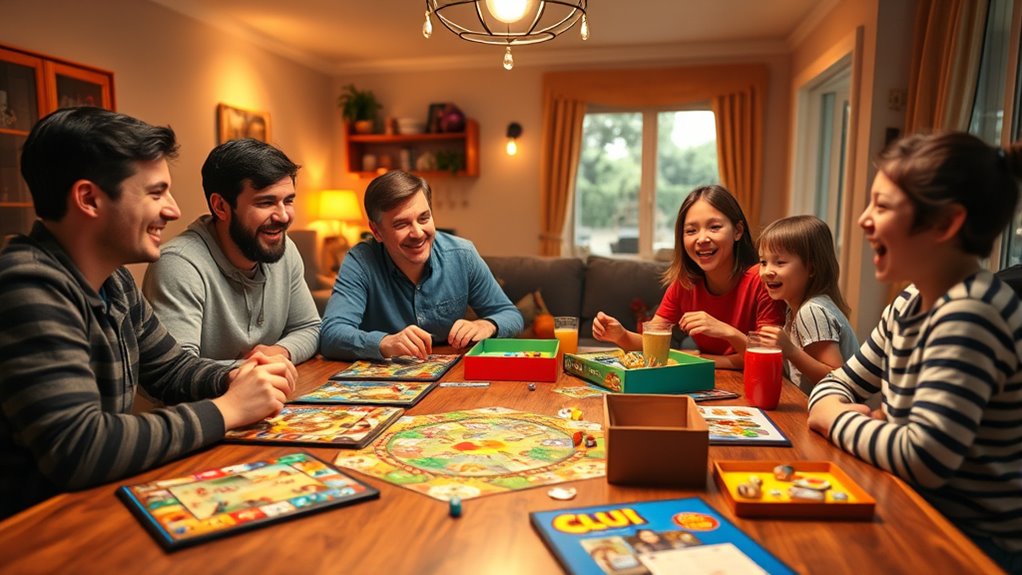

Choosing the right board games for family night often comes down to balancing engagement levels across different ages and attention spans. My top overall recommendation is Hasbro Gaming Scrabble Board Game (Classic Edition) because it bridges the gap between educational value and competitive fun for mixed-age groups. If you need something faster-paced with less reading required, Mattel Games UNO Card Game offers immediate accessibility, while The Original Tapple stands out for high-energy word play without the pressure of spelling. The main tradeoff in this category is between strategic depth and ease of setup; deeper games take longer to explain but hold older players longer, while simpler titles keep younger kids engaged but may bore adults. Continue reading for a detailed breakdown of how each title fits specific family dynamics and play styles.

Get everyday helpers delivered free with Prime
- Fast, free delivery on millions of items
- Prime Video, Amazon Music and more included
- Member-only deals all year
Key Takeaways
- Hybrid games like Hasbro Jenga Refresh Game with Digital Die successfully modernize classics by adding tech elements without requiring app proficiency, making them ideal for tech-averse households.
- Cooperative or low-conflict games such as FoxMind Match Madness Plus+ reduce emotional volatility, which is a decisive factor for families with younger children who struggle with losing.
- Word-based games vary widely in skill requirement; Scrabble demands literacy, whereas Tapple relies on associative thinking, allowing non-readers to participate.
- Setup time is a hidden barrier to frequency; games with integrated storage like Connect 4 see more frequent use than those requiring manual piece sorting.
- Age recommendations often underestimate cognitive load; Sorry! is marketed for ages 6+, but the emotional regulation required for ‘Sorry!‘ cards often suits ages 8+ better.
| Hasbro Connect 4 Game (2025 Edition) – All-in-1 Storage, Carrying Case, Score Tracker |  | Best for Quick Two-Player Rematches | Brand: Hasbro Gaming | Age range: Ages 6+ | Players: 2 | VIEW ON AMAZON | See Our Full Breakdown |
| Mattel Games UNO Card Game |  | Best for Larger Family Groups | Brand: Mattel Games | Age range: 7 years and up | Players: 2–10 | VIEW ON AMAZON | See Our Full Breakdown |
| Trouble Board Game for Kids, Ages 5+, 2–4 Players |  | Best for Younger Kids | Brand: Hasbro | Age range: 5 years and up | Players: 2–4 | VIEW ON AMAZON | See Our Full Breakdown |
| Hedbanz Picture Guessing Game |  | Best for Lively Group Play | Brand: Spin Master Games | Age range: 6 years and up | Players: 2–6 | VIEW ON AMAZON | See Our Full Breakdown |
| Sorry! Board Game for Kids Ages 6 and Up |  | Best for Take-That Family Play | Brand: Hasbro Gaming | Genre: Family | Players: 2–4 | VIEW ON AMAZON | See Our Full Breakdown |
| Hasbro Gaming Scrabble Board Game (Classic Edition) |  | Best for Word-Loving Families | Players: 2–4 | Age range: 8 years and up | Playing time: 40 minutes | VIEW ON AMAZON | See Our Full Breakdown |
| The Game of Life Board Game – Ages 8+, 6 Color Pegs, 2-4 Players |  | Best for Make-Believe Life Choices | Players: 2–4 | Age range: 8 years and up | Edition: Standard Edition | VIEW ON AMAZON | See Our Full Breakdown |
| Hasbro Jenga Refresh Game with Digital Die |  | Best for Lively, Hands-On Rounds | Players: 1 or more | Age range: 6 years and up | Blocks: 54 hardwood blocks | VIEW ON AMAZON | See Our Full Breakdown |
| Candy Land Kingdom of Sweet Adventures Board Game (Ages 3+) |  | Best for Preschoolers and First Game Nights | Players: 2–4 | Age range: 3–6 years | Playing time: 15 minutes | VIEW ON AMAZON | See Our Full Breakdown |
| Do You Really Know Your Family? Fun Family Game for Kids, Teens and Adults |  | Best for Conversation and Larger Groups | Players: 3–8 | Age range: 8 years and up | Recommended age: 8–10 years | VIEW ON AMAZON | See Our Full Breakdown |
| The Original Tapple – Fast-Paced Family Word Game |  | Best for High-Energy Family Interaction | Brand: USAOPOLY | Minimum Age: 8 years and up | Number of Players: 2-8 | VIEW ON AMAZON | See Our Full Breakdown |
| FoxMind Match Madness Plus+ Smart Family Board Game |  | Best for Cognitive Skill Development | Brand: FoxMind | Genre: Puzzle / Board Game | Number of Players: 1-4 | VIEW ON AMAZON | See Our Full Breakdown |
| board games for family night | Brand | Players | Age range | Included components |
|---|---|---|---|---|
| Hasbro Connect 4 Game | Hasbro Gaming | 2 | Ages 6+ | Grid and tray, 42 discs (21 red and 21 yellow), game rules |
| Mattel Games UNO Card Game | Mattel Games | 2–10 | 7 years and up | 112 cards and instructions |
| Trouble Board Game for Kids | Hasbro | 2–4 | 5 years and up | Gameboard, plastic game unit with Pop-O-Matic die roller, 16 pegs, instructions |
| Hedbanz Picture Guessing Game | Spin Master Games | 2–6 | 6 years and up | 6 headbands, 6 headplates, 16 scoring badges, 1 timer, 69 picture cards, 3 sample question cards, instructions |
| Sorry! Board Game for Kids Age | Hasbro Gaming | 2–4 | — | Gameboard, 12 pawns, 45 cards, instructions |
| Hasbro Gaming Scrabble Board G | Hasbro Gaming | 2–4 | 8 years and up | Gameboard, 100 wooden letter tiles, 4 wooden tile racks, drawstring letter bag, game rules |
| The Game of Life Board Game | Hasbro Gaming | 2–4 | 8 years and up | — |
| Hasbro Jenga Refresh Game with | Hasbro Gaming | 1 or more | 6 years and up | Hardwood blocks, stacking sleeve, instructions |
| Candy Land Kingdom of Sweet Ad | Hasbro Gaming | 2–4 | 3–6 years | Game board, 4 gingerbread pawns, card deck, instructions |
| Do You Really Know Your Family | — | 3–8 | 8 years and up | — |
| The Original Tapple | USAOPOLY | — | — | 1 Tapple wheel, 36 cards, instructions |
| FoxMind Match Madness Plus+ Sm | FoxMind | — | — | — |
More Details on Our Top Picks
Hasbro Connect 4 Game (2025 Edition) – All-in-1 Storage, Carrying Case, Score Tracker
For a family night that includes quick head-to-head rounds, this Connect 4 edition is the easiest game here to set up and put away. Its fold-up carrying case stores the discs, while sliding trackers help players keep score across rematches. A round takes about five minutes, making it a handy choice when siblings want a fast contest or a longer game will not fit the evening. Compared with Trouble, it offers a more direct two-player strategy challenge without a shared race around a board. The tradeoff is its strict two-player limit: UNO works better when the whole family wants to join. Its familiar rules suit younger players, though adults may want more depth than this compact game provides.
Pros:- Built-in disc storage and a carrying handle make transport and cleanup straightforward.
- One-motion setup suits short play windows and younger players.
- Sliding score trackers make it easy to keep track of multiple rounds.
- Familiar rules let players start quickly without a long explanation.
Cons:- Only two players can play at a time, unlike UNO’s larger player range.
- Short, familiar matches may not hold the attention of players seeking a longer game.
- The supplied description lists no electronic or digital features.
Best for: Families with two children, or an adult and child, who want quick rounds and easy cleanup at home or while traveling.
Not ideal for: Families who want everyone to play together or prefer games with deeper strategy and more varied decisions.
- Brand:Hasbro Gaming
- Age range:Ages 6+
- Players:2
- Model number:G1500
- Model year:2026
- Included components:Grid and tray, 42 discs (21 red and 21 yellow), game rules
- Set name:Connect 4 Game Edition 2025
Our verdict“Choose Connect 4 for portable, fast two-player matchups, but pick UNO if your family needs one game that accommodates a larger group.”
Mattel Games UNO Card Game
UNO earns its place as the most flexible group pick in this lineup: the same deck supports 2 to 10 players, so it can work for a small game or a crowded family gathering. Matching colors or numbers is simple to teach, while action cards and customizable wild cards give families room to set their own house rules. The graphic symbols for color accessibility are a practical advantage for players who have difficulty distinguishing colors. Compared with Connect 4, UNO brings more relatives to the table at once; unlike Hedbanz, it does not depend on asking questions or acting out clues. The tradeoff is that card draws and action cards can disrupt careful plans, and repeated sessions may feel familiar. It is a strong crowd-friendly choice, not a deep strategy game.
Pros:- Supports 2 to 10 players, giving it more group flexibility than Connect 4 or Trouble.
- Color-blind accessible graphic symbols help players distinguish cards.
- Customizable wild cards let families create house rules.
- A familiar matching goal makes it approachable for casual family play.
Cons:- Action cards and card draws can override planned play and frustrate some players.
- The familiar matching format may feel repetitive over frequent sessions.
- The supplied product data does not list a manufacturer warranty.
Best for: Families who need a compact, easy-to-teach game that can include a wide range of ages and up to ten players.
Not ideal for: Players looking for a board-based game with sustained strategy, or families who dislike luck and sudden changes in turn order.
- Brand:Mattel Games
- Age range:7 years and up
- Players:2–10
- Included components:112 cards and instructions
- Model number:GDJ85
- Special features:Color-blind accessible; customizable wild cards
- Educational objective:Attention, memory, and strategic thinking
Our verdict“Pick UNO when player count and easy group play matter more than a board or strategic depth.”
Trouble Board Game for Kids, Ages 5+, 2–4 Players
Trouble is the most age-accessible board game in this group for children who are ready to move pieces and follow a simple shared goal. Players press the Pop-O-Matic bubble to roll, then race their pegs around the board; its tactile die roller makes taking a turn clear and engaging for younger players. The included Power Up version adds a rules variation for families ready for a little more challenge. Compared with Sorry!, Trouble gives players a straightforward race rather than card-driven movement and frequent setbacks. That simplicity helps children learn quickly, but getting bumped back to start can feel discouraging, and the outcome leans heavily on dice. It works for up to four players, though UNO is a better fit when more relatives want to join.
Pros:- Pop-O-Matic roller makes rolling simple and gives turns a tactile action.
- Rules are approachable for young children and mixed-age family groups.
- Power Up spaces offer a variation for families seeking more challenge.
- The board race provides a clear shared objective for up to four players.
Cons:- A peg can be sent back to start, which may upset younger or less competitive players.
- Dice largely determine movement, limiting players’ control over outcomes.
- Its four-player limit is less flexible than UNO for larger gatherings.
Best for: Families with children around age five or older who want an easy-to-explain board race for two to four players.
Not ideal for: Players who dislike luck-based movement or setbacks, and larger families who want everyone in the same game.
- Brand:Hasbro
- Age range:5 years and up
- Players:2–4
- Edition:Classic Edition
- Included components:Gameboard, plastic game unit with Pop-O-Matic die roller, 16 pegs, instructions
- Model year:2017
- Model name:Trouble
Our verdict“Choose Trouble for a simple, tactile first board race, but opt for UNO when your group has more than four players.”
Hedbanz Picture Guessing Game
For families who would rather talk, laugh, and guess than focus on a board, Hedbanz offers a different kind of family-night energy. Each player wears a headband with a picture card they cannot see, then asks yes-or-no questions to work out what it is. The timer and scoring badges give turns a brisk pace, while the six headbands support groups of up to six. Compared with UNO, Hedbanz asks players to communicate and reason aloud instead of matching cards; compared with Connect 4, it is built for a group rather than a two-player matchup. Its tradeoff is a smaller set of 69 picture cards, which may make repeat sessions feel familiar. Some clues may also challenge the youngest players.
Pros:- Question-based guessing encourages conversation and deductive reasoning.
- Six headbands allow a larger group than Connect 4 or Trouble.
- A timer and scoring badges help keep turns moving.
- Fresh illustrations and themed headbands add variety to the guessing format.
Cons:- The 69 picture cards may feel limiting after repeated family nights.
- Players who dislike performing or speaking in front of a group may not enjoy the format.
- Some clues may be challenging for younger children.
Best for: Families with children six and up who enjoy asking questions, social guessing, and a lively game for up to six players.
Not ideal for: Families seeking a quiet, low-interaction game, or those with younger children who may struggle with the picture clues.
- Brand:Spin Master Games
- Age range:6 years and up
- Players:2–6
- Included components:6 headbands, 6 headplates, 16 scoring badges, 1 timer, 69 picture cards, 3 sample question cards, instructions
- Model year:2023
- Edition:Classic Edition
- Set name:Hedbanz Classic Edition
Our verdict“Pick Hedbanz for an outgoing family that enjoys group conversation and guessing more than quiet, turn-based strategy.”
Sorry! Board Game for Kids Ages 6 and Up
Sorry! suits families who like a race with a little confrontation: card draws move pawns, and players can send opponents back to start. That mix lets children join a familiar race while giving each turn a chance to disrupt someone else’s progress. It supports two to four players and is aimed at ages six and up. Compared with Trouble, which centers movement on a die roller, Sorry! uses cards to shape how pawns move and when players can interfere. The tradeoff is uneven control: card draws limit planning, and a setback can stretch the game or irritate players who are close to finishing. Compared with UNO, it gives the family a shared board and pawn race, but it cannot accommodate as many players.
Pros:- Card-driven movement adds variety to the shared board race.
- Sending opponents back creates direct interaction between players.
- The familiar premise is approachable for many children and adults.
- Includes the board, pawns, cards, and instructions needed to play.
Cons:- Card draws limit players’ control over their moves and strategy.
- Being sent back can frustrate players, especially near the end of a race.
- Game length can vary, making it less predictable than quick rounds of Connect 4.
Best for: Families with children six and up who enjoy card-driven races, friendly rivalry, and sending opponents back as part of play.
Not ideal for: Families with more than four players, or players who prefer predictable game length and a low-conflict experience.
- Brand:Hasbro Gaming
- Genre:Family
- Players:2–4
- Minimum age:6 years
- Edition:Standard Edition
- Included components:Gameboard, 12 pawns, 45 cards, instructions
- Language:English
Our verdict“Choose Sorry! for a family that welcomes playful setbacks and card-driven rivalry, not for a group seeking a calm or reliably short game.”
Hasbro Gaming Scrabble Board Game (Classic Edition)
Scrabble suits family nights built around quiet concentration, vocabulary, and the satisfaction of forming words together. Its 100 wooden tiles, wooden racks, and textured board give turns a tactile quality that a card-based option like Do You Really Know Your Family? doesn’t offer. The included strategy guide and alternate ways to play can help families adjust the challenge, while the age-eight-and-up recommendation makes it a fit for older children and adults.
The tradeoff is pace: a listed playing time of 40 minutes is a substantial commitment, and players need to be comfortable spelling and scoring. Unlike the quick, no-reading Candy Land, Scrabble won’t suit preschoolers or children who find word games frustrating. It also requires at least two players and accommodates only four, so it is less flexible for a large gathering.
Pros:- Wooden tiles and racks provide a satisfying tactile feel.
- Textured board helps keep letter tiles in place during play.
- Strategy guide and alternate ways to play offer options for varying the challenge.
- Supports two to four players, including older children and adults.
Cons:- The listed 40-minute playing time may feel long for younger children or a quick game night.
- Spelling and word scoring can leave less confident readers at a disadvantage.
- Requires at least two players and does not accommodate larger groups.
Best for: Families with children aged eight and up who enjoy spelling, vocabulary challenges, and a calmer game for two to four players.
Not ideal for: Families with preschoolers, short attention spans, or more than four players who want everyone involved in one game.
- Players:2–4
- Age range:8 years and up
- Playing time:40 minutes
- Letter tiles:100 wooden tiles
- Included components:Gameboard, 100 wooden letter tiles, 4 wooden tile racks, drawstring letter bag, game rules
- Materials:Wooden tiles and racks
- Brand:Hasbro Gaming
- Model number:F4204
Our verdict“Choose Scrabble for a word-focused family with older children, but pick Candy Land for pre-readers or Do You Really Know Your Family? for a more conversational game.”
The Game of Life Board Game – Ages 8+, 6 Color Pegs, 2-4 Players
The Game of Life gives family night a story-shaped arc: players choose paths through school, careers, and other milestones, then manage cash and investments along the way. Those choices create more to talk about than the simple color-matching turns in Candy Land, and its mix of board, spinner, cards, cars, pegs, and money helps the game feel like an event. The age-eight-and-up guidance also makes it a plausible pick for families who want to discuss decision-making and basic money concepts as they play.
That extra theme comes with less control than Scrabble: the spinner has a strong influence on outcomes, so planning won’t always determine who gets ahead. It also plays only two to four, which rules it out for larger families unless some players sit out. Pick it for its changing routes and shared storytelling, not for a strategy-heavy contest or a reliably short session.
Pros:- Life-stage choices create conversation and a clear theme for family play.
- Cards, cars, pegs, money, and a spinner provide varied game components.
- Multiple paths and investment options give players choices from one game to the next.
- Can pair family play with informal discussion of decisions and money.
Cons:- Spinner results can outweigh players’ decisions.
- Limited to two to four players.
- The variety of components and choices may be less appealing to families seeking a very quick, simple game.
Best for: Families with children aged eight and up who enjoy career-and-life themes, simple money decisions, and a game with changing routes.
Not ideal for: Larger families, or players who prefer skill to have more influence than a spinner on the outcome.
- Players:2–4
- Age range:8 years and up
- Edition:Standard Edition
- Language:English
- Dimensions:15.75 × 10.5 inches
- Weight:900 g
- Brand:Hasbro Gaming
- Model number:F0800
Our verdict“Pick The Game of Life for families who want a themed journey with simple decisions, but choose Scrabble for more direct word-based skill or Candy Land for younger children.”
Hasbro Jenga Refresh Game with Digital Die
Jenga Refresh is the most physical pick in this group: players remove and restack wooden blocks, while a digital die adds six challenges such as using thumbs only or racing a clock. That makes it a more active change of pace than the word work in Scrabble or the conversation prompts in Do You Really Know Your Family?. It is also listed for one or more players, so it can work when family members want to take turns individually as well as when a group is gathered.
The added challenge comes with a catch: the digital die needs smartphone or web app access, so the game’s extra modes depend on a device. Families who want a fully screen-free session may prefer classic-style stacking without those modes. The tower also calls for steady hands, and the challenge variations may suit some children better than others. Choose this version for physical tension and changing rules, not for a quiet, sit-and-think evening.
Pros:- Six digital-die challenges add variety to the familiar stacking format.
- Includes 54 hardwood blocks for tactile, hands-on play.
- Listed for one or more players, allowing solo turns as well as group play.
- Stacking sleeve helps with setup and storage.
Cons:- Using the digital die requires smartphone or web app access.
- App-dependent challenges may not suit families aiming to keep devices away during game night.
- Steady hands and careful block removal are central to play, which may frustrate some younger players.
Best for: Families with children aged six and up who want a hands-on stacking game and are comfortable using a smartphone or web app for the challenge modes.
Not ideal for: Families seeking a screen-free game, a word or trivia challenge, or play that does not rely on careful block handling.
- Players:1 or more
- Age range:6 years and up
- Blocks:54 hardwood blocks
- Included components:Hardwood blocks, stacking sleeve, instructions
- Materials:Wood blocks; plastic die and sleeve
- Challenge modes:6 digital-die challenges
- Brand:Hasbro Gaming
- Model name:JENGA REFRESH
Our verdict“Choose Jenga Refresh when your family wants physical, changeable challenges and accepts the device requirement; choose Scrabble for a calmer, screen-free game.”
Candy Land Kingdom of Sweet Adventures Board Game (Ages 3+)
Candy Land is the easiest entry point for very young players in this lineup: children follow a colorful path using cards, with no reading required. Its 15-minute playing time and color-based movement make it a gentler first family game than Scrabble, which asks for spelling and a longer session. English and Spanish instructions also give families a choice of language for the rules.
This accessibility limits the challenge. Because play centers on following the path rather than making many strategic choices, older children and adults may find it repetitive compared with the career decisions in The Game of Life or the word-building in Scrabble. The listed age range tops out at six, which signals its strongest fit is early childhood rather than a mixed-age group seeking equal challenge. Its four-player limit also means a bigger family cannot all join one game.
Pros:- No reading is required, making it approachable for pre-readers.
- Color-based movement supports early color recognition and turn-taking.
- Listed playing time of 15 minutes suits shorter attention spans.
- Instructions are provided in English and Spanish.
Cons:- Limited strategic choice may not hold older children’s or adults’ interest.
- Supports only two to four players.
- Plastic gingerbread pawns may be vulnerable to rough handling.
Best for: Families with children aged three to six who are learning turn-taking and color recognition and need a game that requires no reading.
Not ideal for: Families seeking strategic choices for older children and adults, or groups with more than four players.
- Players:2–4
- Age range:3–6 years
- Playing time:15 minutes
- Included components:Game board, 4 gingerbread pawns, card deck, instructions
- Instructions:English and Spanish
- Brand:Hasbro Gaming
- Model number:4700 S5
- Language listed:English
Our verdict“Choose Candy Land for a short first game with preschoolers, but move to The Game of Life or Scrabble when children want more decisions or challenge.”
Do You Really Know Your Family? Fun Family Game for Kids, Teens and Adults
Do You Really Know Your Family? turns the family itself into the subject, using trivia-style questions and silly challenges to get relatives talking and laughing. It accommodates three to eight players, giving it a broader group range than Scrabble or The Game of Life, both of which are listed for two to four. Its card format and simple setup also make it easier to bring out than a board game with a longer sequence of turns.
This is the social pick, not the one for players who want a substantial puzzle or a tightly defined strategy. Compared with Jenga Refresh, it relies on conversation rather than dexterity, so the fun depends on how willing the group is to answer and joke around. The cardstock cards in a portable tin are easy to store, but repeated sessions may feel familiar as prompts recur. Families wanting deeper tactical play should choose Scrabble instead.
Pros:- Supports three to eight players, more than the two-to-four-player board games in this group.
- Questions and silly challenges encourage family conversation.
- Easy to learn and quick to set up.
- Portable tin packaging makes storage and transport convenient.
Cons:- Prompts may feel repetitive after many sessions.
- Enjoyment depends on players being willing to answer questions and join in the social tone.
- Offers less strategic depth than Scrabble or The Game of Life.
Best for: Families with three to eight players, including children aged eight and up, who enjoy conversation, personal trivia, and playful challenges.
Not ideal for: Groups that prefer strategy, word-building, or a game with less emphasis on sharing personal answers; repeated play may also feel familiar.
- Players:3–8
- Age range:8 years and up
- Recommended age:8–10 years
- Theme:Trivia
- Material:Cardstock
- Container:Tin
- Dimensions:2 × 4.7 × 6.7 inches
- Language:English
- Manufacturer:ASM Holdings LLC
Our verdict“Choose this card game for a talkative group of three to eight, but pick Scrabble if your family wants word strategy rather than conversation.”
The Original Tapple – Fast-Paced Family Word Game
This game stands out for its ability to generate immediate excitement through a unique mechanical timer. Unlike Hasbro Gaming Scrabble Board Game, which requires long-term strategy and patience, Tapple rewards quick thinking and verbal agility. The ten-second timer creates a shared sense of urgency that keeps every player engaged, eliminating the downtime common in turn-based classics. However, this speed can be a barrier for younger participants or those who struggle with word recall under pressure. While UNO Card Game offers simpler rules, Tapple provides a more active, physical experience where players race to press the matching letter. It is an excellent choice for families who want to break the ice and start laughing quickly, rather than settling into a slow, methodical evening.
Pros:- The built-in timer creates a fair, objective pace for all players.
- Compact wheel design allows for easy storage and travel.
- 144 categories provide significant variety to prevent repetition.
Cons:- Strict time limits can frustrate slower thinkers or younger children.
- Gameplay relies heavily on individual vocabulary, which may disadvantage non-native speakers.
- The loud buzzer may be disruptive in shared living spaces.
Best for: Families with children ages 8+ who enjoy wordplay and prefer short, high-intensity rounds over long strategic sessions.
Not ideal for: Players who experience anxiety under timed conditions or families with very young children who lack a broad vocabulary.
- Brand:USAOPOLY
- Minimum Age:8 years and up
- Number of Players:2-8
- Playing Time:15 minutes
- Material:Paper, Plastic
- Included Components:1 Tapple wheel, 36 cards, instructions
- Model Year:2022
Our verdict“Choose Tapple if you want a quick, interactive word game that prioritizes speed and laughter over strategic depth.”
FoxMind Match Madness Plus+ Smart Family Board Game
Where most family games rely on luck or social deduction, FoxMind Match Madness Plus+ focuses entirely on spatial reasoning and logic. This deluxe edition offers a progressive difficulty curve that allows siblings of different ages to play together without one dominating the other, a distinct advantage over Candy Land Kingdom of Sweet Adventures Board Game, which offers no strategic agency. The magnetic gift box and premium components signal a higher build quality compared to standard cardboard boxes. Yet, the lack of direct interaction means it feels more like a puzzle competition than a social bonding experience. It is less chaotic than Hasbro Jenga Refresh Game but requires more mental energy. This pick makes the most sense for parents who want screen-free activities that genuinely sharpen problem-solving skills while still being fun.”
Pros:- Six difficulty levels allow for fair play across mixed age groups.
- Strong educational benefits for spatial awareness and logical reasoning.
- Supports both solo play and competitive matches for up to four players.
Cons:- Small magnetic blocks pose a choking hazard for children under three.
- Lack of direct player interaction may feel isolating for social-oriented families.
- Extreme puzzles may be discouraging for beginners despite the progressive levels.
Best for: Parents seeking educational value and families who want a game that scales with different skill levels.
Not ideal for: Families looking for cooperative storytelling or direct player interaction, as this is primarily a parallel puzzle challenge.
- Brand:FoxMind
- Genre:Puzzle / Board Game
- Number of Players:1-4
- Estimated Playing Time:20 minutes
- Minimum Age:8 years and up
- Edition:Deluxe Edition
- Item Dimensions:10.24 x 10.24 x 0.04 inches
- Item Weight:0.41 kg
Our verdict“Select Match Madness Plus+ if you prioritize cognitive development and scalable difficulty over social interaction.”
How We Picked
I evaluated these twelve titles based on three primary criteria: cross-generational appeal, setup and teardown efficiency, and replay value. For a game to make this list, it had to offer a mechanism that remains engaging whether the players are seven years old or seventy. I prioritized games where the rules could be explained in under five minutes, as lengthy tutorials often derail the momentum of a family evening. I also looked for design elements that mitigate ‘kingmaker’ scenarios, where one player’s move disproportionately affects the outcome for others, which can cause friction in family settings.
The ranking logic favors versatility. Games that offer multiple ways to win or adapt to different player counts received higher priority than those that feel rigid. I also considered component durability, as family games often suffer from rough handling. Titles with integrated storage solutions or robust components were favored over those with loose, easily lost pieces. The final order reflects a balance between immediate accessibility for beginners and strategic depth for repeat plays.
| board games for family night | Brand |
|---|---|
| Hasbro Connect 4 Game | Hasbro Gaming |
| Mattel Games UNO Card Game | Mattel Games |
| Trouble Board Game for Kids | Hasbro |
| Hedbanz Picture Guessing Game | Spin Master Games |
| Sorry! Board Game for Kids Age | Hasbro Gaming |
| Hasbro Gaming Scrabble Board G | Hasbro Gaming |
| The Game of Life Board Game | Hasbro Gaming |
| Hasbro Jenga Refresh Game with | Hasbro Gaming |
| Candy Land Kingdom of Sweet Ad | Hasbro Gaming |
| Do You Really Know Your Family | — |
| The Original Tapple | USAOPOLY |
| FoxMind Match Madness Plus+ Sm | FoxMind |
Factors to Consider When Choosing Board Games For Family Night
Selecting a board game for a mixed-age group requires looking beyond the box art. These factors will help you avoid buying titles that sit unplayed on the shelf.Age Range vs. Skill Floor
Most manufacturers list a minimum age based on choking hazards or basic rule comprehension, not actual competitive balance. A game suitable for a six-year-old might have a ‘skill floor’ that is too low for a twelve-year-old, leading to boredom. Look for titles that offer handicapping options or variable difficulty levels, such as The Game of Life, which can be sped up or slowed down depending on the group’s pace. If your family spans a wide age gap, prioritize games where luck plays a larger role than strategy, such as Sorcery! or Candy Land, to keep younger players in contention until the end.
Play Time and Attention Spans
The promised play time on the box is often optimistic, especially with younger children who may get distracted. For family nights, it is safer to choose games that promise 15 to 30 minutes, as longer sessions often lead to fatigue before the game concludes. UNO and Connect 4 excel here because they can be stopped and restarted without losing progress. If you prefer longer narrative experiences, ensure the game has natural break points, but be prepared for the reality that a ’60-minute’ game might take two hours with a group of tired children.
Component Durability and Storage
Family games take a beating. Cards get bent, dice roll under sofas, and boards get sticky. I strongly recommend prioritizing games with integrated storage or compact footprints, like Hasbro Connect 4 or Jenga, which minimize cleanup time and loss risk. Games with many small, loose tokens often frustrate parents more than players. If a game requires sorting dozens of pieces into specific bags every time, it is less likely to be pulled off the shelf for a casual Tuesday night. Look for designs that treat storage as part of the gameplay experience.
Conflict Level and Emotional Regulation
Direct conflict games, where players attack each other directly, can lead to tears and arguments in younger families. Games like Monopoly (not on this list but a common comparison) are notorious for this. In this roundup, titles like FoxMind Match Madness offer competition through parallel play rather than direct interference, which reduces emotional fallout. Consider your family’s dynamic: if losing triggers significant upset, choose cooperative games or those where player interaction is indirect. This choice protects the social fabric of the evening more than the game’s strategic depth does.
Educational Value vs. Pure Fun
Parents often seek games that sneak in learning, but forcing educational content can kill the fun. The best titles in this group, such as Scrabble and Tapple, integrate literacy naturally into the gameplay loop without making it feel like homework. Hedbanz encourages vocabulary and descriptive skills through social deduction. Avoid games that feel like flashcards in disguise. The goal is engagement; if the family enjoys the mechanic, the learning happens as a byproduct. If the game feels like a lesson, resistance will build, and the game will be abandoned.
Frequently Asked Questions
How do I keep older siblings from dominating younger ones?
The most effective strategy is to choose games with high variance or luck elements, such as Sorcery! or Candy Land, where a skilled player can still lose to a lucky roll. Alternatively, implement house rules that give younger players advantages, such as going first or having extra lives, which are common in The Game of Life. Avoid games that rely heavily on memory or vocabulary, like Scrabble, unless you are willing to play with open hands or assistive rules. Consistency in these adjustments helps maintain fairness without making the game feel artificial for the older players.What is the best game for families with mixed literacy levels?
For families where some members cannot read well, visual and icon-based games are the best choice. Hedbanz relies entirely on picture recognition and verbal description, bypassing reading skills completely. UNO uses color and number symbols that are universally understood, though number recognition is still needed. FoxMind Match Madness is also excellent as it focuses on spatial reasoning and visual patterns. Avoid text-heavy games like Tapple or Scrabble if literacy is a barrier, as the frustration of not being able to participate fully can outweigh the fun.How often should we rotate our board game collection?
Rotation prevents boredom and keeps the experience fresh. I suggest introducing one new game from this list every month or two, depending on how frequently you play. Keep a ‘active rotation’ of three to four games that are currently popular, and store the others out of sight. When a game’s playtime feels like a chore or arguments become frequent, it is time to swap it out. This approach prevents decision fatigue at the start of the evening and ensures that no single game becomes stale, maintaining high engagement levels over the year.Are digital-enhanced board games worth the extra cost?
Digital enhancements, like the app integration in Jenga Refresh, add value only if they simplify tracking or add dynamic elements that are hard to replicate physically. For many families, the extra step of pairing a device can be a barrier rather than a benefit. If your family enjoys tech, these features can modernize the experience. However, for traditionalists or those who prefer screen-free time, these additions are unnecessary and sometimes detrimental. Weigh whether the digital component adds genuine fun or just complexity; for Jenga, the digital die adds surprise, which is a net positive for many.What is the best entry point for a family that has never played board games?
Start with Connect 4 or UNO. These games have near-zero barrier to entry, require no reading, and play in under ten minutes. This short cycle allows the family to experience the ‘win/loss’ loop without investing hours of time that could go awry. Once the group is comfortable with taking turns and basic strategy, move to Hedbanz or Tapple, which introduce social deduction and word association without complex rules. Avoid starting with Scrabble or The Game of Life, as their length and specific requirements can overwhelm newcomers and create a negative first impression of the hobby.Conclusion
Choosing the right board game for family night depends heavily on your specific group dynamics and attention spans. For a balanced mix of strategy and accessibility, Hasbro Gaming Scrabble Board Game remains the strongest all-around choice for families with readers. If you need a quick, high-energy option that requires no setup, Mattel Games UNO is the definitive value pick. For families with younger children who struggle with losing, FoxMind Match Madness Plus+ offers a low-conflict alternative that builds confidence. If you want to modernize a classic with a tech twist, Hasbro Jenga Refresh Game provides a unique experience that bridges generations. Finally, for a purely social, laugh-inducing experience that requires zero literacy skills, Hedbanz is the best fit. Match these recommendations to your family’s current energy level and skill mix to ensure the game night is a success.
Halloween Picks
halloween
As an affiliate, we earn on qualifying purchases.