
The best hearing aid for iPhone depends on whether you value personalized sound adjustments, direct call and music streaming, or simple controls. I’d put the BlaidsX Neuro first for its app-based hearing test, audiogram, and noise controls; AuraLink stands out for its stated iOS compatibility and newer Bluetooth specification, while Apple AirPods Pro 3 may suit people who want familiar earbuds and hearing features rather than a conventional hearing aid. The main tradeoff is between hearing-focused fitting and everyday earbud convenience, with battery life, comfort, and app support also shaping the choice. iPhone compatibility alone does not guarantee that every feature will work on your phone or in your region. Read on for the full comparison and guidance on which type makes sense for you.

Get everyday helpers delivered free with Prime
- Fast, free delivery on millions of items
- Prime Video, Amazon Music and more included
- Member-only deals all year
Complete the kit



Key Takeaways
- BlaidsX Neuro leads this lineup for personalization: its listed app hearing test, audiogram support, dual microphones, and multiple DSP channels offer more fitting controls than the simpler one-button models.
- AuraLink is the clearest iOS-focused alternative: its product information explicitly names iOS and Android compatibility, though buyers should verify the exact app and iPhone requirements before purchase.
- AirPods Pro 3 fills a different role from OTC hearing aids: it is an earbud option with active noise cancellation, not a direct substitute for a hearing aid fitted to an individual hearing loss.
- Streaming claims vary in practical value: Vivtone and Mach II Pro list phone-call and music streaming, while several other products emphasize app control or noise reduction without the same clear streaming focus.
- Simple controls and long runtime are competing priorities: Flaygo emphasizes one-button operation and standby time, while app-led models offer more adjustments but ask buyers to manage fitting and settings through a phone.
| BlaidsX Neuro Hearing Aids, Bluetooth Rechargeable OTC Hearing Aids for Seniors and Adults, Mobile App Hearing Test Audiogram & Noise Cancellation, Dual Mic & 32 DSP Channels |  | Best for App-Based Hearing Personalization | Device compatibility: Smartphone; app supports Android and iPhone | Sound processing: 32 DSP channels | Microphones: Dual microphones | VIEW ON AMAZON | See Our Full Breakdown |
| Nano 2 OTC Hearing Aids for Seniors with App Personalization |  | Best for Discreet, App-Tuned Listening | Hearing-loss range: Mild to moderately severe | Connectivity: App-personalized settings; no phone calls or music streaming | App: Cearvol | VIEW ON AMAZON | See Our Full Breakdown |
| Vivtone Bluetooth Hearing Aids with App Control for Precise Fitting, Phone Calls & Music Streaming, Rechargeable OTC Hearing Aids for Seniors and Adults | 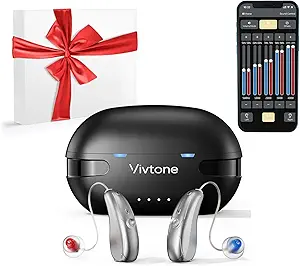 | Best for iPhone Calls and Music | Bluetooth compatibility: iOS 12 and Android 11.0 or newer | Design: Receiver-in-canal | Phone calls: Bluetooth phone-call support | VIEW ON AMAZON | See Our Full Breakdown |
| Apple AirPods Pro 3 Wireless Earbuds with Active Noise Cancellation |  | Best Apple Ecosystem Earbud Alternative | Product type: Wireless earbuds | Noise control: Active noise cancellation | Audio: Spatial audio | VIEW ON AMAZON | See Our Full Breakdown |
| Hearing Aids for Seniors, Rechargeable Bluetooth with APP Control |  | Best for Everyday Calls and Adjustable Modes | Device compatibility: Smartphone | Connectivity: Bluetooth | App control: App-based volume and sound adjustment | VIEW ON AMAZON | See Our Full Breakdown |
| Mach II Pro Wireless OTC Hearing Aids – Rechargeable, Bluetooth Streaming, Nearly Invisible (Graphite) |  | Best for Discreet iPhone Streaming | Battery: Rechargeable; no disposable batteries | Bluetooth compatibility: iOS and Android | Audio modes: Music, Home, Outdoors, Restaurants | VIEW ON AMAZON | See Our Full Breakdown |
| Yeasound RIC800 Hearing Aids with AI Noise Reduction, Bluetooth, and Waterproof Design |  | Best for Long Days Between Charges | Frequency range: Up to 8000 Hz | Battery life: 23 hours in hearing mode; 12 hours in streaming mode | Charging: Wireless charging case with three additional charges | VIEW ON AMAZON | See Our Full Breakdown |
| Hearing Aids for Seniors with Bluetooth APP Control, Noise Cancelling |  | Best for Battery Status at a Glance | Battery type: Lithium-ion | Battery quantity: 1 | Battery weight: 1.83 g | VIEW ON AMAZON | See Our Full Breakdown |
| Diamond X1 Bluetooth Hearing Aids for Seniors with Smartphone App – Noise Cancellation, Clear Sound & Easy to Use |  | Best Earbud-Style Pick for iPhone Users | Suitable for: Mild to moderate hearing loss | Connectivity: Bluetooth 5.3 | Battery life: Up to 12 hours per charge; up to 36 hours total with case | VIEW ON AMAZON | See Our Full Breakdown |
| Vivtone Bluetooth Hearing Aids with Phone Call & Music Streaming, APP Control for Precise Fitting, Rechargeable OTC Hearing Aids for Seniors Adults Men Women |  | Best for Long Hearing-Time Use | Connectivity: Bluetooth | Compatibility: iOS 12 or newer; Android 11.0 or newer | Design: Receiver-in-canal | VIEW ON AMAZON | See Our Full Breakdown |
| Flaygo Hearing Aids for Seniors, Sound Quality Restoration, Noise Reduction, 80h Standby, One-Button Operation, Comfortable Fit, Beige |  | Best for Simple Controls | Digital chip: 16-channel | Sound technology: Sound quality restoration and noise reduction | Battery life: Up to 80 hours standby | VIEW ON AMAZON | See Our Full Breakdown |
| Rechargeable OTC Hearing Aids, Wireless with Noise Reduction, Invisible and Comfortable Design, 30+ Hours Per Charge, Up to 80 Hours with Case, Easy One-Button Control for Clear Conversations – Black |  | Best for Long Wear Between Charges | Noise reduction: Yes | Battery life: 30+ hours per charge; up to 80 hours with case | Control: One button | VIEW ON AMAZON | See Our Full Breakdown |
| AuraLink Bluetooth Hearing Aids for Seniors Adults, App-Controlled, AI Noise Reduction, Bluetooth 5.4, Compatible with iOS & Android |  | Best for iPhone Connectivity | Hearing loss range: 25–85 dB HL | Connectivity: Bluetooth 5.4 | Water resistance: IP68 | VIEW ON AMAZON | See Our Full Breakdown |
| Bluetooth Hearing Aids for Seniors, Rechargeable Earbuds |  | Best for Hearing and Earbud Use Together | Built-in chip: DSP | Volume adjustments: 5 | Maximum volume increase: 42 dB | VIEW ON AMAZON | See Our Full Breakdown |
| hearing aid for iphone | Battery life |
|---|---|
| BlaidsX Neuro Hearing Aids | 12–20 hours per charge, as stated in product description |
| Nano 2 OTC Hearing Aids for Se | Up to 16 hours per charge |
| Vivtone Bluetooth Hearing Aids | — |
| Apple AirPods Pro 3 Wireless E | — |
| Hearing Aids for Seniors | — |
| Mach II Pro Wireless OTC Heari | — |
| Yeasound RIC800 Hearing Aids w | 23 hours in hearing mode; 12 hours in streaming mode |
| Hearing Aids for Seniors with | Up to 21 hours |
| Diamond X1 Bluetooth Hearing A | Up to 12 hours per charge; up to 36 hours total with case |
| Vivtone Bluetooth Hearing Aids | Up to 24 hours in hearing mode; 3 hours in streaming mode |
| Flaygo Hearing Aids for Senior | Up to 80 hours standby |
| Rechargeable OTC Hearing Aids | 30+ hours per charge; up to 80 hours with case |
| AuraLink Bluetooth Hearing Aid | — |
| Bluetooth Hearing Aids for Sen | — |
More Details on Our Top Picks
BlaidsX Neuro Hearing Aids, Bluetooth Rechargeable OTC Hearing Aids for Seniors and Adults, Mobile App Hearing Test Audiogram & Noise Cancellation, Dual Mic & 32 DSP Channels
For iPhone users who want a hearing aid fitted around their own hearing profile, the BlaidsX Neuro stands out for its app-based audiogram and 32 DSP channels. Those channels allow finer sound adjustments than a simple volume control, while its dual microphones support listening across different settings. The stated 12–20 hours of battery life can suit a full day, though actual runtime will depend on use.
Unlike the Nano 2, which does not stream calls or music, BlaidsX advertises Bluetooth streaming alongside app controls. That makes it a more phone-connected choice, but it also means the smartphone is central to getting full functionality. Its passive noise cancellation is not the same as active noise cancellation, so buyers seeking strong electronic noise suppression should compare its approach with the active-cancellation option in this lineup. The FDA-registered class II designation and two-year repair warranty add reassurance, but neither replaces a hearing-care professional’s advice.
Pros:- Companion app supports a customizable audiogram and sound settings
- 32 DSP channels and dual microphones offer detailed processing and microphone input
- Bluetooth streaming adds phone connectivity beyond the Nano 2’s listening-only setup
- Rechargeable design is stated to provide 12–20 hours per charge
Cons:- Full functionality depends on a compatible iOS or Android smartphone
- Passive noise cancellation may not suit buyers seeking active electronic noise suppression
- The stated battery runtime varies across a wide range
Best for: iPhone users who want app-based audiogram customization, Bluetooth streaming, and detailed sound adjustments in a rechargeable hearing aid
Not ideal for: Buyers who want full controls without a smartphone, or who prioritize active noise cancellation over passive noise reduction
- Device compatibility:Smartphone; app supports Android and iPhone
- Sound processing:32 DSP channels
- Microphones:Dual microphones
- Noise control:Passive noise cancellation
- Battery life:12–20 hours per charge, as stated in product description
- Water resistance:IP67
- Item weight:28 g
- Warranty:2 years with free repair
Our verdict“Choose BlaidsX Neuro if personalized iPhone app fitting and Bluetooth streaming matter more than active noise cancellation or phone-free operation.”
Nano 2 OTC Hearing Aids for Seniors with App Personalization
The Nano 2 is for iPhone owners who want to adjust hearing profiles in an app but do not need their aids to act as wireless headphones. The Cearvol app offers personalized settings, listening modes, speech enhancement, noise reduction, and tinnitus masking. Its 2.4 g in-canal design is lighter and more discreet than the receiver-in-canal Vivtone Xpure, while the charging case adds UV cleaning and up to 50 hours of stated capacity.
The main compromise is central to the iPhone use case: Nano 2 does not support phone calls or music streaming. It can offer app personalization, but it is not the pick for taking calls directly through the hearing aids. Its stated hearing-loss range is mild to moderately severe, and tinnitus masking is a feature rather than a treatment. Buyers who want a connected listening device should compare it with Vivtone; buyers who value compact fit and app adjustments over streaming may prefer this simpler setup.
Pros:- Cearvol app provides personalized profiles and multiple listening modes
- Compact in-canal units weigh approximately 2.4 g each
- Charging case includes UV cleaning and up to 50 hours of stated capacity
- IPX5 water resistance supports everyday moisture exposure
Cons:- No phone-call or music streaming support
- Specified for mild to moderately severe hearing loss rather than all hearing needs
- Tinnitus masking is a listening feature, not a treatment
Best for: iPhone users with mild to moderately severe hearing loss who want discreet in-canal aids and app-adjustable listening without call or music streaming
Not ideal for: People who want to answer iPhone calls or listen to music through their hearing aids
- Hearing-loss range:Mild to moderately severe
- Connectivity:App-personalized settings; no phone calls or music streaming
- App:Cearvol
- Battery life:Up to 16 hours per charge
- Charging case capacity:Up to 50 hours
- Weight:Approximately 2.4 g per hearing aid
- Water resistance:IPX5
- Additional features:Multiple listening modes, speech enhancement, noise reduction, tinnitus masking, and UV cleaning case
Our verdict“Pick Nano 2 if discreet fit and app-based adjustments matter more than using your hearing aids for iPhone calls or music.”
Vivtone Bluetooth Hearing Aids with App Control for Precise Fitting, Phone Calls & Music Streaming, Rechargeable OTC Hearing Aids for Seniors and Adults
The Vivtone Xpure is the clearest fit here for an iPhone user who wants hearing support and direct access to calls and music in the same device. Its Bluetooth streaming gives it an advantage over the Nano 2, which offers app personalization but no call or music playback. The companion app provides adjustable settings, while onboard controls give users another way to change settings without relying on the phone for every adjustment.
The receiver-in-canal design and stated up to 24-hour working time suit users who expect to wear their aids through much of the day; a full recharge takes 2.5 hours. Compatibility is listed for iOS 12 and Android 11.0 or newer, so iPhone owners should check their software version. The tradeoff is that a connected, streaming-focused setup may be more than someone needs if they only want discreet amplification, and the product description warns that performance may fall off in extremely noisy environments. Compared with BlaidsX Neuro, Vivtone gives a clear emphasis to calls and media rather than a specified 32-channel processing count.
Pros:- Supports Bluetooth phone calls and music streaming
- App adjustments are complemented by onboard controls
- Stated working time is up to 24 hours per charge
- Recharge time is listed as 2.5 hours
Cons:- App control requires compatible iOS 12 or Android 11.0 or newer
- May be less effective in extremely noisy environments
- Receiver-in-canal style may be less discreet than Nano 2’s in-canal design
Best for: iPhone users who want rechargeable hearing aids for calls, music, app adjustments, and onboard control
Not ideal for: People using older unsupported phone software or those who regularly need strong assistance in extremely noisy environments
- Bluetooth compatibility:iOS 12 and Android 11.0 or newer
- Design:Receiver-in-canal
- Phone calls:Bluetooth phone-call support
- Audio streaming:Music streaming supported
- Recharge time:2.5 hours
- Working time:Up to 24 hours
- Standby time:Up to 1 week
- Charging case:Included
Our verdict“Choose Vivtone Xpure if direct iPhone calling and music playback are priorities and your phone meets its compatibility requirements.”
Apple AirPods Pro 3 Wireless Earbuds with Active Noise Cancellation
The Apple AirPods Pro 3 are a different kind of pick in a hearing-aid roundup: they are wireless earbuds with noise cancellation and health features, not a dedicated OTC hearing aid in the supplied product details. Their strongest case for iPhone owners is the Apple ecosystem integration, including device switching, plus active noise cancellation and several ear-tip sizes for fit. That makes them more versatile for everyday audio than the Nano 2, which is designed around hearing amplification and app personalization but does not stream music or calls.
That versatility comes with a meaningful limitation: the provided details do not specify hearing-aid fitting, an audiogram-based amplification app, or a hearing-loss range. I would not treat them as a substitute for a hearing aid without confirming that the needed accessibility and hearing features are supported. They also depend on compatible Apple devices, and battery life varies with use. Choose them for iPhone audio and noise control; compare with BlaidsX Neuro or Vivtone when hearing-aid functions and personalized amplification are the main goal.
Pros:- Active noise cancellation for reducing surrounding sound during listening
- Multiple ear-tip sizes support a more tailored fit
- Seamless device switching and sharing within compatible Apple devices
- Includes health and activity tracking features, including heart-rate sensing
Cons:- Product details do not establish dedicated hearing-aid fitting or amplification functions
- Features require compatible Apple devices
- Battery life may vary with usage
Best for: iPhone users seeking premium wireless audio, active noise cancellation, and Apple device integration who do not need a dedicated hearing aid
Not ideal for: Buyers looking for a specified OTC hearing aid, audiogram-based fitting, or documented support for a particular hearing-loss range
- Product type:Wireless earbuds
- Noise control:Active noise cancellation
- Audio:Spatial audio
- Fit:Multiple ear-tip sizes
- Health features:Health and activity tracking, including heart-rate sensing
- Device integration:Seamless switching and sharing with compatible Apple devices
- Dimensions:1.1 x 0.8 x 1.2 inches
- Item weight:0.32 ounces
Our verdict“Choose AirPods Pro 3 for iPhone audio and noise control, not as a replacement for a dedicated hearing aid unless its hearing features meet your needs.”
Hearing Aids for Seniors, Rechargeable Bluetooth with APP Control
These rechargeable aids target iPhone users who want one device for hearing support, calls, music, and movies, with app-based volume adjustment and multiple listening modes. Their stated active noise cancellation gives them a different emphasis from the BlaidsX Neuro, which lists passive noise cancellation and more detailed processing specifications. The automatic cancellation and speech-clarity claims may appeal to people who move between everyday environments, while Bluetooth support makes the product more phone-oriented than the Nano 2.
The limitation is how much the product information leaves unspecified: it gives no battery-runtime figure, Bluetooth version, water-resistance rating, or hearing-loss range. That makes it harder to compare long-term practicality with Vivtone Xpure, whose operating time and recharge period are listed. Full feature use also requires a smartphone. I would treat this as a feature-led option for basic app control and streaming, rather than a clearly documented choice for buyers who need precise fitting information or defined durability ratings.
Pros:- App control supports personalized sound settings and volume adjustment
- Bluetooth support is described for calls, music, and movies
- Active noise cancellation and speech-clarity features are listed
- Rechargeable, both-ear design
Cons:- Product details do not state battery runtime or charging time
- No water-resistance rating or Bluetooth version is provided
- Full feature use requires a compatible smartphone
Best for: iPhone users who want rechargeable hearing aids with app-adjustable volume and Bluetooth support for calls, music, and movies
Not ideal for: Buyers who need published battery-runtime, water-resistance, Bluetooth-version, or hearing-loss-range details before choosing
- Device compatibility:Smartphone
- Connectivity:Bluetooth
- App control:App-based volume and sound adjustment
- Noise control:Active noise cancellation
- Audio uses:Phone calls, music, and movies
- Design:Both-ear style
- Color:Black
- Battery:Rechargeable lithium-ion battery
Our verdict“Consider this model if app control and Bluetooth audio are your priorities, but choose a better-documented option if runtime or durability specifications guide your decision.”
Mach II Pro Wireless OTC Hearing Aids – Rechargeable, Bluetooth Streaming, Nearly Invisible (Graphite)
For iPhone users who want hearing support without an earbud-style look, the Mach II Pro pairs Bluetooth streaming with a discreet behind-the-ear fit. It supports calls, podcasts, and music on iOS as well as Android, while four modes—Music, Home, Outdoors, and Restaurants—give listeners basic ways to adapt without a long list of settings. Compared with the earbud-shaped Diamond X1, this design is less conspicuous and may sit more comfortably alongside glasses, though the X1 specifies Bluetooth 5.3 and IPX5 water resistance, which the Mach II Pro listing does not. Its dual directional microphones and 49-band noise reduction aim to help in changing sound environments, but the four preset modes offer less flexibility than a more customizable app-led option. Battery-life details are limited to low-power use, so frequent streaming may require careful charging. The 45-day trial and two-year repair coverage add useful purchase support.
Pros:- Bluetooth streaming for calls, podcasts, and music on iOS and Android
- Nearly invisible behind-the-ear design that can work with glasses
- Dual directional microphones and 49-band noise reduction
- 45-day trial period and two-year repair coverage
Cons:- Battery-life information is limited, and the listing notes low-power use per charge
- Full functionality may depend on a smartphone app
- Four preset audio modes provide less adjustment range than highly customizable alternatives
Best for: iPhone users seeking a discreet behind-the-ear hearing aid for calls and everyday audio, with a defined trial period and repair coverage.
Not ideal for: People who stream audio for long stretches or want extensive app-based fine-tuning; battery performance details are limited and the four preset modes may feel restrictive.
- Battery:Rechargeable; no disposable batteries
- Bluetooth compatibility:iOS and Android
- Audio modes:Music, Home, Outdoors, Restaurants
- Microphones:Dual directional
- Noise reduction:49-band Noise Guardian
- Special features:Whisper Boost, Advanced Whistle Control, Adaptive Feedback Cancellation
- Color:Graphite
- Trial and repair coverage:45-day trial; two-year repair coverage
Our verdict“Choose the Mach II Pro if discreet fit and iPhone streaming matter more than detailed battery information or extensive sound-mode customization.”
Yeasound RIC800 Hearing Aids with AI Noise Reduction, Bluetooth, and Waterproof Design
The Yeasound RIC800 is the strongest fit here for iPhone users who prioritize extended listening over a simple, beginner-first setup. Its stated battery life reaches 23 hours in hearing mode, with 12 hours available during streaming; the wireless case supplies three additional charges. That makes it a more clearly documented all-day option than the Mach II Pro, whose listing gives less specific battery information. AI noise reduction, speech enhancement, and customizable modes are aimed at keeping conversations more distinct as surroundings change, but those controls may take time to learn. The compact receiver-in-canal design is light at 0.088 ounces, while Bluetooth supports calls and music. The product details do not specify iPhone OS requirements, water-resistance certification, or a trial policy, so buyers should verify compatibility and care guidance before choosing it over the better-documented Diamond X1.
Pros:- Up to 23 hours of hearing use and 12 hours of streaming per charge
- Wireless charging case provides three additional charges
- AI noise reduction and speech enhancement with customizable modes
- Compact receiver-in-canal design weighs 0.088 ounces
Cons:- App and mode adjustments may be complicated for first-time users
- The supplied specs do not identify supported iPhone operating-system versions
- The product title mentions waterproof design, but the supplied specifications give no water-resistance rating
Best for: iPhone owners who wear hearing aids for most of the day, stream occasionally, and are comfortable adjusting app-based sound settings.
Not ideal for: First-time users who want especially simple controls, or buyers who need clearly stated iPhone OS support and verified water-resistance details before purchase.
- Frequency range:Up to 8000 Hz
- Battery life:23 hours in hearing mode; 12 hours in streaming mode
- Charging:Wireless charging case with three additional charges
- Weight:0.088 ounces
- Length:1.23 inches
- Noise and speech processing:AI noise reduction and speech enhancement
- Connectivity:Bluetooth streaming for calls and music
Our verdict“Pick the RIC800 for its stated long hearing-time battery life and adjustable noise processing, provided you confirm iPhone compatibility and are willing to learn its controls.”
Hearing Aids for Seniors with Bluetooth APP Control, Noise Cancelling
This model is a practical pick for iPhone users who want basic app adjustments and a visible charge check rather than a feature-heavy streaming setup. The LED display makes battery status easy to read, and the stated 21-hour rechargeable use should cover a typical day. Its app controls cover volume, listening modes, and noise reduction, giving it a clearer customization focus than the fixed four-mode approach of the Mach II Pro. But the product details do not spell out which iPhone versions the app supports, how software updates are handled, or whether Bluetooth is intended for direct call and music streaming. That makes it a less certain choice for buyers whose main goal is using an iPhone as an audio source. Fit comfort may also vary, and unlike the Diamond X1, the listing gives no specific water-resistance rating or detailed mode names.
Pros:- App control for volume, listening modes, and noise reduction
- Stated 21-hour rechargeable use
- LED display shows battery status
- Active noise cancellation is included
Cons:- The listing does not specify supported iPhone versions or software update support
- Bluetooth streaming for calls and music is not clearly described
- Fit comfort may vary, and detailed design measurements are not provided
Best for: Older iPhone users who want app-based volume and noise adjustments, rechargeable daily use, and an easy-to-read battery display.
Not ideal for: Buyers who need confirmed iPhone compatibility, reliable call and music streaming details, or a clearly described fit and water-resistance rating.
- Battery type:Lithium-ion
- Battery quantity:1
- Battery weight:1.83 g
- Battery life:Up to 21 hours
- Control:Bluetooth app control for volume, listening modes, and noise reduction
- Noise feature:Active noise cancellation
- Display:LED battery-status display
- Style:Multicolor-5pcs-g5
Our verdict“Choose this model if app adjustments and a visible battery display are your priorities, but look to the Diamond X1 for clearer streaming and connectivity specifications.”
Diamond X1 Bluetooth Hearing Aids for Seniors with Smartphone App – Noise Cancellation, Clear Sound & Easy to Use
Among these five, the Diamond X1 gives iPhone shoppers one of the clearest spec sheets for comparing streaming, battery, and everyday durability. It uses Bluetooth 5.3, offers app control and four named sound modes, and is rated IPX5 for water resistance. The earbud-style shape will suit people who prefer a familiar wireless-audio look; compared with the discreet behind-the-ear Mach II Pro, it is more visible but has better-documented protection and a charging-case total of up to 36 hours. A single charge is listed for up to 12 hours, falling to three hours when streaming, so frequent callers and music listeners may need to top it up during the day. It is described for mild to moderate hearing loss, not severe loss, and the supplied details do not state iPhone OS versions. The included dome sizes help with fit, though comfort remains personal.
Pros:- Bluetooth 5.3 with smartphone app control
- Four sound modes for indoor, conversation, restaurant, and commute settings
- IPX5 water-resistance rating
- Portable charging case provides up to 36 hours of total battery time
Cons:- Up to 12 hours per charge drops to three hours during streaming
- Specified for mild to moderate hearing loss, not severe hearing loss
- Earbud fit and comfort may not suit every wearer
Best for: iPhone users with mild to moderate hearing loss who prefer an earbud look, app-based sound modes, and stated water resistance.
Not ideal for: People with severe hearing loss or those who stream for many hours without access to the charging case.
- Suitable for:Mild to moderate hearing loss
- Connectivity:Bluetooth 5.3
- Battery life:Up to 12 hours per charge; up to 36 hours total with case
- Charging:Portable charging case
- Noise reduction:10 dB active noise cancellation
- Water resistance:IPX5
- Sound modes:Indoor, Conversation, Restaurant, Commute
- Design and fit:Wireless earbud style; different-sized ear domes included
Our verdict“The Diamond X1 is a good match for iPhone users who want an earbud-style aid with clearly stated Bluetooth and water-resistance specs, as long as their hearing needs are mild to moderate.”
Vivtone Bluetooth Hearing Aids with Phone Call & Music Streaming, APP Control for Precise Fitting, Rechargeable OTC Hearing Aids for Seniors Adults Men Women
The Vivtone Xpure is a strong candidate for iPhone users who want calls and music in the same receiver-in-canal device, with a stated 24 hours of hearing use between charges. Its 2.5-hour recharge is a useful detail for planning a routine, and the app is intended to support precise fitting and sound adjustments. Compared with the Diamond X1, Vivtone lists substantially longer hearing time per charge, while Diamond gives more concrete information about its Bluetooth version, water resistance, and named sound modes. Streaming is the key caveat here: battery life is specified at only three hours during streaming, so frequent callers or music listeners may not get a full day from one charge. The listing supports iOS 12 and newer, but first-time users may find app-based fitting less straightforward than preset controls. Several other technical details are not provided.
Pros:- Compatible with iOS 12 and newer, as well as Android 11.0 or newer
- Up to 24 hours of hearing use per charge
- Bluetooth support for phone calls and music
- Receiver-in-canal design with app-based fitting and sound settings
Cons:- Streaming battery life is listed at only three hours
- App-based fitting may be challenging for first-time users
- The supplied details omit a Bluetooth version and water-resistance rating
Best for: iPhone users on iOS 12 or newer who want long daily hearing use, app-based fitting, and occasional calls or music streaming.
Not ideal for: People who stream calls or music for much of the day, need water-resistance information, or prefer controls that work without learning an app.
- Connectivity:Bluetooth
- Compatibility:iOS 12 or newer; Android 11.0 or newer
- Design:Receiver-in-canal
- Recharge time:2.5 hours
- Battery life:Up to 24 hours in hearing mode; 3 hours in streaming mode
- Standby time:Up to one week
- App function:Control for precise fitting and sound settings
- Streaming:Phone calls and music
Our verdict“Choose the Vivtone Xpure for long stretches of hearing use on a compatible iPhone, but look elsewhere if you expect to stream audio for hours at a time.”
Flaygo Hearing Aids for Seniors, Sound Quality Restoration, Noise Reduction, 80h Standby, One-Button Operation, Comfortable Fit, Beige
For iPhone owners who want straightforward amplification rather than app-based tuning or Bluetooth streaming, Flaygo keeps the controls deliberately simple: a single button cycles through four volume levels, while its 16-channel chip and noise reduction aim to make everyday sound easier to follow. At 3.5 grams, it is also a lightweight choice for extended wear. Compared with the AuraLink Bluetooth Hearing Aids, Flaygo gives up phone connectivity and app customization in exchange for a less involved setup. Its listed 80-hour standby and two-hour USB-C charge may suit people who prefer rechargeable hardware, though standby time is not the same as continuous listening time. Buyers should also expect some initial adjustment, and the limited controls offer less fine-tuning than app-controlled alternatives.
Pros:- One-button operation keeps everyday adjustments simple
- 16-channel processing combines sound restoration and noise reduction
- Lightweight 3.5-gram design is suited to extended wear
- USB-C charging takes about two hours, with up to 80 hours of standby listed
Cons:- No Bluetooth or iPhone app connectivity is specified
- Four volume levels provide limited adjustment compared with app-controlled models
- The 80-hour figure is standby time, not stated continuous listening time
Best for: iPhone users who want basic, lightweight hearing assistance with physical controls and do not need calls or audio streaming through their hearing aids
Not ideal for: Buyers who want direct iPhone Bluetooth streaming, personalized app fitting, or more precise control than four volume levels
- Digital chip:16-channel
- Sound technology:Sound quality restoration and noise reduction
- Battery life:Up to 80 hours standby
- Charging:USB-C; about 2 hours per charge
- Weight:3.5 g
- Operation:One button with four volume levels
- Color:Beige
Our verdict“Choose Flaygo for lightweight, button-operated hearing assistance, but pick AuraLink if iPhone streaming and app fitting matter more.”
This model’s clearest advantage is its stated 30-plus hours per charge, with the case bringing total runtime to up to 80 hours. That can mean fewer charging interruptions than the Flaygo, whose listed 80 hours refers to standby rather than a full listening charge. A one-button control keeps operation simple, and S, M, and L silicone tips give buyers more options for getting a secure fit. The tradeoff for iPhone shoppers is connectivity: although the listing calls the aids wireless, it does not specify Bluetooth streaming, an iOS app, or direct control from an iPhone. The black, low-profile design and noise reduction make it a practical choice for conversation-focused wear, but people wanting phone calls or music through their hearing aids should look at AuraLink instead.
Pros:- Lists over 30 hours of use per charge and up to 80 hours with the case
- One-button control avoids a complex setup
- S, M, and L silicone tips offer fit options
- Noise reduction is designed to support clearer conversations
Cons:- Bluetooth streaming and iPhone app compatibility are not specified
- Actual battery life may vary with volume and settings
- Charging accessories are needed to use the rechargeable design
Best for: Adults who want a simple, low-profile rechargeable aid with multiple tip sizes and long stated runtime, without needing iPhone audio streaming
Not ideal for: iPhone users seeking confirmed Bluetooth calls, music streaming, or app-based sound adjustments
- Noise reduction:Yes
- Battery life:30+ hours per charge; up to 80 hours with case
- Control:One button
- Design:Invisible, ergonomic, lightweight
- Ear tip sizes:S, M, L
- Color:Black
Our verdict“Pick this model for long stated runtime and straightforward controls, but choose AuraLink if iPhone connectivity is a priority.”
AuraLink Bluetooth Hearing Aids for Seniors Adults, App-Controlled, AI Noise Reduction, Bluetooth 5.4, Compatible with iOS & Android
AuraLink is the most directly iPhone-oriented pick in this group: it specifies iOS compatibility, Bluetooth 5.4, and app-based fitting, so buyers can adjust sound rather than rely only on the physical controls found on Flaygo or the one-button rechargeable model. Its AI noise reduction is intended to adapt sound in different settings, while the RIC design and IP68 rating suit people who want a discreet aid for an active routine. The added flexibility comes with a learning curve: full customization depends on a smartphone app, and the stated hearing-loss range is 25–85 dB HL, with the product positioned for mild to moderate loss. Compared with the Bluetooth earbuds-style model in this roundup, AuraLink emphasizes a fitted hearing-aid experience over an all-in-one earbud and power-bank setup.
Pros:- iOS and Android compatibility is explicitly listed
- Bluetooth 5.4 supports connection for calls and music
- App-based personalized fitting offers more adjustment than one-button models
- IP68 water and dust resistance supports active use
Cons:- Full customization requires a smartphone app
- Positioned for mild to moderate hearing loss rather than severe loss
- App setup may feel more involved than Flaygo’s button-based operation
Best for: iPhone users with mild to moderate hearing loss who want app-based fitting, Bluetooth connectivity, and a discreet RIC design
Not ideal for: People who prefer simple button-only operation, do not want to use an app, or need support beyond the stated mild-to-moderate range
- Hearing loss range:25–85 dB HL
- Connectivity:Bluetooth 5.4
- Water resistance:IP68
- Design:Receiver-in-Canal (RIC)
- Compatibility:iOS and Android
- Charging case:UV-sanitizing
- Sound features:AI sound enhancement and noise reduction
Our verdict“Choose AuraLink if iPhone connectivity and app fitting are central to your choice; skip it if you want a no-app, button-only aid.”
Bluetooth Hearing Aids for Seniors, Rechargeable Earbuds
This option combines hearing amplification with Bluetooth earbuds, making it the most versatile fit here for someone who wants one device for listening support, calls, and music. The listed DSP chip, three noise-reduction levels, and five volume adjustments offer more hands-on control than the one-button Flaygo and rechargeable OTC models. Its flexible ear hooks and three tip sizes may help with fit, while the 2000mAh case doubles as a power bank and is listed to provide 17 charge cycles. That multifunction approach also brings compromises: the product data says Bluetooth but does not confirm iPhone compatibility details or an app, so iOS features are less clear than AuraLink’s. The earbud-style fit may take adjustment, and buyers seeking a discreet, dedicated hearing aid may prefer AuraLink’s RIC design.
Pros:- Combines amplification with Bluetooth earbud functions for calls and music
- Five volume adjustments and three noise-reduction levels allow more manual control
- 2000mAh case is listed for 17 charge cycles and can power other devices
- Flexible ear hooks and three tip sizes offer fit choices
Cons:- Bluetooth is listed, but iPhone compatibility details and app support are not specified
- Hook-style fit may require adjustment and may not suit every ear
- A multifunction earbud design may be less discreet than AuraLink’s RIC style
Best for: iPhone owners who want hearing amplification and Bluetooth earbud functions in one device and are comfortable adjusting a hook-style fit
Not ideal for: Buyers who need clearly documented iPhone app support, a discreet receiver-in-canal profile, or a simple hearing-only device
- Built-in chip:DSP
- Volume adjustments:5
- Maximum volume increase:42 dB
- Noise reduction levels:3
- Battery capacity:2000 mAh
- Charge cycles:17
- Usage time:More than 7 days
- Connectivity and control:Bluetooth; button control
- Fit and additional features:Flexible ear hooks; 3 ear tip sizes; LED power display; auto-on/off
Our verdict“Choose this model for a combined hearing-aid and earbud setup, but AuraLink is the clearer choice when documented iPhone compatibility matters most.”

How We Picked
I ranked these products around the needs behind the search for a hearing aid for iPhone: clear evidence of iOS compatibility, useful app controls, call or audio streaming, ease of setup, and practical day-to-day handling. I also compared the stated design and maintenance details, including rechargeable cases, claimed runtime, water resistance, and simplified controls. Since the supplied product information does not establish clinical performance or independent test results, I treat marketing claims as features to verify rather than proof of hearing outcomes.
The order favors products whose listed features make the iPhone connection and fitting process more concrete. BlaidsX Neuro ranks first for its combination of app-based hearing assessment, audiogram personalization, and sound controls; AuraLink follows for explicitly stated iOS support, while products with phone and music streaming earn consideration for that specific use. The general-name models remain lower because their provided details leave more unanswered questions about app compatibility, fitting, and controls. AirPods Pro 3 is included as an adjacent option, but it ranks as an earbud alternative rather than a purpose-built OTC hearing aid.
Factors to Consider When Choosing Hearing Aid For Iphone
Before choosing, separate the job you need the device to do from the word “Bluetooth” on the box. iPhone connection can mean app-based adjustments, phone-call streaming, audio streaming, or only basic wireless control—and those are not interchangeable. I’d verify the exact use you need before prioritizing convenience features.
Check What iPhone Compatibility Actually Covers
A product may connect to an iPhone for its app without streaming calls or music directly to the hearing devices. Look for the manufacturer’s exact compatibility list, the required iOS version, and whether the app remains supported for your phone model. Also check whether the connection is direct or depends on an accessory, since extra hardware changes the setup and what you can do away from home. A Bluetooth version number by itself does not confirm that a specific iPhone feature works. Before buying, confirm that the app is available in your region and that the functions you care about are listed for your operating system.
Choose Between App Fitting and Simpler Controls
App-based adjustment can help you change volume or listening programs without handling tiny device buttons, but it also adds setup steps and a dependency on a working phone. A hearing test or audiogram feature may guide personalization, yet it is not the same as a professional hearing evaluation or a guaranteed fit. One-button designs can be easier to learn and operate, especially if phone menus are a barrier, but they offer less fine control. Think about who will set the device up and whether you’ll want to adjust it independently later. Avoid choosing on the number of settings alone; usable controls matter more than a long feature list.
Decide Whether Streaming Is a Must
If you take calls or listen to audio often, confirm that the hearing aids support the particular kind of streaming you need. Some models list calls and music, while others describe Bluetooth or app control without making their streaming function clear. Streaming can simplify daily use, but it may add battery demands and make microphone behavior during calls a separate issue to check. If your main goal is hearing conversations in person, app adjustments and comfortable wear may matter more than music playback. For an earbud-style option such as AirPods Pro 3, check the hearing features and regional availability rather than assuming it works like an OTC hearing aid.
Match the Device to Your Hearing Needs
OTC hearing aids are generally aimed at adults with perceived mild to moderate hearing loss, not every kind or degree of hearing difficulty. A self-guided app fitting cannot diagnose the cause of hearing changes, and a poor fit may make sound uncomfortable even when the device connects correctly. Sudden hearing loss, pain, drainage, dizziness, or a major difference between ears calls for medical advice rather than a shopping comparison. If you already have an audiogram, check whether the device can use it and whether its fitting range suits your results. Choosing a model with more channels or noise reduction does not by itself show that it is the right match for your hearing profile.
Compare Battery Claims and Daily Maintenance
Battery figures can refer to standby time, listening time, or total use with a charging case, so compare like with like. Streaming, volume, and wireless use can change real-world runtime, making a headline case total less useful than the expected time per charge. Rechargeable models reduce the need to replace small batteries, but they still require reliable charging and careful storage. Check whether the case is included, how charging is done, and what cleaning or replacement parts the maker recommends. If you need a device for a full day away from a charger, prioritize a clear per-charge listening estimate over a large combined case figure.
Weigh Comfort, Visibility, and Support
A discreet design may appeal if you prefer a low-profile fit, but comfort depends on your ear shape, tip options, and how long you wear the device. Ask about return terms and fitting support before ordering, since the first size or sound setting may not suit you. Water resistance can help with sweat or light exposure, but it should not be read as permission to swim or shower with a device unless the maker says so. Check how to contact support, find replacement tips, and handle app or pairing problems. A model with fewer features may be the better purchase if its controls, fit options, and service are easier for you to manage.
Frequently Asked Questions
Will any Bluetooth hearing aid work with my iPhone?
No. Bluetooth on a product listing does not guarantee compatibility with every iPhone or every feature. A device may use Bluetooth for its companion app but not support direct call or music streaming. Check the maker’s current iOS and phone compatibility information, then confirm which functions are supported on your specific device. If you rely on streaming, look for that function to be stated clearly rather than inferred from the Bluetooth label.
Can AirPods Pro 3 replace an OTC hearing aid?
Not automatically. AirPods Pro 3 is an earbud option with hearing-related features, while OTC hearing aids are designed and marketed for adults with perceived mild to moderate hearing loss. The right choice depends on your hearing needs, how you plan to use the device, and which features are available where you live. Check Apple’s current feature requirements and consult a hearing professional if you are unsure whether an earbud feature fits your situation. Seek medical care for sudden changes or other concerning symptoms rather than trying to solve them with earbuds.
Do I need a professional hearing test if a hearing aid has an app test?
An app-based test can help guide device personalization, but it is not the same as a full clinical evaluation. It may not identify the cause of hearing loss or detect issues that need medical care. A professional assessment is a strong choice if your hearing has changed quickly, one ear seems much worse, or you have pain, dizziness, or drainage. Even without those signs, an audiologist can help interpret results and advise whether an OTC option suits your hearing profile. Treat app results as a fitting aid, not a diagnosis.
What should I verify before relying on a hearing aid for iPhone calls?
Confirm that the exact model supports direct phone-call streaming with your iPhone, rather than only pairing to an app. Check whether calls are sent to both devices, how the microphones pick up your voice, and whether call controls work from the hearing aids or the phone. Ask whether streaming affects the stated battery runtime, especially if you take frequent or lengthy calls. If possible, review the maker’s setup instructions before buying so you know what permissions and settings are required. A general Bluetooth claim is not enough to answer these questions.
Should I choose app control or a one-button hearing aid?
Choose based on how you prefer to adjust and manage devices, not on which control style sounds more advanced. App control can offer more personalization and make small controls easier to reach, but it requires a compatible phone and some comfort with setup. A one-button model can be simpler for quick changes and may suit someone who does not want routine phone interaction. Consider whether you or a helper will handle pairing, updates, and settings after the initial setup. If you are unsure, prioritize a clear instruction process and a return policy that gives you time to check fit and usability.
Conclusion
For an overall pick, I’d start with BlaidsX Neuro because its listed audiogram and app controls make the fitting approach clearer than the general-feature models. AuraLink is my choice for buyers who want explicit iOS compatibility, while Vivtone Bluetooth or Mach II Pro deserves a closer look if phone calls and music streaming are priorities—after confirming the exact iPhone support. For a beginner who prefers simple operation, Flaygo’s one-button design may be easier to manage than an app-heavy device. AirPods Pro 3 is the premium earbud alternative for someone seeking Apple’s familiar audio ecosystem, not a like-for-like replacement for a hearing aid. I’d treat the unspecified-feature models as options to investigate only after confirming their app, streaming, fitting, and support details with the seller.
Halloween Picks
halloween
As an affiliate, we earn on qualifying purchases.