
For a church choosing an induction loop kit, the first question is where listeners need coverage: at a welcome desk or across a room. I rank the LA240 Room Loop System as the better fit for a defined listening area, where a user can move within the loop and adjust sound to suit their hearing aid. The Williams AV PLA90 is my pick for a portable, one-to-one listening point, such as a reception counter or information desk. These products solve different problems: the PLA90 has a stated 3–4 ft range, while the LA240 is designed around a looped listening area, but its supplied details do not specify the area’s dimensions. Neither product should be treated as a plug-and-play whole-sanctuary solution without checking the room, installation requirements, and hearing-aid compatibility.

Get everyday helpers delivered free with Prime
- Fast, free delivery on millions of items
- Prime Video, Amazon Music and more included
- Member-only deals all year
Key Takeaways
- For a room-based listening zone: the LA240 is the closer match because it is built around a looped area and permits movement within that zone.
- For a church welcome desk: the PLA90 is portable, includes a microphone, and has a stated short-range coverage distance of 3–4 ft.
- Do not assume sanctuary coverage: neither listing gives enough information to confirm coverage across a large church or a particular seating layout.
- Check the congregation’s equipment: listeners need hearing aids with a T-coil or compatible “T” or “Loop” program to receive an inductive signal.
- Plan for different setup needs: the PLA90 lists its power and battery details, while the LA240 listing does not provide comparable installation or power specifications.
| LA240 Room Loop System |  | Best for a defined church listening area | Product type: Room loop system | Compatibility: Hearing aids with a “T” or “Loop” program | Included loop option: Loop cable or loop pad | VIEW ON AMAZON | See Our Full Breakdown |
| Williams AV PLA90 Portable Induction Counter Loop System with Microphone |  | Best for a welcome desk or one-to-one conversations | Product type: Portable induction counter loop system with microphone | Coverage range: 3–4 ft (1 meter) | Microphone: Integrated microphone | VIEW ON AMAZON | See Our Full Breakdown |
| induction loop kits for church | Product type | Compatibility | Included loop option | Listening area |
|---|---|---|---|---|
| LA240 Room Loop System | Room loop system | Hearing aids with a “T” or “Loop” program | Loop cable or loop pad | Looped area; dimensions not specified in supplied details |
| Williams AV PLA90 Portable Ind | Portable induction counter loop system with microphone | — | — | — |
More Details on Our Top Picks
LA240 Room Loop System
The LA240 is my leading choice when a church needs a looped listening area rather than a portable device for a short conversation. Its stated purpose is to transmit audio inductively around a listening area, and the description says users can move freely within that area. That makes it a closer match than the PLA90 for a quiet room, small group setting, or another defined space where a listener needs to hear a TV or audio device without raising the volume for everyone else.
Listener adjustment is another useful distinction. The LA240 description specifies adjustable volume and tone, giving users a way to tailor the sound without relying only on the source device’s settings. By comparison, the PLA90 is built around a microphone and a short, stated 3–4 ft range. It makes more sense at an information point than as a room listening system. The LA240’s room focus gives it the stronger church use case here, but it does not establish coverage for a sanctuary or any particular room size.
The tradeoff is that the available specifications are sparse. The product includes a loop cable or loop pad, but the supplied description does not say which one comes in a particular package, how large an area either option can serve, or what installation and power requirements apply. Setup may also be complex for some users. I would ask the supplier to confirm the exact included loop, intended coverage, input connections, and compatibility with the church’s audio source before placing it in a regular service. This is the more relevant of the two picks for room listening, but churches needing reliable coverage across many seats should seek a room-specific assessment instead of assuming the LA240 will reach them all.
Choose it when the goal is personal listening within a bounded area and the audio source and loop arrangement can be confirmed. Skip it if you need a clearly specified large-room or whole-sanctuary system, or if you need detailed installation instructions before you can assess fit; the listed information does not answer those questions.
Pros:- Designed to transmit sound within a looped listening area.
- Allows listeners to move within that area rather than remain at a small counter device.
- Adjustable volume and tone support individual listening preferences.
- Includes a loop cable or loop pad, according to the listing.
Cons:- The supplied specifications do not identify the loop area or confirm sanctuary-scale coverage.
- Setup may be complex, and installation details are not provided here.
- Requires hearing aids with a compatible T-coil or T/Loop program.
Best for: Churches setting up a defined listening area for people with hearing aids that support a T-coil or compatible T/Loop program, after confirming the loop option and coverage with the supplier.
Not ideal for: Churches seeking verified whole-sanctuary coverage, a published maximum loop area, or a simple installation based only on the supplied product information.
- Product type:Room loop system
- Compatibility:Hearing aids with a “T” or “Loop” program
- Included loop option:Loop cable or loop pad
- Listening area:Looped area; dimensions not specified in supplied details
- Listener controls:Adjustable volume and tone
- Movement:Allows movement within the looped area
- Audio source:TV or audio devices, according to the description
- Setup:May be complex for some users
Our verdict“I would choose the LA240 over the PLA90 for a confirmed, bounded room listening zone, but not as a presumed whole-church system.”
Williams AV PLA90 Portable Induction Counter Loop System with Microphone
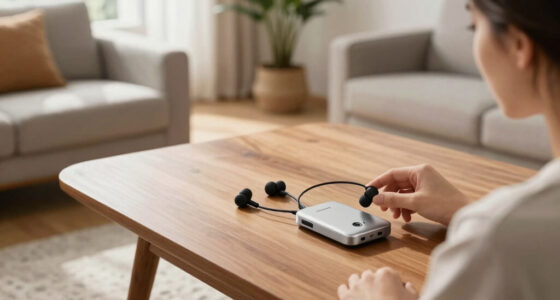
The PLA90 stands out for a different church task: helping a visitor hear a short conversation at a reception counter, welcome desk, or information point. It is a portable all-in-one counter loop with a built-in microphone, and the stated operating range is only 3–4 ft. That clear boundary is useful when planning a single service point, but it also rules the PLA90 out as a substitute for a room loop covering a gathering space.
Its integrated microphone makes this the more direct option for spoken exchanges with a greeter or staff member. An external microphone can also connect through the 3.5 mm mono input, adding some flexibility if a church’s counter setup calls for a separate microphone. The rechargeable battery is listed for up to six hours of operation, which can help when the desk is moved or sits away from an outlet; the system also has a universal AC power supply. Compared with the LA240, the PLA90 offers more explicit microphone and power information, but it covers far less space by design.
That compact format is a strength only when the listening point is close and well defined. A visitor must be within the short range, and the device is not described as serving people seated throughout a sanctuary. Its controls may feel small for some users, and it needs either its battery or external power to operate. I would treat the six-hour battery claim as a planning reference, not a guarantee for every battery’s age or operating condition, and arrange power or charging around the church’s schedule.
For a church that wants one portable assistive-listening point, the PLA90 is easier to match to a specific job than the less fully specified LA240. For a room-based listening zone, the LA240 remains the more appropriate direction. Choose the PLA90 for counter conversations; skip it if the objective is a loop around a meeting room, worship space, or multiple rows of seating.
Pros:- Portable, all-in-one format suits a single service counter or welcome point.
- Built-in microphone supports face-to-face spoken conversations.
- External microphone input offers another setup option.
- Rechargeable battery is listed for up to six hours of operation.
Cons:- The stated 3–4 ft range is too limited for room or sanctuary coverage.
- Operation depends on the battery or an external power supply.
- Compact controls may be too small for some operators.
Best for: Churches that want a portable induction loop at a welcome, reception, ticket, or information counter for close-range conversations with T-coil hearing-aid users.
Not ideal for: Churches looking for a room-wide or sanctuary-wide loop, or for a device whose compact controls may be difficult for the intended operator.
- Product type:Portable induction counter loop system with microphone
- Coverage range:3–4 ft (1 meter)
- Microphone:Integrated microphone
- External microphone input:3.5 mm mono jack
- Headphone output:3.5 mm stereo
- Power supply:Universal 100–240 VAC, 50/60 Hz input; 16 VDC, 1 A output
- Battery:12 VDC, 1300 mA/h NiMH, 10 AA cell pack; up to 6 hours stated
- Enclosure:Silver plastic
- Shipping weight:1.40 pounds
Our verdict“I recommend the PLA90 for a portable church welcome desk, not for serving listeners across a room.”

How We Picked
I ranked these two products by how closely their stated purpose fits common church listening needs, rather than treating them as interchangeable loop kits. A church may want to help someone speak with a greeter at close range, provide an assisted-listening zone in a meeting room, or serve listeners throughout a sanctuary. The supplied information supports the first two use cases to different degrees; it does not establish that either product covers a full sanctuary.
My comparison focuses on coverage intent, portability, listener control, microphone use, power information, and setup uncertainty. The PLA90 earns its place for a specific point-of-service role because it is portable, has a built-in microphone, and gives a stated range. The LA240 ranks ahead for room listening because its description emphasizes movement within a looped area and adjustable volume and tone. That room-oriented advantage comes with a real information gap: the listing does not specify the loop’s dimensions, cable arrangement, or power details. I give neither product credit for features not included in the supplied specifications, and I recommend confirming room suitability with the supplier or an assistive-listening installer before buying.
| induction loop kits for church | Product type |
|---|---|
| LA240 Room Loop System | Room loop system |
| Williams AV PLA90 Portable Ind | Portable induction counter loop system with microphone |
Factors to Consider When Choosing Induction Loop Kits For Churches
I would start a church loop purchase by mapping the listening task, not by choosing a device based on the word “induction” alone. These two products address different scales: the PLA90 is a close-range counter system, while the LA240 is described for a looped room area. Neither product description establishes a coverage plan for a full sanctuary.
Match the loop to the location
List the places where people need help hearing: a staffed welcome desk, a counselling room, a meeting space, or seating in the main worship area. For a single conversation point, the PLA90’s stated 3–4 ft range provides a clear use boundary. If listeners need to move within a listening zone, the LA240’s room-loop design is the closer fit, though its coverage dimensions are not stated. I would ask for a room plan or supplier guidance before treating it as suitable for a particular space.
Confirm T-coil compatibility
An induction loop sends sound to a compatible hearing-aid telecoil, often selected through a device’s T or Loop program. A listener whose hearing aid lacks that function may not receive the loop signal without a separate receiver. Before buying, ask the congregation whether people can access and use a telecoil setting, and check whether the church needs to provide additional listening equipment. The LA240 explicitly lists T/Loop compatibility; the PLA90 description also specifies transmission to T-coil hearing aids.
Check audio input and microphone needs
For spoken exchanges at a desk, the PLA90 has a built-in microphone and a listed 3.5 mm mono external microphone input. That makes its role easier to understand when staff speech is the main source. The LA240 description mentions TV or audio devices, but the provided details do not identify its connectors or explain how to feed it sound from a church sound system. I would verify the source connection and any required accessories before planning either product for regular services.
Ask for real coverage and installation details
A room loop’s performance depends on the chosen loop, its placement, the space, and the installation. The LA240 listing says it includes a loop cable or loop pad but does not specify which option is supplied in a given package or the area it can cover. The PLA90 does state a short range, so its limitation is easier to plan around. For a sanctuary, multiple seating zones, or a room with unusual layout, request a site-specific recommendation instead of assuming that either kit will provide uniform coverage.
Plan power and daily operation
The PLA90 lists both a universal AC power supply and a rechargeable battery with up to six hours of operation. That gives a church some choice for a mobile counter, while making charging and power availability part of the routine. The LA240 details supplied here do not state its power arrangement, so ask the supplier how it is powered and what installation it requires. Also choose an operator who can manage setup and controls, particularly if the system will be moved or adjusted by volunteers.
Set expectations for accessibility
A loop can improve access for people using compatible hearing aids, but it does not replace good speech practices. Clear sightlines, a speaker facing the congregation, controlled background noise, and a functioning sound system still matter. I would tell members where loop coverage is available and how to select their hearing aid’s T-coil program. For a larger church, an accessibility specialist can help determine whether a room loop, a counter system, or another assistive-listening approach fits the building and congregation.
Frequently Asked Questions
Which of these induction loop kits is better for a church sanctuary?
Neither product’s supplied details confirm coverage across a sanctuary. The LA240 is designed for a looped listening area, but its maximum area and installation layout are not specified. The PLA90 has a stated 3–4 ft range and is intended for counter use, so it is not a sanctuary option based on the information provided. Ask the supplier or an assistive-listening installer to assess the sanctuary’s dimensions, seating, and audio system before choosing equipment.
Do church members need special hearing aids to use an induction loop?
They need a hearing aid with a compatible telecoil, commonly accessed through a T-coil or T/Loop program. The LA240 listing names hearing aids with a “T” or “Loop” program, and the PLA90 is described as transmitting to T-coil hearing aids. Members should check their hearing-aid model and know how to switch to the telecoil setting; anyone without a compatible device may need a separate receiver if one is available for the system.
Can the PLA90 help people seated several rows away?
The PLA90 is described as a counter loop with a range of 3–4 ft (1 meter). That makes it suitable for close conversations at a welcome or information desk, not for listeners several rows away. For a room listening area, the LA240 is the more relevant of these two products, but its coverage dimensions are not supplied, so the church should confirm its reach before relying on it for seats at a distance.
What should I confirm about the LA240 before buying it?
Ask which loop option is included, whether it is a cable or pad, what area the chosen configuration can cover, how it connects to the church’s audio source, and what power and installation it requires. The listing describes movement within a looped area and adjustable volume and tone, but it does not give dimensions or detailed setup instructions. Those missing details affect whether it can serve a particular meeting room or worship space.
Can either system be moved between church rooms?
The PLA90 is explicitly described as portable and can run from its rechargeable battery or supplied power arrangement, making it the clearer choice for moving a counter system between suitable service points. The LA240 is described as a room loop, but the information provided does not explain how quickly it can be relocated or whether each new location needs a different loop setup. Confirm installation requirements before planning to share it between rooms.
Conclusion
My recommendation depends on the listening location. Choose the LA240 Room Loop System if your church wants a defined room listening zone, needs users to move within that area, and can confirm the included loop and coverage with the supplier. Pick the Williams AV PLA90 for a portable welcome or reception counter where close-range speech is the goal and staff can manage its power needs. If your priority is hearing assistance throughout a sanctuary, I would not treat either listing as proof of whole-room coverage: request a site-specific assessment and compare systems against the building’s layout and audio setup.
Halloween Picks
halloween
As an affiliate, we earn on qualifying purchases.