
If you’re searching for worldshearing aids, this roundup compares 11 over-the-counter hearing aids and amplifiers for adults with perceived mild to moderate hearing loss. My best overall pick is the ELEHEAR Beyond 2 Pro, while the Audien Atom One stands out for a compact style and the 16-channel models offer more stated sound-processing features. The main tradeoffs are discreet fit versus easier handling, simple controls versus more adjustment options, and rechargeable convenience versus the need to keep a case or charger ready. Product names and listed features alone do not confirm fit, speech clarity, or clinical suitability, so I separate stated specifications from what buyers should verify. Read on for the full breakdown and guidance on choosing the right style for your needs.

Get everyday helpers delivered free with Prime
- Fast, free delivery on millions of items
- Prime Video, Amazon Music and more included
- Member-only deals all year
Complete the kit


Key Takeaways
- ELEHEAR Beyond 2 Pro is the lead all-around option because it is the only named model in this lineup with a specific speech-clarity claim; buyers should still check how that claim was measured and whether the device suits their hearing needs.
- The two 16-channel, two-environment-mode listings offer a more defined feature set than the simpler noise-reduction listings, but extra processing options matter only if the controls are comfortable to use.
- Battery-life claims vary in what they tell you. Two listings state 80+ hours, but buyers should check whether that figure includes the charging case or reflects device runtime.
- Design creates a real usability tradeoff: the CIC and Audien Atom One prioritize a less visible form, while the BTE and behind-the-ear listings may be easier for some people to handle and position.
- Several products are described mainly through broad feature claims. Before choosing, verify return terms, fitting support, included accessories, and whether a licensed hearing professional can help if the device does not meet expectations.






| worldshearing aid | Color | Battery life |
|---|---|---|
| CIC Invisible Hearing Aid for | Apricot | 16 hours per charge; up to 48 hours with case |
| ELEHEAR Beyond 2 Pro OTC Heari | Silver Gray | — |
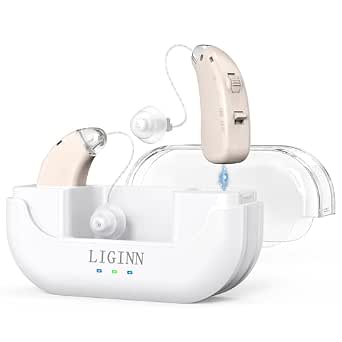
| OTC Hearing Aids for Seniors & | Pure White | 80+ hours |
| OTC Hearing Aids for Seniors | — | — |
| Hearing Aids for Seniors | Black | Up to 25 hours |
| Audien Atom One OTC Hearing Ai | Beige | Requires charging every 24 hours |
| OTC Hearing Aids for Seniors & | Black | 80+ hours |
| OTC Hearing Aids for Seniors & | Light Black | 80+ hours |
| Rechargeable Hearing Amplifier | — | 40 hours |
| Hearing Aids for Seniors and A | White | — |
| Karthus OTC Hearing Aids for S | Brown | — |
More Details on Our Top Picks
CIC Invisible Hearing Aid for Seniors with Rechargeable UV Cleaning Case
This CIC model is the most discreet choice in this group: its in-ear, invisible-style fit keeps the device less visible than the behind-the-ear ELEHEAR Beyond 2 Pro or the two BTE options. Its UV cleaning and charging case pairs routine power-up with device care, while the stated 16 hours per charge and up to 48 hours with the case suit users who prefer a compact daily-wear aid. Dual modes and AI noise filtering offer some flexibility across listening settings, though the description cautions that very noisy places may remain difficult. Compared with the 80+ hour model, it puts less emphasis on extended time between charges and more on discreet fit and case-based hygiene. I’d choose it for appearance and simple mode changes, not for the longest battery interval.
Pros:- Invisible-style in-ear design is less noticeable than the BTE models in this group.
- UV cleaning case combines device care with charging.
- Two listening modes give some flexibility between environments.
- Quick charge provides four hours of use after 15 minutes.
Cons:- The stated 16-hour device runtime is shorter than the 80+ hour option in this roundup.
- Noise filtering may not be enough for extremely noisy environments.
- Only apricot is listed, and the device requires regular charging and case maintenance.
Best for: Seniors who prioritize a low-visibility in-ear fit and want a charging case that also supports routine cleaning.
Not ideal for: People who spend long stretches in very noisy settings or want the longest stated battery life between charges.
- Fit:In-ear
- Style:Invisible
- Color:Apricot
- Battery life:16 hours per charge; up to 48 hours with case
- Charging time:2 hours for a full charge
- Quick charge:15 minutes provides 4 hours of use
- Features:AI chip, dual modes, UV cleaning case
- Microphones:High-sensitivity silicone microphones
Our verdict“Choose this CIC model if discreet in-ear wear and a UV cleaning case matter more to you than maximum battery duration or performance in heavy noise.”
ELEHEAR Beyond 2 Pro OTC Hearing Aids for Seniors, 39% Clearer Speech
The ELEHEAR Beyond 2 Pro is the most connected option here, combining app control with Bluetooth 5.3 and Auracast support for calls, music, and other media. Target speech enhancement and noise reduction make it a stronger fit for buyers who want to adjust listening beyond simple volume or environment buttons. Compared with the one-click BTE model, it offers more customization and wireless functions, but that flexibility brings a setup cost: full functionality depends on a smartphone app, and some users may need help getting started. It is rated IP67 for water resistance, yet it is not an MFi hearing aid, so Apple-device compatibility may be limited. I’d rank it ahead of simpler aids for connected use, but behind them for someone who wants controls without a phone.
Pros:- App control allows more adjustment than the button-only BTE models.
- Bluetooth 5.3 and Auracast support wireless audio features.
- Target speech enhancement and noise reduction focus on conversation clarity.
- IP67 water resistance adds protection for everyday wear.
Cons:- Full functionality depends on a smartphone app, which can make setup less straightforward.
- Not MFi-certified, so compatibility with some Apple devices may be limited.
- Its feature set may be unnecessary for buyers who only want simple volume and mode controls.
Best for: Smartphone-comfortable adults with mild to moderate hearing loss who want app adjustments, Bluetooth audio, and speech-focused processing.
Not ideal for: Buyers who want a phone-free setup or rely on Apple-device hearing-aid compatibility, since it is not MFi-certified.
- Intended hearing loss:Mild to moderate
- Aid weight:4.3 g
- Color:Silver Gray
- Water resistance:IP67
- Connectivity:Bluetooth 5.3 and Auracast
- Control:Mobile app
- Features:Noise reduction, target speech enhancement, music mode
- Battery:Rechargeable lithium-ion
Our verdict“Pick the ELEHEAR Beyond 2 Pro if app-based tuning and wireless audio are priorities and you are comfortable managing setup through a phone.”
OTC Hearing Aids for Seniors & Adults, Rechargeable Hearing Aids with Noise Cancelling & Clear Sound, 16-Channel Digital DSP & 2 Environment Modes, 80+ Hour Battery Life, Comfort-Fit, Pure White
The clearest reason to choose this model is its stated 80+ hours of battery life, which exceeds the 16-hour-per-charge figure listed for the CIC Invisible Hearing Aid and the 25-hour figure for the black BTE model. Its 16-channel digital DSP, noise cancellation, and two environment modes provide a defined set of listening tools without the app-driven feature load of the ELEHEAR Beyond 2 Pro. That makes it a practical match for buyers who want extended runtime and basic setting changes rather than wireless media features. The tradeoff is a comparatively limited description: there is no listed fit style, charging time, or detailed control method, and its Pure White color may not suit buyers seeking a less visible shade. It is not presented as a solution for severe hearing loss.
Pros:- 80+ hour stated battery life is longer than the runtimes listed for the other reviewed models.
- 16-channel digital DSP and noise cancellation support sound processing.
- Two environment modes offer a simple way to adapt settings.
- Rechargeable design avoids routine disposable-aid battery replacement.
Cons:- The product data does not specify fit style, charging time, or control method.
- Pure White is the only listed color.
- Not described as suitable for severe hearing loss.
Best for: Adults who want a rechargeable OTC aid with a long stated runtime and two straightforward environment modes.
Not ideal for: People with severe hearing loss or buyers who need clearly specified fit details, app controls, or multiple color choices.
- Channel count:16
- Environment modes:2
- Battery life:80+ hours
- Color:Pure White
- Rechargeable:Yes
- Noise control:Noise cancelling
- Fit:Comfort fit; specific style not listed
Our verdict“Choose this model for its stated long runtime and two-mode DSP design, provided its unspecified fit and controls meet your needs.”
OTC Hearing Aids for Seniors, 2026 Rechargeable Digital Hearing Amplifier with Noise Cancelling and Easy Volume Control
This model earns its place for buyers who want button-based, one-click operation rather than the app controls on the ELEHEAR Beyond 2 Pro. Its behind-the-ear fit, adjustable earplugs, and lightweight design are aimed at everyday communication and outdoor use; the portable case is described as providing up to 24 hours of use. That runtime is more modest than the 80+ hours listed for the 16-channel DSP model, but the simpler control approach may be easier for users who want fewer settings to manage. There is no smartphone customization, so people who want fine-tuning or connected audio should look elsewhere. The product is described for mild to moderate hearing loss, and new users may need time to get accustomed to wearing and operating it.
Pros:- One-click button operation keeps controls straightforward.
- Behind-the-ear fit includes adjustable earplugs for a more secure fit.
- Portable charging case is stated to provide up to 24 hours of use.
- Lightweight design is intended for daily wear.
Cons:- No smartphone app customization is listed.
- The stated case-supported runtime is shorter than the 80+ hour model.
- New users may need an adjustment period, and the aid is limited to mild to moderate hearing loss.
Best for: Seniors with mild to moderate hearing loss who prefer physical button controls and a behind-the-ear fit over app adjustments.
Not ideal for: Buyers seeking smartphone tuning, wireless audio features, or a battery runtime comparable to the 80+ hour model.
- Fit type:Behind-the-ear
- Intended hearing loss:Mild to moderate
- Control type:Button control
- Power:Rechargeable lithium-ion battery
- Battery voltage:3.7 V
- Case-supported use:Up to 24 hours
- Material:ABS
- Audio sensitivity:120 dB
Our verdict“Choose this BTE amplifier if physical controls and a simple daily setup matter more than app tuning or extended runtime.”
Hearing Aids for Seniors, Rechargeable BTE Hearing Aids, Black
The black BTE model is a straightforward alternative for wearers who want four volume levels and two sound modes without the app dependence of the ELEHEAR Beyond 2 Pro. Its rechargeable lithium-polymer battery is specified for up to 25 hours of use, placing it just above the 24-hour case-supported figure listed for the one-click digital amplifier, though the two products emphasize different controls: this one offers several volume steps and modes, while the other stresses one-click operation. A portable charging case supports daily charging, but the remote requires AAA batteries that are not included, adding a separate battery task. The 30 g item weight is also higher than the listed 4.3 g aid weight for ELEHEAR, though the measurements may describe different components. Buyers who prefer an in-ear design should skip this BTE style.
Pros:- Four volume levels and two sound modes offer more direct adjustment than a single-operation approach.
- Rechargeable battery is specified for up to 25 hours of use.
- Portable charging case supports charging away from a fixed outlet.
- Behind-the-ear design suits buyers who do not want a device in the ear canal.
Cons:- The remote requires AAA batteries, which are not included.
- BTE styling will not suit buyers seeking an in-ear or invisible fit.
- The product information provides limited detail about software updates.
Best for: BTE wearers who want physical volume adjustment and two listening modes, and are comfortable managing a separate remote battery.
Not ideal for: People who prefer an in-ear aid, want app-based customization, or do not want to replace AAA batteries for the remote.
- Style:Behind-the-ear
- Color:Black
- Battery life:Up to 25 hours
- Battery type:Rechargeable lithium polymer
- Volume levels:4
- Sound modes:2
- Noise control:Active noise cancellation
- Item weight:30 g
- Remote battery:AAA; not included
Our verdict“Choose this black BTE model if multiple button-controlled settings matter more than an in-ear profile or app customization.”
Audien Atom One OTC Hearing Aids
The Audien Atom One is the straightforward pick for someone who would rather adjust sound with a physical dial than navigate menus or an app. Its in-ear design is more discreet than the behind-the-ear Rechargeable Hearing Amplifier for Seniors, while the rechargeable battery avoids routine disposable-battery changes. Expert-guided setup is another useful distinction for buyers who want help getting started.
The tradeoff is limited flexibility: this model has no noise-control features, so busy restaurants and other sound-heavy settings may be harder than with the 16-channel options in this lineup. The listed battery interval is about 24 hours between charges, shorter than the 40-hour amplifier’s stated runtime. It is intended for mild to moderate hearing loss, not more severe needs.
Pros:- Analog dials allow direct volume and frequency adjustment without app navigation.
- Rechargeable battery removes the need for routine disposable hearing-aid batteries.
- Discreet in-ear design is less visible than the lineup’s behind-the-ear amplifier.
- Expert-guided setup can help new users adjust the device.
Cons:- No noise-control features for separating speech from busy surroundings.
- Requires charging every 24 hours.
- Designed for mild to moderate hearing loss rather than severe loss.
Best for: Adults with mild to moderate hearing loss who want a discreet in-ear fit, tactile volume and frequency controls, and guided setup.
Not ideal for: People who regularly listen in noisy settings, need noise management, or want longer than a day of use between charges.
- Fit type:In-ear
- Control type:Dial control
- Battery:Rechargeable lithium-ion
- Battery life:Requires charging every 24 hours
- Noise control:None
- Intended hearing-loss range:Mild to moderate
- Materials:Plastic or silicone
- Color:Beige
Our verdict“Choose the Atom One if simple physical controls and discreet in-ear wear matter more than noise management or extended battery life.”
OTC Hearing Aids for Seniors & Adults, Rechargeable, Noise Cancelling, 16-Channel Digital DSP, 2 Environment Modes, 80+ Hour Battery Life, Black
This 16-channel model suits buyers who move between quieter rooms and busier places and want more sound adjustment than the Audien Atom One’s basic dial controls provide. Its two environment modes, noise reduction, and feedback suppression are intended to make everyday listening more adaptable, while the stated 80-plus-hour battery life reduces how often charging interrupts use. A two-hour charge time is also clearly specified.
Those capabilities bring a learning curve: users may need time to understand the controls and choose a mode. Compared with the simpler Atom One, this device offers more listening options but less of a bare-bones setup. Its description does not give a specific fit style or sound-gain range, and it may not suit severe hearing loss. Buyers who want straightforward operation should favor a simpler model.
Pros:- Two environment modes offer options for different listening situations.
- Noise reduction and feedback suppression target distracting sound and whistling.
- Stated battery life exceeds 80 hours.
- Two-hour charge time is specified.
Cons:- Some familiarity with hearing-aid operation may be needed.
- May not be suitable for severe hearing loss.
- Fit style and sound-gain range are not specified in the provided product details.
Best for: Adults who listen in both quiet and noisy settings and are comfortable learning mode controls in exchange for longer stated battery life.
Not ideal for: First-time users seeking very simple controls, people with severe hearing loss, or buyers who need a clearly specified fit or sound-gain range.
- Digital channels:16
- Battery life:80+ hours
- Charge time:2 hours
- Environment modes:2
- Noise features:Noise cancellation and feedback suppression
- Fit style:Not specified
- Color:Black
Our verdict“Pick this model if you want long stated runtime and two listening modes, and are willing to learn controls the simpler Atom One avoids.”
OTC Hearing Aids for Seniors & Adults, Rechargeable, Noise Cancelling, 16-Channel Digital DSP, 80+ Hour Battery Life, Light Black
The distinguishing detail here is its three-level volume adjustment, giving users a small set of direct sound choices without the two environment modes offered by the similarly specified 16-channel Black OTC Hearing Aids. Both options list more than 80 hours of battery life and noise handling, so the decision comes down to whether you prefer simple volume levels or modes tailored to listening environments. This model is described for indoor, outdoor, and noisy settings, with wind-noise management also listed.
The provided details leave important fit questions open: they identify a both-ear style but do not specify water or sweat resistance, and the charging arrangement is not described. Compared with the Audien Atom One, this is a more feature-focused choice for changing surroundings, but it lacks the Atom One’s stated guided setup and dial-based frequency adjustment. Long-term reliability is also harder to judge from the supplied information.
Pros:- Three volume levels provide a limited but direct way to adjust sound.
- Noise cancelling and wind-noise management address common environmental distractions.
- Stated battery life exceeds 80 hours.
- Listed for use in indoor, outdoor, and noisy environments.
Cons:- Water and sweat resistance are not specified.
- Charging details are not provided in the supplied product information.
- Long-term reliability information is limited.
Best for: Seniors and adults who want rechargeable, both-ear devices with a few volume levels for indoor, outdoor, and noisy listening.
Not ideal for: People who need confirmed sweat or water resistance, detailed charging information, or guided setup and frequency controls.
- Digital channels:16
- Battery life:80+ hours
- Volume adjustment:3 levels
- Noise features:Noise cancelling and wind-noise management
- Style:Both ear
- Recommended uses:Indoor, outdoor, and noisy environments
- Color:Light Black
- Model number:M3111
Our verdict“Choose this model over the two-mode Black version if three-step volume adjustment matters more to you than environment-specific modes.”
Rechargeable Hearing Amplifier for Seniors, 45dB Sound Gain, Lightweight Behind-The-Ear Hearing Aid
This behind-the-ear amplifier makes the most sense for buyers who want a clearly stated 45dB sound gain and a single one-touch volume control, rather than the multiple channels and modes of the 16-channel OTC models. Its 40-hour rechargeable battery also sits between the Audien Atom One’s daily charging interval and the Black 16-channel option’s stated 80-plus hours. For conversation, television, and routine daily listening, the simple control scheme may feel less demanding than a feature-heavy device.
The tradeoff is that this is described as a personal sound amplifier, not a medical-grade hearing aid, and it may not suit severe hearing loss. It also does not list noise-control features, so it is less clearly suited to busy environments than either 16-channel model. Buyers wanting a discreet in-ear device should compare it with the Atom One instead.
Pros:- Stated 45dB sound gain gives a defined amplification figure.
- One-touch volume control keeps operation simple.
- Rechargeable battery is rated for 40 hours.
- Lightweight behind-the-ear design is intended for extended wear.
Cons:- May not be suitable for severe hearing loss.
- Described as a personal amplifier rather than a medical-grade hearing aid.
- No noise-control feature is listed.
Best for: Seniors who want a lightweight behind-the-ear amplifier with stated sound gain, one-touch volume control, and rechargeable power.
Not ideal for: People seeking medical-grade hearing aids, noise management for busy settings, or an in-ear design.
- Design:Behind-the-ear
- Sound gain:Up to 45dB
- Battery life:40 hours
- Rechargeable:Yes
- Control:One-touch volume
- Use description:Personal sound amplification
Our verdict“Choose this amplifier if simple behind-the-ear operation and specified sound gain matter more than noise processing or a discreet in-ear fit.”
Hearing Aids for Seniors and Adults – Rechargeable with Noise Cancelling Technology
This behind-the-ear option is aimed at active adults who value a compact travel charging case and noise-cancelling technology more than a long list of fine-tuning controls. That makes it a different proposition from the 16-channel Black model, which specifies its channel count, two environment modes, and battery runtime. Here, the portable case and dust- and moisture-shielding design are the clearest practical advantages for carrying and daily handling.
The supplied specifications are less complete, though. They do not state battery runtime, charge time, or a sound-gain range, so buyers cannot compare endurance as directly with the Black model’s 80-plus hours or the behind-the-ear amplifier’s 40 hours. The listing also describes rechargeable lithium-ion power alongside an included AAA battery, but does not clarify how backup power works; the AAA backup is not included. I would choose it for portability only if those details are acceptable.
Pros:- Compact charging case supports portable storage and charging.
- Noise-cancelling technology is specified.
- Behind-the-ear design is described as durable and suited to daily wear.
- Dust and moisture shielding is listed.
Cons:- Battery runtime and charge time are not provided.
- AAA backup details are unclear, and the backup battery is not included.
- No sound-gain range or software update support details are supplied.
Best for: Active adults who prefer a behind-the-ear fit and want a compact charging case for carrying their hearing aids while traveling.
Not ideal for: Buyers who need a confirmed runtime, charge time, sound-gain range, or clear details about the AAA backup arrangement.
- Style:Behind-the-ear
- Power:Rechargeable lithium-ion battery
- Backup battery:AAA; not included
- Battery runtime:Not specified
- Noise feature:Noise cancelling
- Charging accessory:Compact travel charging case
- Durability features:Dust and moisture shielding
- Color:White
Our verdict“Consider this model for its portable case and behind-the-ear design, but choose a better-documented option if battery runtime is a deciding factor.”
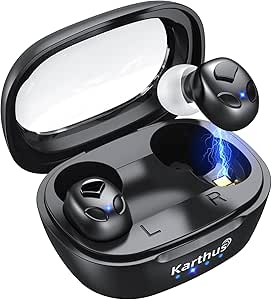
Karthus OTC Hearing Aids for Seniors, Rechargeable with Noise Reduction
I’d shortlist the Karthus for seniors who want straightforward button control rather than app-based adjustments. Its seven volume levels offer some room to tune loudness, while the behind-the-ear fit keeps the controls accessible. The stated 100 hours with the charging case and a 15-minute quick charge suit people who prefer fewer charging interruptions than options in this lineup advertising 80-plus hours.
The tradeoff is a deliberately basic setup: there’s no Bluetooth or app, so buyers seeking wireless audio or fine-grained settings should look instead at a more feature-rich option such as the ELEHEAR Beyond 2 Pro. Karthus is described for mild to moderate hearing loss, not more substantial needs, and the charging station remains part of the routine. I’d choose it for ease and runtime, not connectivity or advanced personalization.
Pros:- One-button operation keeps everyday volume adjustments simple.
- Seven volume levels allow basic loudness tuning.
- Up to 100 hours with the case reduces charging frequency.
- A 15-minute quick charge can help when power runs low.
Cons:- No Bluetooth or app connectivity for streaming or detailed adjustments.
- Specified for mild to moderate hearing loss, limiting suitability for stronger amplification needs.
- Requires its charging station rather than offering a fully wireless charging routine.
Best for: Seniors with mild to moderate hearing loss who want simple physical controls, a behind-the-ear fit, and long runtime from the charging case.
Not ideal for: Buyers who want Bluetooth streaming, app-based adjustments, or support for hearing loss beyond the mild-to-moderate range.
- Fit type:Behind-the-ear
- Control type:Button control
- Volume levels:7
- Battery:Lithium-ion polymer, included
- Battery voltage:3.7 V
- Runtime with case:Up to 100 hours
- Quick charge:15 minutes
- Color:Brown
Our verdict“Choose Karthus if simple button controls and long case-supported runtime matter more than Bluetooth, app features, or advanced adjustment options.”

How We Picked
I organized this comparison around what buyers can actually judge from the supplied product information: wearing style, stated sound-processing features, control simplicity, rechargeability, and the specificity of performance claims. A named model with clearer distinctions earns a stronger position than a listing that relies on broad claims without describing how its settings or fit differ. I also treated advertised battery figures and speech-clarity language as claims to verify, not proof of real-world performance.
The ranking favors options with a more understandable use case and a stated feature set that helps buyers make a meaningful comparison. Products with compact or behind-the-ear designs are included for different handling and visibility preferences, rather than treated as interchangeable. Because the supplied information does not establish clinical benefit, exact fit, support, or independent test results, I call out those unknowns and recommend checking them before buying.
Factors to Consider When Choosing Worldshearing Aids
The right device depends less on the number of features in its name and more on how it fits your ears, daily routine, and hearing needs. I’d check these points before choosing among the styles and feature sets in this roundup.
Match the device style to your dexterity and comfort
A discreet CIC design may appeal if visibility is your main concern, but smaller devices can be harder to place, remove, and adjust. Behind-the-ear styles are more visible, yet their larger shape may be easier to grip for people who have limited finger control. Comfort also depends on the ear tip, retention, and how long you wear the device, none of which a product title can confirm. Don’t assume that an invisible fit will feel better or sound more natural. Check the return policy and included tip sizes, and ask whether a hearing professional can help with fit. If you struggle with small electronics, prioritize handling over concealment.
Choose processing features you can actually use
Channel counts and noise-cancellation labels can sound persuasive, but they do not by themselves tell you how speech will sound in your home, at work, or outdoors. The two 16-channel listings in this roundup also name two environment modes, which gives buyers a clearer basis for comparing settings. Before paying extra for more modes, find out how they are selected and whether adjustments require a phone or tiny buttons. A simple control scheme may be more useful than a long feature list if you want quick changes. Look for clear instructions and a way to adjust volume safely. If possible, ask about a trial period so you can judge speech and background sound in your own routine.
Read battery claims closely
Rechargeable models avoid regular battery replacement, but they still need a dependable charging routine. An 80+ hour claim is hard to compare unless the listing says whether it counts charging-case recharges, device use, or both. Ask how long the aids run on one charge and how long a full recharge takes. Consider whether the case is portable and whether you can tell when charging is complete. A charging case with cleaning features may add convenience, but it does not remove the need to clean the device as directed. If you travel or spend long days away from an outlet, prioritize clear runtime details over a large headline number.
Treat performance claims as starting points, not guarantees
Claims about clearer speech, sound gain, or noise reduction are not directly comparable unless manufacturers describe the testing method and listening conditions. For example, a percentage-based clarity claim and a decibel gain figure measure different things and cannot establish which device will help you more. Consider what you find hardest to hear: conversation in a quiet room, speech with background noise, or television at a comfortable level. Then check whether the device offers settings for that situation and whether support is available if the sound feels harsh or unnatural. If hearing loss is sudden, one-sided, painful, or accompanied by dizziness, consult a health professional rather than relying on an OTC product. A hearing evaluation can also help determine whether an OTC device is appropriate.
Compare support and return terms before buying
With hearing devices, fit and sound preferences are personal, so a clear return window can matter as much as the feature list. Check whether opened or worn devices can be returned, whether restocking or shipping fees apply, and how long you have to decide. Ask whether the seller offers setup help, replacement tips, repairs, or warranty service. These details are not established by the product names in this roundup, so verify them on the current listing or with the seller. Be cautious if the instructions do not explain safe volume adjustment or cleaning. A device that is easy to exchange and supported after purchase may be a better choice than one with a longer list of unspecified features.
Set a realistic budget around your actual needs
Paying more makes sense when it buys something you will use, such as easier controls, useful environment settings, a suitable fit, or responsive support. It makes less sense to pay for technical language that does not explain how the device behaves in everyday listening. For a first OTC purchase, start by identifying your hardest listening situation and the controls you can comfortably manage. If you already know you need a discreet design, compare fit and handling rather than choosing a larger device solely for more listed features. If you need precise programming or have more than mild to moderate hearing loss, an OTC amplifier may not be the right route. Ask a qualified hearing professional about alternatives before committing.
Frequently Asked Questions
Should I choose an OTC hearing aid or a hearing amplifier?
The product names in this roundup use both terms, but a label alone does not tell you whether a device is appropriate for your hearing needs. OTC hearing aids are intended for adults with perceived mild to moderate hearing loss, while a basic amplifier may simply make sounds louder without the same level of hearing-specific adjustment. Check the device’s intended use, fitting guidance, and available sound controls rather than relying on wording in the title. If conversations remain difficult or sounds become uncomfortable, stop increasing volume and seek professional advice. A hearing evaluation can help distinguish hearing loss from other causes of listening difficulty.
Are the 80+ hour battery claims comparable across these listings?
Not from the supplied descriptions alone. Two listings state 80+ hours, but they do not clarify whether the total includes recharging from a case or describes continuous use from the aids themselves. Ask for runtime per charge, case capacity, and recharge time before treating one claim as better than another. Your listening time, volume setting, and use of different modes may affect how often you need to charge. If you need a device for long days away from home, favor a clearly explained runtime and a charging plan that fits your routine.
Will a CIC or other nearly invisible style be easier to wear all day?
Not automatically. A small in-canal device may be less noticeable, but fit, ear-canal shape, pressure, and ease of removal can affect all-day comfort. Smaller controls can also be harder to handle, especially if you have reduced dexterity or vision. A behind-the-ear model is more visible, but some buyers may find its placement and controls easier to manage. Check the seller’s fitting and return arrangements, and avoid choosing a style based on appearance alone.
Does a higher channel count mean clearer speech?
Not by itself. Channel count describes a processing feature, but it does not establish how well a device will handle your particular hearing pattern or difficult listening environments. The two 16-channel listings provide a more specific feature description than several broadly worded models, yet the number alone cannot rank their speech performance. Look for clear instructions on what the channels or modes do and whether you can adjust them comfortably. A trial period or professional guidance is more useful than treating a specification as a guarantee.
When should I seek a hearing evaluation instead of buying an OTC device?
Seek a qualified hearing professional if hearing loss appeared suddenly, affects one ear much more than the other, or comes with pain, drainage, dizziness, or ringing that concerns you. An evaluation is also a sensible next step if an OTC device does not help conversations or if louder sound becomes uncomfortable. OTC aids are intended for adults with perceived mild to moderate hearing loss, not every cause or degree of hearing difficulty. A professional can check for earwax or other treatable causes and advise whether a hearing aid, medical care, or another option fits your situation. Do not use higher volume as a substitute for finding out why hearing is difficult.
Conclusion
For an all-around starting point, I’d choose the ELEHEAR Beyond 2 Pro because its specific speech-clarity claim gives buyers a clearer point of comparison, though that claim should be verified. The best value by feature set is one of the two 16-channel, two-mode models if you want named processing options and confirm the controls suit you; the supplied information does not support a price-based value judgment. For a more feature-focused or premium-style choice, compare the ELEHEAR Beyond 2 Pro with the 16-channel options and give more weight to fitting support than to headline claims. Beginners may prefer the easy-volume-control model for its stated emphasis on simple adjustment, provided its fit and instructions are clear. For specific needs, consider the CIC model if discretion leads, the Audien Atom One if compact styling appeals, or a BTE/behind-the-ear option if handling is the priority. In every case, confirm return terms, runtime details, and suitability before making your choice.