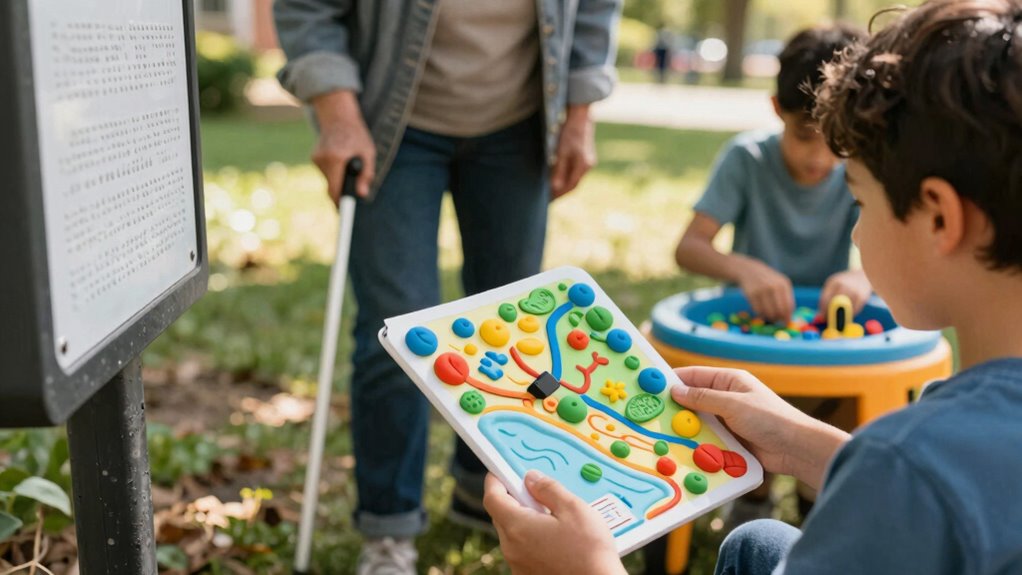

As you go through life with deafblindness, your accessibility tools and support adapt to your changing needs. In early years, tactile and audio aids help you learn and feel included. During adolescence, personalized devices boost independence and confidence in social settings. As an adult, smartphones and community programs support communication and participation. In older age, simpler alerts and safety tools help you stay independent and connected. To discover how these adaptations shape your lifelong journey, keep exploring further.

Get everyday helpers delivered free with Prime
- Fast, free delivery on millions of items
- Prime Video, Amazon Music and more included
- Member-only deals all year
Key Takeaways
- Early assistive tools focus on tactile and auditory learning to support inclusion and foundational skills.
- Adolescents use personalized tactile devices and voice systems to enhance social participation and independence.
- Adults leverage smartphone apps and adaptive technologies for navigation, communication, and employment support.
- Older adults benefit from simplified, safety-oriented devices like vibrating alerts and emergency systems.
- Lifelong development ensures continuous, tailored support fostering meaningful relationships and community engagement.

Living with deafblindness presents unique challenges that require accessible solutions throughout your entire life. As you grow, your needs evolve, and so does the way you access the world around you. Assistive technology plays an essential role in helping you navigate daily activities, communicate, and stay connected. From early childhood to old age, these tools adapt to your changing circumstances, guaranteeing you remain as independent and engaged as possible. Devices like tactile braille displays, vibrating alert systems, and specialized smartphones enable you to receive information and alerts in ways that suit your sensory profile. These technologies also support your social integration, helping you maintain relationships and participate in community life. As a child, assistive tools might focus on educational support, allowing you to learn alongside peers and access information through tactile or audio means. Schools often incorporate specialized devices that make learning accessible, fostering a sense of inclusion and belonging. During adolescence, technology becomes more personalized, helping you develop independence in social settings and school activities. You might use portable tactile devices or voice output systems to communicate more confidently in conversations or group settings, reducing feelings of isolation. As you move into adulthood, assistive technology continues to evolve, empowering you to pursue higher education, employment, and social opportunities. Innovations like smartphone apps designed for deafblind users facilitate navigation, communication, and social engagement, making it easier to connect with friends, colleagues, and community groups. Social integration becomes a fundamental focus, and technology helps break down barriers, guaranteeing you’re not left out of social events or professional networks. Throughout your life, the importance of accessible communication methods grows, and technology adapts to support your goals. In your older years, assistive devices might focus on maintaining independence, such as simplified interfaces or emergency alert systems that use tactile signals or vibrating alerts. These tools help you stay connected to loved ones and emergency services, promoting safety and reassurance. The ongoing development of assistive technology ensures that your ability to participate fully in society improves, regardless of age. The key is that these solutions are flexible and tailored, continuously supporting your individual journey and promoting social integration at every stage. By embracing technology and accessible approaches, you can navigate life’s changes with confidence, maintaining meaningful relationships and engaging actively in your community. Your experience with deafblindness is uniquely yours, and the right tools make it possible to live a fulfilling, connected life across the lifespan. Assistive technology plays a crucial role in adapting to your evolving needs and ensuring accessibility at every stage.
deafblind tactile braille display
As an affiliate, we earn on qualifying purchases.
As an affiliate, we earn on qualifying purchases.
Frequently Asked Questions
How Does Early Intervention Impact Lifelong Deafblind Accessibility?
Early intervention greatly boosts lifelong deafblind accessibility by promoting sensory integration skills and emotional resilience. When you receive support early, you learn effective communication methods and develop stronger coping strategies. This foundation helps you adapt better to changing environments, fostering independence. As a result, you’re more confident steering challenges throughout life, ensuring ongoing access to information and social connections, ultimately enhancing your overall quality of life.
What Technological Advancements Benefit Deafblind Individuals at Different Ages?
You benefit from technological advancements like advanced assistive devices and innovative communication strategies at every age. For children, tactile devices and visual aids improve learning, while adults rely on digital braille readers and video relay services for effective communication. Seniors can use wearable tech and enhanced alert systems. These tools evolve with your needs, helping you stay connected, independent, and engaged throughout your life.
How Do Social Support Needs Change Over a Lifetime?
Have you ever wondered how your social support needs evolve? As you age, your emotional resilience grows, helping you cope with challenges, but you might also seek different kinds of support. Peer mentorship becomes increasingly valuable, offering shared understanding and guidance. Over a lifetime, your social needs shift from family and caregivers to a broader community, reinforcing independence and emotional strength while maintaining essential connections.
Are There Specific Challenges Faced by Aging Deafblind Adults?
Aging deafblind adults face unique challenges due to sensory decline, which can make communication and navigation more difficult. You might experience increased independence challenges as both hearing and vision impairments worsen, leading to feelings of isolation. Adapting assistive technologies and support systems becomes essential to maintain your autonomy. Addressing these challenges early helps improve quality of life, ensuring you stay connected and engaged despite the sensory changes that come with age.
How Can Educational Systems Better Support Deafblind Students Long-Term?
You can better support deafblind students long-term by focusing on sensory integration and tailored communication strategies. Research shows that early intervention improves outcomes, so incorporate multisensory learning approaches and assistive technology from the start. Train educators in specialized communication methods, like tactile signing or braille. This proactive support fosters independence, enhances learning, and guarantees ongoing accessibility as students grow, ultimately empowering them to succeed across their lifespan.
Conclusion
As you navigate life’s journey, you might think accessibility improves with age, but ironically, it often becomes more elusive. What once was clear and adaptable can fade into silence and darkness, demanding new solutions at every turn. So, while technology advances and awareness grows, you’ll find that the true challenge isn’t just in breaking barriers—it’s in holding onto the light enough to see the paths ahead, even when they seem to disappear.
Fall Picks
fall essentials
As an affiliate, we earn on qualifying purchases.