
Personal neckband hearing amplifiers range from simple sound amplifiers to Bluetooth models with wireless microphones and hearing-aid-style features. My best overall pick is the Neosonic NW10 Pro for its wireless microphone setup, while the Williams AV Pocketalker Ultra is a straightforward option for focused one-to-one listening and the ELEHEAR Beyond is a more feature-rich choice for shoppers seeking speech enhancement. The main tradeoffs are convenience versus adjustability, open-ear comfort versus sound isolation, and simple amplification versus app-connected features. These products are not interchangeable with a professional hearing evaluation or prescription hearing aids. Read on for the full breakdown, ranking logic, and guidance on choosing a style that fits your listening needs.

Get everyday helpers delivered free with Prime
- Fast, free delivery on millions of items
- Prime Video, Amazon Music and more included
- Member-only deals all year
Complete the kit



Key Takeaways
- Wireless microphones set the Neosonic NW10 Pro and NW20 apart: they can place a speaker’s voice closer to the listener, a different approach from relying only on microphones worn around the neck.
- The lineup includes more than neckbands: the Joanbro, iRoger, Pocketalker, and ELEHEAR options use different form factors, so buyers should weigh the roundup’s broader alternatives against the neckband fit they searched for.
- Bluetooth is not the same as hearing support: neckbands from DiGGiNGSOUND, ADCDAC, and MEDca add connectivity, but shoppers should check whether a device’s listening controls meet their needs beyond streaming.
- Channel counts and noise-cancellation claims do not settle the choice: LifeZoom and Yolimart advertise 32 channels, but fit, controls, microphone behavior, and support matter just as much in daily use.
- Open-ear and in-ear designs solve different comfort problems: Aurimi‘s bone-conduction format avoids sealing the ear canal, while in-ear models may feel more familiar but can be less comfortable for some wearers.
| Joanbro Pocket Personal Sound Amplifier with 3 Microphones | 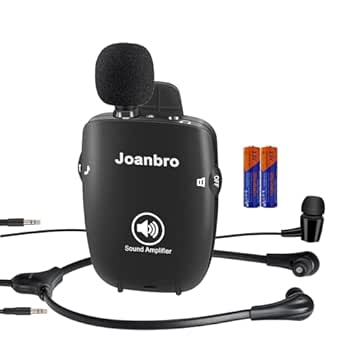 | Best for Flexible TV and Conversation Listening | Additional acoustic gain: 50 dB | Total gain: Up to 108 dB | Microphones: 3 removable types | VIEW LATEST PRICE | See Our Full Breakdown |
| DiGGiNGSOUND Neckband Bluetooth Hearing Amplifier |  | Best for a Straightforward Rechargeable Neckband | Fit type: Neckband | Hearing compensation: Up to 35 dB | Battery life: Up to 24 hours | VIEW LATEST PRICE | See Our Full Breakdown |
| ADCDAC Neckband Bluetooth Hearing Amplifier |  | Best for Multi-Device Bluetooth Controls | Style and fit: Neckband, in-ear | Bluetooth: 5.3 | Hearing compensation: Up to 35 dB | VIEW LATEST PRICE | See Our Full Breakdown |
| Aurimi Bone Conduction Hearing Amplifier, Open-Ear Design |  | Best Open-Ear Alternative | Technology: Bone conduction | Fit: Behind-the-ear, open-ear | Control: One-button | VIEW LATEST PRICE | See Our Full Breakdown |
| DiGGiNGSOUND Neckband Bluetooth Hearing Amplifier |  | Best for Calls and Voice Assistant Access | Style: Neckband | Bluetooth: 5.3 | Hearing compensation: Up to 35 dB | VIEW LATEST PRICE | See Our Full Breakdown |
| Neosonic NW10 Pro Rechargeable Hearing Amplifier with Wireless Microphone |  | Best for Long Listening Sessions | Fit: Body-worn neckband | Microphones: Built-in and wireless remote microphone | Remote microphone range: Up to 20 yards | VIEW LATEST PRICE | See Our Full Breakdown |
| ADCDAC Bluetooth Rechargeable Neckband Hearing Amplifier |  | Best for Smartphone Connectivity | Fit: In-ear | Hearing compensation: Up to 35 dB | Digital channels: 16 | VIEW LATEST PRICE | See Our Full Breakdown |
| Neosonic NW20 Rechargeable Hearing Amplifier with Wireless Microphone |  | Best for Distant Conversation Pickup | Fit: Body-worn neckband with in-ear earbuds | Wireless technology: 2.4 GHz | Microphone range: Up to 60 feet | VIEW LATEST PRICE | See Our Full Breakdown |
| LifeZoom Rechargeable Neckband Hearing Aids for Seniors, 32 Channels |  | Best for Long Battery Life | Audio channels: 32 | Noise cancellation: Triple intelligent noise cancelling | Battery life: Up to 60 hours per charge | VIEW LATEST PRICE | See Our Full Breakdown |
| ADCDAC Neckband Bluetooth Hearing Amplifier, Rechargeable In-Ear |  | Best for Calls and Everyday Audio | Fit: In-ear | Connectivity: Bluetooth | Hearing compensation: Up to 35 dB | VIEW LATEST PRICE | See Our Full Breakdown |
| iRoger Rechargeable Behind-the-Ear Hearing Amplifier with Directional Microphone |  | Best for Long Runtime | Type: Personal sound amplifier | Fit: Behind-the-ear | Maximum sound gain: 65 dB | VIEW LATEST PRICE | See Our Full Breakdown |
| Williams AV Pocketalker Ultra Hearing Amplifier with Earbud & Headphones |  | Best for Flexible Listening | Power source: Battery powered | Batteries required: 2 AAA alkaline batteries, not included | Audio sensitivity: 110 dB | VIEW LATEST PRICE | See Our Full Breakdown |
| MEDca Rechargeable Bluetooth Neckband Hearing Amplifier |  | Best Neckband for Bluetooth Streaming | Design: Neckband with wireless earbuds | Connectivity: Bluetooth | Charging time: 2 hours | VIEW LATEST PRICE | See Our Full Breakdown |
| ELEHEAR Beyond OTC Bluetooth Hearing Aids with AI Speech Enhancement |  | Best App-Controlled Alternative | Technology: VOCCLEAR AI | Design: Receiver-in-the-canal | Maximum gain: Up to 50 dB | VIEW LATEST PRICE | See Our Full Breakdown |
| Yolimart Rechargeable Neckband Hearing Aids with Noise Cancellation, 32 Channels |  | Best for Channel-Based Adjustment | Style: Neckband | Model: AMY-LT2309-FBA | Channels: 32 | VIEW LATEST PRICE | See Our Full Breakdown |
| personal neckband hearing amplifier | Battery life |
|---|---|
| Joanbro Pocket Personal Sound | Approximately 40 hours of moderate use |
| DiGGiNGSOUND Neckband Bluetoot | Up to 24 hours |
| ADCDAC Neckband Bluetooth Hear | Over 24 hours |
| Aurimi Bone Conduction Hearing | Up to 10 hours |
| DiGGiNGSOUND Neckband Bluetoot | Over 24 hours |
| Neosonic NW10 Pro Rechargeable | — |
| ADCDAC Bluetooth Rechargeable | Whole-day use; exact duration not specified |
| Neosonic NW20 Rechargeable Hea | — |
| LifeZoom Rechargeable Neckband | Up to 60 hours per charge |
| ADCDAC Neckband Bluetooth Hear | Over 24 hours |
| iRoger Rechargeable Behind-the | Up to 120 hours |
| Williams AV Pocketalker Ultra | Up to 200 hours |
| MEDca Rechargeable Bluetooth N | — |
| ELEHEAR Beyond OTC Bluetooth H | Up to 20 hours per charge; up to 100 hours with charging case |
| Yolimart Rechargeable Neckband | — |
More Details on Our Top Picks
Joanbro Pocket Personal Sound Amplifier with 3 Microphones
The Joanbro Pocket Personal Sound Amplifier stands apart from the neckband models here by offering three removable microphones for different listening situations. Its included 6 m extension cable can place the TV microphone near a sound source while you listen from farther away, while the shorter cable and other microphone options suit closer conversations. Bass, Normal, and Treble settings plus nine volume levels give more fine adjustment than the five-level DiGGiNGSOUND and ADCDAC options. The tradeoff is a less streamlined setup: the listening accessories are wired, and the amplifier runs on two AAA batteries rather than recharging. I’d choose it for flexible, stationary listening rather than Bluetooth streaming or a hands-free neckband fit.
Pros:- Three removable microphone types support different listening situations.
- Bass, Normal, and Treble settings with nine volume levels allow more adjustment than the five-level neckband models.
- The 6 m extension cable can support TV listening from a distance.
- Includes headphones, earbuds, extension cables, batteries, and a belt clip.
Cons:- Cables can limit movement and add setup compared with the rechargeable neckband options.
- Requires two AAA batteries rather than charging by USB.
Best for: Listeners who want several microphone setups, especially people who watch TV from across a room or switch between conversations and other nearby sounds.
Not ideal for: Buyers seeking a rechargeable neckband with wireless phone or TV streaming; this pocket unit uses wired listening accessories and AAA batteries.
- Additional acoustic gain:50 dB
- Total gain:Up to 108 dB
- Microphones:3 removable types
- Tone settings:Bass, Normal, Treble
- Volume control:9 levels
- Power source:2 AAA alkaline batteries
- Battery life:Approximately 40 hours of moderate use
- Fit:In-ear
- Extension cables:2 m and 6 m
Our verdict“Choose the Joanbro if you value microphone flexibility and wired long-distance TV listening over a rechargeable neckband and Bluetooth audio.”
DiGGiNGSOUND Neckband Bluetooth Hearing Amplifier
The DiGGiNGSOUND Neckband Bluetooth Hearing Amplifier is a practical choice for listeners who want a dedicated neckband without the extra control features described for the ADCDAC and other DiGGiNGSOUND model in this group. It pairs up to 24 hours of use with a 1.5-hour charge, five volume levels, and two noise reduction modes, giving everyday listening adjustments without a complicated control scheme. Bluetooth adds audio access from compatible phones, tablets, and televisions. Five ear-dome sizes also give buyers more opportunity to find a comfortable in-ear fit than a one-size setup. Its limits are the neckband form and rechargeable-only power: it will not suit someone who wants a discreet hearing aid or replaceable batteries. The listed hearing compensation is up to 35 dB.
Pros:- Provides up to 24 hours of use after a 1.5-hour charge.
- Bluetooth supports audio from compatible smartphones, tablets, and televisions.
- Two noise reduction modes and five volume levels allow basic listening adjustments.
- Five ear-dome sizes provide fit options.
Cons:- The neckband is visible and may not suit users seeking a discreet hearing aid.
- The rechargeable battery requires charging and cannot be replaced with standard batteries.
Best for: People who want a rechargeable neckband for daily conversations and Bluetooth audio, with several ear-dome sizes to refine the in-ear fit.
Not ideal for: Listeners who want a discreet, nearly invisible aid, prefer replaceable batteries, or need more than five volume levels.
- Fit type:Neckband
- Hearing compensation:Up to 35 dB
- Battery life:Up to 24 hours
- Charging time:1.5 hours
- Volume levels:5
- Noise reduction modes:2
- Ear-dome sizes:5
- Battery type:Lithium-ion
- Compatible devices:Smartphones, tablets, televisions
Our verdict“Pick this model for simple rechargeable neckband listening and Bluetooth access, but skip it if a discreet fit or replaceable power matters more.”
ADCDAC Neckband Bluetooth Hearing Amplifier
The ADCDAC Neckband Bluetooth Hearing Amplifier is a stronger match than the Joanbro for people who want phone audio and calls integrated with their listening device. Its Bluetooth 5.3 connection supports streaming with iOS and Android phones, while button controls also handle music, calls, and voice assistants. The rechargeable battery runs for over 24 hours after a 1.5-hour USB-C charge, edging past the stated limit of the B0GF83TQJ1 DiGGiNGSOUND model. Both offer five volume levels, two noise reduction modes, and five dome sizes, so the ADCDAC’s clearest distinction is its more explicitly described phone-control and streaming feature set. The in-ear fit may not work for everyone, and charging remains part of regular use.
Pros:- Bluetooth 5.3 supports audio streaming with iOS and Android devices.
- Button controls cover music, calls, and voice assistant functions.
- Over 24 hours of use per USB-C charge suits extended daily wear.
- Five volume levels, two noise reduction modes, and five dome sizes offer useful adjustments.
Cons:- In-ear domes may feel uncomfortable or unsuitable for some wearers.
- The neckband is visible, and its lithium-ion battery must be recharged.
Best for: Smartphone users who want a neckband amplifier for everyday listening alongside Bluetooth music, calls, and voice assistant access.
Not ideal for: People who dislike in-ear domes, want a fully discreet device, or prefer a non-rechargeable power source.
- Style and fit:Neckband, in-ear
- Bluetooth:5.3
- Hearing compensation:Up to 35 dB
- Battery life:Over 24 hours
- Charging:USB-C; 1.5-hour charge
- Volume settings:5 levels
- Noise reduction modes:2
- Included ear domes:5 sizes
- Weight:1 ounce
Our verdict“Choose the ADCDAC for Bluetooth phone features and longer stated runtime than the B0GF83TQJ1 model, provided an in-ear neckband fit suits you.”
Aurimi Bone Conduction Hearing Amplifier, Open-Ear Design
The Aurimi Bone Conduction Hearing Amplifier offers a different wearing experience from the in-ear DiGGiNGSOUND and ADCDAC neckbands: its open-ear design leaves the ear canal unblocked. That may appeal to people who dislike ear domes or want to remain aware of surrounding sounds, though the product is worn behind the ear rather than as a neckband. One-button controls keep operation simple, and magnetic charging avoids plugging in a small port. The key compromise is runtime: up to 10 hours is shorter than the 24-plus hours listed for the Bluetooth neckband models, and the supplied details do not list Bluetooth streaming. Sound adaptation can also take time, including changes in how amplified ambient sounds and your own voice are perceived. Its IPX5 rating is for sweat and light rain, not unrestricted water exposure.
Pros:- Open-ear bone conduction leaves the ear canal unblocked.
- One-button control keeps operation simple.
- Magnetic charging avoids a small charging-port connection.
- IPX5 water resistance is suited to sweat and light rain.
Cons:- Up to 10 hours of battery life is shorter than the 24-plus hours offered by the listed neckband models.
- The behind-the-ear fit is not a neckband and may not meet buyers’ preferred wearing style.
- Sound adaptation may take time, and IPX5 protection does not indicate suitability for immersion.
Best for: Listeners who dislike in-ear domes and want an open-ear, behind-the-ear amplifier for conversations and everyday sounds.
Not ideal for: Buyers set on a true neckband, Bluetooth phone streaming, or all-day runtime beyond the listed 10 hours.
- Technology:Bone conduction
- Fit:Behind-the-ear, open-ear
- Control:One-button
- Charging:Magnetic
- Battery life:Up to 10 hours
- Water resistance:IPX5
- Weight:25 g (listed as 27.22 g in measurements)
- Materials:Plastic, silicone
Our verdict“Choose Aurimi over the in-ear neckbands if an open ear canal matters more than Bluetooth streaming and longer battery life.”
DiGGiNGSOUND Neckband Bluetooth Hearing Amplifier
This DiGGiNGSOUND model makes the most sense for buyers who want their neckband to handle calls, music, and voice assistant access as well as amplification. Compared with the B0GF83TQJ1 DiGGiNGSOUND, it specifies Bluetooth 5.3, USB-C charging, and button controls for those phone functions, while sharing the other model’s two noise reduction modes and rechargeable neckband approach. It offers over 24 hours of use after a 1.5-hour charge and up to 35 dB of hearing compensation. The neckband rests around the neck and avoids a pocket amplifier’s wired setup, but it is less discreet than a small in-ear device. Its rechargeable lithium-ion battery also requires planned charging rather than quick replacement.
Pros:- Bluetooth 5.3 supports compatible phone, tablet, and television audio.
- Button controls provide access to music, calls, and voice assistant functions.
- Over 24 hours of use per 1.5-hour USB-C charge supports extended daily use.
- Two noise reduction modes offer a choice of listening processing.
Cons:- The neckband is more visible than a discreet in-ear hearing device.
- The lithium-ion battery requires charging rather than replacement with standard cells.
Best for: People who regularly use a smartphone for calls, music, and voice assistant functions and want those controls on a rechargeable neckband amplifier.
Not ideal for: Listeners who prioritize discretion, want a non-neckband fit, or need to swap batteries instead of charging.
- Style:Neckband
- Bluetooth:5.3
- Hearing compensation:Up to 35 dB
- Battery life:Over 24 hours
- Charging:USB-C; 1.5-hour charge
- Noise reduction modes:2
- Controls:Button control for music, calls, and voice assistant access
- Battery:3.7 V lithium-ion
- Weight:1 oz
Our verdict“Pick this DiGGiNGSOUND if phone calls and voice assistant controls matter alongside amplification, but choose a smaller style if discretion is your priority.”
Neosonic NW10 Pro Rechargeable Hearing Amplifier with Wireless Microphone
The NW10 Pro is the strongest fit here for people who want a long-lasting neckband and a microphone they can position near a conversation or TV. Its amplifier runs for up to 50 hours per charge, much longer than the NW20’s 20-hour amplifier life, so frequent charging is less of a concern. The remote microphone reaches up to 20 yards for conversations, which can help bring a distant talker forward without requiring the wearer to move closer. It also supports TV listening, though the stated range is only 10 feet. The tradeoff is that the remote mic lasts up to 10 hours, so it may need charging well before the neckband. Choose it over the NW20 for longer amplifier runtime; choose the NW20 if its 60-foot microphone range better suits your room.
Pros:- Amplifier runtime is up to 50 hours per charge
- Remote microphone can be placed up to 20 yards from the wearer
- Supports conversations, meetings, and TV listening
- Rechargeable neckband and remote microphone avoid routine battery replacement
Cons:- Remote microphone lasts up to 10 hours per charge
- TV listening range is limited to up to 10 feet
- The remote microphone adds a separate device to charge and keep track of
Best for: People who wear a neckband amplifier for long stretches and want a remote microphone for group conversations or nearby TV listening
Not ideal for: People who need to listen to a TV from more than 10 feet away or want the remote microphone to last as long as the amplifier
- Fit:Body-worn neckband
- Microphones:Built-in and wireless remote microphone
- Remote microphone range:Up to 20 yards
- TV listening range:Up to 10 feet
- Amplifier battery life:Up to 50 hours per charge
- Remote microphone battery life:Up to 10 hours per charge
- Power:Rechargeable; NiMH battery composition
- Compatible devices:Television and smartphone
Our verdict“Choose the NW10 Pro if long amplifier runtime matters more than extended TV range or matching microphone battery life.”
ADCDAC Bluetooth Rechargeable Neckband Hearing Amplifier
This ADCDAC model is the pick for buyers who want a hearing amplifier that also handles phone calls and audio from a smartphone. Bluetooth 5.3 pairs with iOS and Android devices, while two noise reduction modes and five volume levels give you a few ways to adjust listening. Its 16-channel digital chip sets it apart from the LifeZoom’s 32-channel processing on paper, but the supplied details do not establish how the two compare in real-world speech performance. The main advantage over the similar ADCDAC model in this list is the same smartphone-friendly approach with five dome sizes and a stated 1.5-hour charge time. The limitation is that “whole-day use” has no specific runtime, making it harder to plan around than the other ADCDAC’s stated over-24-hour battery life.
Pros:- Bluetooth 5.3 supports calls and audio with compatible iOS and Android phones
- Two noise reduction modes and five volume levels offer basic listening adjustments
- Five dome sizes allow the wearer to try different ear fits
- Charging time is stated as 1.5 hours
Cons:- Battery life is described only as whole-day use, without a specific duration
- In-ear comfort depends on choosing a suitable dome size
- The listed five volume levels offer fewer adjustment steps than buyers seeking finer control may want
Best for: Smartphone users who want one rechargeable in-ear device for amplification, calls, and audio playback, with several dome sizes to try
Not ideal for: Buyers who need a clearly stated battery runtime or prefer a neckband that avoids an in-ear fit
- Fit:In-ear
- Hearing compensation:Up to 35 dB
- Digital channels:16
- Bluetooth:Bluetooth 5.3
- Noise reduction modes:2
- Volume levels:5
- Dome sizes:5
- Charging time:1.5 hours
- Battery life:Whole-day use; exact duration not specified
Our verdict“Pick this ADCDAC if smartphone calling and audio are priorities, but choose the other ADCDAC if a stated runtime over 24 hours matters more.”
Neosonic NW20 Rechargeable Hearing Amplifier with Wireless Microphone
The NW20 stands out when the microphone needs to sit farther from the wearer: its wireless unit reaches up to 60 feet, compared with the NW10 Pro’s stated 20-yard range. That makes the NW20 a better match for picking up a talker across a larger room, though the listing does not give it the NW10 Pro’s specific TV listening range. Its independent left and right volume controls also let wearers balance each side separately, a useful distinction from models with a single volume setting. The cost of that flexibility is shorter amplifier runtime: up to 20 hours per charge, versus up to 50 hours for the NW10 Pro. The earbuds sit in the ears, too, so this is not the choice for anyone seeking an open or ear-free fit.
Pros:- Wireless microphone range is up to 60 feet
- Separate left and right volume controls allow independent adjustment
- Rechargeable amplifier lasts up to 20 hours per charge
- Compatible with smartphones, tablets, and televisions
Cons:- Amplifier runtime is shorter than the NW10 Pro’s up to 50 hours
- Wireless microphone lasts up to 10 hours per charge
- In-ear earbuds may not suit people who prefer to keep their ears unobstructed
Best for: People who want to place a wireless microphone across a room and adjust left and right listening levels independently
Not ideal for: Wearers who dislike in-ear earbuds or want the longer amplifier battery life offered by the Neosonic NW10 Pro
- Fit:Body-worn neckband with in-ear earbuds
- Wireless technology:2.4 GHz
- Microphone range:Up to 60 feet
- Amplifier battery life:Up to 20 hours per charge
- Microphone battery life:Up to 10 hours per charge
- Controls:Button controls with independent left and right volume adjustment
- Noise control:Active noise cancellation
- Compatible devices:Smartphone, tablet, and television
Our verdict“Choose the NW20 for its longer microphone reach and separate left-right controls, not for maximum time between amplifier charges.”
LifeZoom Rechargeable Neckband Hearing Aids for Seniors, 32 Channels
LifeZoom’s clearest advantage is its stated up to 60-hour battery life, the longest runtime in this group, paired with USB-C charging and a battery display. Those details make it easier to plan charging than with the first ADCDAC, whose “whole-day” estimate is not quantified. Its 32-channel processing and triple noise cancellation give it a more elaborate sound-processing spec than the Neosonic NW20, but channel count alone does not tell a buyer how natural or useful speech will sound. The three-button controls and five volume levels keep operation straightforward, though they offer less fine adjustment than buyers may want. Soft silicone domes in multiple sizes help with fit, but the listing does not specify water resistance, so I would not pick it for wet or sweaty use.
Pros:- Battery life is listed as up to 60 hours per charge
- USB-C charging and a battery display make charging status easier to manage
- 32-channel processing and triple noise cancellation are specified
- Soft silicone ear domes come in multiple sizes
Cons:- Only five volume levels are specified
- Water resistance is not specified
- The channel count does not by itself establish how well speech will sound in a particular setting
Best for: People who prioritize long time between charges, a visible battery display, and USB-C charging in a neckband design
Not ideal for: Buyers who need stated water resistance or want more than five volume steps for fine adjustments
- Audio channels:32
- Noise cancellation:Triple intelligent noise cancelling
- Battery life:Up to 60 hours per charge
- Charging port:USB-C
- Controls:3 buttons
- Volume levels:5
- Latency:3 ms
- Ear domes:Soft silicone, multiple sizes
Our verdict“Choose LifeZoom if long stated runtime and a battery display outrank finer volume control or documented water resistance.”
ADCDAC Neckband Bluetooth Hearing Amplifier, Rechargeable In-Ear
This ADCDAC is a practical choice for someone who wants a neckband amplifier that can also serve as Bluetooth earphones for calls, music, and other phone audio. It offers a more useful battery estimate than the similar ADCDAC model in this roundup: over 24 hours of use after a 1.5-hour USB-C charge, rather than an unspecified “whole-day” duration. Five dome sizes give wearers a chance to find a better in-ear fit, while five volume levels and two noise reduction modes keep the controls simple. Compared with the LifeZoom, it has fewer stated processing features and a shorter stated maximum runtime, but adds Bluetooth listening and calling. The tradeoff is the in-ear design, which may bother people who want a less intrusive fit.
Pros:- Bluetooth supports calls, music, and other smartphone audio
- Battery life is listed as over 24 hours per charge
- USB-C charging takes 1.5 hours
- Five ear-dome sizes and two noise reduction modes support basic fit and listening adjustments
Cons:- In-ear fit may not suit every wearer
- Only five volume levels and two noise reduction modes are specified
- Does not include a wireless remote microphone like the Neosonic NW20
Best for: People who want a rechargeable neckband for amplification plus hands-free calls and music, and who are comfortable with in-ear domes
Not ideal for: Buyers who want detailed sound adjustments, wireless remote-microphone placement, or a design without earbuds in the ears
- Fit:In-ear
- Connectivity:Bluetooth
- Hearing compensation:Up to 35 dB
- Volume levels:5
- Noise reduction modes:2
- Charging:USB-C
- Charging time:1.5 hours
- Battery life:Over 24 hours
- Ear domes:5 sizes
Our verdict“Choose this ADCDAC for a single neckband that combines amplification with phone audio, but skip it if an in-ear fit or limited adjustments are deal-breakers.”
iRoger Rechargeable Behind-the-Ear Hearing Amplifier with Directional Microphone
The iRoger is the better fit for buyers who prioritize long stretches between charges over a neckband form. Its up-to-120-hour battery life and one-hour recharge make it less dependent on daily charging than the MEDca, which lists up to 45 hours of standby time. The directional, noise-canceling microphone and automatic gain control are aimed at bringing forward voices in front of the wearer, while the single knob keeps operation straightforward. The tradeoff is fit: this is a behind-the-ear amplifier, not a personal neckband model, so skip it if you specifically want a neck-worn device or wireless streaming. Manual volume adjustments and a plastic housing also make it a more basic choice than the app-connected ELEHEAR Beyond.
Pros:- Up to 120 hours of use from a rechargeable battery
- One-hour charging time
- Directional microphone and automatic gain control support clearer focus on voices ahead
- Single-knob power and volume control is straightforward
Cons:- Behind-the-ear fit does not meet a preference for a neckband design
- Volume must be adjusted manually
- Plastic construction may feel less substantial than other materials
Best for: People who want a simple behind-the-ear personal amplifier with long battery life and focused voice pickup.
Not ideal for: Buyers set on a neckband amplifier, app-based controls, or streaming audio over Bluetooth.
- Type:Personal sound amplifier
- Fit:Behind-the-ear
- Maximum sound gain:65 dB
- Microphone:Directional, noise-canceling
- Battery:Rechargeable lithium-ion
- Charging time:1 hour
- Battery life:Up to 120 hours
- Weight:4.8 ounces
- Warranty and service:2-year manufacturer warranty and lifetime repair service
Our verdict“Choose the iRoger if long runtime and simple voice-focused amplification matter more than a neckband fit or Bluetooth features.”
Williams AV Pocketalker Ultra Hearing Amplifier with Earbud & Headphones
The Pocketalker Ultra suits listeners who want to switch between personal listening and TV audio without relying on Bluetooth or an app. Its package includes folding headphones, an earbud, and a TV cord, and the neck-loop-compatible jack adds another listening option. That versatility gives it a different advantage from the MEDca, whose neckband and wireless earbuds favor wearing the amplifier rather than choosing among included wired accessories. The volume and tone knobs are simple to operate, and the listed battery life reaches up to 200 hours on two AAA batteries. The cost of that flexibility is a battery-powered setup: cells are not included, and it is a pocket amplifier rather than a true neckband. Buyers seeking a rechargeable wearable should compare it with the MEDca instead.
Pros:- Includes folding headphones, an earbud, and a TV cord
- Neck-loop-compatible jack supports an additional listening setup
- Simple volume and tone controls require no app or pairing
- Up to 200 hours of battery life on two AAA cells
Cons:- Two AAA batteries are required and are not included
- Pocket-style amplifier is not a neckband design
- Amplifies sound but is not a medical hearing aid
Best for: Seniors, caregivers, or households that want a straightforward amplifier with included options for TV and personal listening.
Not ideal for: Buyers who want a rechargeable neckband, wireless streaming, or a medical hearing aid rather than a personal amplifier.
- Power source:Battery powered
- Batteries required:2 AAA alkaline batteries, not included
- Audio sensitivity:110 dB
- Fit type:In-ear
- Included accessories:Folding headphones, earbud, and TV cord
- Connection:Neck-loop-compatible jack
- Controls:Volume and tone knobs
- Battery life:Up to 200 hours
Our verdict“Pick the Pocketalker Ultra for accessory flexibility and simple wired listening, but choose the MEDca if a rechargeable neckband is the priority.”
MEDca Rechargeable Bluetooth Neckband Hearing Amplifier
Among these five products, the MEDca most directly matches the personal neckband hearing amplifier brief: its neckband holds the device close, while wireless earbuds and Bluetooth let it double as a streaming companion for compatible devices. That makes it more wearable and connected than the Williams AV Pocketalker Ultra, which relies on included wired accessories, but its listed battery figure is up to 45 hours of standby, not a stated continuous listening runtime. Volume, mode, and pairing buttons keep core adjustments on the device, and the included ear domes and wings offer some fit options. The tradeoffs are a two-hour charge and an older micro-USB cable. Choose this for the neck-worn format and streaming; skip it if you need clear evidence of all-day active runtime or app-based fitting tools like the ELEHEAR Beyond offers.
Pros:- Neckband design keeps the amplifier together and easy to locate
- Bluetooth supports wireless audio streaming from compatible devices
- Volume, mode, and pairing controls are built in
- Includes multiple ear dome sizes, ear wings, and a cleaning tool
Cons:- Two-hour charging time is longer than the iRoger’s stated one-hour charge
- Up to 45 hours refers to standby time, not specified active listening time
- Uses a micro-USB charging cable
Best for: Neckband-preferring listeners who want a rechargeable amplifier that can also stream audio wirelessly from compatible devices.
Not ideal for: Buyers who need a clearly specified continuous-use battery duration, modern charging connector, or app-based sound adjustments.
- Design:Neckband with wireless earbuds
- Connectivity:Bluetooth
- Charging time:2 hours
- Standby time:Up to 45 hours
- Controls:Volume, mode, and Bluetooth pairing buttons
- Included fit accessories:3 pairs of ear domes and 1 pair of ear wings
- Charging cable:Micro-USB
- Other included accessory:Cleaning tool
Our verdict“Choose the MEDca when a rechargeable neckband with Bluetooth streaming matters more than a specified long listening runtime or app customization.”
ELEHEAR Beyond OTC Bluetooth Hearing Aids with AI Speech Enhancement
The ELEHEAR Beyond is the most feature-rich option here for buyers willing to move away from a neckband. These are receiver-in-the-canal OTC hearing aids for mild to moderate hearing loss, with VOCCLEAR AI processing, noise attenuation, and feedback control. App adjustments for iOS and Android give listeners more control over sound than the MEDca’s on-device buttons, while automatic power behavior and a charging case support a more self-contained daily routine. The case provides up to 100 hours of total use, though each charge is listed for up to 20 hours. This is a different category from a personal neckband amplifier: it is better suited to buyers seeking app-tuned hearing aids, not those who want a neck-worn device. App features also depend on having a compatible phone, and the stated suitability does not extend to severe hearing loss.
Pros:- VOCCLEAR AI processing includes noise attenuation and feedback control
- App offers adjustable volume and sound settings on iOS and Android
- Up to 20 hours per charge and up to 100 hours with the charging case
- Multiple dome sizes and automatic power control support daily use
Cons:- Receiver-in-the-canal style is not a neckband design
- App features require a compatible iOS or Android device
- Designed for mild to moderate hearing loss, not severe hearing loss
Best for: Adults with mild to moderate hearing loss who want app-adjustable OTC hearing aids and rechargeable, in-canal wear.
Not ideal for: People specifically seeking a neckband amplifier, those without a compatible smartphone, or people with severe hearing loss.
- Technology:VOCCLEAR AI
- Design:Receiver-in-the-canal
- Maximum gain:Up to 50 dB
- Noise attenuation:24 dB
- Hearing loss suitability:Mild to moderate
- Connectivity and app:Bluetooth; iOS and Android app compatibility
- Battery life:Up to 20 hours per charge; up to 100 hours with charging case
- Charging case:Provides up to 4 additional charging cycles
- Care service:ElePro Audiologist Remote Care
Our verdict“Choose the ELEHEAR Beyond if app-tuned OTC hearing aids suit you better than a neckband amplifier and your hearing needs fall within its stated range.”
Yolimart Rechargeable Neckband Hearing Aids with Noise Cancellation, 32 Channels
Yolimart brings the neckband form together with 32 channels and noise cancellation, making it a candidate for buyers who want more channel-based adjustment than the MEDca’s description specifies. The product data, however, offers little detail about how those channels are adjusted or what listening modes are available, so the number alone does not tell a buyer how finely they can tailor sound. It is rechargeable and designed for mild to moderate hearing loss, but there is no battery-life or charging-time figure to compare with the MEDca’s stated standby time. The most unusual usability detail is the 10-second press to power on; that is a deliberate hold, not a quick switch. Choose it for the neckband and listed channel count, but favor the MEDca if Bluetooth streaming and clearer operating details matter more.
Pros:- Neckband form keeps the device wearable and together
- Lists 32 channels for sound processing
- Noise cancellation is included
- Rechargeable design avoids disposable batteries
Cons:- Power-on requires holding the button for 10 seconds
- Product data does not provide battery life or charging time
- Bluetooth connectivity and specific channel adjustment options are not listed
Best for: Buyers seeking a rechargeable neckband device with noise cancellation and a listed 32-channel design for mild to moderate hearing loss.
Not ideal for: Listeners who want Bluetooth streaming, a quick power-on, or published battery-life details before choosing.
- Style:Neckband
- Model:AMY-LT2309-FBA
- Channels:32
- Power:Rechargeable
- Noise cancellation:Yes
- Intended hearing loss:Mild to moderate
- Power on:Press and hold button for 10 seconds
- Power off:Press and hold button for 3 seconds
Our verdict“Choose Yolimart if its neckband, noise cancellation, and 32-channel specification are your main priorities, but pick the MEDca for documented Bluetooth streaming.”

How We Picked
I ranked these products by how well their design fits the personal neckband amplifier use case, then compared the listening approach, microphone and wireless-microphone options, Bluetooth functions, adjustability, wearing comfort, charging, and everyday control. I gave more weight to clear, practical use cases than to feature counts alone: a wireless microphone may be useful for conversation across a room, while a simpler amplifier can suit someone who wants direct, low-complexity listening.
The order also reflects tradeoffs and category fit. Neckband models appear ahead when their form and functions align with the search, while non-neckband alternatives are included for readers whose needs may be better served by a pocket, behind-the-ear, bone-conduction, or OTC hearing-aid-style device. Product names and advertised features are not proof of medical suitability; buyers should verify fit, return terms, support, and whether the product is appropriate for their hearing needs.
Factors to Consider When Choosing Personal Neckband Hearing Amplifiers
Before choosing among personal neckband hearing amplifiers, decide where and how you expect to listen. The biggest difference is often not a headline feature but whether the device suits conversation at home, television listening, mobile audio, or a mix of situations.
Match the microphone setup to your listening setting
Think about who or what you need to hear most often: a nearby conversation partner, a television, or voices in a group. A built-in microphone captures sound from around the wearer, while a separate wireless microphone can be placed nearer to a speaker in some setups. That can help with distance, but it also means another device to charge, carry, and keep paired. For conversations with several people, a single microphone aimed at one speaker may not capture everyone equally. Avoid choosing based on a noise-reduction label alone; ask how the microphone is positioned and what you can adjust. A simple amplifier may be easier for a fixed listening routine, while a microphone system may suit someone who regularly listens to a person across a room.
Separate Bluetooth streaming from amplification needs
Bluetooth can make it easier to listen to a phone or other compatible source, but it does not automatically mean the device will improve every conversation. Check whether the product can handle streaming and amplified environmental sound in the way you expect, and whether switching between them is simple. Some buyers mainly want television or phone audio; others need speech to be clearer in the room. Those are related but different jobs. Review the controls and connection instructions before buying, especially if pairing menus are uncomfortable to use. If you do not plan to stream audio, a simpler model may avoid paying attention to features that will sit unused.
Treat fit and ear contact as practical performance factors
A neckband can reduce the feeling of wearing a device inside the ear, but the earphones, earbuds, or transducers still determine comfort and sound delivery. Check whether the design rests in, over, or near the ear, and whether the package offers alternate tips or listening attachments. An in-ear fit may feel secure to one wearer and irritating to another, while an open-ear or bone-conduction style leaves the canal unobstructed but has a different listening sensation. Think about glasses, mobility, and how long you expect to wear the device at a time. Do not assume that a neckband will fit every body or stay comfortable through a full day. When possible, prioritize a clear trial or return policy over a feature claim.
Choose controls you can manage without frustration
Volume adjustment, program selection, pairing, and microphone switching can matter more than a long list of modes. If the wearer has reduced dexterity or vision, small buttons and multi-step controls may make an otherwise capable device difficult to use independently. Look for clearly distinguished controls and instructions that explain how to return to a familiar setting after a change. More channels or adjustment options can offer flexibility, but only when the wearer or a helper can set them up effectively. A beginner may prefer fewer controls and a predictable routine. Ask who will handle initial setup and whether ongoing adjustments require a phone app or outside help.
Compare battery routines and ongoing upkeep
Rechargeable designs avoid regular battery replacement, but they make charging part of the daily routine. Check the stated operating time against how long the device is likely to be worn, and find out whether it can be used while charging rather than assuming it can. Ear tips, cables, microphones, and storage cases can also affect upkeep and replacement needs. A separate wireless microphone adds another battery to manage, even when it improves access to a distant speaker. If the device is for an older adult, a visible charging indicator and an uncomplicated charging connection may matter more than small differences in listed capacity. Make sure replacement accessories and customer support are available before settling on a model.
Know when an amplifier is not the right next step
Personal sound amplifiers are intended to make sounds louder, while hearing aids are designed and fitted for hearing loss; the categories should not be treated as equivalent. New, sudden, one-sided, or rapidly changing hearing trouble deserves medical attention rather than a purchase alone. A hearing professional can help identify whether hearing loss is present and discuss suitable options. If speech remains unclear even when louder, simply increasing volume may not address the problem and can make listening uncomfortable. Buyers comparing OTC hearing aids, such as the ELEHEAR Beyond, should check eligibility, fitting support, and return terms separately from amplifier features. Choose based on the hearing need, not just the product label.
Frequently Asked Questions
Should I choose a neckband amplifier or a wireless-microphone model?
Choose a standard neckband when you mainly want a wearable device that picks up nearby sound or supports compatible audio listening. A wireless-microphone model makes more sense when one speaker is often farther away, since the microphone can be placed closer to that person. It adds equipment and charging, so it may be unnecessary for casual listening around the home. Consider whether your conversations are usually one-to-one or spread across a group. If you are unsure, compare setup steps and return policies before deciding.
Can a Bluetooth neckband amplifier replace hearing aids?
Not necessarily: Bluetooth describes a connection, not the level or type of hearing support a device provides. Many amplifiers make sound louder, while hearing aids are intended to address hearing loss through a different fitting and adjustment process. A model may stream phone audio well yet still be a poor match for understanding speech in daily settings. If you suspect hearing loss, arrange an evaluation and ask what device category fits your needs. Treat product descriptions as a starting point, not a diagnosis.
Are 32 channels enough to tell which amplifier will work best?
No. A channel count describes one aspect of how a device may divide or adjust sound, but it does not tell you how comfortable it will feel or how clearly you will hear in your own settings. Microphone placement, fit, controls, and the ability to tailor sound can be just as relevant. Compare how each model handles the situations you actually face rather than ranking devices by one number. If the product does not explain how adjustments work, ask the seller or manufacturer before buying.
What should I check before buying an amplifier for an older family member?
Check whether the wearer can put it on, adjust the volume, and charge it without help. Clear controls, a comfortable ear interface, straightforward instructions, and accessible support can matter more than a large feature set. If a family member will set it up, confirm how often pairing or settings may need attention. Also ask the wearer which listening situations are most frustrating instead of choosing based on age alone. Sudden or unexplained hearing changes should be discussed with a health professional.
When is a pocket amplifier a better choice than a neckband?
A pocket model may suit someone who prefers a handheld control unit, needs a simple listening setup, or does not like wearing a neckband. It can also offer a different way to position a microphone, depending on the included accessories. The tradeoff is carrying and managing a separate unit and its cable or earpiece. A neckband may feel more self-contained for someone who wants the amplifier worn on the body. Compare the complete setup, not just the shape of the main device.
Conclusion
For the broadest fit among the featured models, I’d start with the Neosonic NW10 Pro as best overall, particularly for buyers who value its wireless-microphone approach. The Williams AV Pocketalker Ultra is my pick for best value in a simpler, focused listening setup, while the ELEHEAR Beyond is the best premium-style option for shoppers who want an OTC hearing-aid format with speech-enhancement features. For beginners, I’d favor a straightforward model with controls the wearer can operate comfortably, such as the Pocketalker Ultra, rather than paying for features they may not use. For specific needs, consider the Aurimi for an open-ear bone-conduction design or the Neosonic NW20 if a wireless microphone setup is the priority. Before choosing, confirm fit, charging routine, support, and whether an amplifier or hearing aid better matches your hearing needs.