Audiologists measure hearing beyond pure tones by using extensive assessments that evaluate how your ears and brain interpret sound. They perform speech recognition tests, especially in noisy environments, and auditory processing evaluations that identify how well your brain processes complex sounds. These tests reveal issues standard methods might miss and help tailor personalized solutions. If you’re curious about how modern technology and specific strategies improve hearing, keep exploring to learn more about advanced audiology approaches.

Get everyday helpers delivered free with Prime
- Fast, free delivery on millions of items
- Prime Video, Amazon Music and more included
- Member-only deals all year
Key Takeaways
- Audiologists conduct speech recognition tests in quiet and noisy environments to evaluate real-world listening skills.
- Auditory processing assessments identify how the brain interprets complex sounds and speech patterns.
- Tests measuring neurological and cognitive functions help understand processing difficulties beyond pure-tone sensitivity.
- Advanced evaluations include speech-in-noise tests and pattern recognition to detect auditory processing issues.
- Modern hearing assessments incorporate neuroplasticity principles and specialized device tuning for personalized solutions.
When it comes to diagnosing hearing issues, audiologists play an essential role in accurately measuring your hearing ability. They don’t just rely on the standard pure-tone audiogram; instead, they use a variety of tests that go deeper into how your ears and brain process sound. This thorough approach helps identify not only the degree of hearing loss but also the specific challenges you might face in understanding speech or processing auditory information. Modern hearing aid technology, for example, has advanced considerably, and audiologists need to understand your auditory processing skills to optimize device settings. They assess how well your brain interprets sounds, which can be different from just detecting quiet noises at certain frequencies.
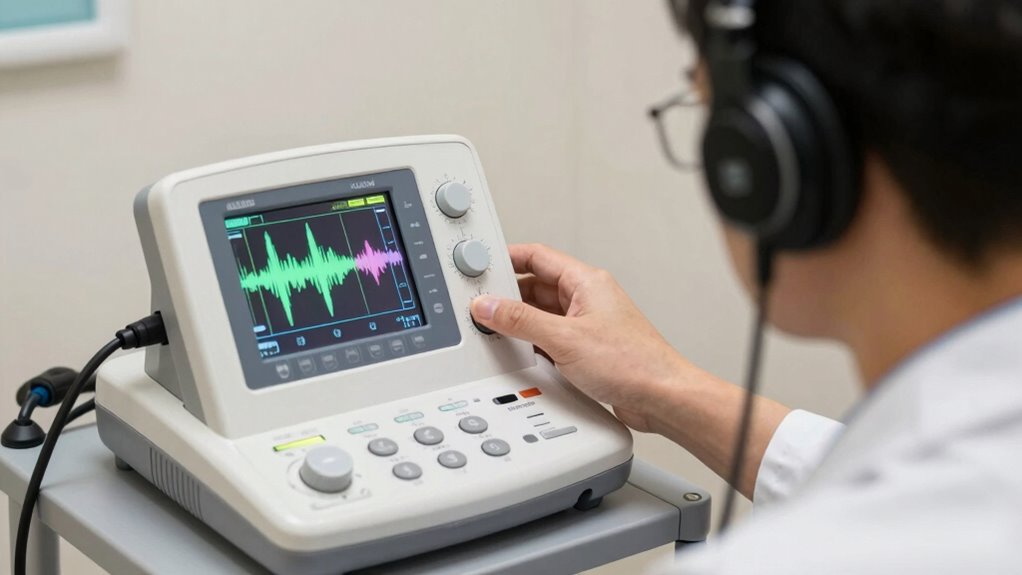
Audiologists use speech recognition tests to evaluate how well you understand words at different volume levels and in noisy environments. These tests reveal how auditory processing issues might impact your daily communication, even if your basic hearing sensitivity seems normal. For instance, someone might hear pure tones clearly but struggle to distinguish speech amidst background noise. This indicates that their auditory processing skills need targeted support, and audiologists can tailor hearing aid technology to better accommodate these challenges. Auditory processing skills are crucial in understanding how effectively the brain interprets complex sounds. Additionally, audiologists may incorporate neuroplasticity principles into their training approaches to help improve auditory perception over time.
Furthermore, audiologists perform auditory processing assessments that measure how your brain interprets complex sounds. These tests often involve tasks like distinguishing similar sounds, recognizing patterns, or understanding speech amid competing noise. Such evaluations are essential because they uncover difficulties that standard pure-tone tests might miss. Once these issues are identified, audiologists can recommend specific hearing aids with advanced features like directional microphones or noise reduction algorithms, which are designed to improve speech understanding in challenging environments. Modern hearing technology plays a significant role in addressing these complex auditory processing challenges. Recognizing the importance of comprehensive assessments, audiologists are increasingly incorporating neurological factors into their evaluations to better customize treatment plans.
In short, audiologists measure hearing beyond pure tones by examining your auditory processing and speech recognition skills. This detailed assessment guarantees that your hearing solutions are personalized and effective. It’s not just about amplifying sound; it’s about enhancing how you interpret and make sense of auditory information. As hearing aid technology continues to evolve, the role of audiologists becomes even more indispensable—they serve as your guide in choosing and fine-tuning devices that address your unique hearing profile. By understanding both the physical and neurological aspects of hearing, they help you regain clarity and confidence in your daily interactions, making sure that your hearing health is managed thoroughly and precisely.
As an affiliate, we earn on qualifying purchases.
Frequently Asked Questions
How Do Audiologists Test for Speech Understanding in Noisy Environments?
You’re tested for speech understanding in noisy environments through speech masking and noise adaptation tests. During these assessments, audiologists present speech signals with background noise at different levels to see how well you can understand. They analyze how your hearing adapts to noise, identifying challenges in noisy settings. These tests help determine your ability to differentiate speech from background sounds, guiding tailored solutions like hearing aids or auditory training.
What Role Do Middle Ear Tests Play in Hearing Assessments?
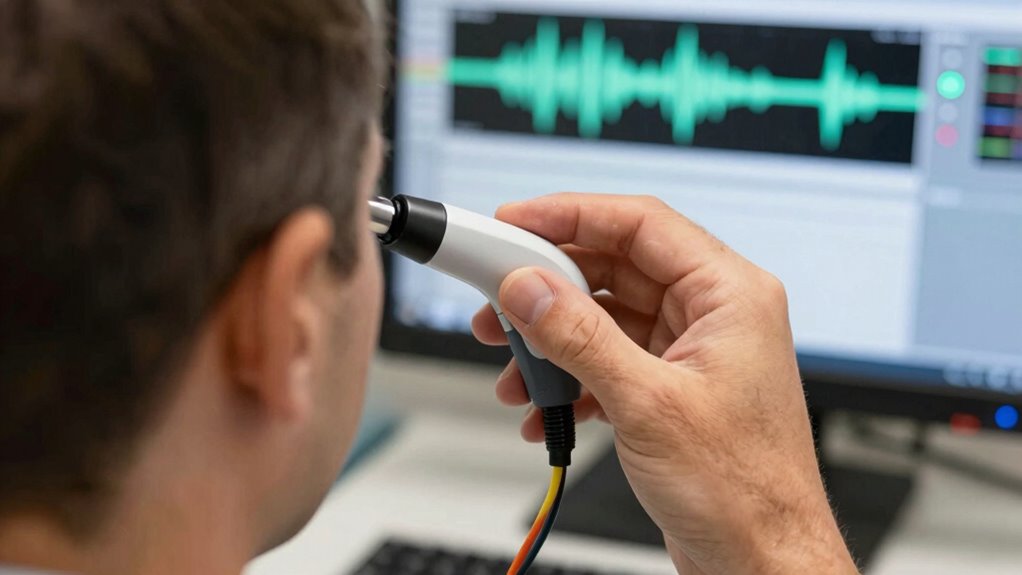
Middle ear tests, like tympanometry testing, play an essential role in your hearing assessment by evaluating how well your middle ear functions. During tympanometry, you’ll have a probe placed in your ear to measure ear drum movement and middle ear pressure. This helps audiologists identify issues such as fluid buildup, ear infections, or eardrum problems, ensuring an accurate diagnosis and appropriate treatment plan for your hearing health.
Can Audiologists Detect Hidden Hearing Loss During Evaluation?
Yes, audiologists can detect hidden hearing loss during evaluations by evaluating cochlear health and identifying hidden damage not revealed by standard tests. They use specialized assessments like speech-in-noise tests and auditory brainstem responses to uncover issues affecting how your brain processes sound. These tests help reveal damage to delicate inner ear structures that may not impact pure-tone thresholds but still cause hearing difficulties, especially in noisy environments.
How Do Bone Conduction Tests Differ From Air Conduction Tests?
Bone conduction tests bypass your outer and middle ear, directly stimulating your auditory pathways via vibrations on your skull. This method differs from air conduction tests, which send sound through your ear canal. Bone conduction helps audiologists determine if hearing loss stems from issues in your auditory pathways or if it’s caused by problems in your outer or middle ear. This distinction guides appropriate treatment options for your hearing health.
What New Technologies Are Being Used to Measure Hearing?
You’ll find new hearing measurement technologies like otoacoustic emissions testing, which detect tiny echoes from your inner ear, offering detailed insights into your hearing health. Additionally, hearing aid compatibility has improved, allowing devices to seamlessly connect with smartphones and other tech. These advancements enable audiologists to assess your hearing more precisely, leading to more tailored solutions and better overall hearing care.
Conclusion
Think of your hearing as a vast, vibrant landscape. Audiologists are the explorers, mapping out every sound with precision beyond simple tones. They use a variety of tools, like a compass and flashlight, illuminating hidden corners of your auditory world. By understanding this intricate terrain, they help you navigate life’s symphony with clarity and confidence. So, when you listen, remember—you’re benefiting from a skilled guide charting your unique soundscape.
Halloween Picks
halloween
As an affiliate, we earn on qualifying purchases.