
TL;DR

Get everyday helpers delivered free with Prime
- Fast, free delivery on millions of items
- Prime Video, Amazon Music and more included
- Member-only deals all year
A KFF Health News analysis of flood hazard data from Fathom identified 100 U.S. nursing homes where a 100-year flood could bring at least 2 feet of water to the buildings. New Richland Care Center in Minnesota, which flooded in September and had to evacuate 36 residents, shows the disruption such flooding can cause. The analysis does not establish that all 100 facilities will flood or say when any might do so.
A KFF Health News analysis identified 100 U.S. nursing homes where a modeled 100-year flood could bring at least 2 feet of water to the buildings, a risk illustrated when a Minnesota care center evacuated 36 residents during September flooding. The findings draw on flood hazard maps provided by Fathom, and point to the difficulty of protecting residents who may need continuous care and face health risks from relocation.
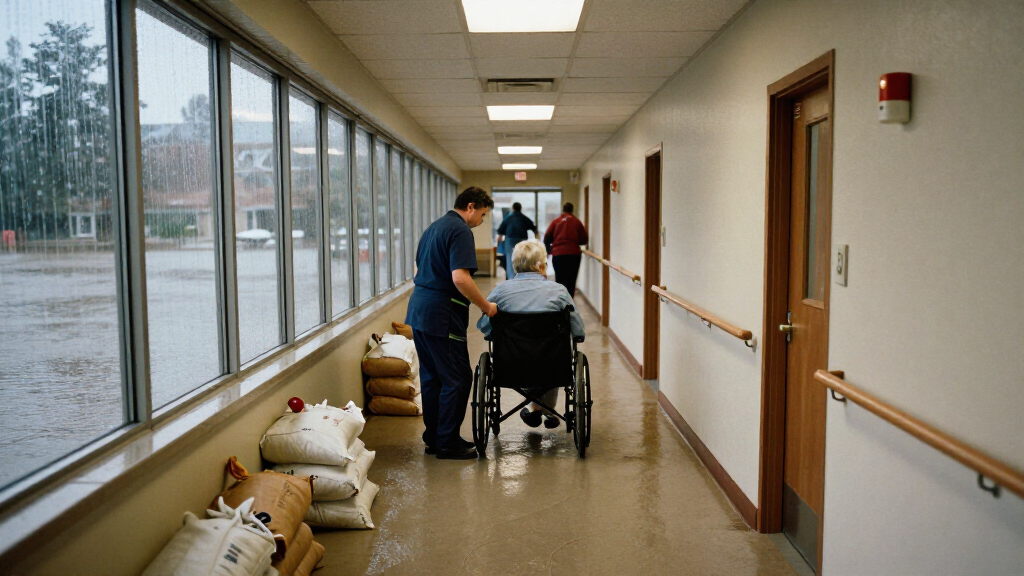
At New Richland Care Center in southern Minnesota, water entered through the front door before sunrise on Sept. 19. Staff moved 36 residents out as water rose inside. Administrator Robert Johannsen told KFF Health News that residents in wheelchairs were pushed through about 4 inches of water to buses. The last three residents were taken out on hospital beds, which firefighters and volunteers pushed across the street, he said. The building later had at least 2½ feet of water in its hallways and was shuttered.
The center sits about 100 yards from a drainage ditch and had flooded three times in 16 years, according to the report. The National Weather Service described the September storm as large but far from historic. The incident shows that a facility can face a serious evacuation and closure even without a storm described as historically extreme.
For each of the 100 facilities in the analysis, Fathom’s data predicted that a 100-year flood event could put at least 2 feet of water at the building. A 100-year flood has a 1% chance in any given year; the label does not mean such a flood occurs only once in a century. The analysis uses peer-reviewed flood hazard mapping. KFF Health News says this mapping is generally more modern than FEMA flood maps, which can be out of date and do not account for a changing climate.
Flooding Can Disrupt Resident Care
Flood risk at a nursing home carries consequences beyond damage to the building. The U.S. has nearly 15,000 nursing homes housing more than 1.2 million people, according to the report. Residents may be medically frail, cognitively impaired or unable to move without help. Some depend on daily care that may be hard to provide during a disaster, while moving them can also place them under physical strain.
That creates a difficult choice when water threatens a facility: staying may expose residents to floodwater and interrupted care, while evacuation can itself carry health risks. In a 2011 peer-reviewed study co-written by David Dosa, researchers recorded more than 270 nursing home evacuations ahead of three Gulf hurricanes. The affected regions saw a cumulative 277 more resident deaths than expected in the 30 days after the storms. The study reported an association with evacuation; it does not establish that evacuation alone caused those deaths.
A separate 2024 study found a 16% greater chance of emergency room visits among residents of Florida assisted living facilities evacuated before Hurricane Irma in 2017. Assisted living residents generally need less care than nursing home residents, so the result cannot be treated as a direct estimate for nursing homes. It does, however, add evidence that relocation can affect older adults who need support.
How the Flood Risk Was Mapped
The KFF Health News analysis builds on a 2025 investigation that used Fathom mapping to identify at least 170 U.S. hospitals at risk of significant flooding. The nursing home report applies flood modeling to facilities whose residents may need help evacuating and ongoing medical support.
Fathom’s analysis estimates exposure under a modeled severe flood scenario. It does not give a date for a future flood at any named facility, and the supplied report does not say that all 100 sites have flooded. The model’s threshold—at least 2 feet of water—describes predicted water depth in the specified event, not a routine forecast.
Facility locations and their surroundings can shape exposure. The report says many nursing homes were built near coastlines or waterways in the 1970s, when proximity to water was seen as comfortable for residents. Geriatrician David Dosa told KFF Health News that those locations can now leave facilities more exposed. The source also notes that flooding can happen where rain falls, including places that may not be seen as obvious flood zones.
““There was at least 2½ feet of water flowing down the hallways.””
— Robert Johannsen, administrator of New Richland Care Center
What the Model Cannot Predict
The analysis identifies modeled exposure, not a schedule of future floods. It does not establish that any of the 100 facilities will experience a flood, how often a particular building might flood, or whether a given storm would produce the modeled depth. The supplied report excerpt also does not name all 100 facilities or provide facility-by-facility estimates beyond the threshold.
It remains unclear from the available material what protective measures each facility has, how evacuation plans differ across the listed homes, or whether the analysis prompted changes to those plans. New Richland’s repeated flooding is a documented local history, but it cannot be assumed to apply to the other homes. Flood maps and models also describe hazards; they do not by themselves show how well a facility can respond when water rises.
The report cites climate scientists who say warming contributes to heavier rainfall and rising seas, and that storms are affecting regions once considered lower risk. Those statements provide broader context for the analysis, but do not identify the cause of the Minnesota storm or establish when any specific nursing home will face flooding.
Facility Plans and Flood Preparedness
The immediate next steps for readers and communities are not specified in the supplied report. The analysis makes the 100 facilities a focus for questions about local flood exposure, emergency plans, resident transportation and continuity of care. Any response would need to account for the risks of both remaining in a threatened building and moving residents who may be medically fragile.
For New Richland Care Center, the report says the facility was shuttered after the flood; it does not state when it would reopen or what longer-term arrangements were made for its residents. For the other homes, the source material gives no announced deadlines, policy changes or scheduled actions. Further details about facility-specific plans and any steps taken after publication remain to be reported.
Key Questions
What did the analysis find?
KFF Health News identified 100 U.S. nursing homes where Fathom’s flood data predicts at least 2 feet of water at the buildings in a modeled 100-year flood event.
Does a 100-year flood happen only once every century?
No. It describes a flood event with a 1% chance in any given year. Such an event can happen more than once within a century.
What happened at the Minnesota nursing home?
New Richland Care Center evacuated 36 residents on Sept. 19 after water entered the building. Administrator Robert Johannsen said water later reached at least 2½ feet in the hallways, and the facility was shuttered.
Does the report say all 100 homes will flood?
No. The analysis estimates exposure under a modeled flood scenario. It does not establish that every listed facility will flood or when a flood might occur.
Source: rss
Halloween Picks
halloween
As an affiliate, we earn on qualifying purchases.