
TL;DR

Get everyday helpers delivered free with Prime
- Fast, free delivery on millions of items
- Prime Video, Amazon Music and more included
- Member-only deals all year
Moving your AI rig into a closet or separate room offers the biggest noise reduction. Proper ventilation and strategic placement of acoustic treatment prevent heat build-up and echo, making closet setups surprisingly effective without sounding boxy or boomy.
Ever wondered if a closet could be your secret weapon for quiet, powerful AI workstations? The answer is yes — with the right approach. Most people think soundproofing is about foam panels or thick walls, but the real game-changer is where you place your rig and how you manage heat and noise. You can learn more about acoustic dampening and placement strategies.
In this guide, you’ll learn the smartest tricks to make your closet setup both silent and cool. From understanding the difference between dampening and soundproofing to positioning your hardware for maximum effect, you’ll get practical advice that actually works — backed by real-world examples.
Acoustic dampening
& the rig in the closet.
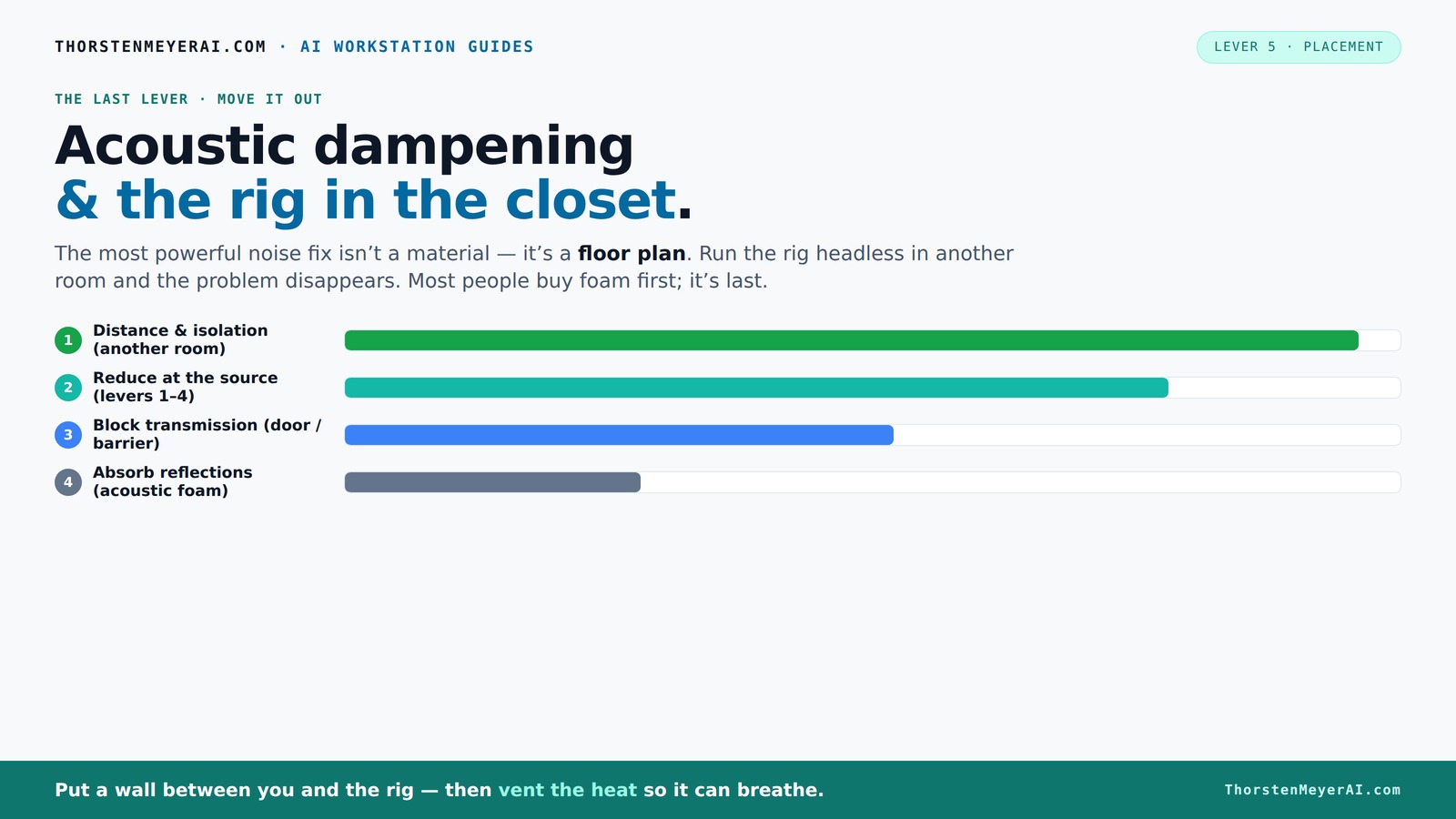
The most powerful noise fix isn’t a material — it’s a floor plan. A rig you can’t hear because it’s in another room beats any amount of foam. Tap the approaches in Part 1 to see what actually works.
(another room)
(levers 1–4)
(door / barrier)
(acoustic foam)
Contain the noise, not the heat
Key Takeaways
- Moving your rig into another room is the most effective noise reduction method by eliminating sound transmission altogether.
- Proper ventilation is critical in closet setups; without airflow, heat builds up rapidly, causing noise and performance issues.
- Strategic placement of acoustic treatment—especially at reflection points—improves sound quality dramatically inside small spaces.
- Sealing gaps and adding mass with drywall or damping compounds greatly enhances sound isolation.
- Choosing between condenser and dynamic mics depends on how well your closet is treated; dynamics are more forgiving for untreated spaces.
As an affiliate, we earn on qualifying purchases.
Why Moving Your Rig Is the Single Biggest Noise Hack
Placing your noisy AI rig in another room — a closet, basement, or spare space — is the fastest way to cut noise. It’s like turning the volume all the way down without touching a dial. You SSH into the machine, and it’s whisper-quiet in your workspace.
Imagine your GPU tower roaring at 80 dB on your desk. Now picture it tucked away in a closet with a wired connection and proper ventilation. The sound pressure drops dramatically, making your workspace peaceful. This approach replaces all the fancy treatment with a simple, practical move. For additional tips, see acoustic treatment placement advice.
For AI work, this is perfect. The machine doing the heavy lifting doesn’t need to be right next to you. Your laptop or workstation can stay silent, while the rig lives somewhere else, far away from your ears.
How to Safely Put a Hot, Noisy Rig in a Closet Without Meltdown
Placing a high-powered rig in a closet sounds ideal but comes with a heat trap risk. Without proper airflow, the temperature skyrockets, fans scream, and performance stalls. The key is to give your rig plenty of breathing room. Learn more about proper acoustic and ventilation setup.
Here’s how to do it right:
- Install passive vents or ducted airflow to let heat escape. This prevents heat from building up and ensures your components stay within safe operating temperatures, which is critical for longevity and stability.
- Use a quiet exhaust fan that’s thermostatically controlled. This allows the system to automatically increase airflow during intensive tasks, balancing noise levels with cooling needs.
- Consider a purpose-built soundproof cabinet with built-in cooling — they’re designed to dissipate heat without noise. These units often include insulated panels and active cooling solutions that minimize both sound and heat buildup.
- Keep ambient temperature in check; a room warmer than 80°F can cause throttling. Ensuring the room itself is cool helps your cooling solutions work more efficiently and reduces the risk of overheating.
For more advanced cooling, liquid cooling solutions with heat export radiators outside the closet can keep temperatures down while suppressing noise. Learn more about cooling options at liquid vs. air cooling.
The Best Places to Position Acoustic Treatment Inside a Closet
Acoustic dampening in a closet isn’t just about slapping foam everywhere. It’s about strategic placement that tackles reflections and low-end buildup. The goal: make the space sound natural and prevent echo that makes recordings or inference noisy and boomy.
Start by identifying the key reflection points:
- Side walls — especially around your mic and monitor.
- Behind the microphone — to reduce flutter echoes.
- Ceiling above your speaking or recording position.
Use thicker panels (around 2 inches) for bass control and softer, thinner foam for early reflection points. In small spaces, placing absorption on the side walls and ceiling makes a big difference. For low frequencies, add bass traps at corners where sound waves tend to accumulate.
Proper placement of acoustic materials is crucial because it directly influences how sound waves behave inside the space. Poor placement can lead to uneven sound absorption, resulting in residual echoes or bass muddiness that compromises audio clarity. You can find detailed guidance on strategic acoustic placement.
Blocking Sound Leaks: Doors, Gaps, and Structural Tricks
Sound leaks through cracks, gaps, and poorly sealed doors — that’s where noise sneaks out and into your space. Basic foam panels won’t stop this. You need to focus on sealing the whole enclosure.
Here’s what works:
- Weatherstripping around the door frame — inexpensive and effective. Proper weatherstripping creates a tight seal that prevents sound from escaping through small gaps, significantly reducing noise transmission.
- Adding mass with an extra drywall layer or damping compounds like Green Glue. Increasing the mass of the enclosure makes it harder for sound waves to pass through, effectively improving isolation.
- Seal cracks with acoustic caulk or sealant. This prevents sound from leaking through tiny openings that are often overlooked. For structural soundproofing tips, see soundproofing structural tricks.
- Use a solid core door or add a door sweep to block sound from escaping underneath. Ensuring the door itself is soundproofed is vital, as gaps around it are common leak points.
In some cases, the best option is a custom-built soundproof box with controlled ventilation. For example, a closet lined with insulation and mass, combined with a sealed door, can cut noise transmission by over 90% [1]. Understanding these structural tricks allows you to make informed choices that significantly enhance sound isolation, making your setup much quieter for both recording and inference tasks. Visit spectralore.com for more guides on acoustic and lighting optimization.
Bass Traps and Controlling Low-End Buildup in Small Closets
Low frequencies are the sneakiest. They travel through walls, floors, and ceilings, creating boomy, muddy sounds. In a closet, parallel walls and small volume make bass buildup worse.
To tame this:
- Install bass traps in corners where low-end energy concentrates. Proper placement in corners is essential because low frequencies tend to accumulate there, causing muddiness and reduced clarity.
- Use thicker, dense absorption panels (3 inches or more) for bass treatment. Thicker panels provide the density needed to absorb low-frequency energy without just reflecting it back into the space.
- Consider adding a membrane bass trap if low-frequency issues persist. These specialized traps use a membrane to vibrate and absorb bass energy more effectively, especially in confined spaces.
Proper bass treatment ensures your recordings or inferences aren’t just clear on the high end but also tight and punchy at the low end. Without addressing low-frequency buildup, recordings can sound hollow or boomy, undermining clarity. Implementing these strategies strikes a balance, ensuring a flat frequency response and professional sound quality. For detailed bass management, check this guide.
Choosing the Right Microphone for a Closet Setup: Condenser or Dynamic?
In small, untreated spaces, your microphone choice makes a big difference. Condenser mics pick up more room sound and reflections, making them less forgiving. Dynamic mics tend to reject background noise better.
If your closet isn’t perfectly treated, a dynamic mic (like the Shure SM7B) can help keep noise out. Condensers are better if you can tame the space with treatment, but they’ll pick up more room echo if untreated.
For voiceover work or vocals in a closet, many pros prefer dynamics for their rejection of ambient noise. For clean, studio-quality recordings, a condenser with proper treatment works well.
Choosing the right microphone involves understanding how your space interacts with the mic’s pickup pattern and sensitivity. Dynamics are inherently less sensitive to room acoustics because they have narrower pickup patterns and lower sensitivity, making them more forgiving in untreated or semi-treated environments. Condensers, while capable of capturing more detail, require a well-controlled environment to avoid picking up unwanted room reflections and noise. Therefore, your choice should consider both your treatment level and the type of recording you aim to achieve, balancing clarity with noise rejection.
Avoiding Common Mistakes When Using a Closet as a Voice or AI Rig
Many beginners overdo the treatment or seal off the space completely, causing deadness or heat issues. Others forget airflow, leading to noisy fans or overheating. The biggest mistake? Not treating reflection points or sealing gaps properly.
Be sure to:
- Focus treatment on reflection points, not every surface. Over-treating can deaden the sound unnaturally and reduce overall clarity, so target critical reflection points for a balanced acoustic environment.
- Seal gaps around the door but leave ventilation open. Proper sealing prevents noise leaks, but adequate ventilation is essential to prevent heat buildup and ensure cooling.
- Use soft materials like rugs or blankets on hard surfaces, but don’t block airflow. Soft materials absorb reflections but can also restrict airflow if improperly placed, so strategic placement is key.
- Monitor temperatures regularly to avoid thermal throttling. Overheating not only damages hardware but can also cause performance drops and increased fan noise.
Remember, a balanced approach — combining strategic treatment, sealing, and ventilation — gives the best results without turning your closet into a dead, overheated box. Recognizing the trade-offs between acoustic treatment and thermal management ensures your setup remains both quiet and functional.
Frequently Asked Questions
Can I really record vocals or run inference in a closet without it sounding bad?
Yes, if you treat reflection points and control low-end buildup, your closet can produce professional-quality sound. Proper acoustic treatment and mic choice are key to avoiding echo and muddiness.What’s the difference between acoustic dampening, treatment, and soundproofing?
Dampening reduces reflections inside a space, treatment controls internal echoes, and soundproofing blocks sound from entering or escaping. They work together but serve different purposes.Where should I place panels inside my closet?
Focus on first reflection points — the side walls, ceiling above your mic, and behind you. Use the mirror trick: position a mirror so you see your reflection of the speaker or mic, then place panels there.Should I add bass traps in my small closet?
Absolutely. Bass traps in corners eliminate low-end buildup that causes boomy sound. Use thicker, dense panels for best low-frequency control.What’s the best way to seal sound leaks around the door?
Use weatherstripping, acoustic door seals, and a door sweep. Combining these creates a tight seal that prevents sound from leaking out or in.Conclusion
Transforming a closet into a quiet, effective AI or voice setup hinges on smart placement, sealing leaks, and managing heat. It’s not about muffling the noise — it’s about controlling where it goes and how it behaves.
Think of your closet as a carefully crafted environment, not just a box to hide your gear in. With the right balance, you get a professional-quality workspace that’s silent, cool, and efficient. Your next step? Treat the reflection points, seal the leaks, and give your rig the airflow it needs. Happy quieting!
COLUMBUS DAY / I Columbus Day / Indigenous Peoples' Day Picks
long weekend saleslong weekend sales
As an affiliate, we earn on qualifying purchases.