TL;DR

Get everyday helpers delivered free — and shop member deals
- Fast, free delivery on millions of items
- Access to Prime Big Deal Days deals on October 6–7
- Prime Video, Amazon Music and more included
Hearing aid batteries come in four color-coded zinc-air sizes (yellow 10, brown 312, orange 13, blue 675) lasting 3–14 days, plus rechargeable lithium-ion options that run 16–24 hours per charge. The sticker tab keeps air out — once removed, the battery activates and drains whether you use it or not, so never peel it early. Bluetooth streaming, humidity, and opened tabs are the top reasons batteries die faster than expected.
Your hearing aid dies in the middle of a dinner party. You dig through your pocket for a spare battery, peel the sticker, and jam it in — only to hear the low-battery beep again twenty minutes later. If this has happened to you, you probably skipped one small step that battery makers don’t explain loudly enough: waiting a minute after removing the tab.
Hearing aid batteries look interchangeable, but they’re not. There are four disposable sizes, a color-code system that saves you from memorizing numbers, and a fast-growing rechargeable option that has quietly become the default in premium hearing aids from Phonak, Oticon, ReSound, and others.
This guide covers the types of hearing aid batteries, how long each actually lasts, why yours keep dying early, and how to stop wasting money on them.
Match batteries by tab color: yellow = size 10, brown = 312 (most common), orange = 13, blue = 675 — bigger means longer life (3–14 days).
Never peel the sticker tab early: zinc-air batteries activate on contact with air and drain whether used or not. Wait one minute after peeling before inserting.
Bluetooth streaming is the #1 hidden battery killer — expect several hours less daily life if you stream calls or audio through your aids.
Open the battery door overnight and use a dehumidifier; skip the refrigerator myth entirely.
Rechargeable lithium-ion aids run 16–24 hours per charge and the battery lasts 4–5 years, but replacement ($70–150) usually requires the manufacturer or provid…
The Color-Coded System That Tells You Exactly Which Battery to Buy
Hearing aid batteries use a simple color code: every disposable battery has a colored sticker tab that matches its size, so you never have to memorize numbers. Yellow means size 10, brown means 312, orange means 13, and blue means 675. Match the color on your old battery’s tab to the color on the package, and you’re done.
The reason this system exists is practical: the batteries themselves are tiny and the size numbers are printed in microscopic type — nearly impossible to read with aging eyes or without magnification. A grandmother shopping for her first pair of aids doesn’t need to squint at ‘PR-312’ on a disc the size of an aspirin; she just needs to remember ‘brown.’ Manufacturers standardized the colors decades ago precisely because mixing up sizes is the most common first-time buyer mistake — and a size 10 simply won’t make contact in a compartment designed for a 675, so there’s no damage risk, just frustration at the pharmacy counter.
If you don’t have the old tab handy, check inside your hearing aid’s battery door — most manufacturers print the size right there. Your user manual works too, or a quick call to your audiologist.
Here’s the full lineup:
| Tab Color | Size | Typical Life | Best For |
|---|---|---|---|
| Yellow | 10 | 3–5 days | Smallest, nearly invisible aids (CIC styles) |
| Brown | 312 | 5–7 days | The most common size; thin behind-the-ear aids |
| Orange | 13 | 6–10 days | Larger behind-the-ear and in-the-ear aids |
| Blue | 675 | 9–14 days | High-power aids for severe hearing loss |
The pattern is intuitive: bigger battery, longer life. Size 10 batteries are about the size of a peppercorn and burn out fast; a chunky blue 675 can run nearly two weeks. This is a real tradeoff worth understanding when you’re choosing hearing aids. If cosmetics matter most to you and you choose a completely-in-canal style that takes yellow size 10 batteries, you’re signing up for a battery swap every three to five days — and about $100–150 a year in disposables. Someone with a larger behind-the-ear aid on blue 675s replaces batteries half as often. Over five years, that difference adds up to hundreds of dollars and dozens of pharmacy trips, which is exactly why many audiologists now steer dexterity-challenged patients away from the smallest styles: fumbling a peppercorn-sized battery into a tiny slot every four days is genuinely hard for arthritic fingers, while a 675 is much easier to handle.
Why There’s a Sticker on Your Battery (and Why Peeling It Early Costs You Money)
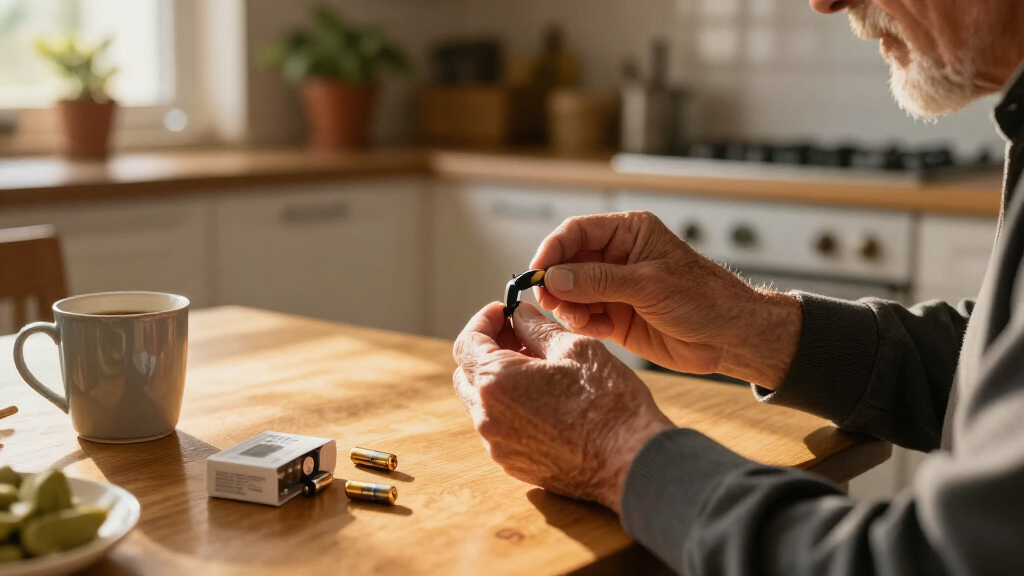
That sticker isn’t packaging — it’s the battery’s life support. Disposable hearing aid batteries are powered by oxidizing zinc with air. The tab seals tiny air holes in the battery, and only when air enters does the chemical reaction begin. Once you peel it, the battery is awake and draining, whether it’s in your ear or sitting in a junk drawer.
The best analogy: think of a zinc-air battery as a candle. The sticker is the wrapping around an unlit wick — it can sit in a drawer for years, inert. Peel the tab, and you’ve struck the match. A candle burns whether or not you’re reading by it, and a zinc-air battery drains whether or not it’s amplifying sound. There’s no off switch once air gets in, which is a fundamentally different mental model than the AA batteries in your TV remote, and it’s why habits that work fine elsewhere cost you money here.
Consider a concrete example: a well-meaning grandson peels the tabs off six spare batteries on Sunday so his grandfather won’t struggle with them later in the week. Those six batteries begin draining immediately. By Thursday, the last few may have lost most of their charge before ever touching a hearing aid — that’s $6–12 literally evaporated, and grandfather still needs fresh ones. The same trap catches people who pre-peel a spare and keep it in their wallet ‘just in case.’
This is why storage discipline matters so much:
- Never peel the tab until you’re ready to use the battery — an activated battery dies within two weeks regardless of use
- Intact-tab batteries have a shelf life of 3–4 years, so buying a reasonable stockpile is fine
- After peeling, let the battery sit for about one minute before inserting it — this lets air fully penetrate the cell and improves both performance and lifespan
- Check the expiration date on the package; old stock is a common reason for disappointing battery life
Think of the tab as a pause button on the battery’s life. Peel it, and the countdown starts — used or not.
That one-minute wait feels trivial, but it’s one of the highest-impact habits in hearing aid care. Why? If you insert the battery before air fully saturates the cell, the hearing aid draws power from a half-activated battery, forcing a weak start that can permanently reduce its total output — like flooring the accelerator on a cold engine. Batteries activated with enough air time consistently deliver closer to their rated lifespan.
Why Your Batteries Keep Dying Early: 5 Real Culprits
The most common reason hearing aid batteries die quickly is Bluetooth streaming, which can shave several hours off a battery’s daily life. If you take phone calls or stream music through your hearing aids, expect noticeably shorter battery life than the box promises.
Here’s why: the tiny radio chips doing Bluetooth work can draw more power than the amplification itself. Picture it this way — your hearing aid’s main job is like whispering to you across the room, but streaming music means also running a small walkie-talkie back and forth to your phone all day. The advertised ‘7 days per battery’ on the 312 box assumes you’re wearing the aid 12–16 hours a day with no streaming; a retiree who streams podcasts for four hours daily might only see 4–5 days. That gap between the label and reality is the single most common complaint audiologists hear about batteries — and it’s almost always streaming.
Here are the five biggest battery drains, roughly in order:
- Streaming and telecoil use — the radio chips doing Bluetooth work are power-hungry
- Severe hearing loss — more amplification requires more current, which is why high-power aids use bigger batteries
- Humidity and heat — hot, muggy climates can shorten battery life; cold temporarily weakens zinc-air cells too
- Long daily wear — 16-hour days simply consume more than 8-hour days
- Batteries that were activated too early or are old stock — degraded before you ever used them
One more overlooked cause: if your aid cuts out intermittently, the problem may not be the battery at all. Wipe the battery contacts clean with a dry cloth first — corrosion and debris on the contacts mimic a dying battery perfectly. A retiree in Florida who assumed she needed new aids discovered the real culprit was simply sweat-and-humidity corrosion on the contacts; a weekly wipe restored her battery life overnight. Diagnose the cheap problem before buying the expensive solution.
Rechargeable vs. Disposable: Which One Actually Saves You Money?
Rechargeable lithium-ion batteries are now the default in most premium hearing aids, offering 16–24 hours per charge with a roughly 3-hour overnight recharge. They last about 4–5 years before needing replacement, which is typically done by the manufacturer or your hearing care provider.
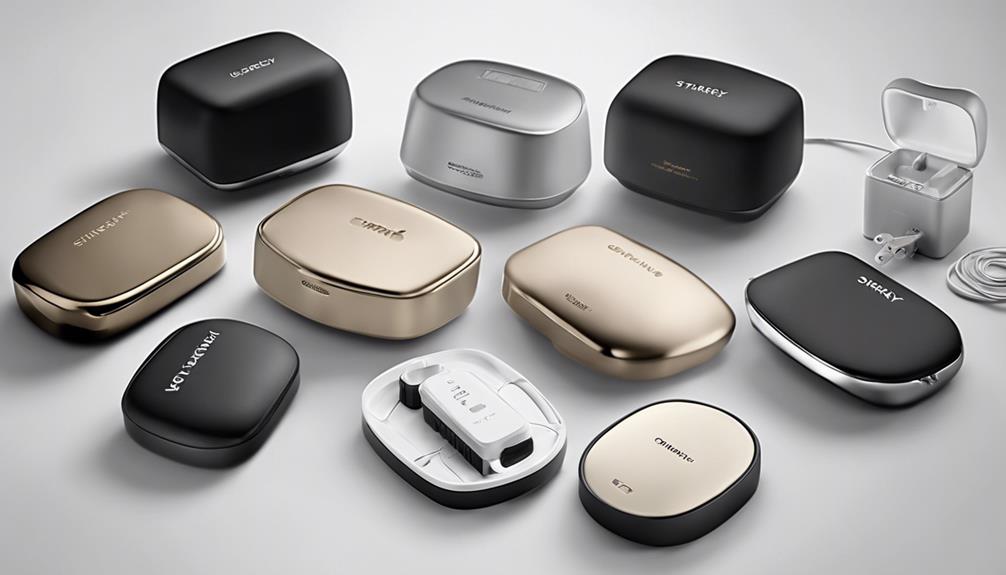
Disposable zinc-air batteries cost roughly $1–2 each, or $50–150 per year depending on your size and usage. Rechargeables are bundled into the device’s price, so the math depends on how long you keep your aids.
To make the tradeoff concrete: consider two 65-year-olds buying aids they’ll keep for five years. The first picks a rechargeable Phonak model — after the upfront device cost, battery spending is $0, plus maybe $100–150 per side in year four or five when the lithium-ion cells fade. The second picks a comparable disposable-battery model and streams music daily: at $1.50 per battery replaced every four days, that’s roughly $1,350 over five years — plus the hassle of ordering, carrying spares, and mid-meeting swaps. Run the same math for someone who wears aids only a few hours a day on size 13 batteries, and the disposable total drops to around $300 — the gap narrows considerably. The point: streaming-heavy, all-day wearers benefit most from rechargeables; light users have less financial reason to care.
| Factor | Rechargeable (Li-ion) | Disposable (Zinc-Air) |
|---|---|---|
| Daily life | 16–24 hours per charge | 3–14 days per battery |
| Annual cost | Included in device price | ~$50–150 |
| Battery lifespan | 4–5 years, then ~$70–150 replacement | Ongoing purchases |
| Convenience | Drop in charger overnight | Carry spares, swap on the go |
| Flexibility | Tied to specific charger | Buy anywhere, works in any compatible aid |
The tradeoff: heavy streamers may find a rechargeable running low by evening, while disposable users just pop in a fresh cell. This is the rechargeable’s Achilles’ heel — imagine a wedding day: aids on at 9 a.m., streaming and conversation until midnight. A rechargeable that reliably does 18 hours may not make it to the last dance, and unlike a disposable, you can’t fix that mid-event with a coin-sized swap. Frequent long-day travelers face the same issue: forget your proprietary charging case at home, and your aids may be dead by day two, whereas disposables can be bought at nearly any pharmacy in the world.
There are also silver-zinc rechargeable batteries (like ZPower) that can be retrofitted into some existing hearing aids — worth asking your audiologist about if you love your current devices but hate buying batteries.
Since over-the-counter hearing aids became available in the U.S. in October 2022, demand for standard disposable sizes has grown, since many OTC devices run on replaceable zinc-air cells. That matters for the market: disposables aren’t a dying technology, so budget buyers can count on yellow, brown, orange, and blue tabs staying on shelves for years to come.
Simple Habits That Stretch Every Battery Further
The single easiest way to extend battery life is to open the battery door at night. This switches the hearing aid off completely and lets moisture evaporate — humidity trapped inside the battery compartment quietly eats battery life and corrodes contacts.
Think of the battery compartment as a tiny humid terrarium if you close it at night: a full day of body heat and perspiration has left warm, moist air sealed inside with the battery, and that moisture accelerates corrosion on the contacts and degrades the cell. Cracking the door turns the terrarium back into a dry room. Users who adopt this one habit often report gaining a day or more of life per battery — which, multiplied across a year, is roughly 20–30 fewer batteries purchased.
Here’s a practical routine, framed as an evening ritual that takes under a minute:
- Open the battery door every night when you remove your aids — same place, same time, so it becomes automatic (beside where you set your phone down is a good anchor)
- Store the aids in a dehumidifier or drying jar overnight — it protects both battery and electronics. A basic dry-storage kit costs $10–30 and pays for itself within months
- Keep spare batteries at room temperature in a dry place — never the refrigerator, a persistent myth. Fridge logic made sense for old mercury batteries, but zinc-air cells are different: moving a cold battery into warm air causes condensation to form on it — essentially giving it a tiny shower — which blocks the air holes it needs to function
- Buy in moderate quantities so you’re not sitting on expired stock — a good rule of thumb is no more than a six-month supply
- Recycle used batteries at pharmacies, audiologist offices, or municipal drop-off programs — button batteries shouldn’t go in household trash
Cost tip: multi-packs and battery subscriptions from reputable sellers beat drugstore prices — a 60-pack of 312s online often costs half the per-battery price of a drugstore 8-pack. But be cautious with suspiciously cheap online batteries — counterfeit and expired batteries are a documented problem, and a bargain pack that dies in two days is no bargain. Example: an online ‘deal’ at 40 cents per battery looks unbeatable until each one lasts two days instead of six — you’ve actually paid more per day of hearing than the name-brand pack you skipped.
The Safety Warning Every Household With Kids or Pets Needs to Hear
Button batteries are a serious swallowing hazard for children and pets. If swallowed, a button battery can cause severe chemical burns to the esophagus within hours — this is a medical emergency, not a wait-and-see situation. Seek immediate medical care if you suspect a swallowing.
To understand why something so small is so dangerous: when a button battery gets lodged in the moist tissue of the esophagus, the battery’s current runs through the surrounding fluid and generates hydroxide — essentially creating a chemical burn from the inside, like a tiny caustic lye factory switched on against the tissue wall. Serious burns can occur in as little as two hours, which is why a swallowed button battery is treated with the same urgency as a poison ingestion. Children under four are at highest risk because these shiny, coin-like discs look exactly like something fun to put in your mouth; dogs face the same risk from batteries dropped on the floor.
The risk is significant enough that it changed U.S. law. Reese’s Law, passed in 2022 — named after Reese Hamsmith, a toddler who died after a button battery from a remote control burned through her esophagus — requires child-resistant packaging for button cell batteries and warnings on products containing them.
Practical steps:
- Store batteries in a locked drawer or child-resistant case, not loose in a purse or nightstand — the case your batteries ship in already complies with Reese’s Law child-resistant standards, so keep using it rather than decanting them into a pill organizer
- Dispose of used batteries immediately at a recycling point — dead batteries can still hold enough charge to injure
- Keep hearing aids themselves out of toddlers’ reach; the battery door is a tempting little door to tiny fingers
If you travel: batteries are fine on planes. Keep spare lithium batteries in your carry-on bag, not checked luggage, per airline rules — the reasoning is that a fire in the cabin can be caught and extinguished by crew, while one in the cargo hold cannot.
Frequently Asked Questions
How long do hearing aid batteries last?
Disposable zinc-air batteries last 3–14 days depending on size: size 10 (yellow) runs 3–5 days, 312 (brown) 5–7 days, 13 (orange) 6–10 days, and 675 (blue) 9–14 days. Rechargeable lithium-ion batteries last 16–24 hours per charge and about 4–5 years total before needing replacement. Streaming, humidity, and hours of daily use all shift these numbers.
Why do my hearing aid batteries die so fast?
The most common cause is Bluetooth streaming, which can cut several hours from daily battery life. Other culprits include high amplification needs, humid weather, batteries that were activated too early (peeled tabs drain even in storage), and expired stock. Also try wiping the battery contacts — dirty contacts mimic a dead battery.
Should I store hearing aid batteries in the refrigerator?
No — this is a myth. Refrigerator condensation can harm zinc-air batteries. Store them at room temperature in a dry place with the tabs intact, where they’ll keep for 3–4 years. Open the battery door on your hearing aid overnight so moisture evaporates instead.
Are hearing aid batteries dangerous if swallowed?
Yes — button batteries can cause severe chemical burns within hours if swallowed by a child or pet, and it’s a medical emergency requiring immediate care. U.S. Reese’s Law (2022) now requires child-resistant packaging. Store batteries locked away and recycle used ones promptly, since even dead batteries can injure.
What happens when a rechargeable hearing aid battery wears out?
Rechargeable lithium-ion batteries last roughly 4–5 years before losing capacity. Replacement typically costs $70–150 per battery or may be covered under warranty, and it’s usually handled by the hearing aid manufacturer or your service provider rather than done at home.
Conclusion
If you remember one thing from this article, make it this: the tab is the battery’s off switch. Keep it on until the moment of use, wait a minute after peeling, and match your replacement by tab color. Those three habits alone will get you the battery life printed on the package — and save you a frustrating number of mid-conversation dead zones.
Your hearing aids are only as reliable as the little cell powering them. Treat that cell with a bit of respect, and it will return the favor.
Fall Picks
fall essentials
As an affiliate, we earn on qualifying purchases.