

Digital hearing aids range from simple rechargeable amplifiers to self-fitting OTC devices with app controls and Bluetooth. For this roundup, the Jabra Enhance Select M2 Swift is my best overall pick for buyers prioritizing a self-fitting process, while the Sennheiser All-Day Clear stands out for programmable sound and Bluetooth, and the ELEHEAR Beyond 2 Pro is a compelling option for feature-focused shoppers. The main tradeoffs are how much fitting guidance and personalization you get, how discreet or easy-to-handle the design is, and whether charging and phone features suit your routine. A product’s listed features cannot confirm that it matches your hearing loss, so fit and professional guidance still matter. Read on for the full comparison and advice on choosing among these 15 options.

Get everyday helpers delivered free with Prime
- Fast, free delivery on millions of items
- Prime Video, Amazon Music and more included
- Member-only deals all year
Complete the kit


Key Takeaways
- Self-fitting support separates the more guided options: Jabra Enhance Select M2 Swift and Sennheiser All-Day Clear are distinct from the simpler amplifier-style products in this lineup.
- ELEHEAR offers several feature-led choices: Beyond, Beyond 2 Pro, and Beyond Bluetooth models make it worth comparing exact controls and connectivity rather than choosing by family name alone.
- Rechargeable designs dominate this roundup: Most listed options use rechargeable batteries or charging cases, so buyers should compare handling, case routine, and charging convenience.
- Behind-the-ear and in-ear designs solve different daily problems: BTE models may be easier to handle, while in-ear options can appeal to buyers who prefer a less visible fit; neither style suits everyone.
- Some listings are close variants, not meaningfully different categories: The two Vivtone Lucid508 entries differ by listed color, and several brands offer multiple models, making exact model identification important before purchase.
| QIPOPC Rechargeable Behind-the-Ear Hearing Amplifier with Noise Reduction |  | Best for Simple, App-Free Controls | Brand and model: QIPOPC ZF-M802 | Fit: Behind-the-ear | Battery: Rechargeable lithium-ion | VIEW LATEST PRICE | See Our Full Breakdown |
| ELEHEAR Beyond OTC Rechargeable Bluetooth Hearing Aids |  | Best for App-Based Personalization | Technology: VOCCLEAR AI | Maximum gain: Up to 50 dB | Noise attenuation: 24 dB | VIEW LATEST PRICE | See Our Full Breakdown |
| Audien Atom X OTC Hearing Aids with Touchscreen Charging Case |  | Best for Mode Switching Without an App | Fit: In-ear | Listening modes: Conversation, Crowd, TV, Comfort | Controls: Touchscreen charging case | VIEW LATEST PRICE | See Our Full Breakdown |
| Manzelun GM-105 Rechargeable Behind-the-Ear Hearing Aids with Noise Cancellation |  | Best for Tactile Volume Adjustment | Brand and model: Manzelun GM-105 | Fit: Behind-the-ear | Weight per hearing aid: 5.5 g | VIEW LATEST PRICE | See Our Full Breakdown |
| Audien Atom One Rechargeable OTC Hearing Aids |  | Best for Direct Analog Tuning | Fit: In-ear | Intended hearing loss: Mild to moderate | Controls: Analog volume and frequency dials | VIEW LATEST PRICE | See Our Full Breakdown |
| ELEHEAR Beyond 2 Pro OTC Rechargeable Hearing Aids |  | Best for Phone Connectivity | Fit: Behind-the-ear, receiver-in-canal | Connectivity: Bluetooth 5.3 | Phone compatibility: iPhone with iOS 15 or later; Android 8.0 or later | VIEW LATEST PRICE | See Our Full Breakdown |
| BIBIED Rechargeable In-Ear Hearing Aids with Noise Reduction |  | Best for Direct, Simple Controls | Fit: In-ear | Audio processing: DSP chip with noise-reduction processing | Continuous use: Up to 36 hours per charge | VIEW LATEST PRICE | See Our Full Breakdown |
| Oricle Rechargeable In-Ear Hearing Aids with Noise Reduction and Charging Case |  | Best for Compact In-Canal Wear | Model: Standard 3.0 (HA-JHA490-3.0) | Fit: In-ear, completely-in-canal | Sound levels: 5 | VIEW LATEST PRICE | See Our Full Breakdown |
| Sennheiser All-Day Clear Bluetooth Hearing Aids – OTC, Self-Fitting, Programmable Sound, FDA Cleared, Light Grey |  | Best for Self-Fitting and Automatic Adaptation | Model: All-Day Clear ADC1 | Fit: In-ear, receiver-in-canal | Power source: Rechargeable lithium-ion battery | VIEW LATEST PRICE | See Our Full Breakdown |
| Vivtone Lucid508 Rechargeable BTE Hearing Aids with Charging Case | 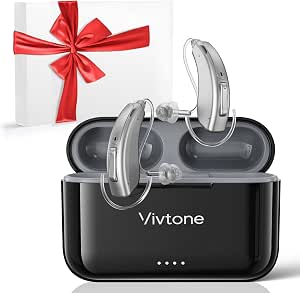 | Best for Tinnitus Masking Modes | Type: Behind-the-ear digital hearing aids | Peak sound gain: Up to 41 dB | Listening modes: Quiet, noisy, and tinnitus masking | VIEW LATEST PRICE | See Our Full Breakdown |
| Vivtone Lucid508 Rechargeable BTE Hearing Aids with Charging Case, Beige |  | Best for Long Backup Runtime | Type: Digital behind-the-ear hearing aids | Peak sound gain: Up to 41 dB | Listening modes: Quiet, noisy, tinnitus masking | VIEW LATEST PRICE | See Our Full Breakdown |
| ELEHEAR Beyond Rechargeable OTC Hearing Aids with AI Noise Cancellation |  | Best for App-Based Fine-Tuning | Type: Rechargeable OTC behind-the-ear hearing aids | Intended hearing loss: Mild to moderate | Amplification: 50 dB | VIEW LATEST PRICE | See Our Full Breakdown |
| Jabra Enhance Select M2 Swift FDA-Cleared Self-Fitting Hearing Aids, Sand |  | Best for Streaming and Self-Fitting | Design and weight: Mini ergonomic design; 2.12 grams | Self-fitting: FDA-cleared in-app hearing test and personalization | Connectivity: Bluetooth streaming, Bluetooth LE Audio, Auracast | VIEW LATEST PRICE | See Our Full Breakdown |
| Karthus Rechargeable In-Ear Hearing Aids with Noise Reduction |  | Best Simple In-Ear Option | Fit: In-ear | Intended hearing loss: Perceived mild to moderate | Listening modes: Noise Reduction and Quiet | VIEW LATEST PRICE | See Our Full Breakdown |
| Karthus Rechargeable OTC Hearing Aids for Seniors |  | Best for Phone-Free Physical Controls | Fit type: Behind-the-ear | Intended hearing loss: Mild to moderate | Audio processing: 16-channel DSP | VIEW LATEST PRICE | See Our Full Breakdown |
| digital hearing aid | Fit | Controls |
|---|---|---|
| QIPOPC Rechargeable Behind-the | Behind-the-ear | Button control |
| ELEHEAR Beyond OTC Rechargeabl | Receiver-in-the-canal; multiple dome sizes included | Automatic power on/off when removed from or placed in charging case |
| Audien Atom X OTC Hearing Aids | In-ear | Touchscreen charging case |
| Manzelun GM-105 Rechargeable B | Behind-the-ear | Slide switch and continuous volume knob |
| Audien Atom One Rechargeable O | In-ear | Analog volume and frequency dials |
| ELEHEAR Beyond 2 Pro OTC Recha | Behind-the-ear, receiver-in-canal | ELEHEAR app |
| BIBIED Rechargeable In-Ear Hea | In-ear | — |
| Oricle Rechargeable In-Ear Hea | In-ear, completely-in-canal | Button; five-second long press to turn on or off |
| Sennheiser All-Day Clear Bluet | In-ear, receiver-in-canal | — |
| Vivtone Lucid508 Rechargeable | — | — |
| Vivtone Lucid508 Rechargeable | — | — |
| ELEHEAR Beyond Rechargeable OT | — | — |
| Jabra Enhance Select M2 Swift | — | — |
| Karthus Rechargeable In-Ear He | In-ear | — |
| Karthus Rechargeable OTC Heari | — | Physical switch and one-button control |
More Details on Our Top Picks
QIPOPC Rechargeable Behind-the-Ear Hearing Amplifier with Noise Reduction
The QIPOPC is the straightforward pick for someone who wants button-operated amplification rather than app setup. Its digital noise reduction is intended to make voices easier to follow, while the behind-the-ear fit and interchangeable silicone domes give buyers a way to adjust how it sits. Compared with the ELEHEAR Beyond, it skips Bluetooth and app-based sound adjustments, so there is less customization but also less to configure. The magnetic charging case and USB-C cable support a rechargeable routine, though the stated up to 120 hours does not explain how that runtime is measured. This is an amplifier, not a substitute for a hearing evaluation or a fit tailored by a hearing professional. I’d choose it for basic daily use, but not for app-driven tuning or detailed runtime certainty.
Pros:- Button controls allow direct power and volume adjustment without a phone.
- Digital noise reduction is designed to help speech stand out from background sound.
- Magnetic charging case and USB-C cable support rechargeable use.
- Multiple silicone dome sizes allow some fit adjustment.
Cons:- The stated up-to-120-hour battery life has no measurement conditions provided.
- Fit and comfort depend on selecting a suitable dome size.
- No Bluetooth or companion-app customization is specified.
Best for: Adults who want a rechargeable behind-the-ear hearing amplifier with physical controls and no phone setup.
Not ideal for: Buyers who want Bluetooth streaming, app-based sound adjustments, or a clearly defined battery-runtime test.
- Brand and model:QIPOPC ZF-M802
- Fit:Behind-the-ear
- Battery:Rechargeable lithium-ion
- Stated battery life:Up to 120 hours
- Controls:Button control
- Special features:Digital noise reduction; lightweight design
- Included accessories:Magnetic charging case, USB-C charging cable, replacement silicone domes, quick-start guide
- Color:Khaki
Our verdict“Choose the QIPOPC for simple, app-free behind-the-ear amplification, but pick ELEHEAR Beyond if you want Bluetooth and adjustable app settings.”
ELEHEAR Beyond OTC Rechargeable Bluetooth Hearing Aids
Among these five, ELEHEAR Beyond offers the most active sound customization: its iOS and Android app provides adjustable settings, while VOCCLEAR AI, noise attenuation, and feedback control are designed to support speech clarity. That makes it a more configurable choice than the QIPOPC, which relies on physical buttons and does not specify Bluetooth or app tuning. The receiver-in-the-canal design and multiple dome sizes provide fit options, and the case can supply up to four additional charges. Each charge is listed for up to 20 hours, with up to 100 hours total including the case. The tradeoff is a more involved setup, and some features depend on the app. Its stated intended range is mild to moderate hearing loss, so it is not presented as a solution for severe loss.
Pros:- App compatibility with iOS and Android enables adjustable volume and sound settings.
- VOCCLEAR AI, noise attenuation, and feedback control target speech listening.
- Charging case adds up to four charging cycles beyond the stated per-charge runtime.
- Multiple dome sizes support fit adjustment in a receiver-in-the-canal design.
Cons:- Some customization features require the companion app.
- Designed for mild to moderate hearing loss and may not meet needs associated with severe loss.
- Runtime is listed as up to 20 hours per charge, shorter than the QIPOPC’s stated figure, though that figure has unclear measurement conditions.
Best for: Adults with mild to moderate hearing loss who want app-based sound adjustments and Bluetooth in a rechargeable, discreet design.
Not ideal for: People who prefer device-only controls, do not want companion-app features, or need support for severe hearing loss.
- Technology:VOCCLEAR AI
- Maximum gain:Up to 50 dB
- Noise attenuation:24 dB
- Intended hearing loss:Mild to moderate
- Connectivity and app:Bluetooth; iOS and Android compatibility
- Fit:Receiver-in-the-canal; multiple dome sizes included
- Runtime:Up to 20 hours per charge; up to 100 hours with charging case
- Charging case:Provides up to four additional charging cycles
- Controls:Automatic power on/off when removed from or placed in charging case
Our verdict“Choose ELEHEAR Beyond if app-based tuning and Bluetooth matter more than the simpler controls offered by the QIPOPC.”
Audien Atom X OTC Hearing Aids with Touchscreen Charging Case
The Atom X suits buyers who want more listening choices than a basic volume adjustment but do not want to manage those choices through a phone. Its touchscreen charging case controls four preset modes for conversations, crowds, TV, and quieter settings. That gives it a broader set of ready-made listening profiles than the Audien Atom One, whose analog dials adjust volume and frequency but whose description lists no noise-control feature. The convenience has a catch: adjustments happen on the case, so it needs to be within reach, and the modes are pre-programmed rather than described as user-configurable. Up to 16 hours per charge and up to 48 hours of hearing aid use with the case are shorter stated runtimes than the Atom One’s up-to-24-hour per-charge figure. Multiple domes and guided setup help address fit, but won’t suit everyone’s ears.
Pros:- Four preset modes cover conversations, crowds, TV, and quieter moments.
- Touchscreen case provides controls without an app or small device buttons.
- Multiple ear dome sizes, replacement wax guards, and cleaning supplies are included.
- Portable charging case provides up to 48 hours of hearing aid use.
Cons:- Changing settings requires access to the touchscreen charging case.
- The four listening modes are pre-programmed, with no further customization described.
- Stated runtime is up to 16 hours per charge, below the Audien Atom One’s up-to-24-hour figure.
Best for: OTC hearing-aid buyers who want several preset listening modes and case-based controls without using a phone app.
Not ideal for: People who want to adjust settings directly on the hearing aids, customize modes beyond presets, or prioritize longer stated per-charge runtime.
- Fit:In-ear
- Listening modes:Conversation, Crowd, TV, Comfort
- Controls:Touchscreen charging case
- Battery life:Up to 16 hours per charge
- Charging case capacity:Up to 48 hours of hearing aid use
- Battery type:Lithium-ion
- Noise control:Active noise cancellation
- Included accessories:Touchscreen charging case, USB charging cable, wall adapter, multiple-size ear domes, replacement wax guards, cleaning brush
- Prescription requirement:No
Our verdict“Pick the Atom X for convenient preset mode changes without an app, but choose the Atom One if you prefer direct analog adjustment and longer stated per-charge runtime.”
Manzelun GM-105 Rechargeable Behind-the-Ear Hearing Aids with Noise Cancellation
The Manzelun GM-105 is the clearest fit here for buyers who want to make adjustments by touch: it pairs a slide switch with a continuous volume knob instead of relying on an app or touchscreen case. Its behind-the-ear format and flexible ear hooks offer a different wearing style from the in-ear Audien Atom X, while the case can recharge both devices up to four times. The listed use time is approximately 25 hours per charge cycle, but that is not directly comparable to products whose runtime is stated as an upper limit. Noise cancellation is included, though the description does not provide a reduction figure or explain how it performs across settings. The stated possibility of slight operating noise and an adaptation period matters for new users. I’d favor it for hands-on controls, not for buyers seeking app tuning or a near-invisible in-ear fit.
Pros:- Physical slide switch and continuous volume knob offer direct tactile adjustment.
- Behind-the-ear design includes flexible ear hooks and ergonomic earpieces.
- Charging case supports up to four full charges for both hearing aids.
- Five pairs of ear tips and two cleaning brushes are included.
Cons:- The product description notes that slight operating noise may occur.
- New users may need an adaptation period.
- No app connectivity or detailed noise-cancellation measurement is specified.
Best for: Adults who prefer behind-the-ear devices with a physical on/off switch, continuous volume knob, and a case that can recharge both aids multiple times.
Not ideal for: Buyers who want app-based customization, a discreet in-ear style, or a device with no reported operating noise or adjustment period.
- Brand and model:Manzelun GM-105
- Fit:Behind-the-ear
- Weight per hearing aid:5.5 g
- Battery:Lithium-ion, 3.7 V
- Noise control:Active noise cancellation
- Controls:Slide switch and continuous volume knob
- Charging:Cable or charging case
- Charging case capacity:Up to four full charges for both hearing aids
- Usage time:Approximately 25 hours
Our verdict“Choose the Manzelun GM-105 if physical controls and a multi-charge case matter more than the Atom X’s preset modes and in-ear form.”
Audien Atom One Rechargeable OTC Hearing Aids
The Audien Atom One makes sense for buyers who want to adjust sound on the device itself and avoid an app. Its analog volume and frequency dials offer a more direct form of tuning than the Audien Atom X, which uses a touchscreen case to select four preset modes. The Atom One also lists up to 24 hours per charge, compared with the Atom X’s up-to-16-hour figure, though the Atom X adds defined listening profiles for TV, crowds, conversation, and quieter settings. The tradeoff is that the Atom One specifies no noise-control feature, so it may be less suited to buyers who need help with background sound. Three dome sizes and a universal fit that works in either ear help with placement; the roughly three-hour recharge time still requires planning.
Pros:- Analog volume and frequency dials allow direct adjustment without an app.
- Up to 24 hours of use per charge is the longest stated per-charge runtime among these five products.
- Three silicone dome sizes support fit adjustment.
- Universal design fits either ear and includes a pull-wire for removal.
Cons:- No noise-control feature is specified.
- Charging takes about three hours.
- Unlike the Audien Atom X, it does not list preset modes for crowds, TV, or other listening situations.
Best for: Adults with mild to moderate hearing loss who want rechargeable in-ear aids with direct volume and frequency controls and no app.
Not ideal for: People who need listed noise control, want preset listening modes, or prefer charging that takes less than about three hours.
- Fit:In-ear
- Intended hearing loss:Mild to moderate
- Controls:Analog volume and frequency dials
- Battery:Rechargeable lithium-ion
- Battery life:Up to 24 hours
- Charging time and connector:About 3 hours; USB-C
- Ear dome sizes:Small, medium, large
- Included accessories:USB-C charging dock and cable, power adapter, cleaning brush, volume adjustment tool, wax guard kit, ear domes
- Warranty:1 year
Our verdict“Choose the Atom One for direct analog tuning and longer stated per-charge use, but select the Atom X if preset listening modes and noise control are higher priorities.”
ELEHEAR Beyond 2 Pro OTC Rechargeable Hearing Aids
Bluetooth 5.3 streaming and hands-free calling make the ELEHEAR Beyond 2 Pro a better match for buyers who want hearing support and phone audio in one device. Its receiver-in-canal fit pairs speech enhancement, noise reduction, and feedback suppression with app-based volume and listening adjustments. Compared with the simpler manual controls on the BIBIED Rechargeable In-Ear Hearing Aids, this model offers more phone-linked customization, but it also makes the app part of everyday use. The rechargeable case provides four additional charges, and the IP67 rating adds protection against dust, sweat, and light rain. The tradeoffs are its mild-to-moderate-loss focus and lack of Apple MFi hearing-aid connectivity; live video fine-tuning is also an optional service limited to 29 U.S. states.
Pros:- Bluetooth 5.3 supports music, video, and hands-free calls on compatible phones.
- Speech enhancement and feedback suppression work alongside noise reduction.
- IP67 protection helps guard against dust, sweat, and light rain.
- Rechargeable case supplies four additional charges.
Cons:- Hearing adjustments require the ELEHEAR app.
- Does not connect as an Apple MFi hearing aid.
- Designed for perceived mild to moderate hearing loss; live video fine-tuning is an optional service available only in 29 U.S. states.
Best for: Adults with perceived mild to moderate hearing loss who want app adjustments, phone streaming, and hands-free calls.
Not ideal for: People who want direct controls without a smartphone, need Apple MFi hearing-aid connectivity, or require support beyond mild to moderate loss.
- Fit:Behind-the-ear, receiver-in-canal
- Connectivity:Bluetooth 5.3
- Phone compatibility:iPhone with iOS 15 or later; Android 8.0 or later
- Water and dust resistance:IP67
- Battery life:Up to 20 hours per charge
- Charging case:Four additional charges
- Recharge time:About 1.5 hours
- Controls:ELEHEAR app
Our verdict“Choose the ELEHEAR Beyond 2 Pro if app control and Bluetooth calling matter more to you than standalone controls or Apple MFi support.”
BIBIED Rechargeable In-Ear Hearing Aids with Noise Reduction
The BIBIED is a straightforward choice for buyers who prefer adjusting their hearing aids on the device rather than in an app. Its manual power switch and volume dial give it a simpler control style than the ELEHEAR Beyond 2 Pro, which relies on an app for hearing adjustments and adds Bluetooth streaming. BIBIED instead focuses on DSP-based noise reduction, an in-ear fit, and long intervals between charges: up to 36 hours of use per charge, with the case providing another four to five charges. Ten pairs of silicone domes help users try different fits. The tradeoff is that an in-ear design may not suit every ear, and the product data does not specify phone connectivity or a hearing-adjustment app. It suits buyers who value direct controls and battery endurance over connected features.
Pros:- Manual power switch and volume dial allow direct adjustments.
- DSP processing is designed to clarify speech and reduce background noise.
- Up to 36 hours of continuous use per charge.
- USB-C case includes an LED battery display and four to five additional charges.
Cons:- In-ear fit may not be comfortable or secure for every user.
- No Bluetooth connectivity or companion app is specified in the product data.
- Requires charging, with continuous use limited to up to 36 hours per charge.
Best for: Adults seeking rechargeable in-ear hearing aids with a physical volume dial, a manual power switch, and extended use between case charges.
Not ideal for: Buyers who dislike in-ear devices, want Bluetooth phone streaming, or need documented app-based customization.
- Fit:In-ear
- Audio processing:DSP chip with noise-reduction processing
- Continuous use:Up to 36 hours per charge
- Total playtime:Up to 150 hours with charging case
- Charging case capacity:300 mAh
- Charging port:USB Type-C
- Included ear domes:10 pairs of silicone domes
- Weight:2.08 oz
Our verdict“Pick BIBIED if physical controls and long battery intervals matter more than the Bluetooth features offered by the ELEHEAR Beyond 2 Pro.”
Oricle Rechargeable In-Ear Hearing Aids with Noise Reduction and Charging Case
Oricle’s completely-in-canal design suits buyers who want a compact aid that sits inside the ear, rather than the receiver-in-canal approach of the Sennheiser All-Day Clear. Five sound levels, button controls, and memory settings provide a basic way to adapt the sound without the app-centered customization offered by the ELEHEAR Beyond 2 Pro. The soft silicone tips and automatic on/off are intended to make everyday wear and handling more convenient. The manufacturer states up to 60 hours on a single charge, a strong endurance claim, though no charging time is provided in the supplied specifications. Buyers should also be comfortable with the five-second long press needed to switch the aids on or off. This is a compact, relatively simple option, not a connected streaming pick.
Pros:- Completely-in-canal design keeps the devices compact.
- Five sound levels support basic adjustments for different environments.
- Automatic on/off and memory settings simplify routine use.
- Soft silicone tips are designed for a secure, comfortable fit.
Cons:- Requires a five-second long press to turn on or off.
- Charging time is not stated in the product specifications.
- No Bluetooth connectivity or app-based adjustment is specified.
Best for: Adults who prefer a compact, completely-in-canal fit with button controls and several basic sound levels.
Not ideal for: People who want Bluetooth streaming, app-based fitting, a quick power button, or clearly specified charging time.
- Model:Standard 3.0 (HA-JHA490-3.0)
- Fit:In-ear, completely-in-canal
- Sound levels:5
- Battery:Rechargeable lithium-ion
- Stated battery life:Up to 60 hours on a single charge
- Controls:Button; five-second long press to turn on or off
- Features:Noise reduction, automatic on/off, and memory settings
- Included components:Hearing aids, case, and charger
Our verdict“Choose Oricle for compact in-canal wear and simple button adjustments, but pick Sennheiser All-Day Clear if Bluetooth streaming is a priority.”
Sennheiser All-Day Clear Bluetooth Hearing Aids – OTC, Self-Fitting, Programmable Sound, FDA Cleared, Light Grey
The Sennheiser All-Day Clear stands out for combining self-fitting and programmable sound with automatic adjustment to the surrounding environment. That makes it a stronger choice for buyers who want more guided customization than the basic sound levels on the Oricle Rechargeable In-Ear Hearing Aids. Its receiver-in-canal design also supports Bluetooth calls and media, while the stated battery life reaches up to 24 hours. Compared with the ELEHEAR Beyond 2 Pro, Sennheiser’s listed strengths center on self-fitting and automatic sound adaptation; the supplied product data does not specify a Bluetooth version, IP rating, or charging-case backup capacity. It is intended for adults with mild to moderate hearing loss, so buyers with greater hearing needs should look beyond this model. The included ear tips and cleaning accessories support routine fitting and care.
Pros:- Automatically adapts sound to the surrounding environment.
- Self-fitting and app customization allow personal adjustments.
- Bluetooth supports calls and media streaming from iOS and Android devices.
- Up to 24 hours of rechargeable use per charge.
Cons:- Designed for mild to moderate hearing loss and may not suit severe impairment.
- The supplied specifications do not state a Bluetooth version or water-resistance rating.
- Charging-case backup capacity is not specified in the supplied product data.
Best for: Adults with mild to moderate hearing loss who want self-fitting, automatic sound adaptation, and Bluetooth calls or media.
Not ideal for: People with severe hearing loss, or buyers who need specified water resistance, a stated Bluetooth version, or documented case backup capacity.
- Model:All-Day Clear ADC1
- Fit:In-ear, receiver-in-canal
- Power source:Rechargeable lithium-ion battery
- Battery life:Up to 24 hours
- Connectivity:Bluetooth for calls and media
- Intended hearing-loss range:Mild to moderate
- Included ear tips:8 tips in sizes S, M, and L
- Included accessories:Charging case, USB charging cable, US wall plug, wax guards, cleaning brush, and instruction manual
Our verdict“Choose the Sennheiser All-Day Clear if self-fitting and automatic sound adaptation matter more than the Oricle’s smaller in-canal style.”
Vivtone Lucid508 Rechargeable BTE Hearing Aids with Charging Case
The Vivtone Lucid508 earns its place through a feature the other picks here do not list: a dedicated tinnitus masking mode alongside quiet and noisy listening modes. That makes it more targeted than the BIBIED Rechargeable In-Ear Hearing Aids, which emphasize noise reduction and manual controls, but it does not offer the Bluetooth streaming specified for the ELEHEAR Beyond 2 Pro. Its behind-the-ear fit may appeal to buyers who do not want a fully in-ear device, and the case supplies up to four recharges for a stated maximum of 125 hours of backup power. Each charge provides up to 25 hours of use. The tradeoffs are a two-hour charging period and broad hearing-loss suitability claims that may not match every individual need; the listed peak gain is up to 41 dB.
Pros:- Three listening modes include quiet, noisy, and tinnitus masking.
- Up to 25 hours of use per charge.
- Charging case provides up to four recharges and up to 125 hours of backup power.
- Lightweight, discreet behind-the-ear design.
Cons:- A full charge takes about two hours.
- Bluetooth connectivity is not specified in the product data.
- Intended for mild to significant hearing loss, a broad range that may not suit every hearing need.
Best for: Adults who want a behind-the-ear rechargeable aid with a dedicated tinnitus masking mode and multiple listening settings.
Not ideal for: Buyers who need Bluetooth calls or streaming, or who want hearing support tailored to a specific level of loss without professional guidance.
- Type:Behind-the-ear digital hearing aids
- Peak sound gain:Up to 41 dB
- Listening modes:Quiet, noisy, and tinnitus masking
- Use per charge:Up to 25 hours
- Charging time:2 hours
- Charging case capacity:Up to four recharges
- Backup power:Up to 125 hours
- Design and materials:Lightweight, discreet design with medical-grade materials
Our verdict“Choose the Lucid508 if tinnitus masking and BTE wear are your priorities; choose the ELEHEAR Beyond 2 Pro instead for specified Bluetooth streaming and calls.”
Vivtone Lucid508 Rechargeable BTE Hearing Aids with Charging Case, Beige
The Lucid508 suits buyers who want multiple listening modes and fewer charging interruptions without app-based adjustments. Its quiet, noisy, and tinnitus-masking modes give it a broader listening focus than the simpler Karthus Rechargeable In-Ear Hearing Aids, which offer two modes and six volume levels. A full charge takes about two hours and supports up to 25 hours of use; the case adds up to 125 hours of backup power, the largest stated reserve among these five options. Automatic power on and off also cuts down on button handling. The tradeoff is its behind-the-ear fit, which may not suit people who prefer in-ear devices, and the product details do not explain how fitting or adjustments work. I’d favor it for runtime and mode variety, not for personalized app tuning.
Pros:- Three modes cover quiet, noisy, and tinnitus-masking listening needs.
- Charging case provides up to 125 hours of backup power.
- Automatic on/off operation reduces manual handling.
- Up to 25 hours of use per charge with a roughly two-hour recharge.
Cons:- Behind-the-ear fit may not match buyers seeking a discreet in-ear style.
- The supplied details do not explain fitting or adjustment controls.
- No app or Bluetooth features are specified.
Best for: Adults seeking a behind-the-ear device with tinnitus masking, multiple listening modes, and substantial charging-case backup.
Not ideal for: People who prefer an in-ear fit or want clearly described app-based fitting and sound adjustments.
- Type:Digital behind-the-ear hearing aids
- Peak sound gain:Up to 41 dB
- Listening modes:Quiet, noisy, tinnitus masking
- Charging time:About 2 hours
- Use per charge:Up to 25 hours
- Charging case backup power:Up to 125 hours
- Automatic power:Turns on and off when removed from or placed in the case
- Included accessories:Charging case, anti-lost lanyard, clip
Our verdict“Choose the Lucid508 if long case-backed runtime and a tinnitus-masking mode matter more than app customization or an in-ear fit.”
ELEHEAR Beyond Rechargeable OTC Hearing Aids with AI Noise Cancellation
The ELEHEAR Beyond is the most adjustable pick here for buyers willing to manage sound through a phone. Its app controls volume, frequency, directionality, and environment profiles, while four scene modes offer more listening presets than the three modes on the Vivtone Lucid508. That range can help users tailor sound across settings rather than rely on one fixed setup. The stated 50 dB amplification and speech-focused noise cancellation are aimed at mild to moderate hearing loss, and nine dome sizes give buyers more ways to find a secure, comfortable fit. The tradeoff is that detailed adjustments depend on the app, so it is less suitable for someone who wants physical, phone-free controls like the Karthus Rechargeable OTC Hearing Aids for Seniors. Runtime is up to 20 hours per charge, shorter than the Lucid508’s stated 25 hours.
Pros:- App adjusts volume, frequency, directionality, and environment profiles.
- Four scene modes support different listening environments.
- Nine dome sizes allow more fit choices.
- Quick charge provides up to six hours of runtime from 15 minutes.
Cons:- Detailed hearing adjustments require app use.
- A suitable fit depends on selecting the right dome size.
- Up to 20 hours per charge is shorter than the Vivtone Lucid508’s stated runtime.
Best for: Adults with mild to moderate hearing loss who want app control over sound settings and a choice of dome sizes.
Not ideal for: Buyers who avoid smartphone apps, prefer physical controls, or prioritize longer use per charge over detailed adjustment options.
- Type:Rechargeable OTC behind-the-ear hearing aids
- Intended hearing loss:Mild to moderate
- Amplification:50 dB
- Noise reduction:Up to 24 dB
- Scene modes:4
- App controls:Volume, frequency, sound directionality, environment profiles
- Runtime:Up to 20 hours per charge; up to 100 hours with case
- Quick charge:15 minutes for up to 6 hours of runtime
- Dome sizes:9
Our verdict“Pick ELEHEAR Beyond if phone-based sound customization and flexible dome sizing are priorities, and you are comfortable managing settings in an app.”
Jabra Enhance Select M2 Swift FDA-Cleared Self-Fitting Hearing Aids, Sand
The Jabra Enhance Select M2 Swift stands apart from the other picks here by combining FDA-cleared in-app self-fitting with Bluetooth streaming. Its mini, ergonomic design weighs 2.12 grams, and adaptive listening is intended to adjust sound as environments change, offering more connected functionality than the app-free Karthus models. Compatible Apple and Android devices can stream calls and media, while Bluetooth LE Audio and Auracast add supported connection options. The portable charger provides up to 96 hours of on-the-go power, and the listed battery life is over 24 hours per charge. This flexibility comes with dependence on a compatible phone for personalization and streaming; buyers seeking straightforward physical controls may prefer the Karthus Rechargeable OTC Hearing Aids for Seniors. Its nearly invisible form and connectivity also make it a different kind of choice from the larger-featured, mode-focused Vivtone Lucid508.
Pros:- FDA-cleared in-app hearing test and personalization.
- Bluetooth streaming works with compatible Apple and Android devices.
- Mini design weighs 2.12 grams and has an IP68 rating.
- Portable charger supplies up to 96 hours of on-the-go power.
Cons:- Personalization and hearing controls rely on the app.
- Streaming requires a compatible Apple or Android device.
- Connected features may be unnecessary for buyers seeking simple, phone-free operation.
Best for: People seeking app-based self-fitting, a compact design, and hearing aids that can stream calls and media from a compatible phone.
Not ideal for: Buyers who do not use a compatible Apple or Android device or want hearing controls that work without an app.
- Design and weight:Mini ergonomic design; 2.12 grams
- Self-fitting:FDA-cleared in-app hearing test and personalization
- Connectivity:Bluetooth streaming, Bluetooth LE Audio, Auracast
- Device compatibility:Compatible Apple and Android devices
- Battery life:Over 24 hours per charge
- Portable charger:Included; up to 96 hours of on-the-go power
- Water and dust resistance:IP68 with weatherproof nano-coating
- Charging:USB-C portable charger
- Warranty and protection:1-year warranty; 1-year loss and damage protection
Our verdict“Choose the Jabra if self-fitting, a compact build, and phone streaming matter more than app-free controls.”
Karthus Rechargeable In-Ear Hearing Aids with Noise Reduction
For buyers who want an in-ear device without phone setup, this Karthus model keeps operation direct: choose between two listening modes, adjust one of six volume levels, and place the aids in the case to recharge. Its 16-channel digital chip is a stated processing detail, but the practical distinction is its straightforward controls and in-ear form. Compared with the behind-the-ear Karthus Rechargeable OTC Hearing Aids for Seniors, this model is better suited to shoppers who want an in-ear fit, while the other Karthus offers seven volume levels and up to 30 hours per charge. The in-ear model lists up to 24 hours per charge and up to 96 hours total with its case. It has no app or Bluetooth, which simplifies setup but rules out streaming and app-based personalization.
Pros:- In-ear form offers an alternative to behind-the-ear designs.
- Two modes cover quiet and noise-reduction listening.
- Six volume levels provide direct adjustment without an app.
- Case supports up to 96 hours of total use and charges through Type-C.
Cons:- No app or Bluetooth connectivity for personalization or streaming.
- Up to 24 hours per charge is less than the other Karthus model’s stated 30 hours.
- Designed for perceived mild to moderate hearing loss.
Best for: Adults with perceived mild to moderate hearing loss who prefer an in-ear fit and simple controls without a smartphone.
Not ideal for: People who want Bluetooth streaming, app adjustments, or more than six volume levels.
- Fit:In-ear
- Intended hearing loss:Perceived mild to moderate
- Listening modes:Noise Reduction and Quiet
- Volume levels:6
- Digital chip:16-channel
- Battery life:Up to 24 hours per charge; up to 96 hours total with case
- Charging:Type-C rechargeable case
- Connectivity:No app or Bluetooth
- Included components:2 hearing aids, charging case, 2 wax guard tools, 2 domes, cleaning brush, charging cable
Our verdict“Choose this Karthus model if you prefer an in-ear fit and uncomplicated controls over streaming or app features.”
Karthus Rechargeable OTC Hearing Aids for Seniors
This Karthus model is a practical fit for buyers who want physical controls without an app. Seven volume levels and two listening modes let users adjust the aids directly for quieter settings or busier environments, while the behind-the-ear design avoids the in-ear fit of the other Karthus model in this group. It offers up to 30 hours per charge and up to 100 hours with its case, exceeding that in-ear model’s stated 24-hour per-charge runtime. A 15-minute quick charge is listed for up to six hours of use. Its 16-channel DSP is a processing specification, not a substitute for personalized app fitting; unlike the Jabra Enhance Select M2 Swift, it has no Bluetooth, streaming, or phone-based personalization. That simplicity is useful for app-averse buyers but limits sound adjustment and connectivity.
Pros:- Seven volume levels and two modes are controlled directly on the device.
- No app, Bluetooth, or pairing is required.
- Up to 30 hours per charge and up to 100 hours with the case.
- A 15-minute quick charge provides up to six hours of use.
Cons:- No Bluetooth streaming or app-based sound personalization.
- Not intended for severe or profound hearing loss.
- Fit and listening results can vary by wearer and environment.
Best for: Seniors or other adults with mild to moderate hearing loss who want behind-the-ear aids with physical controls and no smartphone setup.
Not ideal for: People seeking Bluetooth streaming, app-based fitting, or hearing aids intended for severe or profound hearing loss.
- Fit type:Behind-the-ear
- Intended hearing loss:Mild to moderate
- Audio processing:16-channel DSP
- Listening modes:Quiet Mode and Noise Mode
- Volume levels:7
- Controls:Physical switch and one-button control
- Connectivity:No app, Bluetooth, or pairing required
- Battery life:Up to 30 hours per charge; up to 100 hours with case
- Quick charge:15 minutes provides up to 6 hours of use
Our verdict“Pick this Karthus if you want longer stated per-charge runtime and physical, phone-free controls in a behind-the-ear design.”

How We Picked
I organized the ranking around practical differences that can change daily use: fitting and adjustment support, hearing-related controls, Bluetooth features, physical style, charging approach, and the clarity of the product’s intended use. I gave more weight to choices with a defined OTC self-fitting or programmable approach when ranking for broad suitability, while treating basic rechargeable amplifiers as more limited picks for buyers seeking straightforward amplification rather than a guided fitting experience.
I also compared products within the lineup instead of treating every feature claim as equivalent. The Jabra and Sennheiser models rank highly for their self-fitting and personalization emphasis; ELEHEAR’s Beyond models offer alternatives for shoppers comparing added sound and connectivity features. In-ear and BTE choices earn places for different fit preferences, but product naming alone cannot establish clinical fit, sound quality, or compatibility with a particular hearing profile. I recommend checking the current manufacturer details, return terms, and suitability guidance before choosing.
| digital hearing aid | Fit |
|---|---|
| QIPOPC Rechargeable Behind-the | Behind-the-ear |
| ELEHEAR Beyond OTC Rechargeabl | Receiver-in-the-canal; multiple dome sizes included |
| Audien Atom X OTC Hearing Aids | In-ear |
| Manzelun GM-105 Rechargeable B | Behind-the-ear |
| Audien Atom One Rechargeable O | In-ear |
| ELEHEAR Beyond 2 Pro OTC Recha | Behind-the-ear, receiver-in-canal |
| BIBIED Rechargeable In-Ear Hea | In-ear |
| Oricle Rechargeable In-Ear Hea | In-ear, completely-in-canal |
| Sennheiser All-Day Clear Bluet | In-ear, receiver-in-canal |
| Vivtone Lucid508 Rechargeable | — |
| Vivtone Lucid508 Rechargeable | — |
| ELEHEAR Beyond Rechargeable OT | — |
| Jabra Enhance Select M2 Swift | — |
| Karthus Rechargeable In-Ear He | In-ear |
| Karthus Rechargeable OTC Heari | — |
Factors to Consider When Choosing Digital Hearing Aids
Choosing among digital hearing aids takes more than comparing the number of features on a listing. I would start with the kind of fitting process and day-to-day handling you can realistically maintain, then check whether the device’s stated use matches your needs.
Match the fitting process to your hearing needs
OTC hearing aids are intended for adults with perceived mild to moderate hearing loss, not every kind of hearing difficulty. A self-fitting model can offer more control than a basic amplifier, but that control is useful only if you are comfortable following setup steps and adjusting settings. Avoid assuming that app-based personalization means the device has been clinically fitted to your hearing. If hearing changes are sudden, affect one ear much more than the other, or come with pain or dizziness, seek medical advice instead of relying on a retail device. Buyers who are unsure about their hearing profile may benefit from an audiology appointment before committing.
Choose a style you can put in and maintain
Behind-the-ear devices and in-ear designs differ in handling, visibility, and how they sit on the ear. A compact in-ear model may appeal if you want a less noticeable device, yet small parts can be harder to place, clean, or retrieve. BTE styles can be easier for some people to grip, though the fit and feel behind the ear may take getting used to. Think about dexterity, glasses, masks, and whether you can manage cleaning without help. Do not choose by appearance alone; a device that is uncomfortable or awkward to maintain is unlikely to become part of a steady routine.
Treat Bluetooth and app controls as convenience features
Bluetooth can make phone calls or streamed audio more convenient, while an app may provide access to volume or sound adjustments. Those features do not guarantee that a model will connect smoothly with every phone or support the functions you expect. Check the current compatibility list and distinguish direct streaming from remote control, since they are not the same capability. If you mainly want help hearing conversations in person, connectivity may matter less than comfortable fit and usable controls. Buyers who prefer not to manage apps should favor a simpler setup rather than paying attention to a feature set they will rarely use.
Plan for charging, cleaning, and replacement parts
Rechargeable devices reduce the need to handle disposable batteries, but they make a charging routine part of daily use. Check whether the case itself needs frequent charging, whether the device can be charged in the way you prefer, and how clearly the product explains battery care. Earwax and moisture can affect small hearing devices, so look for understandable cleaning instructions and access to filters or other replaceable parts. A charging case can be helpful for travel, but it adds another item to keep track of. Compare the ongoing care routine, not just the headline promise of rechargeable power.
Check support, returns, and the limits of product claims
Hearing aids often need a period of adjustment, so access to setup help and clear troubleshooting instructions can matter as much as the device itself. Read the return policy closely, including any hygiene rules, trial period conditions, and who pays return shipping. Verify the exact model and included accessories, especially when a brand has several similarly named products or color variants. Treat phrases such as noise reduction as descriptions of intended processing, not proof that every voice will become clear in every setting. A good purchase is one you can test safely, adjust, and return or get help with if the fit is wrong.
Frequently Asked Questions
Should I choose an OTC hearing aid or a basic hearing amplifier?
An OTC hearing aid is designed for adults with perceived mild to moderate hearing loss and may include fitting or sound-adjustment steps. A basic amplifier may simply make sounds louder and may offer less guidance for tailoring output to your hearing. The products in this roundup range from amplifier-style listings to named OTC self-fitting models, so compare the intended use rather than relying on a brand label. If you have significant hearing difficulty or are uncertain about the cause, a hearing assessment can help you avoid buying a device that is not suited to the problem. Do not use a retail device as a substitute for medical evaluation when symptoms are unusual or sudden.
Is a self-fitting model worth choosing if I have never used hearing aids?
A self-fitting device may be a good starting point if you are comfortable following setup instructions and making adjustments gradually. Jabra Enhance Select M2 Swift and Sennheiser All-Day Clear are the clearest matches in this lineup for shoppers seeking a defined self-fitting approach. A simpler device may feel easier at first, but fewer adjustment options can also limit how well it addresses different listening situations. Check what setup help is available and whether the controls are manageable with your phone and dexterity. If you are not confident doing the fitting steps alone, ask about professional support before ordering.
Will Bluetooth hearing aids stream audio from any phone?
No; Bluetooth support does not mean every phone, operating system, or audio feature will work the same way. Some devices use a phone connection mainly for controls, while others may support audio streaming or calls. Confirm compatibility for your exact phone model and check whether the functions you need are supported, rather than assuming the word Bluetooth covers them all. The Sennheiser and ELEHEAR listings highlight connectivity, but buyers should verify current manufacturer specifications for the exact model. If streaming is not a priority, a simpler device may be easier to manage.
How do I choose between an in-ear device and a behind-the-ear model?
Start with comfort, handling, and maintenance rather than visibility alone. In-ear devices can suit buyers who prefer a smaller profile, but their compact parts may be harder to insert or clean. Behind-the-ear models are more visible, yet some people find them easier to grip and position. The lineup includes both styles, so it offers options for different preferences but cannot predict which will fit your ear comfortably. Check the product’s fitting guidance and return conditions, and ask a hearing professional for advice if you have recurring ear irritation or difficulty inserting small devices.
What should I verify before buying a rechargeable hearing aid?
Confirm how the device and its case charge, how long the manufacturer says a charge lasts, and whether the needed cable or power accessories are included. Read the care instructions for cleaning, moisture exposure, and replaceable filters, since rechargeable power does not remove routine maintenance. Check the return policy and support options in case the fit or controls do not work for you. This roundup includes many rechargeable models, but their charging cases and handling needs are not necessarily interchangeable. If you rely on a device throughout the day, plan for what you will do when charging is delayed or the case is unavailable.
Conclusion
For the strongest all-around starting point, I would choose the Jabra Enhance Select M2 Swift for its self-fitting emphasis. The best premium-leaning choice is the Sennheiser All-Day Clear for buyers who want programmable sound and Bluetooth features, while the best feature-focused alternative is ELEHEAR Beyond 2 Pro. For beginners who want a more guided setup, I would compare Jabra and Sennheiser first; for buyers prioritizing a simpler rechargeable design, the Audien Atom One or a basic BTE option may be easier to assess. I cannot name a universal best value from the listing details alone, so I would compare the exact included accessories, support, and return terms before deciding. Choose an in-ear model only if its fit and handling suit you, and seek professional guidance when you are unsure whether an OTC device matches your hearing needs.