Personal FM listening systems cover a surprisingly wide category, and the biggest mistake I see buyers make is confusing two very different products: a portable AM/FM pocket radio for personal listening on the go, and an FM assistive listening system with a transmitter and receivers designed to carry a speaker’s voice directly to listeners’ ears in a venue. Both technically deliver audio over FM, but they solve completely different problems, and picking the wrong type wastes money fast.

Get everyday helpers delivered free with Prime
- Fast, free delivery on millions of items
- Prime Video, Amazon Music and more included
- Member-only deals all year
If you simply want a tiny radio for walking the dog or sitting in the garden, my top pick is the Personal Portable Radio AM FM Rechargeable Mini Radio, which packs DSP-enhanced reception and a rechargeable battery into a package weighing barely an ounce. If your goal is helping people hear clearly in a church, classroom, or courtroom, the Williams Sound PFM PRO stands out as the most complete single-user assistive kit, while the Retekess TT119 (1 TX 50 RX) makes the most sense for outfitting large congregations or multilingual events where dozens of receivers are needed. The main tradeoffs throughout this roundup come down to scale versus simplicity: single-user kits are flexible and affordable, multi-receiver systems cost more and demand setup effort, and pocket radios trade capability for sheer convenience.
Key Takeaways
- Pocket radios and transmitter-receiver FM systems serve different purposes: one tunes broadcast stations, the other delivers a live audio feed to listeners’ ears.
- The Williams Sound PFM PRO is the best single-listener assistive option thanks to its bundled accessories and hearing aid compatibility via telecoil neckloops.
- For venues with 30-50 listeners, the Retekess TT119 1TX 50RX kit offers the lowest per-listener cost and unlimited receiver expansion.
- All three TT119 configurations share the same 300 m range and 17 channels; the differences are receiver count and kit contents, so buy based on audience size.
- The mini pocket radio requires earphones for the best sound and suits solo listeners only — it cannot broadcast or assist with hearing in venues.
| Personal Portable Radio AM FM Rechargeable Mini Radio with Great Reception |  | Best Budget Pick for Solo Listening | Frequency Range: FM: 60-108MHz; AM: 520-1710KHz | Station Storage: 70 stations (50 FM, 20 AM) | Size: 3.5 x 1.5 x 0.3 inches | VIEW LATEST PRICE | See Our Full Breakdown |
| Williams Sound PFM PRO Personal FM Listening System |  | Best Overall for Assistive Listening | Frequency Band: 72-76 MHz | Selectable Channels: 17 | Operating Range: Up to 150 ft (46 m) | VIEW LATEST PRICE | See Our Full Breakdown |
| Retekess TT119 Assistive Listening System, Church Translation (1 TX 50 RX) |  | Best for Large Venues and Congregations | Configuration: 1 transmitter, 50 receivers | Range: 300 m / 980 ft | Channels: 17, unlimited expandable receivers | VIEW LATEST PRICE | See Our Full Breakdown |
| Retekess TT119 Church Translation System, Assistive Listening (1TX 10RX) |  | Best Value Starter System for Small Venues | Configuration: 1 transmitter, 10 receivers | Audio Output: Stereo, adjustable volume | Transmission Range: 300 m | VIEW LATEST PRICE | See Our Full Breakdown |
| Retekess TT119 Assistive Listening and Church Translation System (1 Transmitter, 10 Receivers) |  | Best Feature-Rich System for Growing Organizations | Configuration: 1 transmitter, 10 receivers | Working Range: Up to 300 m (984 ft) | Channels: 17 | VIEW LATEST PRICE | See Our Full Breakdown |
| personal FM listening system | Configuration |
|---|---|
| Personal Portable Radio AM FM | — |
| Williams Sound PFM PRO Persona | — |
| Retekess TT119 Assistive Liste | 1 transmitter, 50 receivers |
| Retekess TT119 Church Translat | 1 transmitter, 10 receivers |
| Retekess TT119 Assistive Liste | 1 transmitter, 10 receivers |
More Details on Our Top Picks
Personal Portable Radio AM FM Rechargeable Mini Radio with Great Reception
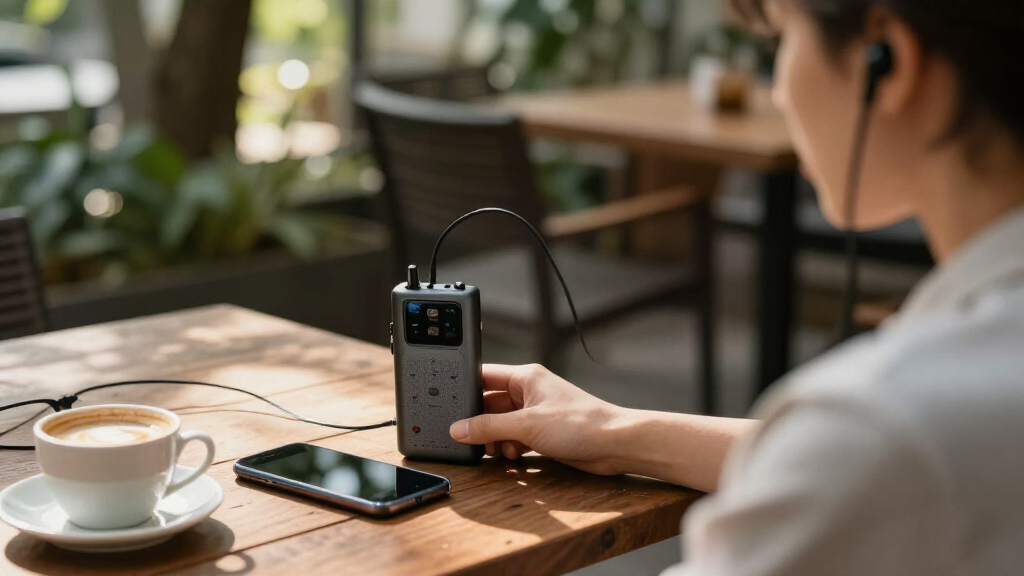
This palm-sized radio earns its place as the most affordable and portable option in the lineup, and it is the only product here designed to tune broadcast stations rather than receive a dedicated transmitter. Digital signal processing gives it genuinely strong reception for its size, and the ability to store 70 preset stations means less manual hunting once it is configured. At 1.14 ounces with a removable clip and lanyard, it disappears into a pocket in a way none of the venue systems can match.
Compared with the Williams Sound PFM PRO, the tradeoffs are obvious but worth spelling out: this radio pulls in whatever a station broadcasts, while the PFM PRO delivers a specific audio feed directly to your ears, which is what someone struggling to hear in a noisy room actually needs. The rechargeable battery is a quiet advantage over the TT119 receivers, which depend on disposable AA cells — a single USB charge delivers up to ten hours without recurring battery costs. The green backlight and time display make it usable at night, though the tiny chassis will frustrate anyone with larger hands, and earphones are effectively required because the built-in speaker cannot carry the audio on its own.
Pros:- DSP digital processing delivers excellent AM and FM reception for the size
- Rechargeable 400mAh battery with up to 10 hours of playback
- 70 station presets eliminate repeated manual tuning
- Clip, lanyard, backlight, and lock button make it genuinely pocket-ready
Cons:- Earphones are needed for acceptable sound quality
- AM/FM broadcast only — no assistive or transmitter functionality
- Very small controls are awkward for users with larger hands
Best for: Walkers, joggers, campers, and anyone who wants lightweight personal access to AM/FM broadcast stations without a subscription or app.
Not ideal for: Anyone buying an assistive listening system for a venue, or listeners who want loudspeaker output without earphones.
- Frequency Range:FM: 60-108MHz; AM: 520-1710KHz
- Station Storage:70 stations (50 FM, 20 AM)
- Size:3.5 x 1.5 x 0.3 inches
- Weight:1.14 oz
- Battery:400mAh rechargeable
- Playback Time:Up to 10 hours
- Extras:Backlight, time display, lock button, clip, lanyard
Our verdict“For under the cost of a single professional receiver, this mini radio delivers dependable personal FM listening, as long as your goal is broadcast stations rather than assistive audio.”
Williams Sound PFM PRO Personal FM Listening System
The PFM PRO is the product I would point most personal listeners toward, because it is a complete, ready-to-run kit: transmitter, receiver, two listening accessories, a lavalier microphone, batteries, and a carry case all ship in one box. Nothing else in this roundup arrives as turnkey for a single user. The 17 selectable channels on the 72-76 MHz band allow it to coexist with other FM systems in the same building, and the 150-foot range comfortably covers a home, classroom, small sanctuary, or guided tour group.
Its standout differentiator is hearing aid compatibility. Through a 3.5 mm jack, it works with neckloops and telecoil-equipped hearing aids, which no other product here supports out of the box — though note that the neckloop itself is sold separately. Audio compression circuitry smooths out sudden volume spikes, a thoughtful touch for listeners with sensitivity to loud sounds. Compared with the Retekess TT119 kits, the PFM PRO trades raw range (150 ft versus 980 ft) and multi-receiver scalability for simplicity and portability. Compared with the pocket radio, it solves an entirely different problem: instead of tuning stations, the transmitter sends a mic or aux feed straight to the listener’s ear, defeating background noise and distance. The main caveats are legal rather than practical — FCC rules restrict its use to auditory assistance, and the 72-76 MHz band is not permitted in every country.
Pros:- Complete bundled kit with transmitter, receiver, microphone, earphones, headphones, and case
- Neckloop and telecoil hearing aid compatibility
- 17 selectable channels and 150 ft range for flexible deployment
- Audio compression protects sensitive listeners from volume spikes
Cons:- FCC rules restrict use to auditory assistance applications
- 72-76 MHz band not legal in every country
- Telecoil neckloop must be purchased separately
Best for: Individuals with hearing difficulty, TV listeners, small tour groups, and classrooms who need one-on-one audio delivery with a true all-in-one kit.
Not ideal for: Large venues needing dozens of receivers, or buyers outside regions where 72-76 MHz operation is permitted.
- Frequency Band:72-76 MHz
- Selectable Channels:17
- Operating Range:Up to 150 ft (46 m)
- Audio Jack:3.5 mm
- Audio Controls:Compression and mute
- Power:2 AA alkaline batteries
- Includes:Transmitter, receiver, earphone, folding headphone, audio cable, lavalier mic, batteries, carry case
Our verdict“The most complete single-user assistive listening package available in this comparison, ideal when hearing clarity — not scale — is the priority.”
Retekess TT119 Assistive Listening System, Church Translation (1 TX 50 RX)
When audience size is the driving constraint, this 50-receiver configuration is the value leader per listener in the entire roundup. One transmitter serves fifty lightweight receivers, and because the system supports unlimited receivers on 17 channels with up to six simultaneous language groups in the same space, a growing church or conference operation can scale without replacing hardware. The 300-meter range towers over the PFM PRO’s 150 feet, covering auditoriums, overflow rooms, and outdoor gatherings.
Input flexibility is another reason it ranks above its sibling kits for serious deployments: XLR, AUX, RCA, and USB connections mean it plugs into virtually any sound desk, mixer, or media player a venue already owns. The included D-type non-in-ear headphones are a hygienic choice for shared equipment, since they do not sit inside the ear canal of successive users. The tradeoffs mirror the platform’s quirks — mono is the default audio mode, so stereo requires a manual settings change, and each receiver runs on batteries with roughly ten hours of life, meaning fifty units demand a serious battery budget and charging discipline. Compared with the 1TX 10RX kits below, this bundle only makes sense if you genuinely need the receiver count; smaller ministries would be paying a premium for hardware that sits in a closet.
Pros:- 50 receivers included for the lowest per-listener cost in this lineup
- 300 m range with support for six simultaneous language groups
- XLR, AUX, RCA, and USB inputs fit any venue sound system
- Hygienic D-type non-in-ear headphones suit shared use
Cons:- Mono default requires manual switching to stereo
- Fifty AA-powered receivers create ongoing battery costs
- 10-hour battery ceiling limits all-day events
Best for: Large churches, multilingual conferences, and schools needing to equip 30-50 listeners at the lowest per-seat cost.
Not ideal for: Small groups or single users — the receiver count and price far exceed what a modest setting requires.
- Configuration:1 transmitter, 50 receivers
- Range:300 m / 980 ft
- Channels:17, unlimited expandable receivers
- Audio Inputs:XLR, AUX, RCA, USB
- Receiver Weight:90 g
- Battery Life:Up to 10 hours
- Headphones:D-type, non-in-ear
Our verdict“The scalable workhorse for big audiences, provided you actually need fifty receivers and can manage the battery logistics that come with them.”
Retekess TT119 Church Translation System, Assistive Listening (1TX 10RX)
This configuration is the entry point into the TT119 platform, pairing one transmitter with ten receivers at a price that small churches, study groups, and meeting rooms can absorb. Unlike the other two TT119 listings here, this version is described as an all-in-one design with stereo output and adjustable volume, and it keeps the platform’s 300-meter transmission range, so a small congregation gives up almost nothing in raw performance compared with the 50-receiver flagship. The stereo sound is a genuine plus for music-forward services where mono would flatten the mix.
Where this kit differs most from its siblings is practicality rather than capability. The package is bulkier — over 2 kg and around 10 by 11 inches — and it is listed as corded electric, which means the transmitter needs a wall outlet and outdoor deployment is limited unless you have power access. Detailed specifications are thinner on this listing than on the others, which matters if your technical team needs exact input options before purchasing. Compared with the Williams Sound PFM PRO, you get ten receivers for the price of one-listener convenience, but you lose hearing aid compatibility and the compact portability. Compared with the 1TX 10RX listing below, read both carefully: the feature overlap is substantial, and pricing will likely decide the winner on any given day.
Pros:- Ten receivers included at an accessible entry price
- Stereo sound with adjustable volume suits music and speech
- 300 m transmission range matches the larger kits
- Simple all-in-one operation with minimal setup learning curve
Cons:- Bulky, outlet-dependent transmitter limits portability and outdoor use
- Sparse published specifications complicate technical planning
- Fixed ten-receiver count may not fit growing audiences
Best for: Small churches, Bible studies, classrooms, and meeting rooms serving roughly ten listeners who want stereo audio on a modest budget.
Not ideal for: Mobile or outdoor events without reliable power, and buyers who need fully documented specs before committing.
- Configuration:1 transmitter, 10 receivers
- Audio Output:Stereo, adjustable volume
- Transmission Range:300 m
- Connectivity:Auxiliary
- Supported Formats:MP3, WAV
- Dimensions:10.35 x 9.37 x 11.02 inches
- Weight:2043 g
Our verdict“A sensible starter system for small venues that want the TT119’s range and stereo sound without paying for receivers they do not need.”
Retekess TT119 Assistive Listening and Church Translation System (1 Transmitter, 10 Receivers)
Of the three TT119 variants, this listing is the most fully documented and feature-forward, and that transparency is exactly why I rank it above the other 10-receiver kit. Automatic channel pairing removes the fiddliest part of multi-receiver setup, and the control set — one-click mute, touch lock, external recording, background-music pause, and original-language switching — reflects real interpreter workflows rather than a generic spec sheet. Interpreter monitoring is a thoughtful inclusion, letting a translator check their own output mid-session, and XLR/AUX/RCA/USB inputs match the 50-receiver flagship’s flexibility.
The feature set makes this the pick for organizations that expect to grow or run multilingual programs, since up to six language groups can operate in the same coverage area on 17 channels. The 90 g receivers running ten hours on two AA batteries each are manageable at a count of ten, though the same battery logistics that scale badly at fifty units still apply here — ten receivers means twenty batteries to feed. Stereo, once again, must be enabled manually because the platform ships in mono, an annoyance anyone moving from the stereo-default sibling kit will notice. Compared with the Williams Sound PFM PRO, this system sacrifices hearing aid telecoil support but delivers ten listeners for a comparable investment, which is the entire calculation a small venue has to make.
Pros:- Automatic pairing and touch lock simplify managing multiple receivers
- Interpreter monitoring, recording, and language-switching tools support multilingual events
- XLR, AUX, RCA, and USB inputs plus six simultaneous language groups
- Lightweight 90 g receivers with 10-hour battery life
Cons:- Twenty AA batteries needed across ten receivers
- Stereo must be enabled manually (mono is default)
- No hearing aid or telecoil compatibility
Best for: Growing churches and conference organizers running interpretation tracks who want documented features like auto-pairing, recording, and monitor functions.
Not ideal for: Hearing aid users relying on telecoil coupling, and anyone wanting a single-listener personal system.
- Configuration:1 transmitter, 10 receivers
- Working Range:Up to 300 m (984 ft)
- Channels:17
- Simultaneous Language Groups:Up to 6 in one area
- Audio Modes:Mono and stereo
- Audio Inputs:XLR, AUX, RCA, USB
- Receiver Power:2 AA batteries, up to 10 hours
- Pairing:Automatic on matching channel
Our verdict“The most capable and clearly specified TT119 bundle for ten listeners, best suited to organizations with interpretation needs and room to grow.”

How We Picked
Because this category mixes consumer radios with professional assistive listening hardware, I separated the lineup by intended use case first, then ranked within each. For pocket radios, I prioritized reception quality, battery practicality, and portability. For assistive systems, my ranking criteria centered on operating range, channel flexibility, hearing aid compatibility, expandability, and what the kit actually includes — a transmitter sold without receivers creates hidden costs that undo an attractive sticker price.
I also weighed regulatory realities. The Williams Sound system operates on the 72-76 MHz band, which is legal in the United States for auditory assistance under FCC rules but restricted elsewhere, while the Retekess systems operate on frequencies with different regional rules. I factored in real ownership costs too: AA batteries across a fleet of ten receivers behave very differently than a single rechargeable unit. Finally, I compared how each product stacks against its siblings in this list, because three of the five entries are variations of the same TT119 platform, and understanding those differences is the fastest way to avoid overbuying or underbuying.
Factors to Consider When Choosing Personal FM Listening Systems
Choosing a personal FM listening system comes down to answering three questions honestly: who is listening, where they are listening, and what audio source they need to hear. The answers eliminate most of the lineup immediately.Broadcast Radio vs. Assistive Listening
The first fork is fundamental. A pocket AM/FM radio like the mini radio in this roundup tunes public broadcast stations for one listener’s entertainment. An assistive listening system uses a transmitter connected to a microphone or sound source and sends that specific audio to receivers worn by listeners. If the goal is helping someone hear a pastor, lecturer, or TV over background noise, only the second category works.
Range and Venue Size
Range needs scale with venue size, but buying more than you need wastes money. The Williams Sound PFM PRO covers 150 feet, which handles homes, classrooms, and small sanctuaries. All TT119 configurations reach 300 meters, roughly six times farther, which suits large auditoriums, overflow seating, and outdoor events. Measure your space before paying for distance you will never use.
Receiver Count and Expandability
Match the receiver count to your real audience, not your aspirational one. A ten-receiver kit serves most small congregations; the 50-receiver bundle drops the per-listener cost dramatically but only pays off at scale. Since the TT119 platform supports unlimited receivers, starting small and adding units later is a low-risk path — just confirm any added receivers match your transmitter’s channel plan.
Hearing Aid Compatibility
If any listeners wear hearing aids with telecoils, the Williams Sound PFM PRO is the only option in this lineup that couples with them (via a separately purchased neckloop). None of the TT119 receivers offer telecoil support, so hearing aid users on those systems must remove their aids and use headphones instead, which degrades sound quality for people who need it most.
Power and Operating Costs
Rechargeable batteries, as in the mini pocket radio, cost nothing after purchase. AA-powered receivers add roughly twenty batteries for a ten-receiver TT119 kit and a hundred for the fifty-receiver bundle, on top of staff time to swap them. For weekly services, factor recurring battery costs into the purchase price before comparing stickers.
Legal and Regulatory Constraints
The PFM PRO operates on 72-76 MHz, a band the FCC reserves for auditory assistance in the United States; using it for other purposes, or operating it in countries that do not permit that band, is a compliance problem. TT119 systems carry their own regional frequency rules. Check your country’s regulations before ordering any transmitter-based system, especially for permanent installations.
Frequently Asked Questions
Can I use a personal FM listening system to hear the TV better at home?
Yes, and it is one of the most common uses. The Williams Sound PFM PRO is particularly well suited to this because its transmitter accepts an auxiliary connection from your TV’s audio output, sending the sound directly to the receiver in your hands or pocket while everyone else listens at normal volume. The included audio cable makes the hookup simple. A pocket radio cannot do this — it only tunes broadcast stations, so it will never carry your TV’s audio. For home TV listening with hearing aids, the PFM PRO plus a neckloop is the strongest combination in this roundup.
What is the difference between the three Retekess TT119 systems in this guide?
All three share the same core platform: a 300-meter transmission range, 17 channels, and support for multiple simultaneous language groups. The differences are bundling and documentation. The 1TX 50RX version targets large venues with fifty receivers and hygienic non-in-ear headphones. The 1TX 10RX stereo version (B0F7RQPZ61) is a compact, outlet-powered starter kit for ten listeners with sparser published specs. The 1TX 10RX version (B0D2XB8KH4) serves ten listeners too but documents features like automatic pairing, interpreter monitoring, and recording more completely. Choose by audience size first, then by feature documentation and current pricing.
Do I need to buy anything extra to make these systems work?
It depends on the product. The Williams Sound PFM PRO ships as a complete single-user kit — transmitter, receiver, microphone, two listening options, batteries, and case — so you only need extras if you want a telecoil neckloop for hearing aids. The TT119 kits include receivers and headphones, but you should budget for AA batteries, since ten receivers consume twenty cells per session. The mini pocket radio includes a charging cable, clip, and lanyard, but you will want a decent pair of earphones, because its internal speaker is a fallback rather than a feature.
Is a longer transmission range always better?
No. Range is a capacity figure, not a quality figure, and paying for range you do not use buys nothing. The PFM PRO’s 150-foot range fully covers a home, classroom, or small sanctuary, and its single-user convenience and hearing aid compatibility matter far more in those settings than the TT119’s 300-meter reach. Extra range becomes valuable for overflow rooms, outdoor services, courthouse complexes, or venues where the transmitter sits far from the sound desk. Match the range to the actual distances in your space and spend the savings on receivers or accessories instead.
Are these FM listening systems legal to use anywhere?
Not automatically. The Williams Sound PFM PRO transmits on the 72-76 MHz band, which the FCC in the United States permits specifically for auditory assistance — using it for general audio distribution would violate those rules, and some countries do not allow that band at all. The Retekess systems operate under their own regional frequency regulations, which vary by country. Before purchasing any transmitter-based system, verify the operating band is legal in your location and that your intended use (assistance, interpretation, or general listening) matches what the regulations permit, particularly if you plan a permanent installation in a public venue.
Conclusion
After comparing all five, my recommendations split cleanly by buyer type. Solo listeners who just want radio on the go should buy the mini rechargeable pocket radio — nothing else here is as light, cheap, or convenient for walks and camping. Individuals with hearing difficulty, plus small classrooms and tour groups get the most from the Williams Sound PFM PRO, the only kit here with telecoil hearing aid compatibility and a genuinely complete accessory bundle.
Small churches and meeting rooms serving about ten people should compare the two TT119 ten-receiver kits on price the day they buy, leaning toward the B0D2XB8KH4 version if interpreter features like monitoring, auto-pairing, and recording matter, or the B0F7RQPZ61 version if a simple stereo starter setup fits better. Large congregations, conferences, and multilingual events should go straight to the 1TX 50RX bundle, whose per-listener cost and unlimited expandability make it the only sensible choice once audiences pass thirty or so. Whatever you choose, buy the receiver count you actually need today — every TT119 system can grow with you later.
Halloween Picks
halloween
As an affiliate, we earn on qualifying purchases.