Choosing the right assistive listening devices for auditory processing disorder requires looking beyond simple volume amplification to focus on signal clarity and noise reduction. My top overall pick is the ConvoAssist Personal Sound Amplifier because its dual wireless microphones allow users to isolate specific speakers in noisy environments, directly addressing the difficulty of separating speech from background noise. For those needing robust solutions in large venues, the Avantree AuraPlex MX stands out for its Auracast technology, providing a stable, interference-free connection in churches or theaters. The main tradeoff in this category is between portability and functionality; pocket-sized amplifiers offer convenience but lack the directional control needed for complex listening scenarios, while larger systems provide clarity but are less discreet. Continue reading to see how these options stack up against each other for your specific auditory processing needs.

Get everyday helpers delivered free with Prime
- Fast, free delivery on millions of items
- Prime Video, Amazon Music and more included
- Member-only deals all year
Complete the kit


Key Takeaways
- Directional microphone technology, like that found in the ConvoAssist, is more effective for APD than simple volume gain because it reduces cognitive load by filtering out irrelevant background noise.
- Auracast-compatible systems (Avantree AuraPlex) are superior for group settings compared to traditional FM/IR systems due to their ability to use standard Bluetooth headphones, eliminating the need for specialized receivers.
- Bone conduction devices (CORE) offer a unique advantage for users who experience sensory overload from ear canal occlusion, keeping the ear open to environmental awareness while amplifying speech.
- High-decibel amplifiers (Reizen Loud Ear) are often counterproductive for APD, as excessive raw volume can distort speech frequencies and increase auditory fatigue rather than improving clarity.
- Rechargeability and ease of use are critical differentiators; devices requiring complex pairing or frequent battery changes are less likely to be used consistently in daily life.
| Rechargeable Hearing Amplifier for Seniors, 45dB Sound Gain, Lightweight Behind-The-Ear Hearing Aid |  | Best for Simple Everyday Amplification | Sound gain: Up to 45 dB | Battery life: Up to 40 hours | Design: Behind-the-ear | VIEW ON AMAZON | See Our Full Breakdown |
| Avantree AuraPlex MX Auracast Assistive Listening Devices for Churches |  | Best for Medium Venues and Shared Listening | System type: Assistive listening system | Included receivers: 10 | Range: Up to 328 feet | VIEW ON AMAZON | See Our Full Breakdown |
| Venucast AuraPlex M3 Auracast Assistive Listening System for Churches |  | Best for Small Groups | Model: AuraPlex M3 (BTTC-500K) | Included receivers: 3 AuraClip receivers | Range: Up to 328 feet | VIEW ON AMAZON | See Our Full Breakdown |
| ConvoAssist™ Personal Sound Amplifier with Dual Wireless Microphones and Rechargeable Case |  | Best for Following Conversation Speakers | Microphones: Two wireless clip-on microphones | Battery life: Up to 8 hours per charge | Power source: Rechargeable lithium polymer batteries | VIEW ON AMAZON | See Our Full Breakdown |
| CORE Bone Conduction Sound Amplifier for Seniors – Open-Ear Hearing Support for Clearer Conversations |  | Best Open-Ear Personal Option | Fit: Open-ear, behind-the-ear | Weight: 20 g | Controls: Button controls with independent left/right volume | VIEW ON AMAZON | See Our Full Breakdown |
| Joanbro Personal Sound Amplifier for Seniors – 50dB Gain with Headphones & Earbud, Multiple Mic Options | 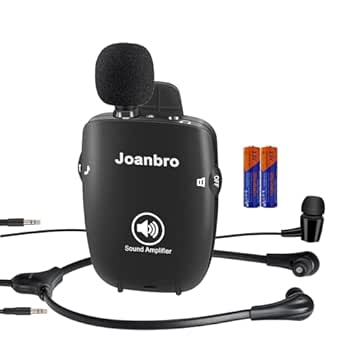 | Best for Flexible Microphone Placement | Gain: 50 dB; up to 108 dB total gain | Noise control: Active noise cancellation and automatic gain control | Microphones: Three removable microphones | VIEW ON AMAZON | See Our Full Breakdown |
| SuperEar SE5000 Hearing Amplifier for Seniors, Sound Amplifier, Headphones |  | Best for Simple Portable Listening | Amplification range: 50+ dB | Battery life: Up to 30 hours | Microphone: Swivel microphone | VIEW ON AMAZON | See Our Full Breakdown |
| Hearing Aids for Seniors, Neckband Style Bluetooth Earphones |  | Best for Bluetooth Convenience | Fit: Neckband | Bluetooth: Bluetooth 5.3 | Battery type: Lithium-ion | VIEW ON AMAZON | See Our Full Breakdown |
| Williams Sound Pocketalker Ultra Hearing Amplifier |  | Best for Straightforward Body-Worn Use | Amplification: Up to 40 dB | Fit: Body-worn | Controls: Button control with adjustable volume and tone | VIEW ON AMAZON | See Our Full Breakdown |
| Retekess TT119 Assistive Listening System – Church Translation (1 TX, 10 RX) |  | Best for Large Group Venues | System configuration: One transmitter and 10 receivers | Transmission range: Up to 300 m (984 ft) | Channels: 17 | VIEW ON AMAZON | See Our Full Breakdown |
| Bluetooth Hearing Amplifiers for Seniors and Hearing Impairments |  | Best for Daily Personal Use | Battery Life: 45 hours | Connectivity: Bluetooth (iOS/Android) | Noise Control: Environmental Noise Cancellation | VIEW ON AMAZON | See Our Full Breakdown |
| Avantree Audiplex M3 Multi-Channel Assistive Listening System |  | Best for Group Settings | Channels Supported: Up to 4 | Wireless Range: 100 meters / 328 feet | Audio Latency: 30ms | VIEW ON AMAZON | See Our Full Breakdown |
| Reizen Loud Ear 110dB Gain Personal Amplifier |  | Best for High-Volume Amplification | Sensitivity: 110dB ±3dB | Battery Life: 48 hours | Frequency Range: 20Hz – 20KHz | VIEW ON AMAZON | See Our Full Breakdown |
| assistive listening devices for auditory processing disorder | Battery life |
|---|---|
| Rechargeable Hearing Amplifier | Up to 40 hours |
| Avantree AuraPlex MX Auracast | — |
| Venucast AuraPlex M3 Auracast | — |
| ConvoAssist™ Personal Sound Am | Up to 8 hours per charge |
| CORE Bone Conduction Sound Amp | — |
| Joanbro Personal Sound Amplifi | About 40 hours |
| SuperEar SE5000 Hearing Amplif | Up to 30 hours |
| Hearing Aids for Seniors | Over 24 hours per charge |
| Williams Sound Pocketalker Ult | — |
| Retekess TT119 Assistive Liste | — |
| Bluetooth Hearing Amplifiers f | 45 hours |
| Avantree Audiplex M3 Multi-Cha | — |
| Reizen Loud Ear 110dB Gain Per | 48 hours |
More Details on Our Top Picks
Rechargeable Hearing Amplifier for Seniors, 45dB Sound Gain, Lightweight Behind-The-Ear Hearing Aid
This behind-the-ear amplifier is the most straightforward personal option here: its 45 dB sound gain and one-touch volume control are aimed at making everyday conversation and TV easier to hear, without a separate transmitter or phone setup. Compared with the ConvoAssist, which sends sound from wireless microphones to headphones, this model is simpler for general listening but offers less control over which speaker is emphasized. Its 40-hour rechargeable battery is a practical advantage over ConvoAssist’s stated eight hours per charge, though it still needs regular charging. The tradeoff is that amplification alone may raise background noise along with speech, and the listing gives no directional microphone or noise-processing details. I’d choose it for uncomplicated daily use, not for a group setting where isolating one voice matters.
Pros:- Up to 45 dB of sound gain for general listening
- Up to 40 hours of use per charge
- Lightweight behind-the-ear design
- One-touch volume control keeps operation simple
Cons:- General amplification may raise surrounding noise along with speech
- No additional speech-selection or connectivity features are specified
- Requires charging and may not suit severe hearing loss
Best for: Older adults seeking a lightweight, simple amplifier for everyday conversation, television, and routine activities.
Not ideal for: People who need a microphone placed near a distant or specific speaker, detailed noise-control features, or support for severe hearing loss.
- Sound gain:Up to 45 dB
- Battery life:Up to 40 hours
- Design:Behind-the-ear
- Rechargeable:Yes
- Volume control:One-touch
- Intended use:Seniors, conversations, TV, and outdoor activities
Our verdict“Choose this for simple, long-running everyday amplification, but pick ConvoAssist if placing microphones near speakers is a priority.”
Avantree AuraPlex MX Auracast Assistive Listening Devices for Churches
The AuraPlex MX is the strongest fit in this group for a venue serving several listeners: the package includes one transmitter and ten receivers, so a church, classroom, or event can distribute dedicated listening units rather than relying on general amplification. Its stated 328-foot range and Auracast support also give compatible hearing aids and devices a way to receive synchronized audio. Compared with the Venucast AuraPlex M3, the MX is packaged for a larger group; the M3’s three receivers make more sense for a small class or household. That scale comes with limits: Auracast functionality depends on compatible equipment, and the system is not recommended for outdoor or heavily obstructed settings. For auditory processing needs, it can deliver a cleaner, focused program feed, but it does not by itself clarify every face-to-face conversation.
Pros:- Includes ten receivers for group distribution
- Auracast and Bluetooth LE Audio support
- Stated range of up to 328 feet for medium venues
- Bluetooth, optical, and AUX connectivity options
Cons:- Full Auracast use depends on compatible hearing aids or devices
- Not recommended for outdoor or heavily obstructed environments
- A venue system is less suited to spontaneous one-to-one conversations
Best for: Churches, classrooms, and event organizers who need to provide listening receivers to a group and can confirm device compatibility.
Not ideal for: Individuals seeking a portable personal conversation amplifier, or venues with large outdoor spaces, heavy obstructions, or no compatible receiving devices.
- System type:Assistive listening system
- Included receivers:10
- Range:Up to 328 feet
- Supported standards:Auracast, Bluetooth
- Connectivity:Bluetooth, optical, AUX
- Battery type:Lithium
- Receiver weight:7 g
Our verdict“Choose the MX when a medium venue needs to serve more listeners than the three-receiver Venucast M3 can accommodate.”
Venucast AuraPlex M3 Auracast Assistive Listening System for Churches
With three AuraClip receivers and a transmitter, the AuraPlex M3 suits a small congregation, classroom, or family group that needs a shared audio feed without managing a larger receiver pool. It supports Bluetooth LE Audio, optical, and AUX, which gives organizers several ways to connect a source. Compared with the Avantree AuraPlex MX, the M3 includes fewer receivers, but that smaller package is a closer match for a room with only a handful of listeners. Its stated range reaches 328 feet, although the system is not water resistant and the listing warns against outdoor or heavily obstructed use. For auditory processing, a direct program feed can reduce the effort of following a service or presentation; it is not a substitute for a personal microphone setup when the goal is to follow one speaker in a changing conversation.
Pros:- Three AuraClip receivers suit a small group
- Bluetooth LE Audio, optical, and AUX input options
- Stated range of up to 328 feet
- Includes a three-slot charging base and connection accessories
Cons:- Three receivers may be insufficient for larger groups compared with the Avantree MX
- Not water resistant and not recommended for obstructed or outdoor environments
- Compatible devices are required to use Auracast functionality
Best for: Small churches, classes, and groups that need a shared listening feed for up to three receiver users.
Not ideal for: Large venues needing many receivers, outdoor use, or listeners who need a portable device focused on individual conversation.
- Model:AuraPlex M3 (BTTC-500K)
- Included receivers:3 AuraClip receivers
- Range:Up to 328 feet
- Connectivity:Bluetooth LE Audio, optical, AUX
- Charging base:Three-slot
- Included audio accessories:3.5 mm cable, optical cable, dual 6.35 mm TS to 3.5 mm TRS adapter
- Water resistance:Not water resistant
Our verdict“Pick the M3 for a small group needing a shared program feed; choose the Avantree MX when more receivers are required.”
ConvoAssist™ Personal Sound Amplifier with Dual Wireless Microphones and Rechargeable Case
ConvoAssist takes a more targeted approach than a conventional amplifier: its two wireless clip-on microphones can be placed near conversation partners, sending their voices to the listener’s headphones or earbuds. That makes it a better match for auditory processing challenges in conversations than the Rechargeable Hearing Amplifier, which provides general sound gain rather than a selectable nearby voice. Automatic pairing and headphone compatibility also keep the setup relatively approachable, while the portable case supports up to eight hours of use per charge. The tradeoff is dependence on headphones and microphone placement; it is less convenient if the user wants a self-contained behind-the-ear device. The product information offers little detail on noise control, so a microphone may still pick up surrounding sound. I’d favor it for planned conversations, not as a venue-wide listening system like the AuraPlex models.
Pros:- Two wireless microphones can be placed near conversation partners
- Works with headphones or earbuds
- Automatic pairing reduces setup steps
- Portable rechargeable case is included
Cons:- Requires headphones or earbuds for listening
- Up to eight hours of use per charge may not cover a full day
- Noise-control performance is not detailed
Best for: People who struggle to follow one or two conversation partners and are comfortable wearing headphones or earbuds with clip-on microphones.
Not ideal for: Listeners who want a self-contained hearing amplifier, need all-day use beyond the stated eight hours per charge, or need a venue-wide broadcast system.
- Microphones:Two wireless clip-on microphones
- Battery life:Up to 8 hours per charge
- Power source:Rechargeable lithium polymer batteries
- Headphone compatibility:Works with headphones or earbuds
- Charging case:Portable magnetic case
- Weight:8 ounces
- Included accessories:Wired earbuds and USB charging cable
Our verdict“Choose ConvoAssist to bring nearby speakers’ voices to your headphones, rather than for general amplification or group broadcasts.”
CORE Bone Conduction Sound Amplifier for Seniors – Open-Ear Hearing Support for Clearer Conversations
The CORE stands apart from the behind-the-ear amplifier by using a lightweight open-ear fit with independent left- and right-side volume control. That design may appeal to listeners who dislike conventional in-ear listening and want to adjust each side separately without a phone or app. Its voice clarity optimization is intended to support conversation, while button controls keep operation simple. Compared with ConvoAssist, CORE is a self-contained personal device rather than a system that sends audio from clip-on microphones to existing headphones; that is simpler to carry, but it offers less flexibility in placing a microphone close to a speaker. The listing provides limited detail about its sound processing and battery runtime, so buyers cannot readily judge how it will perform in noisy settings or between charges. It is best viewed as basic personal support, not a substitute for a clinical hearing assessment.
Pros:- Open-ear design avoids an in-ear fit
- Independent left- and right-side volume controls
- Standalone operation with button controls and no app required
- Lightweight 20 g construction
Cons:- No smartphone connectivity or app support
- Battery runtime is not specified
- Limited product detail makes noise performance difficult to judge
Best for: Older adults who prefer open-ear wear, want separate left/right volume adjustment, and do not want app-based setup.
Not ideal for: People who need a microphone close to a distant speaker, detailed battery-runtime information, or advanced connectivity and sound controls.
- Fit:Open-ear, behind-the-ear
- Weight:20 g
- Controls:Button controls with independent left/right volume
- Special features:Voice clarity optimization, rechargeable battery
- Battery:One included lithium-ion battery
- Connectivity:Standalone; no phone or app required
- Materials:ABS plastic and silicone
Our verdict“Choose CORE for simple open-ear personal listening, but consider ConvoAssist if placing microphones near speakers matters more.”
Joanbro Personal Sound Amplifier for Seniors – 50dB Gain with Headphones & Earbud, Multiple Mic Options
The Joanbro stands out for listeners who need to bring a speaker’s voice closer, rather than simply amplify everything around them. Its three removable microphones have cables ranging from 2 to 19 feet, giving it more placement flexibility than the SuperEar SE5000’s swivel microphone. That can help in a home conversation or when positioning a mic near a TV speaker, though it is not a wireless, speech-filtering system designed specifically for auditory processing needs. Adjustable tone and volume offer some personalization, while the stated gain makes careful volume adjustment especially important. The tradeoff is a tangle of cables and accessories that may be less convenient for quick everyday use. Compared with the body-worn Williams Sound Pocketalker Ultra, Joanbro offers more mic-placement choices but a more involved setup.
Pros:- Three removable microphones with different cable lengths allow flexible placement
- Adjustable tone and volume support basic sound personalization
- Includes headphones and a single earbud for different listening preferences
- Runs for up to about 40 hours on two AAA batteries
Cons:- Multiple cables and accessories can make setup and storage cumbersome
- High amplification calls for cautious volume adjustment
- Sound amplification alone may not resolve difficulty separating speech from competing voices
Best for: People who want to position a microphone near a conversation partner or TV and can manage a wired setup.
Not ideal for: Listeners who need a discreet, wireless device or prefer a simple one-piece setup with fewer cables and controls.
- Gain:50 dB; up to 108 dB total gain
- Noise control:Active noise cancellation and automatic gain control
- Microphones:Three removable microphones
- Microphone cable lengths:2.0 ft, 6.6 ft, and 19 ft
- Fit:In-ear
- Controls:Button control, volume knob, and tone wheel
- Power:Two included alkaline AAA batteries
- Battery life:About 40 hours
- Included accessories:Belt clip, anti-dropping headphones, single earbud, suction cup microphone, and extension cables
Our verdict“Choose Joanbro if microphone placement flexibility matters more than a compact, wireless setup.”
SuperEar SE5000 Hearing Amplifier for Seniors, Sound Amplifier, Headphones
The SuperEar SE5000 is the straightforward pick for someone who wants to carry an amplifier between rooms or take it outdoors without managing a larger system. Its swivel microphone and adjustable volume focus on nearby ambient sound, while the included stereo headphones and earbuds give the listener a choice of fit. Compared with the Joanbro, it has fewer microphone-placement options and less detailed tone adjustment, but that simpler arrangement may suit a buyer who wants fewer pieces to organize. It is still an amplifier, not a selective speech-processing device: noisy surroundings can remain challenging when several voices compete. The lack of wireless connection also rules out direct pairing with a phone or TV, unlike the Bluetooth neckband option in this lineup.
Pros:- Portable design with a swivel microphone for directing pickup
- Adjustable volume accommodates different listening levels
- Includes stereo headphones and earbuds
- Up to 30 hours of battery life
Cons:- Does not connect wirelessly to phones, TVs, or other devices
- Amplifies ambient sound rather than isolating speech from competing voices
- Provides fewer microphone-placement choices than the Joanbro
Best for: Listeners who want a lightweight, battery-powered amplifier for nearby conversations and ambient sound at home or outdoors.
Not ideal for: People seeking direct wireless phone or TV audio, or listeners who need speech separated from busy background noise.
- Amplification range:50+ dB
- Battery life:Up to 30 hours
- Microphone:Swivel microphone
- Controls:Adjustable volume
- Included listening accessories:Stereo headphones and earbuds
- Power:AAA battery included
- Included carrying accessory:Belt clip
- Compatibility:Compatible with disposable earpad covers and extension cables
Our verdict“Pick the SuperEar for portable, uncomplicated ambient amplification when wireless device audio is not a requirement.”
Hearing Aids for Seniors, Neckband Style Bluetooth Earphones
This neckband is the lineup’s most convenient route to Bluetooth audio from compatible phones and TVs, making it a different kind of choice from the microphone-based Joanbro and SuperEar amplifiers. Its rechargeable design and stated 24-hour-plus runtime can suit someone who wants to keep calls, programs, and everyday listening in one wearable device. Noise-reduction modes may help with listening comfort, but the product information does not specify a directional microphone, a speech-in-noise measure, or detailed settings for auditory processing needs. That makes it harder to judge how well it separates a speaker from competing sounds. The neckband may also feel less discreet than an in-ear option, and its controls may take practice. I’d choose it for device connectivity, not as a proven solution for complex listening environments.
Pros:- Bluetooth 5.3 supports pairing with compatible devices
- Rechargeable battery offers over 24 hours of stated use
- Lightweight neckband format avoids managing separate cables
- Noise-reduction modes and button controls are provided
Cons:- Product details provide limited information about speech separation and sound customization
- Controls may be less intuitive for some users
- Neckband form is less discreet than a small ear-level amplifier
Best for: People who regularly listen to phone calls or TV audio and prefer a rechargeable Bluetooth neckband over a wired amplifier.
Not ideal for: Listeners who need a clearly documented speech-focused system for group settings or want a small, discreet in-ear device.
- Fit:Neckband
- Bluetooth:Bluetooth 5.3
- Battery type:Lithium-ion
- Battery voltage:3.7 V
- Battery life:Over 24 hours per charge
- Controls:Button control
- Audio sensitivity:100 dB
- Dimensions:6.6 x 5.5 inches
- Weight:1 ounce
Our verdict“Choose this neckband if Bluetooth access and rechargeable everyday listening matter more than detailed evidence of speech-in-noise performance.”
Williams Sound Pocketalker Ultra Hearing Amplifier
The Pocketalker Ultra earns its place for listeners who want a body-worn amplifier with direct volume and tone controls, rather than the neckband Bluetooth approach or the Joanbro’s collection of microphone cables. Its compact control unit and included headphones, earbuds, and microphone extension give buyers several ways to arrange a listening setup. The tone control may help tailor sound, but amplification remains different from separating speech from competing voices, so auditory processing challenges in groups may persist. The listed amplification reaches up to 40 dB, making this a more modestly specified option than the SuperEar’s 50+ dB range and Joanbro’s stated total gain. That may be a sensible fit for mild to moderate needs, but not for someone seeking stronger amplification. It also depends on batteries rather than recharging.
Pros:- Body-worn design keeps the controls accessible
- Separate volume and tone controls allow basic sound adjustment
- Includes headphones, earbuds, and a microphone extension
- Portable unit measures 3.38 by 2.23 inches
Cons:- Specified amplification is limited to up to 40 dB
- Uses batteries rather than a rechargeable power system
- May not address speech-separation difficulties associated with auditory processing disorder
Best for: People with mild to moderate hearing needs who want a simple body-worn amplifier with volume and tone adjustment.
Not ideal for: People who need stronger amplification, rechargeable operation, or a system designed to distinguish speech from multiple competing voices.
- Amplification:Up to 40 dB
- Fit:Body-worn
- Controls:Button control with adjustable volume and tone
- Power:Alkaline batteries
- Dimensions:3.38 x 2.23 inches
- Weight:16 ounces
- Included accessories:Headphones, earbuds, microphone extension, batteries, and accessories
- Compatible devices:PockeTalker HED021 Deluxe Headphones, PockeTalker EAR013 Single Earbud, and neckloops
Our verdict“Pick the Pocketalker Ultra for a portable, adjustable amplifier suited to mild to moderate listening needs.”
Retekess TT119 Assistive Listening System – Church Translation (1 TX, 10 RX)
Unlike the personal amplifiers in this group, the Retekess TT119 is built to send a shared audio feed across a venue. Its transmitter supports 17 channels and a stated range up to 300 metres, giving churches, conference rooms, and auditoriums a way to provide listeners with a receiver-based feed rather than relying on room acoustics alone. That can be useful for following one presenter, but it is a venue system, not an individual device for everyday conversations or unscripted group discussion. Compared with the Avantree Auracast systems mentioned elsewhere in this roundup, the TT119 is specified around FM transmission and multiple channels; buyers should match the system to their venue’s equipment and operating needs. The transmitter is heavy, and each receiver runs on a single AA battery for up to 10 hours.
Pros:- Stated operating range reaches up to 300 metres
- Supports 17 simultaneous channels for multi-channel use
- Accepts XLR, AUX, RCA, and USB audio inputs
- Receiver weighs 90 grams and runs for up to 10 hours
Cons:- Transmitter weighs 3.86 kg and is less practical for personal use
- Receiver relies on a single AA battery
- Default mono output may require manual adjustment for stereo
Best for: Churches and event organizers who need to distribute a presenter or translated audio feed to listeners across a large venue.
Not ideal for: Individuals seeking a personal daily-use amplifier, or small groups that do not need a dedicated transmitter and receiver system.
- System configuration:One transmitter and 10 receivers
- Transmission range:Up to 300 m (984 ft)
- Channels:17
- Connectivity:Auxiliary, FM, and wireless
- Input support:XLR, AUX, RCA, and USB
- Transmitter power:Corded electric
- Receiver power:One AA battery
- Receiver battery life:Up to 10 hours
- Receiver weight:90 grams
Our verdict“Choose the TT119 when a venue needs long-range distribution of a specific speaker or translation feed, not for individual everyday listening.”
Bluetooth Hearing Amplifiers for Seniors and Hearing Impairments
This device stands out for its 45-hour battery life and seamless Bluetooth connectivity, making it a versatile choice for individuals who need to switch between phone calls and ambient sound enhancement. Unlike the Reizen Loud Ear 110dB, which relies on raw amplification power, this model offers noise-canceling modes that help filter out background static, a critical feature for those with auditory processing disorder who struggle to separate speech from noise. The LED display provides immediate feedback on battery and mode status, reducing the guesswork often associated with smaller hearing aids. However, the in-ear fit can be problematic for users with smaller ear canals, and the lack of detailed app customization means you cannot fine-tune frequency responses as precisely as with higher-end medical devices. It is a solid daily driver but lacks the granular control needed for complex listening environments.Pros:- Extended 45-hour battery life reduces charging frequency
- Bluetooth pairing allows direct audio streaming from phones and tablets
- Environmental noise cancellation helps isolate speech in busy settings
- Clear LED display simplifies battery and mode monitoring
Cons:- In-ear design may cause discomfort or fit issues for some users
- Limited software customization compared to app-enabled competitors
- Requires charging every two days under heavy usage
Best for: Active individuals who need a reliable, rechargeable device for phone calls and general environmental listening throughout the day.
Not ideal for: Users with very small ear canals or those who require specific frequency adjustments via a smartphone app.
- Battery Life:45 hours
- Connectivity:Bluetooth (iOS/Android)
- Noise Control:Environmental Noise Cancellation
- Battery Capacity:400mAh
- Charging Time:2 hours
- Weight:22.68 g
- Control Type:Push Button with LED Display
Our verdict“This is the ideal choice for seniors or adults who prioritize battery longevity and Bluetooth convenience over complex audio tuning.”
Avantree Audiplex M3 Multi-Channel Assistive Listening System
While most personal amplifiers focus on individual use, the Avantree Audiplex M3 excels in group environments like classrooms or small meetings. Its multi-channel support allows multiple listeners to tune into different audio sources without interference, a feature completely absent in single-user devices like the Reizen Loud Ear 110dB. The 30ms low latency is particularly beneficial for auditory processing disorder, as it ensures that lip movements match the audio, reducing cognitive load during speech. With a 100-meter range, it covers medium-sized venues effectively. However, the system is bulkier and less portable than personal in-ear devices, and the package includes only three receivers, which may require additional purchases for larger groups. It is a specialized tool rather than a daily wearable, making it less suitable for solitary activities like grocery shopping.Pros:- Multi-channel capability supports simultaneous different audio streams
- Low latency ensures synchronized audio for speech and video
- Long wireless range of 100 meters covers medium venues
- Includes wired earbuds for immediate plug-and-play usage
Cons:- Limited to 3 receivers in the standard package
- Bulkier transmitter unit is not designed for pocket portability
- No mention of app-based control or configuration options
Best for: Educators, small group leaders, or families who need to share specific audio content in shared spaces.
Not ideal for: Individuals seeking a discreet, pocketable device for solo use in public places.
- Channels Supported:Up to 4
- Wireless Range:100 meters / 328 feet
- Audio Latency:30ms
- Included Receivers:3 Clip-on Receivers
- Power Source:3 Lithium-ion Batteries
- Total Weight:706 g
- Audio Input:Wired Earbuds Included
Our verdict“This system is the best option for structured group activities where synchronized, multi-source audio is required.”
Reizen Loud Ear 110dB Gain Personal Amplifier
The Reizen Loud Ear distinguishes itself with a massive 110dB gain, making it suitable for users who need extreme volume boost rather than nuanced sound processing. Compared to the Bluetooth Hearing Amplifiers, which offer noise cancellation and connectivity, this device is purely analog and simplistic, lacking any digital signal processing that might help with auditory processing disorder. Its 100-foot pickup range allows users to hear distant sounds, which can be helpful in large open spaces but problematic in close quarters where background noise becomes overwhelming. The reliance on two AAA batteries is a logistical drawback compared to the rechargeable options in this list. While it is durable and straightforward, the lack of tone control or noise reduction means it amplifies everything equally, potentially causing listening fatigue for those sensitive to auditory clutter.Pros:- Extremely high 110dB gain for severe hearing needs
- Long 48-hour battery life using standard AAA batteries
- Simple, durable plastic construction with belt clip
- Wide frequency range of 20Hz – 20KHz
Cons:- No noise cancellation or tone control features
- Requires replacement AAA batteries instead of charging
- Amplifies background noise equally, risking listening fatigue
Best for: Users with significant hearing loss who need maximum volume amplification without the complexity of digital features.
Not ideal for: Individuals with auditory processing disorder who need noise filtering or frequency-specific adjustments.
- Sensitivity:110dB ±3dB
- Battery Life:48 hours
- Frequency Range:20Hz – 20KHz
- Power Source:2 AAA Batteries
- Weight:2.4 ounces
- Dimensions:2.5″ H x 1.75″ L x 0.75″ W
- Pickup Range:Up to 100 feet
Our verdict“This amplifier is best for users who need raw power and simplicity over advanced audio processing capabilities.”

How We Picked
I evaluated these devices based on their ability to improve the signal-to-noise ratio, which is the primary challenge for individuals with Auditory Processing Disorder. Rather than focusing solely on maximum decibel output, I prioritized features that enhance speech intelligibility, such as directional microphones, noise cancellation algorithms, and frequency-specific amplification. I also assessed the versatility of connectivity, favoring devices that integrate seamlessly with modern Bluetooth standards and Auracast protocols, which offer greater flexibility than older infrared or FM systems.
Usability and form factor were equally important, as devices that are cumbersome or require technical setup are often abandoned by users. I compared the ergonomics of behind-the-ear models against neckband and pocket styles to determine which offered the best balance of discretion and performance. Finally, I looked at ecosystem compatibility, ensuring that recommended systems could work with a variety of headphones and hearing aids, providing a future-proof solution for changing user needs.
Factors to Consider When Choosing Assistive Listening Devices For Auditory Processing Disorder
Selecting a device for APD is different from selecting a standard hearing aid or amplifier. The goal is not just to make sounds louder, but to make them clearer and easier to process. Here are the critical factors to weigh before making your decision.
Signal Clarity vs. Raw Volume
Many buyers mistakenly assume that higher decibel gain equals better performance. For APD, raw volume can actually worsen listening fatigue by amplifying background noise alongside speech. Look for devices with noise reduction capabilities or directional microphones that focus on the speaker in front of you. The ConvoAssist, for example, uses a wireless lavalier mic to capture the speaker’s voice directly, bypassing room reverberation entirely. This approach reduces the brain’s effort to decode mixed audio streams, which is far more beneficial than simply turning up the volume on a standard amplifier.
The Importance of Auracast and Bluetooth Standards
Traditional assistive listening systems use FM or Infrared (IR) technology, which require specialized receivers that can be bulky and prone to interference. Auracast (Bluetooth LE Audio) represents a significant shift, allowing users to stream audio directly to compatible Bluetooth headphones or hearing aids. This eliminates the need to carry extra hardware and provides a more natural listening experience. If you already own high-quality Bluetooth headphones, choosing an Auracast-compatible transmitter like the Avantree AuraPlex allows you to leverage your existing gear. This interoperability is a major long-term advantage over closed-system FM devices.
Form Factor and Sensory Preferences
Individuals with APD often have co-occurring sensory sensitivities. Some may find the sensation of something in their ear canal (occlusion effect) distracting or uncomfortable. Bone conduction devices bypass the ear canal entirely, transmitting sound through the cheekbones. This keeps the ear open, which can reduce feelings of claustrophobia and allow for better awareness of surroundings. Conversely, those who need total isolation from environmental noise might prefer in-ear monitors or over-ear headphones connected to a transmitter. Assess your sensory profile before choosing between open-ear, in-ear, or bone conduction formats.
Ease of Use and Daily Integration
A device is only useful if you actually use it. Complex pairing processes, frequent charging needs, or unintuitive controls can lead to abandonment. I prioritized devices with simple, one-touch operation and long battery life. For instance, neckband styles often offer easier handling for those with fine motor skill challenges compared to tiny behind-the-ear models that are hard to insert. Consider where you will use the device most: if it is primarily for one-on-one conversations, a portable personal amplifier with a wireless mic is ideal; if it is for lectures or church services, a receiver-based system is more practical.
Future-Proofing and Ecosystem Compatibility
Technology in hearing assistance is evolving rapidly. Buying into a proprietary, closed ecosystem can limit your options if you change your primary headphones or hearing aids. Devices that adhere to open standards, such as Bluetooth LE Audio and Auracast, are more likely to remain compatible with future devices. Additionally, check if the manufacturer offers software updates or app-based customization. Being able to adjust frequency responses or noise reduction levels via an app allows you to fine-tune the device to your specific auditory processing profile, a feature that standard analog amplifiers lack.
Frequently Asked Questions
Do assistive listening devices cure auditory processing disorder?
No, assistive listening devices do not cure auditory processing disorder. APD is a neurological condition related to how the brain interprets sound, not a physical damage to the ear. These devices function as compensatory tools that make listening easier and less fatiguing by improving the clarity of the signal reaching the ear. They help manage symptoms in specific environments, such as noisy classrooms or meetings, but they do not alter the underlying neural processing deficits. Therapy and accommodations remain the primary methods for managing APD long-term.
Can I use my regular Bluetooth headphones with an assistive listening transmitter?
It depends on the technology used. Traditional FM or Infrared transmitters require their own specific receivers and will not work with standard Bluetooth headphones. However, Auracast-enabled transmitters (like the Avantree AuraPlex) are designed to broadcast audio via Bluetooth LE Audio, which can be received by compatible Bluetooth headphones or hearing aids. If you want to use your existing headphones, you must ensure both the transmitter and your headphones support Auracast or standard Bluetooth streaming protocols. Always check compatibility lists before purchasing.
Why is a wireless microphone better than a built-in microphone for APD?
A wireless microphone, such as a lavalier or neck-worn mic, captures the speaker’s voice at close range, resulting in a much stronger signal-to-noise ratio. Built-in microphones on hearing amplifiers pick up sound from all directions, including background noise, HVAC hum, and reverberation. For someone with APD, this extra noise makes it difficult for the brain to isolate speech. A wireless mic filters out distant noise and delivers a clearer, more direct audio stream to your receiver, significantly reducing the cognitive effort required to understand conversation.
Are bone conduction devices effective for auditory processing disorder?
Bone conduction devices can be highly effective for some individuals with APD, particularly those who experience sensory overload from having their ear canals blocked. By transmitting sound through the cheekbones, these devices leave the ear canal open, allowing natural environmental sounds to mix with amplified speech. This can feel more natural and less disorienting than traditional hearing aids. However, bone conduction typically offers lower fidelity and bass response than air-conduction devices, so it may be better suited for voice-focused applications rather than music or complex audio environments.
How do I know if I need a personal amplifier or a system for public spaces?
This depends on your primary listening challenges. If you struggle mainly in one-on-one conversations or small groups, a personal amplifier with a wireless microphone (like the ConvoAssist) is the most practical and discreet choice. If your difficulties arise in large venues like churches, theaters, or lecture halls, a personal amplifier will struggle with distance and reverberation. In these cases, you need a system that connects to the venue’s infrastructure (via Auracast, FM, or IR) to receive the direct audio feed from the speaker’s microphone, bypassing the room’s acoustic issues entirely.
Conclusion
Choosing the right assistive listening device for auditory processing disorder hinges on matching the technology to your specific listening environments and sensory preferences. For most users seeking versatile, high-clarity assistance in daily life, the ConvoAssist Personal Sound Amplifier is the best overall choice due to its dual wireless microphones and focus on speech intelligibility. If you frequently attend large events or religious services, the Avantree AuraPlex MX is the premium pick for its Auracast compatibility and ease of use with standard Bluetooth headphones. For those on a budget or needing a simple entry point, the Williams Sound Pocketalker Ultra remains a reliable, no-frills option for basic amplification. Finally, if you have sensitivity to ear canal occlusion, the CORE Bone Conduction Sound Amplifier offers a unique, open-ear solution that reduces sensory fatigue. Evaluate your primary environments and sensory tolerances to make the most informed decision.