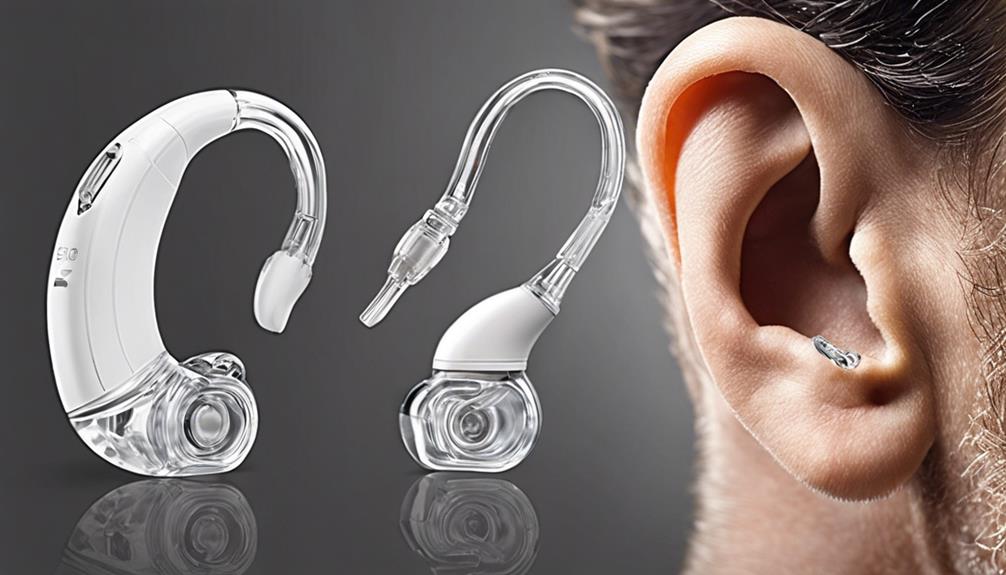
Bluetooth audio transmitters for hearing assistance can send TV or travel audio to compatible hearing aids, but compatibility matters more than a long feature list. My best overall pick is the BA210 v2 Auracast Bluetooth Transmitter for its Auracast support and optical and 3.5mm inputs. For a hearing-aid-focused TV setup, the Phonak TV Connector is a standout when paired with compatible Phonak aids, while the BT618T is another option for shoppers seeking TV audio with Auracast support. The main tradeoff is between broad input flexibility and direct compatibility with a specific hearing-aid system. Read on for how the six options differ and what to check before choosing.

Get everyday helpers delivered free with Prime
- Fast, free delivery on millions of items
- Prime Video, Amazon Music and more included
- Member-only deals all year
Key Takeaways
- The BA210 v2 leads on connection flexibility: optical and 3.5mm inputs give it more ways to connect to audio sources than a single-purpose TV streamer.
- Hearing-aid compatibility is not universal: the Phonak TV Connector is purpose-built for compatible Phonak hearing aids, so buyers should verify their aid model before choosing it.
- Auracast support is a distinct advantage, not a guarantee: the BA210 v2, BT618T, and airplane LE Audio adapter advertise Auracast, but the receiving hearing aids must support the relevant broadcast features.
- Travel adapters and home TV streamers solve different problems: the compact airplane-focused adapter prioritizes portable listening, while the Phonak Connector and BT618T are aimed at TV audio.
- Feature-heavy general adapters have a compatibility tradeoff: the Ultra Bluetooth 5.4 and 2026 Bluetooth 6.0 models offer broad device use, but their transmitter and receiver functions do not by themselves confirm hearing-aid support.
| BA210 v2 Auracast Bluetooth Transmitter with aptX Lossless and Optical & 3.5mm Inputs |  | Best Overall for Auracast-Capable Hearing Aids | Wireless technology: Auracast | Audio technologies: aptX Lossless, aptX HD | Inputs: Optical, 3.5mm, RCA | VIEW ON AMAZON | See Our Full Breakdown |
| Ultra Bluetooth 5.4 Transmitter Receiver with CNC Metal & Glass – Airplane Bluetooth Adapter with Qualcomm aptX LL/HD, Compatible with AirPods & Headphones, Wireless Audio for Travel, TV, Gym |  | Best Compact Travel Adapter | Bluetooth version: 5.4 | Modes: Transmitter and receiver | Battery life: Up to 24 hours | VIEW ON AMAZON | See Our Full Breakdown |
| 2026 Upgraded Pro Bluetooth 6.0 Transmitter Receiver – Wireless Adapter for TV, Airplane, Gym, Car, Home Stereo |  | Best for Sharing with Two Bluetooth Listeners | Bluetooth version: 6.0 | Modes: Transmitter and receiver | Battery life: 20+ hours | VIEW ON AMAZON | See Our Full Breakdown |
| Phonak TV Connector for Hearing Aids – Wireless Bluetooth Audio Streaming Device for Clear TV Sound |  | Best for Compatible Phonak Hearing Aids | Compatible hearing aids: Phonak Marvel, Paradise, Lumity, Audéo, Naída, Bolero | Inputs: Optical (TOSLINK), 3.5mm auxiliary | Audio output: Stereo | VIEW ON AMAZON | See Our Full Breakdown |
| Auracast & Bluetooth TV Audio Transmitter for Hearing Aids – BT618T |  | Best for Multi-Device Auracast Setups | Bluetooth version: 5.4 | Chipset: Qualcomm QCC3086 | Audio codecs: aptX HD, aptX Adaptive, AAC, SBC | VIEW ON AMAZON | See Our Full Breakdown |
| Airplane Bluetooth LE Audio Adapter & Auracast Transmitter for Hearing Aids |  | Best for Travel and Auracast Sharing | Audio input: 3.5mm AUX | Hardware interfaces: 3.5mm audio; USB Type-C | Supported standards: Bluetooth LE Audio, LC3, aptX, aptX Adaptive, aptX-HD | VIEW ON AMAZON | See Our Full Breakdown |
| bluetooth audio transmitters for hearing assistance | Inputs | Bluetooth version |
|---|---|---|
| BA210 v2 Auracast Bluetooth Tr | Optical, 3.5mm, RCA | — |
| Ultra Bluetooth 5.4 Transmitte | — | 5.4 |
| 2026 Upgraded Pro Bluetooth 6. | — | 6.0 |
| Phonak TV Connector for Hearin | Optical (TOSLINK), 3.5mm auxiliary | — |
| Auracast & Bluetooth TV Audio | HDMI ARC, optical (SPDIF), 3.5mm AUX, MIC | 5.4 |
| Airplane Bluetooth LE Audio Ad | — | — |
More Details on Our Top Picks
BA210 v2 Auracast Bluetooth Transmitter with aptX Lossless and Optical & 3.5mm Inputs
For a TV setup where Auracast-enabled hearing aids are the priority, the BA210 v2 offers a useful mix of broadcast support and wired inputs. Its optical, 3.5mm, and RCA connections cover many televisions and audio sources, while its listed Auracast range reaches up to 330 feet in line of sight. That makes it more suitable for sharing audio across a room or larger space than the Phonak TV Connector, which is designed for specific Phonak hearing aids and has a shorter stated range.
The tradeoff is setup: optical output needs the source set to PCM, and the product data gives little detail about app controls. Its aptX features are useful only when connected devices support the relevant codecs; hearing-aid compatibility should be checked before buying. I rank it ahead of conventional adapters for its broadcast focus, but not for shoppers seeking a brand-specific, hands-off Phonak connection.
Pros:- Auracast broadcast can send audio to multiple compatible devices.
- Optical, 3.5mm, and RCA inputs suit a range of TVs and audio sources.
- Listed line-of-sight range reaches up to 330 feet for Auracast.
- Supports aptX Lossless and aptX HD with compatible devices.
Cons:- Optical sources need to be set to PCM.
- Compatibility depends on the hearing aids supporting Auracast.
- App-control features are not clearly detailed in the product information.
Best for: TV viewers with Auracast-compatible hearing aids who want several input choices and the option to broadcast audio over a broad area.
Not ideal for: Owners of hearing aids that do not support Auracast, or buyers who want a simple Phonak-specific setup without checking audio formats and device compatibility.
- Wireless technology:Auracast
- Audio technologies:aptX Lossless, aptX HD
- Inputs:Optical, 3.5mm, RCA
- Standard range:Up to 165 ft (50 m), line of sight
- Auracast range:Up to 330 ft (100 m), line of sight
- Supported media:MP3, WAV, AAC, FLAC
- Enclosure:Plastic
- Warranty:1 year
Our verdict“Choose the BA210 v2 if you have Auracast-capable hearing aids and want a flexible, long-range TV broadcast transmitter.”
Ultra Bluetooth 5.4 Transmitter Receiver with CNC Metal & Glass – Airplane Bluetooth Adapter with Qualcomm aptX LL/HD, Compatible with AirPods & Headphones, Wireless Audio for Travel, TV, Gym
This small, battery-powered adapter is aimed at people who want to send or receive audio away from a fixed TV setup. At 50 g with up to 24 hours of battery life, it is easier to pack for travel than the home-focused BA210 v2 or the BT618T, which offers more input choices and Auracast broadcasting. Its transmitter and receiver modes also let it serve different roles: sending audio to headphones or receiving audio for another sound system.
For hearing assistance, though, its appeal is conditional. The supplied details do not establish Auracast support or compatibility with hearing aids, so I would treat it as a Bluetooth headphone adapter, not a dedicated aid streamer. Low-latency performance also depends on the headphones supporting aptX-LL or Adaptive, and pairing may require disconnecting earbuds. Choose it for portable headphone use; skip it if direct aid compatibility is the main requirement.
Pros:- Light 50 g design is convenient for travel.
- Up to 24 hours of battery life and a stated 1.5-hour charge time.
- Transmitter and receiver modes cover both sending and receiving audio.
- Auto-reconnect and plug-and-play operation can simplify repeat use.
Cons:- Product details do not confirm Auracast or direct hearing-aid compatibility.
- Low latency depends on headphone support for aptX-LL or Adaptive.
- Some earbuds may need to be disconnected to pair reliably.
Best for: Travelers who want a lightweight, rechargeable transmitter for compatible Bluetooth headphones and may also need receiver mode.
Not ideal for: Buyers seeking a dedicated hearing-aid transmitter, especially those whose aids rely on Auracast or a manufacturer-specific streaming connection.
- Bluetooth version:5.4
- Modes:Transmitter and receiver
- Battery life:Up to 24 hours
- Charging time:1.5 hours
- Weight:50 g
- Materials:Aerospace-grade alloy and ceramic glass
- Listed compatibility:AirPods, Sony, and other Bluetooth headphones
Our verdict“Pick this compact adapter for travel with compatible Bluetooth headphones, not as a confirmed direct streamer for hearing aids.”
2026 Upgraded Pro Bluetooth 6.0 Transmitter Receiver – Wireless Adapter for TV, Airplane, Gym, Car, Home Stereo
The main reason to choose this adapter is dual-link sharing: it is designed to send audio to multiple Bluetooth devices, which can help two listeners use their own compatible headphones. Its 20-plus-hour battery life, USB-C charging, and transmitter/receiver modes also suit travel or use with older AUX and RCA equipment. Compared with the BA210 v2, it is more portable and versatile as a general Bluetooth adapter, but it lacks the BA210’s stated Auracast broadcast range and high-quality codec details.
For hearing assistance, the limitation is decisive: the product data says it is not compatible with Bluetooth hearing aids. That makes it a poor match for the roundup’s core purpose, even if it can serve household listeners with regular headphones. I would consider it only when sharing audio between supported Bluetooth devices matters more than direct aid streaming; the Bluetooth 6.0 label alone does not establish aid compatibility.
Pros:- Dual-link sharing supports audio for multiple compatible listeners.
- More than 20 hours of playback supports extended travel or daily use.
- USB-C charging and auto-pairing simplify routine operation.
- Transmitter and receiver modes work with AUX, RCA, and Bluetooth devices.
Cons:- Not compatible with Bluetooth hearing aids, limiting its use for hearing assistance.
- The provided information does not specify detailed codec support or a range figure.
- Its sharing feature depends on the receiving devices being compatible.
Best for: Travelers or households who want to share audio with two compatible Bluetooth devices and need a battery-powered AUX or RCA adapter.
Not ideal for: Hearing-aid users seeking direct wireless TV audio; the product data specifically excludes Bluetooth hearing-aid compatibility.
- Bluetooth version:6.0
- Modes:Transmitter and receiver
- Battery life:20+ hours
- Charging:USB-C
- Connections:AUX, RCA, Bluetooth
- Pairing:Auto-pairing
- Indicators:LED battery and connection status
- Certifications:FCC, CE, RoHS, BQB
Our verdict“Choose it for sharing audio with regular Bluetooth headphones, but skip it if you need a transmitter for hearing aids.”
Phonak TV Connector for Hearing Aids – Wireless Bluetooth Audio Streaming Device for Clear TV Sound
If you already use a compatible Phonak model, the TV Connector is the most direct, brand-focused option here. It is designed to stream TV audio to listed Phonak Marvel, Paradise, Lumity, Audéo, Naída, and Bolero aids, with plug-and-play setup and no manual pairing required. That is a simpler path than the BA210 v2, which relies on Auracast compatibility and may require changing an optical source to PCM.
This simplicity comes with a narrow fit: it is not a universal hearing-aid transmitter, and the listed range is 15 meters rather than the BA210 v2’s longer stated Auracast range. It also needs a wired connection to the TV or audio source. I would favor it for a supported Phonak setup where straightforward operation matters more than broad device sharing; people with other aid brands should look at compatible alternatives instead.
Pros:- Designed for multiple listed Phonak hearing-aid families.
- Plug-and-play setup requires no manual pairing according to the product details.
- Includes optical and 3.5mm cables for common TV audio connections.
- Stated wireless range is up to 15 meters.
Cons:- Compatibility is limited to specified Phonak hearing-aid models.
- Requires a wired connection to the TV or other audio source.
- Its 15-meter range is shorter than the BA210 v2’s stated Auracast range.
Best for: Phonak hearing-aid owners with a listed compatible model who want a dedicated, straightforward way to hear TV audio through their aids.
Not ideal for: People with non-Phonak aids, or households seeking an Auracast broadcast that can serve a broad range of compatible devices.
- Compatible hearing aids:Phonak Marvel, Paradise, Lumity, Audéo, Naída, Bolero
- Inputs:Optical (TOSLINK), 3.5mm auxiliary
- Audio output:Stereo
- Range:Up to 15 m (50 ft)
- Connection type:Wired source connection
- Color:Black
- Included accessories:Power adapter, optical cable, 3.5mm cable, user manual
Our verdict“Choose the TV Connector if you own a listed compatible Phonak aid and value a dedicated, simple TV connection over universal broadcasting.”
Auracast & Bluetooth TV Audio Transmitter for Hearing Aids – BT618T
The BT618T suits buyers who want a TV transmitter to serve more than one kind of listener. It can broadcast through Auracast and Bluetooth simultaneously, and its inputs include HDMI ARC, optical, AUX, and microphone. That makes it more flexible for a shared living room, classroom, or event than the Phonak TV Connector, which is tailored to specified Phonak aids. Its stated range reaches 100 meters, and support for aptX codecs and LC3 adds options for compatible devices.
The tradeoff is setup and compatibility: Auracast requires LE Audio-capable devices, and the range and codec benefits do not make every hearing aid compatible. The BA210 v2 also offers Auracast and a longer stated Auracast range, while the BT618T stands out for HDMI ARC and its mix of outputs. I would choose this model for a multi-device installation, but not for someone who wants the simplest single-aid connection.
Pros:- Can transmit to Auracast and Bluetooth devices simultaneously.
- HDMI ARC, optical, AUX, and microphone inputs offer broad source flexibility.
- Listed range reaches up to 100 meters.
- Supports LC3 and aptX HD/Adaptive codecs for compatible devices.
Cons:- Full Auracast use requires compatible Bluetooth LE Audio devices.
- Multiple connection types and broadcast options may take more setup than the Phonak TV Connector.
- The listed warranty is limited to 12 months.
Best for: Households, classrooms, and event spaces that need to send TV or source audio to multiple Auracast or compatible Bluetooth listeners.
Not ideal for: Buyers who want a simple one-to-one hearing-aid connection or whose aids lack Auracast/LE Audio support.
- Bluetooth version:5.4
- Chipset:Qualcomm QCC3086
- Audio codecs:aptX HD, aptX Adaptive, AAC, SBC
- Inputs:HDMI ARC, optical (SPDIF), 3.5mm AUX, MIC
- Outputs:Headphone, stereo
- Range:Up to 100 meters
- Supported technologies:Auracast, LE Audio LC3
- Warranty:12 months
Our verdict“Choose the BT618T for a flexible multi-listener setup if your hearing aids support Auracast or another listed compatible connection.”
Airplane Bluetooth LE Audio Adapter & Auracast Transmitter for Hearing Aids
For hearing-aid users who want audio from an airplane’s wired entertainment jack, this compact adapter is the most travel-focused option in the lineup. Its 3.5mm AUX input connects to the seat’s audio output, while Auracast support can share a broadcast with compatible devices—useful when more than one listener wants the same program. Up to 35 hours of battery life also suits long trips better than a device that needs frequent charging. Unlike the Phonak TV Connector, which is designed around home TV listening, this adapter is aimed at travel and can also connect to laptops and televisions with an AUX output. The tradeoff is compatibility: hearing aids must support Bluetooth LE Audio and Auracast, and pairing may take more work than a purpose-built hearing-aid TV accessory.
Pros:- 3.5mm AUX input suits airplane entertainment systems with wired headphone jacks
- Auracast enables audio sharing with compatible devices
- Up to 35 hours of stated playtime supports extended travel
- Works with hearing aids, headphones, AirPods, laptops, and televisions
Cons:- Hearing aids need Bluetooth LE Audio and Auracast support for the intended connection
- Bluetooth pairing may be less straightforward for users unfamiliar with device setup
- Requires a Bluetooth-enabled receiving device and a suitable audio output
Best for: Travelers with Bluetooth LE Audio and Auracast-compatible hearing aids who want to stream airplane entertainment and share audio with another compatible device.
Not ideal for: Hearing-aid users whose devices lack Bluetooth LE Audio or Auracast, or anyone seeking a simple, dedicated home-TV connection.
- Audio input:3.5mm AUX
- Hardware interfaces:3.5mm audio; USB Type-C
- Supported standards:Bluetooth LE Audio, LC3, aptX, aptX Adaptive, aptX-HD
- Compatibility:Headphones, AirPods, hearing aids, laptop, smartphone, television
- Audio output:Bluetooth; headphone
- Playtime:Up to 35 hours
- Power source:Battery
- Battery:One lithium-polymer battery
- Enclosure material:ABS
Our verdict“Choose this adapter if your hearing aids support Auracast and you want a long-lasting travel transmitter for airplane audio and compatible shared listening.”
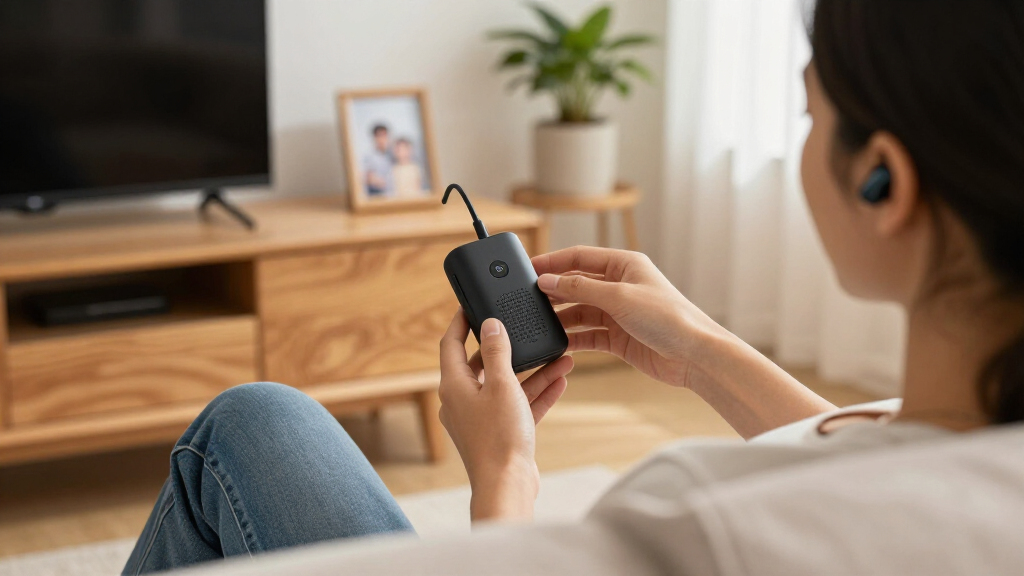
How We Picked
I ranked these products around the needs behind hearing assistance: whether the device is designed for hearing aids, which audio sources it can connect to, and whether its wireless features match the receiving aid. Hearing-aid compatibility and intended use carry more weight than headline Bluetooth versions or travel-oriented extras. I also compared input options, portability, and versatility so the list distinguishes a home TV streamer from a general adapter or airplane transmitter.
The order reflects how directly each model serves a hearing-assistance use case, alongside the flexibility it offers. The BA210 v2 ranks first for combining Auracast with optical and 3.5mm inputs; the Phonak TV Connector follows for buyers with compatible Phonak aids who want a dedicated TV solution. The BT618T and airplane LE Audio adapter offer more specific Auracast-oriented use cases, while the general-purpose Ultra and Bluetooth 6.0 adapters rank lower because their listed features do not establish direct support for hearing aids. Before buying, confirm compatibility with the hearing-aid manufacturer; product names and wireless standards alone cannot establish a working connection.
| bluetooth audio transmitters for hearing assistance | Inputs |
|---|---|
| BA210 v2 Auracast Bluetooth Tr | Optical, 3.5mm, RCA |
| Ultra Bluetooth 5.4 Transmitte | — |
| 2026 Upgraded Pro Bluetooth 6. | — |
| Phonak TV Connector for Hearin | Optical (TOSLINK), 3.5mm auxiliary |
| Auracast & Bluetooth TV Audio | HDMI ARC, optical (SPDIF), 3.5mm AUX, MIC |
| Airplane Bluetooth LE Audio Ad | — |
Factors to Consider When Choosing Bluetooth Audio Transmitters For Hearing Assistance
Choosing a transmitter for hearing assistance is less about chasing the newest wireless number and more about matching the source, transmitter, and hearing aids. These checks can help prevent buying an adapter that pairs with headphones but not with your aids.
Confirm the Hearing Aids Can Receive the Signal
Start with the exact hearing-aid make and model, then check its manual or ask the audiologist which streaming methods it supports. Bluetooth audio, LE Audio, and Auracast are not interchangeable labels for every hearing aid. A transmitter may advertise a standard without the aids supporting the matching receiver function. Some hearing aids also need a brand-specific accessory rather than connecting directly to a general transmitter. Verify the complete transmitter-to-aid pairing path before comparing secondary features.
Match the Transmitter to the Audio Source
Check the ports on the TV, stereo, or airplane entertainment system before choosing a device. Optical output is common on televisions, while 3.5mm connections may suit older TVs or portable equipment; some sources provide only other outputs. A transmitter cannot fix an incompatible source connection without the right cable or converter. Also check whether the TV’s output settings can send audio while its speakers remain active, since household listening needs vary. Choose inputs around the equipment you own, not the ports a listing happens to emphasize.
Decide Whether You Need a Dedicated Streamer or a General Adapter
A dedicated hearing-aid streamer may offer a simpler path for a compatible aid brand, while a general transmitter can serve headphones and other listening devices too. That wider role does not automatically mean it can connect to hearing aids. Think about who will use the device and whether it must switch between a TV, phone, or travel source. General-purpose models can add flexibility, but their modes and pairing steps may make setup less straightforward. Prioritize confirmed aid support over multi-device claims when hearing-aid listening is the main goal.
Treat Auracast as a Compatibility Check, Not a Shortcut
Auracast can support shared audio broadcasts, but both the transmitter and receiving device need compatible capabilities for that use. Check whether the hearing aids receive Auracast directly or require an accessory, and whether the intended broadcast setup is supported. Do not assume that a product with “Auracast” in its name will pair with any hearing aid over Bluetooth. For households with several listeners, confirm how each listener joins and controls the audio. The value of Auracast depends on the receiver side, so validate that before paying for the feature.
Choose for the Place You Will Listen Most
Home TV listening and airplane entertainment call for different priorities. A home setup benefits from dependable connections to the TV and simple everyday operation, while travel use puts more weight on compact size and compatibility with the seat’s audio jack. Some devices list several settings, but switching locations can still mean changing cables or modes. If you mainly want television audio, a travel adapter’s portability may add little value. Buy for your most frequent listening setting, then treat extra uses as a bonus.
Check Controls, Delay, and Shared Listening Needs
Ask how the transmitter is powered, where volume is controlled, and whether the hearing aids can adjust their listening level independently. For television, audio delay can make dialogue feel out of sync, so look for clear information about latency and supported codecs rather than assuming a codec name guarantees lip-sync performance. Shared viewing may also require the TV speakers to remain on while the transmitter sends audio to the aids. Check whether the device supports that arrangement with your TV. Ease of daily control can matter as much as connection quality, especially for listeners who do not want to manage settings each time.
Frequently Asked Questions
Will any Bluetooth transmitter connect directly to my hearing aids?
No. A transmitter’s ability to pair with Bluetooth headphones does not prove it can send audio to your hearing aids. Compatibility depends on the wireless features built into the aids and, in some cases, a brand-specific accessory. Check the exact aid model’s streaming options with its manufacturer or audiologist before ordering. If the product listing does not name your aid or supported protocol, treat compatibility as unconfirmed.
Should I choose the Phonak TV Connector or a transmitter with Auracast?
Choose based on the hearing aids you own and the listening setup you want. The Phonak TV Connector is the more direct candidate for compatible Phonak aids and a home television, while an Auracast transmitter makes sense only if your aids or an accessory can receive its broadcast. Auracast may suit shared or supported broadcast listening, but the feature name alone does not confirm a working connection. Verify compatibility and TV input support before deciding between the two approaches.
Can I use an airplane Bluetooth adapter for TV listening at home?
Possibly, but check its inputs, power arrangement, and intended operating modes before relying on it for a home setup. An airplane-focused adapter is designed around portable audio connections, which may not match the output available on your TV. It may also lack the simple everyday setup or hearing-aid compatibility of a dedicated TV streamer. If home television is your main use, choose a device with a confirmed TV connection path and verified support for your aids.
Does aptX Low Latency or a newer Bluetooth version guarantee good TV sound in hearing aids?
No. A codec or Bluetooth version matters only when the transmitter and receiving device both support it in the intended mode. Many hearing aids rely on their own streaming methods, so a feature aimed at headphones may not apply to them. TV lip-sync also depends on the source, transmitter, and receiver working together. Confirm aid compatibility and latency support as a complete system rather than judging by one specification.
What should I check if I want TV speakers on while audio streams to my hearing aids?
Check the TV’s audio-output settings and the transmitter’s instructions before buying. Some televisions mute their built-in speakers when an external audio output is active, while others allow both outputs to play. This matters when family members want to listen through the room speakers as one person uses hearing aids. Confirm the arrangement with the exact TV model, and check whether separate volume control is available for the hearing aids.
Conclusion
Best overall: I’d start with the BA210 v2 if you need Auracast support and flexible optical or 3.5mm source connections, after confirming that your hearing aids can receive its signal. Best for compatible Phonak users: choose the Phonak TV Connector for a dedicated home-TV path. Best for Auracast-focused TV use: compare the BT618T against your aid’s supported features and your television’s outputs. Best for travel: the airplane LE Audio adapter is the focused pick when portability and the airplane use case lead your needs. Best value and best for beginners: I would decide between the simpler, purpose-matched option and a more flexible adapter only after confirming aid compatibility; the general Ultra and Bluetooth 6.0 models should not be treated as hearing-aid-ready based on their broad Bluetooth claims alone. For any buyer, the safest choice is the one with a verified connection to your specific aids and audio source.
Halloween Picks
halloween
As an affiliate, we earn on qualifying purchases.