

For most photographers, I’d choose the DJI Mini 5 Pro Fly More Combo as the best overall pick: its 1-inch sensor and compact design make it a strong balance of image quality and portability. The DJI Mavic 4 Pro is the premium choice for more advanced aerial work, while the DJI Mini 4K offers a simpler route to stabilized 4K footage. The main tradeoffs are camera capability versus size, flight time, ease of control, and the extra batteries or accessories you may need. Smaller beginner-focused drones can be easier to carry and fly, but they may not match dedicated camera drones for framing and image flexibility. Read on for the full comparison and guidance on choosing a drone that suits the way you shoot.

Get everyday helpers delivered free with Prime
- Fast, free delivery on millions of items
- Prime Video, Amazon Music and more included
- Member-only deals all year
Key Takeaways
- The DJI Mini 5 Pro models stand out for compact camera capability: both list a 1-inch CMOS sensor, while the Plus combo also specifies a 52-minute flight time and obstacle sensing.
- The Mavic 4 Pro is the premium pick for demanding photography: it sits above the Mini options for buyers prioritizing a more advanced aerial platform over compact size.
- The Mini 4K combos differ mainly in included batteries and accessories: compare the single-drone listing with the two- and three-battery bundles based on how long you need to shoot between charging breaks.
- The Neo models prioritize approachable flying and tracking: palm takeoff, gesture control, or obstacle sensing can suit casual clips, but they serve a different camera-first role than gimbal-equipped Mini drones.
- Long advertised flight times and high photo-resolution claims need context: compare camera stabilization, controls, and included equipment, not headline numbers alone, when judging the Ruko and generic GPS options.




| drones for photography | Weight | Gimbal |
|---|---|---|
| DJI Mini 4K Fly More Combo | Under 249 g | 3-axis stabilization |
| Ruko Drone with Camera for Adu | 249 g | 3-axis brushless |
| DJI Mavic 4 Pro Drone with DJI | 2,372 g | 360° Infinity Gimbal |
| DJI Mini 5 Pro Fly More Combo | 249.9 g | — |
| DJI Neo Mini Drone with 4K UHD | 135 g | — |
| DJI Mini 3 with DJI RC | Under 249 g | 3-axis mechanical |
| DJI Mini 3 | 248 g | 3-axis |
| GPS Drone with 4K Camera and 4 | 193 g | — |
| DJI Mini 4K Drone with 4K UHD | Under 249 g | 3-axis |
| DJI Mini 5 Pro Fly More Combo | 249.9 g | — |
| DJI Neo 2 Drone Only | 151 g | — |
| DJI Neo 2 Fly More Combo with | 151 g | — |
| Drone with Camera and Built-in | — | — |
| DJI Mini 4K Camera Drone Combo | Under 249 g | 3-axis |
More Details on Our Top Picks
DJI Mini 4K Fly More Combo
I’d put the DJI Mini 4K Fly More Combo first for new aerial photographers who want stabilized 4K footage without a heavy learning curve. Its three-axis gimbal helps keep clips smooth as the drone moves, while GPS return and QuickShots make it easier to bring home usable material on early flights. Three batteries provide up to 93 minutes of listed flight time across a session, a practical advantage over the DJI Neo, which is more focused on quick, casual captures.
The tradeoff is that this is a straightforward 4K camera rather than a higher-resolution stills system like the Ruko’s 48MP camera or the Mavic 4 Pro’s multi-camera setup. Its transmission range can also shrink with interference, and app installation may take extra steps. I’d choose it for approachable landscapes and travel video, not demanding professional shoots.
Pros:- Three-axis gimbal supports smooth-looking 4K footage
- Three included batteries offer up to 93 minutes of listed combined flight time
- GPS return and QuickShots simplify early flights and repeatable clips
- Under-249 g design is easy to pack for travel
Cons:- Still-photo resolution and camera flexibility are more limited than the Ruko and Mavic 4 Pro
- Transmission range may be reduced by interference or surroundings
- DJI app installation may require downloading outside Google Play
Best for: First-time drone photographers who want stabilized 4K travel footage, simple automated shots, and multiple batteries for a day outdoors.
Not ideal for: Photographers who need high-resolution stills, telephoto framing, or advanced multi-camera control; the Mavic 4 Pro is better equipped for those jobs.
- Weight:Under 249 g
- Camera resolution:4K UHD
- Gimbal:3-axis stabilization
- Maximum transmission range:10 km
- Maximum flight time:93 minutes with 3 batteries
- Flight time per battery:Up to 31 minutes
- Wind resistance:Level 5 (38 kph)
- Included accessories:3 batteries, two-way charging hub, shoulder bag
Our verdict“Choose this combo for an approachable first photography drone with stabilized 4K video and enough batteries for extended outings.”
Ruko Drone with Camera for Adults 4K Video & 8K Photo
The Ruko’s clearest photography advantage is its 48MP, 1/2-inch sensor, which supports 8K stills while recording 4K video. That makes it a more natural fit for buyers who want detailed landscape images to crop or print than the DJI Mini 4K Fly More Combo, whose appeal centers on accessible 4K capture and flight aids. A three-axis brushless gimbal helps steady video, and the three-battery package is listed for up to 96 minutes of flight time.
Those headline photo numbers don’t make it a match for the DJI Mavic 4 Pro, which adds a Hasselblad camera and dual telephoto lenses for more flexible framing. The Ruko records video at 4K/30fps, so it gives up higher-frame-rate capture, and its long advertised control range should not be mistaken for a guarantee in real conditions. I’d pick it for stills-first outdoor use, not polished cinematic production.
Pros:- 48MP sensor captures 8K still images
- Three-axis gimbal stabilizes 4K video
- Three batteries provide up to 96 minutes of listed flight time
- GPS auto-return supports more confident outdoor flying
Cons:- Video is limited to 4K/30fps
- Advertised 20,000-foot range may be constrained by local conditions and interference
- High-resolution stills do not provide the Mavic 4 Pro’s dual-telephoto framing options
Best for: Outdoor photographers who prioritize high-resolution aerial stills and want several batteries for longer shooting sessions.
Not ideal for: Video creators who need 6K capture, high-frame-rate footage, or telephoto composition; the Mavic 4 Pro offers more camera flexibility.
- Sensor:1/2-inch CMOS, 48MP
- Photo resolution:8K
- Video resolution:4K/30fps
- Gimbal:3-axis brushless
- Flight time:Up to 96 minutes with 3 batteries
- Control range:Up to 20,000 ft
- Weight:249 g
- Storage:Micro SDXC
Our verdict“Choose the Ruko if detailed aerial stills matter more to you than high-frame-rate video or pro-level lens flexibility.”
DJI Mavic 4 Pro Drone with DJI RC 2
For photographers who need options beyond a single wide camera, the DJI Mavic 4 Pro is the most capable tool in this group. Its 100MP Hasselblad camera, dual telephoto lenses, and 360-degree gimbal give buyers more ways to frame distant subjects and build cinematic sequences than the compact DJI Mini models. The listed 51-minute flight time also leaves room to work through compositions, while night obstacle sensing is aimed at pilots who need added awareness in dim conditions.
That capability comes with a sharp portability cost: at 2,372 g, it is far heavier than the under-249 g Mini 4K and the 135 g DJI Neo. It also has a steeper feature set, so casual travelers may carry complexity they won’t use. I’d reserve it for deliberate commercial, landscape, or production work where lens choice and high-resolution capture matter more than a small travel footprint.
Pros:- 100MP Hasselblad camera supports detailed still photography
- Dual telephoto cameras expand framing options without repositioning as often
- 360-degree gimbal enables distinctive camera movements
- Night obstacle sensing adds awareness in low-light conditions
Cons:- At 2,372 g, it is substantially heavier and less portable than the Mini models
- Advanced camera and flight features bring a steeper learning curve
- Its professional capabilities may be unnecessary for casual travel photography
Best for: Experienced aerial photographers and production teams who need high-resolution capture, telephoto options, and advanced framing control.
Not ideal for: Travelers and first-time pilots seeking a lightweight, uncomplicated camera drone; the Mini 4K is much easier to pack and approach.
- Main camera:100MP Hasselblad
- Video:Up to 6K/60fps HDR
- Tele cameras:Dual telephoto
- Gimbal:360° Infinity Gimbal
- Obstacle sensing:0.1-lux Nightscape sensing
- Maximum flight time:Up to 51 minutes
- Transmission range:Up to 30 km
- Weight:2,372 g
Our verdict“Choose the Mavic 4 Pro when your work calls for multiple focal lengths and high-resolution capture, and its size is acceptable.”
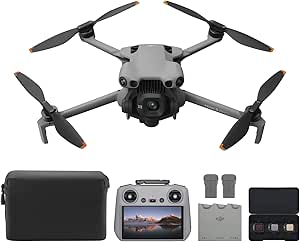
DJI Mini 5 Pro Fly More Combo with DJI RC 2
The DJI Mini 5 Pro suits photographers who want a compact aircraft but don’t want to settle for the simpler camera approach of the DJI Mini 4K. Its 1-inch CMOS sensor and 4K/60fps HDR recording give more room to capture detailed, fluid footage, while the 225-degree gimbal rotation supports angles that a conventional fixed orientation can’t deliver. Omnidirectional sensing with LiDAR and vision sensors adds help around obstacles, and the included three batteries make it better suited to extended outings than a single-battery travel setup.
It remains far smaller than the Mavic 4 Pro, but it cannot match that model’s 100MP camera and dual telephoto reach. The listed weight is 249.9 g, so buyers should check the rules where they fly rather than assume a particular regulatory exemption. DJI Fly may also require manual installation on Android, and flight time varies with conditions.
Pros:- 1-inch CMOS sensor supports stronger image capture than entry-level compact models
- 4K/60fps HDR provides smoother, high-dynamic-range video options
- Omnidirectional obstacle sensing combines LiDAR and vision sensors
- Three included batteries support longer shooting days
Cons:- Does not offer the Mavic 4 Pro’s dual telephoto cameras or 100MP stills
- Listed weight of 249.9 g means buyers should check applicable local rules
- DJI Fly may need to be installed manually on Android devices
Best for: Travel and landscape photographers seeking a foldable drone with a larger sensor, HDR video, obstacle sensing, and multiple batteries.
Not ideal for: Pilots who need long telephoto reach or professional multi-camera coverage; the Mavic 4 Pro is the stronger fit for those assignments.
- Weight:249.9 g
- Sensor:1-inch CMOS
- Video:4K/60fps HDR
- Maximum flight time:Up to 36 minutes
- Gimbal rotation:225°
- Obstacle sensing:Omnidirectional LiDAR and vision sensors
- Internal storage:42 GB
- Included batteries:3
Our verdict“Choose the Mini 5 Pro for a portable, feature-rich camera upgrade when you don’t need the Mavic 4 Pro’s larger professional setup.”
DJI Neo Mini Drone with 4K UHD Camera
The DJI Neo is the easiest pick here for people who want quick personal footage rather than a full aerial photography workflow. At 135 g, it is the lightest option in this group, and palm takeoff, subject tracking, voice control, and QuickShots lower the friction of capturing a short clip during a walk or outdoor activity. Its 4K camera and stabilization make it more useful for video than a simple toy drone, while its small size gives it a portability advantage over the Mini 4K and Mini 5 Pro.
That convenience involves compromises: the listing specifies 12MP stills, far below the Ruko’s 48MP sensor or the Mavic 4 Pro’s 100MP camera. The Neo also needs a smartphone or RC for full control, and its 10 km maximum range doesn’t make it a substitute for a dedicated long-range photography platform. I’d choose it for casual, close-to-home clips, not detailed landscapes or controlled production work.
Pros:- 135 g body is especially light and easy to carry
- Palm takeoff and landing simplify quick captures
- Subject tracking and QuickShots support hands-free video
- 4K UHD camera records stabilized video
Cons:- 12MP still resolution is limited beside the Ruko and Mavic 4 Pro
- Full control requires a smartphone or RC
- Not as suited to deliberate long-range or fine-composition photography as the Mini models
Best for: Hikers, families, and solo travelers who want hands-free tracking and quick stabilized clips with minimal setup.
Not ideal for: Photographers who regularly crop or print aerial stills, or who need precise long-range framing; the Ruko or Mavic 4 Pro is better suited.
- Weight:135 g
- Video resolution:4K UHD
- Effective still resolution:12MP
- Video format:MP4
- Maximum range:Up to 10 km
- Connectivity:Bluetooth, Wi-Fi
- Battery capacity:1,435 mAh
- Dimensions:5.12 × 6.18 × 1.91 in
Our verdict“Choose the Neo for lightweight, hands-free 4K clips, but pick another model if detailed still photography is your main goal.”
DJI Mini 3 with DJI RC – Compact 4K Drone with 3-Axis Gimbal
The DJI Mini 3 with DJI RC is a strong fit for photographers who want stable 4K HDR footage and images framed for vertical platforms without carrying a larger aircraft. Its 3-axis mechanical gimbal helps keep shots smooth, while the camera’s vertical shooting mode avoids relying on a crop from a horizontal frame. The controller’s built-in screen also makes framing easier in bright conditions than using a phone. Compared with the DJI Mini 4K, the Mini 3 puts more emphasis on vertical capture and offers a longer stated flight time when paired with an optional battery. The tradeoff is that the advertised 51 minutes depends on that battery, and a charger is not included. I’d choose it for travel and social content, but not if the simplest out-of-box battery setup is the priority.
Pros:- Under-249 g design is easy to carry on trips.
- 3-axis gimbal stabilizes 4K HDR video.
- Vertical shooting supports portrait-oriented content.
- DJI RC has a built-in 5.5-inch HD display.
Cons:- Up to 51 minutes requires an optional battery and actual flight time varies.
- Battery charger is sold separately.
- Some capabilities require extra batteries or accessories.
Best for: Travel photographers and social creators who want stabilized 4K HDR footage, vertical framing, and a controller with its own display.
Not ideal for: Buyers who need the longest included flight time without optional batteries or who want a complete charging setup in the box.
- Weight:Under 249 g
- Camera:4K HDR video
- Gimbal:3-axis mechanical
- Flight time:Up to 51 minutes with optional battery
- Maximum transmission range:10 km
- Wind resistance:Level 5
- Controller display:Built-in 5.5-inch HD display
- Control:DJI RC with DJI Fly app
Our verdict“Choose the Mini 3 if vertical-ready footage and a built-in controller screen matter more than having every flight accessory included.”
DJI Mini 3 (DJI RC) Drone with 4K Camera and Accessories
This Mini 3 bundle makes sense for photographers who want the core 4K HDR camera and 3-axis gimbal alongside practical extras for getting to a shooting location. The included carrying case and landing pad can help with transport and takeoff on uneven ground, while spare parts and an anti-collision light add useful backup gear. Its 48 MP still resolution gives it a photo-forward spec advantage over the DJI Mini 4K listing, though resolution alone does not determine image quality. Like the other Mini 3, it weighs under 249 g and suits travel better than a larger camera drone. The compromise is that the bundle’s headline flight time depends on the battery configuration, and setup requires activation through the DJI Fly app. I’d pick this package over the standalone Mini 3 when the accessories will actually be used.
Pros:- Under-249 g body is suited to compact travel kits.
- 4K HDR video and stated 48 MP still resolution support mixed photo and video use.
- 3-axis gimbal helps steady footage.
- Bundle includes a carrying case, landing pad, anti-collision light, and spare parts.
Cons:- Activation through the DJI Fly app is required before use.
- HDR video is limited to 30 fps or lower.
- Stated flight time varies with battery choice and conditions.
Best for: Aerial photographers who want a portable Mini 3 plus a case, landing pad, and spare accessories for location shoots.
Not ideal for: Minimalist buyers who already own compatible accessories or prefer a straightforward setup without app activation.
- Weight:248 g
- Video resolution:4K
- Effective still resolution:48 MP
- Gimbal:3-axis
- Maximum range:10 km
- Flight time:Up to 38 minutes with intelligent flight battery
- Connectivity:Bluetooth
- Battery type:Lithium-ion
Our verdict“Pick this Mini 3 package over the standalone version if its included field accessories are more useful to you than keeping the kit lean.”
GPS Drone with 4K Camera and 4.5-Inch HD Screen on Controller, Auto Return, 3 Batteries, 90 Min Flight, 3280 FT Range, Follow Me & Circle Fly, Foldable for Beginners
This foldable GPS model’s clearest photography advantage is three included batteries, with a stated combined flight time of up to 90 minutes. That can give a beginner more opportunities to practice composition and repeat a shot before packing up. The controller’s 4.5-inch screen also provides a direct viewing option, while GPS return and Follow Me modes offer accessible ways to start exploring aerial framing. Its specs list 2K video and 8.3 MP stills, however, so the “4K camera” wording should not be mistaken for 4K video capture. Compared with the DJI Mini 3, it has lower listed image and video resolution, a shorter 3,280-foot range, and a less established imaging feature set. I’d consider it for casual practice, not demanding landscape or commercial photography.
Pros:- Three batteries provide up to 90 minutes of stated combined flight time.
- Built-in 4.5-inch controller screen supports direct live viewing.
- GPS, auto return, Follow Me, and Circle Fly modes simplify basic shooting.
- Foldable 193 g design is easy to pack.
Cons:- Listed capture specs are 2K video and 8.3 MP stills, below the DJI Mini 3.
- Maximum listed range is 3,280 feet, shorter than the DJI Mini 3’s 10 km.
- Wi-Fi control range can vary with the surrounding environment.
Best for: Beginners who want several batteries, a controller screen, and basic GPS shooting modes for casual outdoor photography practice.
Not ideal for: Photographers who need verified 4K video, higher-resolution stills, long-range transmission, or advanced stabilization for polished work.
- Listed video resolution:2K
- Effective still resolution:8.3 MP
- Control technology:Wi-Fi
- Maximum range:3,280 feet
- Weight:193 g
- Flight time:Up to 90 minutes with three batteries
- Special features:GPS, auto return, Circle Fly, Follow Me, EIS
- Controller display:4.5-inch HD screen
Our verdict“Choose this as a practice-focused starter kit if battery quantity matters more than the sharper imaging and longer range of the DJI Mini 3.”
DJI Mini 4K Drone with 4K UHD Camera, Under 249 g
The DJI Mini 4K keeps the photography essentials focused: a lightweight airframe, 4K UHD video, a 3-axis gimbal, and QuickShots that help beginners create repeatable camera moves. Its stated 31 minutes per battery is clear and straightforward, with options to carry more batteries for longer sessions. Compared with the DJI Mini 3, it gives up the listed vertical-shooting emphasis and the included controller screen, but remains a practical choice for buyers who mainly want stabilized landscape footage. The main setup wrinkle is app availability: the DJI Fly app must be downloaded from DJI’s website according to the product information. Battery life also changes with conditions, and local flight rules still apply despite the sub-249 g weight. I’d pick it for uncomplicated 4K practice rather than specialized portrait framing.
Pros:- Under-249 g weight makes it compact for travel.
- 4K UHD camera and 3-axis gimbal support stabilized footage.
- QuickShots offer guided camera movements for newer pilots.
- Additional battery options allow longer flying sessions.
Cons:- DJI Fly app must be downloaded from DJI’s website, according to the product information.
- Listed maximum flight time is 31 minutes per battery and varies with conditions.
- Lacks the Mini 3’s stated vertical-shooting emphasis.
Best for: First-time aerial photographers who want stabilized 4K landscape footage and simple guided shooting modes in a lightweight drone.
Not ideal for: Creators who prioritize native vertical framing, a built-in controller display, or advanced camera capabilities beyond the listed 4K setup.
- Weight:Under 249 g
- Camera resolution:4K UHD
- Gimbal:3-axis
- Maximum flight time:31 minutes per battery
- Maximum transmission range:10 km
- Wind resistance:Level 5
- Battery options:1, 2, or 3 batteries; stated totals of 31, 62, or 93 minutes
- App compatibility:DJI Fly app download from DJI official website
Our verdict“Choose the Mini 4K for a straightforward, stabilized 4K starter drone, but favor the Mini 3 if vertical composition or a built-in screen is a priority.”
DJI Mini 5 Pro Fly More Combo Plus with DJI RC 2, 4K Camera, 1-Inch CMOS, Obstacle Sensing, ActiveTrack 360°, 52-Minute Flight
The DJI Mini 5 Pro Fly More Combo Plus is the most capable photography choice in this group for buyers who value sensor size, tracking, and flight safety over the lightest possible regulatory footprint. Its 1-inch CMOS sensor and 4K/60fps HDR capture offer a more ambitious imaging setup than the Mini 3 or Mini 4K, while ActiveTrack 360° can keep a moving subject in frame for solo creators. Omnidirectional sensing with LiDAR and vision sensors adds help around obstacles, and the combo includes three batteries, ND filters, and a charging hub. That feature set comes with a key tradeoff: listed weight is 249.9 g, so it may cross rules that apply to drones under 250 g. I’d choose it for demanding shoots, not for buyers seeking the simplest lightweight option.
Pros:- 1-inch CMOS sensor with 4K/60fps HDR capture is the strongest listed imaging setup here.
- ActiveTrack 360° supports moving-subject compositions.
- Omnidirectional obstacle sensing uses LiDAR and vision sensors.
- Combo includes DJI RC 2, three batteries, ND filters, and a charging hub.
Cons:- Listed 249.9 g weight may exceed rules or thresholds based on a 250 g limit.
- Advanced features and included accessories may be unnecessary for casual photography.
- DJI Fly app is not available on Google Play according to the product information.
Best for: Experienced creators and solo videographers who want a larger listed sensor, subject tracking, obstacle sensing, and a ready-to-shoot accessory kit.
Not ideal for: Buyers who need to stay strictly below 250 g, want the simplest regulatory profile, or only need basic stabilized 4K footage.
- Weight:249.9 g
- Camera:1-inch CMOS, 4K/60fps HDR
- Gimbal rotation:225°
- Obstacle sensing:Omnidirectional with LiDAR and vision sensors
- Flight time:Up to 52 minutes per battery
- Internal storage:42 GB
- Battery:Intelligent Flight Battery Plus
- Included accessories:DJI RC 2, three batteries, spare propellers, charging hub, ND filters
Our verdict“Choose the Mini 5 Pro combo for advanced imaging and tracking, but opt for the Mini 3 or Mini 4K if staying below 250 g is a firm requirement.”
DJI Neo 2 Drone Only, Lightweight 4K Camera Drone with Gesture Control and Obstacle Sensing
For photographers who want quick self-portraits or tracking clips without carrying a controller, the DJI Neo 2 is the most casual-friendly pick here. At 151 g, it is easy to pack, and palm takeoff, gesture controls, and ActiveTrack make spontaneous framing simpler than piloting the DJI Mini 4K. Its 4K video and 12 MP stills suit social posts and everyday memories, while omnidirectional obstacle sensing adds reassurance during close-range flights. The tradeoff is that this drone-only package leaves batteries and other accessories to source separately, so it is less ready for longer outings than the Fly More Combo version. The DJI Fly app availability issue on Google Play may also complicate setup for some Android users. I’d choose it for easy, near-field capture, not as a substitute for a stabilized travel camera drone.
Pros:- 151 g body is easy to carry for spontaneous shooting
- Palm takeoff, gesture control, and ActiveTrack simplify hands-free framing
- 4K video and 12 MP stills cover casual aerial content
- Omnidirectional obstacle sensing supports close-range flying
Cons:- Drone-only package does not include the extra batteries and accessories offered with the Fly More Combo
- DJI Fly app availability on Google Play may complicate Android setup
- No 3-axis gimbal is listed, unlike the DJI Mini 4K
Best for: Solo travelers and casual creators who want palm-launch selfies, subject tracking, and a compact drone for short photo and video sessions.
Not ideal for: Photographers planning extended outings or carefully composed landscape footage; the drone-only package lacks the combo’s extra batteries, and it does not list a 3-axis gimbal.
- Weight:151 g
- Dimensions:6.74 × 5.8 × 1.59 in
- Video resolution:4K
- Still resolution:12 MP
- Obstacle sensing:Omnidirectional
- Control features:Gesture control, palm takeoff and landing, ActiveTrack
- Connectivity:Bluetooth, Wi-Fi
- Maximum range:10 km
Our verdict“Choose the Neo 2 for portable, hands-free selfies and tracking clips, but pick the DJI Mini 4K for stabilized landscape footage.”
DJI Neo 2 Fly More Combo with RC-N3 Remote Controller
The DJI Neo 2 Fly More Combo makes more sense than the drone-only Neo 2 for photographers who want to keep flying between battery changes and have a remote for deliberate framing. It retains the compact 151 g body, 4K video, 12 MP photos, and obstacle sensing, but the included multiple batteries and RC-N3 controller make it better suited to planned outings than quick palm-launched clips. Compared with the DJI Mini 4K Combo, the Neo 2 leans toward tracking and accessible close-range capture rather than stabilized, cinematic footage: the Mini’s listed 3-axis gimbal is a meaningful advantage for smoother moving shots. The Neo 2’s 10 km maximum range is ample on paper, but does not remove the need to follow local flight rules. Android users may also need to work around DJI Fly app availability on Google Play.
Pros:- Multiple included batteries support longer outings than the drone-only Neo 2
- RC-N3 controller allows more deliberate framing than gesture-only operation
- Compact 151 g design is easy to pack
- 4K capture, 12 MP stills, and omnidirectional obstacle sensing
Cons:- No 3-axis gimbal is listed, unlike the DJI Mini 4K
- DJI Fly app availability on Google Play may add setup friction for Android users
- Requires familiarity with drone operation to get the most from its controls
Best for: Newer drone photographers who want a controller, spare batteries, and tracking-friendly features for repeated short shooting sessions.
Not ideal for: Creators prioritizing smooth cinematic travel footage or a listed 3-axis gimbal; the DJI Mini 4K is a stronger fit for that style.
- Weight:151 g
- Dimensions:6.74 × 5.8 × 1.59 in
- Video resolution:4K
- Still resolution:12 MP
- Maximum range:10 km
- Controller:RC-N3 remote controller
- Included batteries:Multiple batteries
- Connectivity:Bluetooth, Wi-Fi
Our verdict“Pick this combo over the drone-only Neo 2 if you want a controller and extra batteries, but choose the Mini 4K for gimbal-stabilized footage.”
Drone with Camera and Built-in Screen on Controller
This foldable quadcopter suits buyers who value a built-in controller screen and simple recreational flying over high-detail photography. Its 1080P camera has an adjustable 80° lens, while two included batteries are listed for up to 25 minutes of flight time. That makes it a more self-contained starter option than the DJI Neo 2 drone-only, which captures 4K and offers obstacle sensing but does not include extra accessories in that package. The difference in image capability is substantial: this model’s 1080P footage and Wi-Fi connection are a step down from the Neo 2’s 4K capture, and the product data does not specify a still-photo resolution or gimbal stabilization. Propeller guards and one-key controls help with practice flights, but the recommendation to use it in windless conditions limits outdoor photography. An SD card is also needed to save images and video.
Pros:- Built-in controller screen shows live footage and flight information
- Two batteries are included, with up to 25 minutes of flight time listed
- Adjustable 80° lens offers some control over camera framing
- Propeller guards and one-key takeoff and landing support beginner practice
Cons:- 1080P camera falls short of the 4K capture on both DJI Neo 2 models
- SD card is required for saving footage and is not included
- Best suited to windless conditions, limiting outdoor photography flexibility
Best for: First-time flyers and families seeking a foldable practice drone with a controller display, basic 1080P capture, and included spare battery.
Not ideal for: Travel photographers or creators who need detailed 4K files, stabilized footage, or dependable control in breezy outdoor conditions.
- Camera resolution:1080P HD
- Lens adjustment:80°
- Flight time:Up to 25 minutes
- Included batteries:2
- Control modes:Remote control, app control
- Connectivity:Wi-Fi
- Safety features:Propeller guards, child lock, low power alarm
- Storage requirement:SD card required; not included
Our verdict“Choose this for a screen-equipped starter flyer and basic 1080P clips, not for detailed or stabilized aerial photography.”
DJI Mini 4K Camera Drone Combo, 4K UHD, Under 249g, 3-Axis Gimbal, 10km Transmission, Auto Return, 2 Batteries, QuickShots
For travel photographers choosing between convenience and footage quality, the DJI Mini 4K Combo is the strongest camera-first option in this group. Its 3-axis gimbal helps keep 4K footage steady as the drone moves, a clear advantage over both Neo 2 models, whose listed specs do not include a gimbal. The under-249 g build and two included batteries make it portable and more practical for a day of shooting than the drone-only Neo 2. GPS Return to Home and one-tap takeoff also make it approachable for beginners, while Level 5 wind resistance supports more situations than the 1080P foldable quadcopter, which is best used in windless conditions. Its main compromise is the lack of listed obstacle avoidance, so careful route planning matters. DJI Fly app setup may also require downloading outside Google Play.
Pros:- 3-axis gimbal steadies 4K footage for smoother moving shots
- Under-249 g design is compact for travel
- Two included batteries support longer shooting outings
- GPS Return to Home and one-tap takeoff help newer pilots
Cons:- Obstacle avoidance is not specified in the product data
- DJI Fly app download may require visiting DJI’s official website
- Flight time can vary with environmental conditions
Best for: Travel and landscape photographers who want portable 4K video with gimbal stabilization, beginner-friendly flight features, and two batteries.
Not ideal for: People who want hands-free selfie tracking or listed obstacle sensing; the Neo 2 models are better aligned with those needs.
- Weight:Under 249 g
- Camera resolution:4K UHD
- Gimbal:3-axis
- Maximum transmission range:10 km
- Maximum flight time:62 minutes with 2 batteries
- Wind resistance:Level 5
- Maximum altitude:4,000 m
- Remote controller:DJI RC-N1C
Our verdict“Choose the Mini 4K Combo for portable, stabilized travel footage; opt for a Neo 2 if hands-free tracking matters more than a listed gimbal.”

How We Picked
I ranked these drones around their usefulness for photography and stabilized video, rather than treating every camera claim as equal. The main criteria were stated sensor and camera details, gimbal or stabilization features, flight and transmission capabilities, portability, control options, and features that can help frame or repeat a shot. I also considered how clearly each listing describes what is included, since batteries, controllers, and accessories can change how practical a drone is for a full outing.
The ranking favors camera-focused models with clearer imaging and flight-control details, then separates them by buyer fit. That puts the Mini 5 Pro and Mavic 4 Pro ahead for image-making, while the Mini 4K models earn value-oriented positions through stabilized 4K and distinct bundle choices. Neo drones and less clearly specified GPS or screen-controller models can make sense for casual use or simpler operation, but their listed features provide less evidence of a photography-first advantage. I treat product names and listing specifications as claims, not proof of image results; buyers should verify exact bundle contents and current manufacturer specifications before purchase.
Factors to Consider When Choosing Drones For Photography
Choosing a photography drone is not just a matter of picking the biggest camera number. I’d start with the kinds of images you want, then weigh how much control, setup time, and carrying weight you’re willing to accept.
Match Camera Capability to the Images You Want
Think about whether you mainly want travel memories, social video, landscape stills, or footage that may need substantial editing. Sensor size and stabilization usually tell you more about image-making potential than a resolution figure by itself. A high megapixel claim does not guarantee better detail in changing light or cleaner files for editing. If you plan to crop heavily or work in mixed lighting, favor a clearly specified camera and gimbal over broad claims that leave those details unclear. For casual daylight clips, a simpler 4K camera may be enough. Avoid paying for advanced imaging features unless your shooting and editing habits can make use of them.
Plan Around Real Shooting Time
Advertised maximum flight time is a comparison point, not a promise of how long every battery will last on location. Wind, temperature, flight style, and the need to return with a safe reserve all affect usable airtime. Count the number of batteries in the exact bundle you are buying, and consider whether you can recharge between flights. A multi-battery kit can be more useful than a small increase in stated flight time when you are shooting at several locations. New pilots may also spend more battery time learning controls and setting up shots. Leave room in your plan for takeoff checks, repositioning, and a cautious return.
Choose Portability With Your Whole Kit in Mind
A compact drone is easier to bring on hikes and trips, but the aircraft is only part of the load. The controller, spare batteries, charging gear, and protective case can add bulk to a bag. Before choosing a lightweight model, check which controller comes with it and whether the package includes the batteries and accessories you need. A screen-equipped controller can simplify setup, while a phone-based controller may mean carrying another device and cable. If you mostly fly near home, a larger kit may be an acceptable trade for more capable equipment. If the drone stays behind because it is inconvenient to carry, its camera features do not help your photography.
Treat Tracking and Automation as Aids, Not a Camera Plan
Follow, tracking, and quick-shot modes can help create repeatable movement without manually steering every moment. They do not replace choosing a safe route, checking the background, or deciding where the subject should sit in the frame. Obstacle sensing is useful, but it does not remove every collision risk, especially around thin branches, wires, or complex settings. Learn how the drone behaves when tracking loses the subject and how to take control promptly. For still photography, manual positioning and a stable hover may matter more than a long list of automated modes. Pick automation that solves a real problem in your shoots rather than paying for features you are unlikely to use.
Check Control, Transmission, and Local Rules
Reliable control and a clear live view help you compose shots without relying on guesswork. A stated transmission range is a technical claim, not a suitable target for ordinary flying; signal conditions, terrain, and local restrictions can limit practical distance. Check whether the included controller uses a phone or has its own display, and confirm what devices and cables are required. Before buying, review the rules that apply where you intend to fly, including registration, airspace, and privacy requirements. Lightweight status does not mean a drone can be flown anywhere without restrictions. Build your shooting plan around legal, visible, and controlled flights rather than the maximum range listed on a box.
Compare Bundles and Verify Exact Model Details
Product names can be very similar while the included batteries, remote, and accessories differ. In this roundup, the Mini 4K appears as a single-drone option and as bundles with two or three batteries, so the right choice depends on what the package actually contains. Listings can also use broad phrases such as “4K camera” or “8K photo” without giving enough detail to judge the full imaging system. Check the manufacturer’s specification page for sensor, gimbal, controller compatibility, and supported recording formats. Confirm whether a listing is a combo, a drone-only package, or a version with a particular remote. Comparing the complete kit prevents an apparent bargain from turning into missing equipment you still need to buy.
Frequently Asked Questions
Is a Mini 4K enough for landscape photography, or should I choose a Mini 5 Pro?
The Mini 4K is a sensible starting point if you want stabilized 4K footage and straightforward aerial photos without prioritizing advanced camera specifications. The Mini 5 Pro is the stronger fit when its listed 1-inch sensor and added camera-focused features better match your plans for editing or varied shooting conditions. Neither choice can compensate for poor light, unsafe flying, or rushed composition. Think about how often you will edit and crop images, and whether the extra camera capability will change your results. If you are unsure, compare the exact camera and recording specifications for the package you plan to buy.
Should I buy a Fly More Combo or the drone-only version?
A combo makes sense when its extra batteries and accessories match the way you shoot, especially on trips where you cannot recharge between flights. A drone-only package can be a better fit if you already own compatible equipment or only plan short sessions. Check the exact contents rather than relying on the word “combo,” since bundles vary across models and sellers. Also account for the controller, charging options, and spare propellers you may need. The best package is the one that gives you a complete working kit without duplicating gear you already have.
Does a drone advertised with an 8K photo camera take better pictures than a 4K drone?
Not necessarily: the number in a listing does not tell the whole story about sensor size, lens quality, stabilization, or how the image is processed. This roundup includes less-detailed camera claims alongside models that specify features such as a 1-inch sensor or a 3-axis gimbal. Those details can be more useful when judging whether a camera suits your work. Look for sample files and full manufacturer specifications, especially if you plan to edit or crop stills. Treat resolution claims as one part of the comparison, not a reliable ranking on their own.
Do obstacle sensing and subject tracking make a drone safer for a beginner?
They can help with some situations, but they do not replace learning basic controls and checking the flight area. Sensors may not detect every obstacle, and tracking can behave unpredictably if a subject is obscured or the background is complex. A beginner should first practice takeoff, hovering, turning, and landing in an open, permitted area. Read the manual to learn how to stop automation and regain direct control. Choose these features as useful assistance, not as a reason to fly close to people, trees, or buildings.
Is a lightweight drone automatically the best travel photography choice?
Low aircraft weight can make a drone easier to pack, but travel convenience also depends on the controller, batteries, charger, and case. A smaller drone may also involve camera tradeoffs compared with a more advanced model. Check travel and aviation rules at your destination, since requirements vary by location and can change. Consider whether you will have time and suitable places to fly, not just whether the drone fits in your bag. For frequent travel, the best choice is usually the lightest complete kit that still meets your camera needs and local rules.
Conclusion
For a single camera-focused recommendation, I’d choose the DJI Mini 5 Pro Fly More Combo as best overall for its stated 1-inch sensor in a compact format. The DJI Mini 4K is my best-value direction for buyers who want stabilized 4K and can select a battery bundle suited to their outings; the Mini 4K Fly More Combo is the better fit when three batteries matter. For premium aerial work, consider the DJI Mavic 4 Pro, while beginners who value palm takeoff and simple automated shots may prefer the DJI Neo. If you want a compact step-up with listed obstacle sensing and a longer stated flight time, compare the Mini 5 Pro Fly More Combo Plus against the standard combo. I’d choose the Ruko or generic GPS options only after checking full camera specifications and exact package contents; their headline claims alone do not make them the clearest photography picks.