Choosing hearing aids for profound hearing loss takes more than comparing channel counts or noise-reduction claims: the right choice depends on hearing-test results, usable amplification, and a secure fit. My best overall pick is the Fun SP Behind-the-Ear Hearing Aid, because its stated severe-to-profound use and behind-the-ear design align more directly with this need than general OTC models. The JUSHA B501 stands out for its stated 45 dB gain, while the ELEHEAR Beyond Pro may suit shoppers who want Bluetooth features but should not be assumed to provide enough power for profound loss. The main tradeoffs are stronger, clinically matched amplification versus convenient OTC controls, rechargeability, and features that may not translate into better speech understanding. Read on for the full comparison, selection criteria, and guidance on when professional fitting matters more than added features.

Get everyday helpers delivered free with Prime
- Fast, free delivery on millions of items
- Prime Video, Amazon Music and more included
- Member-only deals all year
Complete the kit


Key Takeaways
- Fit for profound loss separates the list: the Fun SP is explicitly marketed for severe-to-profound loss, while many other entries are general OTC devices and may not supply enough usable amplification.
- Published specifications need context: JUSHA states 45 dB gain, but a gain figure alone does not show whether a device matches a particular audiogram or provides adequate output safely.
- Most options emphasize convenience: rechargeable cases, one-button controls, and long stated battery life recur across the lineup; these features help with daily handling but do not establish clinical suitability.
- More channels are not proof of stronger hearing support: several models advertise 11 or 16 channels, yet real-world benefit depends on fitting, maximum output, and the listener’s hearing profile.
- Bluetooth and discreet designs serve different priorities: ELEHEAR Beyond Pro is the connectivity-led option, while an over-the-ear design such as Fun SP may be easier to handle and more appropriate to investigate for higher amplification needs.




| hearing aids for profound hearing loss | Battery life |
|---|---|
| ELEHEAR Beyond Pro Bluetooth O | Up to 20 hours per charge |
| Fun SP Behind-the-Ear Hearing | — |
| True Hearing Aids Not Amplifie | — |
| Vivtone Rechargeable Hearing A | Up to 25 hours per charge |
| Rechargeable Hearing Aids for | — |
| Hearing Amplifier with 16-Chan | Up to 80 hours |
| OTC Hearing Aids for Seniors & | 80+ hours |
| Hearing Aids for Seniors | Over 24 hours per charge |
| Karthus Rechargeable Hearing A | Up to 30 hours per charge; up to 100 hours with charging case |
| Manzelun GM-105 Rechargeable B | — |
| JUSHA B501 Behind-the-Ear Hear | Up to 8 hours per charge; up to 50 hours with charging case |
More Details on Our Top Picks
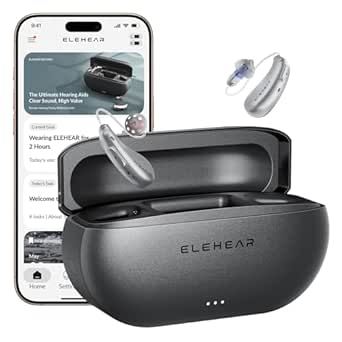
ELEHEAR Beyond Pro Bluetooth OTC Hearing Aids for Seniors and Adults
ELEHEAR Beyond Pro stands out for buyers who want app-based adjustments and Bluetooth features alongside speech processing. Its VocClear 2.0 system is advertised as improving speech clarity by 30%, while the RIC design and multiple dome sizes offer more fit flexibility than the fixed behind-the-ear approach of the Fun SP. A 15-minute charge is listed to provide six hours of use, useful when a battery runs low during the day; the case also holds four additional full charges.
The tradeoff is that full control depends on a smartphone app, and its Bluetooth features do not establish that it can provide the amplification or clinical fitting a person with profound loss may need. The listed high-frequency range and quick charging are useful features, not proof of suitability for profound hearing loss. I would treat it as an OTC option to discuss with an audiologist, not a substitute for a hearing assessment or prescription device.
Pros:- App control and Bluetooth connectivity support personalized everyday use
- Advertised 30% speech-clarity improvement with VocClear 2.0
- A 15-minute charge is listed to provide six hours of use
- RIC fit includes multiple dome sizes and a lightweight contoured design
Cons:- Product information does not establish that its amplification is suitable for profound hearing loss
- Full control and adjustments require a compatible iOS or Android phone
- Bluetooth connectivity is limited to compatible devices
Best for: Adults with mild-to-moderate hearing needs who want smartphone adjustments, Bluetooth connectivity, and translation features for travel.
Not ideal for: People with profound hearing loss seeking verified high-power amplification or buyers who do not use a compatible smartphone for adjustments.
- Style:Receiver-in-Canal (RIC)
- Processing technology:VocClear 2.0
- Advertised speech clarity:30% improvement
- High-frequency range:Up to 8500 Hz
- Latency:8 ms
- Battery life:Up to 20 hours per charge
- Quick charging:15 minutes for up to 6 hours of use
- Connectivity and app:Bluetooth; iOS and Android compatibility
- Translation languages:11, including Spanish, French, Italian, Japanese, and Chinese
Our verdict“Choose ELEHEAR Beyond Pro for app-connected convenience and quick charging, but seek a professionally fitted option if your hearing loss is profound.”
Fun SP Behind-the-Ear Hearing Aid for Severe to Profound Hearing Loss
Fun SP is the most directly targeted option in this group: its product information explicitly lists a severe-to-profound hearing-loss range, unlike the Vivtone model, which is described for mild to significant loss. Six-channel digital processing and four preset sound profiles give users a straightforward way to select among listening environments without making an app the center of daily operation. That simpler setup may appeal to someone who wants a conventional BTE device and a guided fitting process.
Its limitations matter, particularly for a profound-loss buyer. The listing does not give a gain or output rating, so the stated hearing-loss range alone cannot establish that it will meet an individual’s needs. It also uses a nonstandard battery, and the product data gives no software-update support date. Compared with the rechargeable ELEHEAR Beyond Pro, it offers less connected control, but its stated target range is more relevant to this roundup. I’d confirm fit and output with an audiologist before relying on it.
Pros:- Explicitly marketed for severe-to-profound hearing loss
- Six-channel digital processing
- Four preset sound profiles for different environments
- Simple fitting process and battery included
Cons:- Uses a nonstandard battery rather than a rechargeable system
- No gain or maximum output specification is provided
- Software update support date is unknown
Best for: Adults seeking a simple behind-the-ear device explicitly marketed for severe-to-profound loss, especially those who prefer preset profiles over app adjustments.
Not ideal for: Buyers who need documented maximum gain or output, rechargeable convenience, or clear information about future software support.
- Style:Behind-the-ear
- Listed hearing-loss range:Severe to profound
- Digital processing:6 channels
- Sound profiles:4 preconfigured profiles
- Battery:1 nonstandard battery
- Battery included:Yes
- Color:Beige
- Manufacturer:VATSALYA MEDITECH
Our verdict“Fun SP is the most directly relevant listed pick for severe-to-profound needs, but verify its output and fitting with an audiologist before purchase.”
True Hearing Aids Not Amplifier – 11 Channels Professional Rechargeable Hearing Aids for Seniors with Noise Cancelling and Magnetic Charging Box
This behind-the-ear model pairs 11-channel processing with button controls and a magnetic charging box, making it a more hands-on, device-based alternative to the app-dependent ELEHEAR Beyond Pro. Its noise-cancellation feature and stated long-use charging setup may suit a buyer who wants fewer phone interactions and a simple physical control. The channel count and controls can help distinguish it from the six-channel Fun SP, though channel count by itself does not show how much amplification it can deliver.
That distinction is especially important for profound hearing loss: the supplied details do not list a supported loss range, gain, or maximum output. Battery information is also inconsistent: the description claims up to 100 hours of use with a magnetic charging box, while the specifications list one included AAA battery and NiMH chemistry. I would confirm how charging works and ask an audiologist whether its output is appropriate before choosing it over the more explicitly targeted Fun SP.
Pros:- 11-channel digital processing
- Button controls avoid dependence on a smartphone app
- Noise cancellation is listed as a feature
- Magnetic charging box is described for everyday recharging
Cons:- No supported hearing-loss range, gain, or maximum output is provided
- Battery details conflict between the AAA specification and rechargeable description
- Behind-the-ear fit may not suit every ear
Best for: Older adults who prefer physical button controls and want a behind-the-ear device with rechargeable-battery claims and noise cancellation.
Not ideal for: People with profound hearing loss who need a stated fitting range and verified output, or buyers who need unambiguous battery and charging details.
- Fit:Behind-the-ear
- Digital processing:11 channels
- Controls:Button control
- Noise control:Active noise cancellation
- Charging accessory:Magnetic charging box
- Listed battery requirement:1 AAA battery, included
- Battery chemistry:NiMH
- Claimed use time:Up to 100 hours, according to product description
Our verdict“Pick this model for physical controls and a claimed magnetic charging setup only after confirming its battery system and suitability for your hearing loss.”
Vivtone Rechargeable Hearing Aids for Seniors Adults with Recycle Charging Case
Vivtone is a better match for buyers who want routine convenience and tinnitus masking than for readers focused on profound loss. Its listed 41 dB peak sound gain gives more useful context than the ELEHEAR Beyond Pro listing, but the product is still described for mild to significant loss and may not provide enough support for profound hearing needs. The quiet, noisy, and tinnitus-masking modes offer distinct listening choices, while auto-on/off reduces the steps involved in everyday use.
The case is described as holding up to 125 hours of backup power, and each charge is listed for 25 hours; that favors straightforward upkeep over the Fun SP’s replaceable battery. However, the two-hour charging time is not especially quick, and the product data does not identify waterproof or sweat resistance. I would put this below Fun SP for the roundup’s most severe cases, while considering it for people whose needs fall within its stated range and who value tinnitus masking.
Pros:- 41 dB peak sound gain is specified
- Quiet, noisy, and tinnitus-masking modes
- Up to 25 hours of use per charge
- Charging case is listed with up to 125 hours of backup power
Cons:- Product description says it may be less effective for severe hearing loss
- Two-hour charging time is slower than the quick-charge claims of ELEHEAR Beyond Pro
- Waterproof and sweat-resistance details are not provided
Best for: Adults with mild-to-significant hearing loss who want tinnitus masking, automatic on/off, and a charging case for daily use.
Not ideal for: People with profound hearing loss seeking a device explicitly rated for that range, or users who need documented water and sweat protection.
- Peak sound gain:41 dB
- Battery life:Up to 25 hours per charge
- Charging time:2 hours
- Charging-case backup power:Up to 125 hours
- Modes:Quiet, Noisy, Tinnitus masking
- Design:Discreet, lightweight BTE
- Operation:Auto-on/off
Our verdict“Choose Vivtone for tinnitus masking and convenient daily charging if your hearing needs fit its stated range, not as a first choice for profound loss.”
Rechargeable Hearing Aids for Seniors Severe Hearing Loss Earrck Hearing Amplifier with Noise Cancelling OTC Hearing Aid with Volume Control Dual Micphone (Silver)
Earrck aims at severe hearing loss and offers three modes for everyday, noisy, and tinnitus-masking use. Its standout claim is a case with up to 350 hours of backup power, paired with more than 35 hours of use after a full charge. That makes its stated charging reserve substantially longer than Vivtone’s 125-hour case backup, though Earrck takes up to six hours to recharge. Feedback reduction and dual microphones are described as tools for clearer conversations, but the supplied data does not quantify gain or maximum output.
For profound hearing loss, that missing output information is a real limitation, and “severe” in the title does not verify an individual fitting. The three listening modes and long reserve may suit a buyer who values fewer charging interruptions, but the Fun SP is the clearer choice on stated target range because it explicitly names severe-to-profound loss. I would seek professional guidance before treating either OTC-style product as adequate for profound loss.
Pros:- Three modes include noisy-environment and tinnitus-masking options
- Description claims more than 35 hours of use per full charge
- Charging case is claimed to provide up to 350 hours of backup power
- Feedback reduction and dual microphones are described for conversation listening
Cons:- No gain, maximum output, or verified profound-loss fitting range is specified
- Full charging takes up to six hours
- Product listing does not provide a detailed technical specification table
Best for: Adults with severe hearing needs who prioritize long charging-case reserve, multiple listening modes, and a rechargeable BTE-style device.
Not ideal for: People with profound loss who require verified gain and maximum output, or buyers who need a short charging cycle.
- Device type:OTC hearing aid / hearing amplifier
- Color:Silver
- Listening modes:Normal, Noisy Environment, Tinnitus Masking
- Claimed use per charge:More than 35 hours
- Charging time:Up to 6 hours
- Charging-case backup:Up to 350 hours
- Charging-case capacity:About 5 charges for two hearing aids, according to product description
- Listed sound features:Feedback reduction, digital processing, dual microphones
Our verdict“Earrck suits buyers who value extended case backup and listening modes, but profound-loss users should confirm its output with an audiologist first.”
Hearing Amplifier with 16-Channel Digital Chip, Rechargeable, Noise Reduction, and Invisible Design
The standout here is up to 80 hours of use per charge, paired with a small in-ear design for people who prioritize discreet, extended wear. Its 16-channel chip, noise reduction, and anti-howling technology aim to make speech easier to follow, while four listening modes offer some flexibility across settings. Compared with the Karthus Rechargeable Hearing Aids, this model lists more environmental modes and stepless volume adjustment, but Karthus provides clearer details about its fit and seven volume levels. The one-button switching keeps routine changes simple, though new users may need time to learn which mode suits each setting. Most importantly for this roundup, it is described as a hearing amplifier and may not provide enough support for profound hearing loss; I would not treat it as a substitute for a clinician-fitted device.
Pros:- Up to 80 hours of use per charge, according to the product data
- USB-C charging simplifies cable compatibility
- Four environment modes and stepless volume control allow in-use adjustment
- Lightweight, nearly invisible in-ear design
Cons:- The product data warns it may not suit severe hearing loss, making it a poor match for profound loss
- Users need to learn the mode choices and initial setup
- No app, Bluetooth, or fitting range is specified
Best for: Adults seeking a discreet, rechargeable amplifier for mild or moderate hearing difficulty who value long intervals between charges and several environment modes.
Not ideal for: People with profound hearing loss who need verified high-output amplification, or buyers who want app-based adjustment and detailed fitting support.
- Channels:16
- Battery life:Up to 80 hours
- Charging:USB-C fast charging
- Design:Lightweight, invisible in-ear
- Environmental modes:General, Leisure, Outdoor, Conversation
- Sound features:Noise reduction and anti-howling technology
- Volume control:Stepless adjustment
Our verdict“Choose it for discreet wear and long battery life only if your hearing needs are below the profound-loss range and its amplification is confirmed as suitable.”
OTC Hearing Aids for Seniors & Adults, Rechargeable, Noise Cancelling, 16-Channel Digital DSP, 2 Environment Modes, 80+ Hour Battery Life, Comfort-Fit, Black
This pair favors a short learning curve over fine-grained scene selection: its controls offer just Quiet Mode and Noise-Canceling Mode. That simplicity may suit someone who wants a quick choice between calmer surroundings and noisier ones, while the stated 80+ hour battery life reduces charging interruptions. Against the first-listed 16-channel amplifier, this model has fewer environment modes, but it specifies a two-hour charge time, giving buyers a useful recharge estimate that the other listing does not provide. Noise reduction and feedback suppression are intended to help with everyday listening, though the product data says performance may fall off in extremely noisy settings. Neither those features nor the channel count establish suitability for profound hearing loss. I would seek an audiologist’s guidance before relying on this OTC device for severe or profound needs.
Pros:- Two clearly defined modes keep everyday adjustments straightforward
- Stated battery life exceeds 80 hours
- Two-hour charge time is specified
- Noise reduction and feedback suppression are included
Cons:- Only two environment modes, fewer than the four listed for the first 16-channel amplifier
- The product data cautions that it may be less effective in extremely noisy environments
- No stated fitting range or output details confirm suitability for profound loss
Best for: Adults with mild or moderate hearing difficulty who prefer two straightforward listening modes, a black discreet fit, and a stated two-hour charging time.
Not ideal for: People with profound loss, listeners who need multiple finely tailored environment programs, or anyone who regularly depends on hearing support in very noisy places.
- Channels:16
- Battery life:80+ hours
- Charge time:2 hours
- Environment modes:2: Quiet Mode and Noise-Canceling Mode
- Sound features:Noise reduction and feedback suppression
- Fit:Comfort-fit, discreet design
- Color:Black
Our verdict“Pick this for uncomplicated two-mode use and a long stated battery life, not as a proven solution for profound hearing loss.”
Hearing Aids for Seniors, OTC Hearing Aids with Long Battery Life and Upgraded 16-Channel Chip
Four named modes—Normal, Restaurant, Outdoor, and Music—make this the most scene-specific choice among the OTC models in this batch. That menu gives users a way to change the sound profile for different routines; by comparison, the OTC Hearing Aids for Seniors & Adults offer only quiet and noise-canceling modes. This model uses a receiver-in-ear design and lists over 24 hours per charge, a more modest claim than the 80-hour figures on the first two products here. Its 1.5-hour charge time is relatively quick, while one-button control and automatic power on/off may reduce daily handling. The tradeoff is limited customization without app support, and the data says nothing about water resistance. It is an OTC option, not a verified profound-loss fitting; buyers with profound loss should seek professional assessment.
Pros:- Four distinct listening modes cover common settings, including restaurant and music
- Receiver-in-ear design is described as lightweight and discreet
- One-button control and automatic power on/off reduce routine steps
- 1.5-hour charging time is specified
Cons:- Over 24 hours per charge is less than the 80-hour claims on two other products in this batch
- No app support for more detailed sound customization
- Water and sweat resistance are not specified
Best for: Adults with mild or moderate hearing difficulty who want four preset listening scenes, a receiver-in-ear style, and simple button controls.
Not ideal for: People with profound hearing loss, users who need app-based fine-tuning, or anyone seeking specified sweat or water protection.
- Channels:16
- Battery life:Over 24 hours per charge
- Charging time:1.5 hours
- Listening modes:4: Normal, Restaurant, Outdoor, Music
- Design:Receiver-in-ear (RIE)
- Weight:Lightweight; exact weight not specified
- Controls:One-button control with automatic power on/off
Our verdict“Choose it for a useful range of preset listening scenes and simple operation if your hearing loss is not profound.”
Karthus Rechargeable Hearing Aids for Seniors, Noise Cancelling, Clear Sound, 100H Battery Life, 7 Volume Levels, One-Button Operation, Char Black
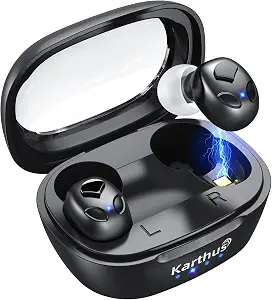
The Karthus stands out for seven volume levels and one-button operation, a practical combination for users who want more level choices without relying on an app. Its behind-ear RIC fit and soft tulip tips also give a clearer picture of how it sits than the in-ear models from the first two products. The headline 100-hour figure refers to use with the charging case; the aids themselves are listed for up to 30 hours per charge. That distinction matters if you expect continuous daily wear. Compared with the Manzelun GM-105, Karthus specifies more volume levels and two listening modes, while Manzelun offers physical slide and rotary controls plus multiple ear tips. Karthus is explicitly described for mild to moderate loss, so it is not a credible pick for profound hearing loss without professional confirmation.
Pros:- Seven volume levels offer more adjustment steps than a simple two-mode choice
- One-button operation needs no app or Bluetooth
- Behind-ear RIC design includes soft tulip ear tips
- Charging case supports up to 100 hours of combined use
Cons:- A single charge provides up to 30 hours, not the full 100-hour case-supported figure
- Product data limits the intended range to mild to moderate hearing loss
- No wireless or Bluetooth connectivity
Best for: Seniors with mild or moderate hearing loss who want tactile one-button operation, several volume steps, and a behind-ear RIC fit.
Not ideal for: People with profound hearing loss, buyers who need Bluetooth or app controls, or those who interpret the 100-hour claim as continuous use without the charging case.
- Battery life:Up to 30 hours per charge; up to 100 hours with charging case
- Charging time:15 minutes for hours of support
- Design:Behind-ear RIC with soft tulip ear tips
- Volume levels:7
- Modes:Quiet Mode and Noise Mode
- Operation:One-button control; no app or Bluetooth
- Color:Char Black
Our verdict“Choose Karthus for straightforward manual adjustment and case-supported battery capacity only if your needs fall within its stated mild-to-moderate range.”
Manzelun GM-105 Rechargeable Behind-the-Ear Hearing Aids with Noise Cancellation
Manzelun takes a more traditional, hands-on approach: a slide switch and continuous volume knob let users adjust the aids directly, without stepping through preset volume levels. Its behind-the-ear hooks and five pairs of ear tips offer fit choices, which may help users who find a small in-ear amplifier difficult to handle. The included case can recharge both aids up to four times, but the devices themselves are rated for up to 25 hours of use—shorter than the Karthus’s 30 hours per charge and far below the 80-hour claims elsewhere in this group. Two charging options add flexibility, although operating noise and an adjustment period are listed drawbacks. Noise cancellation does not establish support for profound loss, and this listing provides no gain figures or fitting range, so I would verify suitability with a hearing professional.
Pros:- Slide switch and continuous volume knob provide direct physical adjustment
- Flexible ear hooks and five pairs of ear tips support fit experimentation
- Charging is available by cable or case
- Case can recharge both aids up to four times
Cons:- Up to 25 hours per use period is shorter than the Karthus’s stated 30 hours per charge
- Product data mentions possible operating noise and an adaptation period
- No stated gain or fitting range confirms suitability for profound loss
Best for: Adults who prefer visible physical controls, need several ear-tip sizes, and want either a charging cable or case for daily recharging.
Not ideal for: People with profound hearing loss who need documented amplification specifications, or buyers prioritizing the longest use per charge, Bluetooth, or a low-profile in-ear fit.
- Brand and model:Manzelun GM-105
- Fit type:Behind-the-ear
- Color:Beige
- Weight:48 g
- Battery:Lithium-ion, 3.7 V
- Controls:Slide switch and continuous volume control knob
- Noise control:Active noise cancellation
- Usage time and charging:Up to 25 hours; cable or case charging, with the case recharging both aids up to four times
- Included fit and care accessories:Five pairs of ear tips and two cleaning brushes
Our verdict“Choose Manzelun for direct physical controls and flexible charging, but skip it if you need documented support for profound hearing loss or longer single-charge use.”
JUSHA B501 Behind-the-Ear Hearing Aids with 45 dB Gain and Charging Case
The JUSHA B501 earns a place for buyers who want app-adjustable listening and a rechargeable behind-the-ear fit. Its 45 dB maximum gain and 16-channel processing provide a stated level of amplification and sound adjustment, but those figures alone do not establish suitability for profound hearing loss. Compared with the Fun SP, which is explicitly described for severe to profound loss, the B501’s product information gives less reason to treat it as a first choice for that degree of impairment; seek an audiologist’s guidance before relying on it.
Four scene modes can help tailor sound for different settings, while three dome sizes offer fit choices. The tradeoff is up to 8 hours per charge, so long days may call for charging breaks despite the case extending stated use to 50 hours. Its 4 g weight is a practical advantage, but the behind-the-ear style will not suit everyone.
Pros:- Four app-controlled scene modes allow adjustments for different listening environments.
- Charging case extends stated battery use to up to 50 hours.
- Three dome sizes provide options for adjusting the fit.
- Lightweight 4 g behind-the-ear design.
Cons:- Maximum gain is listed as 45 dB, but the product data does not establish that it is suitable for profound hearing loss.
- Up to 8 hours of use per charge may require a midday charging break.
- Behind-the-ear fit may not suit people who prefer another style.
Best for: Adults who prefer a lightweight behind-the-ear device, want app-controlled scene options, and have confirmed with a hearing professional that this level of amplification suits their loss.
Not ideal for: People with profound hearing loss seeking a device specifically identified for that severity, or users who need uninterrupted wear beyond the stated 8 hours per charge.
- Brand and model:JUSHA B501
- Fit:Behind-the-ear
- Maximum gain:45 dB
- Sound processing:16 channels
- Scene modes:4, adjustable through a smartphone app
- Battery life:Up to 8 hours per charge; up to 50 hours with charging case
- Charging:Rechargeable
- Fit accessories and weight:Three dome sizes; 4 g
Our verdict“Choose the B501 for app-based scene adjustments and a lightweight fit only after confirming with a hearing professional that its stated 45 dB gain is appropriate for your hearing loss.”

How We Picked
I ranked these products around the needs that matter most for profound hearing loss: clear evidence that the device is intended for severe-to-profound loss, published amplification information, fitting and control options, physical design, and practical charging or maintenance. A device marketed for profound loss or one that states a measurable gain receives more attention than a general OTC model with feature claims but little evidence of suitability. I also treated Bluetooth, noise reduction, channel counts, and battery claims as supporting details rather than substitutes for verified output and a fitting matched to an audiogram.
The supplied product names do not provide enough comparable technical data to confirm maximum output, fitting range, clinical validation, or compatibility with every hearing profile. For that reason, the ranking favors clearer relevance to the stated use case, not a claim that any device will work for every person with profound loss. OTC aids may be a poor match for profound hearing loss; buyers should check product documentation and consult an audiologist or hearing-care professional before relying on any device.
Factors to Consider When Choosing Hearing Aids For Profound Hearing Loss
For profound hearing loss, the first decision is not which device has the most features; it is whether the device can provide suitable, safely fitted amplification for your hearing profile. These broader checks can help you avoid paying for convenience features that cannot make up for a mismatch.
Confirm the device fits your audiogram
A hearing test records how much sound you need at different frequencies, and that pattern matters as much as the general label of profound loss. Before buying, compare the product’s stated fitting range with your audiogram rather than relying on terms such as “powerful” or “severe.” Ask whether the listed range applies across speech frequencies and whether the device can be adjusted independently for each ear. A single gain number is useful only as a starting point; it does not describe maximum output or how sound is shaped. If the maker does not publish fitting limits, request them before purchase. A mismatch can leave speech inaudible or make louder sounds uncomfortable.
Check whether OTC is appropriate
OTC hearing aids are generally intended for adults with perceived mild-to-moderate hearing loss, not profound loss. A product title that mentions severe loss does not establish that it meets a clinical fitting need or is regulated for that use. Ask an audiologist or hearing-care professional whether an OTC model is appropriate for your test results before treating it as a replacement for prescription care. If speech remains unclear even when sounds are louder, the issue may involve fitting, ear health, or the hearing profile—not a lack of volume alone. Professional evaluation can also identify causes that a consumer device will not address. The tradeoff is less convenience at the outset in exchange for guidance on fit, output, and follow-up.
Prioritize output and safe adjustment over feature counts
Channel counts describe how sound may be divided for processing; they do not tell you how much usable amplification a device can deliver. Look for documented maximum output, fitting range, and adjustment controls, then ask how the device limits uncomfortable loudness. Do not turn the volume up repeatedly to compensate for speech that remains unclear. That can raise sound levels without improving understanding. Noise reduction may make some environments more comfortable, but it cannot restore speech cues that the fitting fails to provide. When comparing products, favor verifiable specifications over broad claims about digital chips or clear sound.
Choose a style you can manage every day
Behind-the-ear devices can be easier to grasp and may accommodate larger controls, while small or in-ear designs can feel less visible but may be harder to handle. Check whether you can insert and remove the device, change settings, and clean it without help. Dexterity, eyesight, ear shape, and the need to wear glasses can all affect comfort. A compact design is not automatically a better choice if it is difficult to position securely. Ask about available ear tips or molds, since a loose fit can cause feedback and reduce usable amplification. A hands-on fitting appointment can reveal handling problems that product photos cannot.
Match charging and maintenance to your routine
Rechargeable models reduce the need to replace small batteries, but they depend on a regular charging routine and a working case or cable. Compare the stated runtime with how many hours you wear the aids, and check whether the case can provide backup charges away from an outlet. Long battery-life claims may rely on particular settings, streaming use, or testing conditions, so ask how your own use could change runtime. Keep cleaning tools and replacement ear tips in the plan; moisture and wax can affect sound even when the electronics are charged. If you travel often or cannot reliably charge overnight, ask whether the device has a practical backup option. Choose the system you can maintain consistently rather than the one with the biggest headline figure.
Check support, returns, and follow-up before buying
Hearing aids often need adjustment after the first fitting, so find out who can help if the sound is too sharp, feedback occurs, or speech remains unclear. Confirm the return period, warranty coverage, repair process, and whether remote or in-person support is available. Ask if a professional can program the device from your hearing test or if it only offers preset modes. Keep written notes about situations where you struggle; those details can guide useful adjustments better than changing settings at random. Support can matter more than an extra listening mode when a device is not comfortable or clear. For profound loss, a clear path to professional follow-up should weigh heavily in the decision.
Frequently Asked Questions
Can an OTC hearing aid be enough for profound hearing loss?
Many OTC hearing aids are intended for mild-to-moderate hearing loss, so a general OTC label does not confirm suitability for profound loss. Check the device’s documented fitting range and maximum output, then compare them with a current hearing test. A hearing-care professional can tell you whether an OTC model is a reasonable option or whether a prescription device and custom fitting are more appropriate. If speech stays unclear when the volume rises, do not assume a stronger setting will solve the problem. Seek professional guidance before relying on an OTC device for daily communication.
Is a stated 45 dB gain enough to choose the JUSHA B501?
Not by itself. Gain describes amplification under specified conditions, but it does not tell you the maximum output, frequency-by-frequency fitting range, or whether the device matches your hearing test. Ask the seller or manufacturer for technical documentation and confirm how the aid is adjusted for each ear. A hearing professional can interpret those figures against your audiogram and check whether the output is both useful and comfortable. Treat the stated gain as one comparison point, not proof that the device will meet your needs.
Should I choose a hearing aid with more channels for profound loss?
More channels can allow more detailed sound adjustment, but the count alone does not indicate stronger amplification or better speech understanding. A model with fewer channels may be a better fit if its output and fitting range match your audiogram and its controls can address your needs. Ask how the channels are programmed, whether the device can be adjusted by frequency, and who can make those changes. Also confirm whether the manufacturer publishes maximum output and fitting limits. Compare usable, verifiable fitting information before treating channel count as a deciding factor.
When should I choose prescription hearing aids instead of one of these devices?
Discuss prescription hearing aids with a hearing-care professional if your test shows profound loss, if OTC devices have not made speech understandable, or if you need more precise fitting and follow-up. Prescription options may offer programming tied to an audiogram, custom coupling, and professional adjustments, though the right choice depends on your needs and local clinical advice. An appointment can also check for earwax, ear conditions, or other issues affecting hearing. Bring details about where communication is hardest and what devices you have tried. That information helps shape a practical recommendation rather than relying on broad product claims.
What should I check before relying on rechargeable hearing aids for a full day?
Ask how runtime was measured, whether it includes Bluetooth streaming, and whether higher amplification or other settings reduce the stated battery life. Check that the charging case is easy to use, that it provides the number of backup charges you need, and that replacement charging accessories are available. Consider what you would do if the case is lost or cannot be charged while away from home. Clean the devices as directed, since blocked microphones or receivers can make a charged aid seem ineffective. If you need dependable all-day use, test the routine during the return period and confirm the seller’s support and warranty terms.
Conclusion
For profound hearing loss, I would start with a hearing test and a professional check of the product’s fitting range before choosing any OTC device. Among these listed options, the Fun SP Behind-the-Ear Hearing Aid is my best overall pick to investigate because it is the most explicitly aligned with severe-to-profound loss; that label still does not replace verified specifications or a fitted trial. The JUSHA B501 is the best value-style choice for specification checking if its stated 45 dB gain matches your needs, while ELEHEAR Beyond Pro is the best for Bluetooth-focused shoppers who have confirmed adequate amplification. For beginners, I would favor whichever option has the clearest controls, dependable support, and a return path—not simply the most modes. A best premium pick cannot be responsibly named from the supplied product details because no comparable premium service or performance evidence is provided. If your loss is confirmed as profound, prioritize professional fitting and documented output over battery claims, channel counts, or discreet styling.