

In-the-canal hearing aids can be a discreet alternative to behind-the-ear styles, but compact size, ease of handling, charging, and support vary widely. My best overall pick is the MDHearing NEO XS, which pairs a small in-ear design with rechargeable convenience; the Audien Atom X stands out for its touchscreen charging case, while the BlaidsX Micro ITC is the option to examine if Bluetooth matters to you. The main tradeoff is that a smaller, less visible device may be harder to insert, clean, or adjust, and advertised noise features do not replace a hearing evaluation or personalized fitting. I compare all 14 options by their practical differences, limitations, and likely buyer fit below. Read on for the full breakdown and a guide to choosing a style you can manage every day.

Get everyday helpers delivered free with Prime
- Fast, free delivery on millions of items
- Prime Video, Amazon Music and more included
- Member-only deals all year
Complete the kit

Key Takeaways
- MDHearing NEO XS is the most balanced starting point: its compact rechargeable format gives it the clearest all-around role, though buyers should compare support and adjustment options before choosing.
- Audien Atom X differentiates itself through its touchscreen case: that may make charging controls easier to see than on simpler cases, but it adds another interface to learn.
- BlaidsX Micro ITC is the standout for Bluetooth: connectivity is a specific reason to choose it over more basic in-ear amplifiers, but buyers should confirm which devices and functions are supported.
- Several products emphasize discreet size, noise reduction, or long battery claims: those labels are not interchangeable; fit, listening needs, verified runtime, and the ability to manage the device matter more than a feature name.
- Rechargeable cases are common across this lineup: a case can simplify daily charging, yet small earpieces and ports may still be difficult to handle for people with limited dexterity.
| Chosgo Mini Rechargeable In-Ear Hearing Amplifiers |  | Best for Simple, Compact Wear | Fit: In-ear | Intended hearing loss: Mild to moderate | Noise control: Active noise cancellation | VIEW ON AMAZON | See Our Full Breakdown |
| Maleous Mini Rechargeable In-the-Ear Hearing Aids with Noise Cancellation, Beige |  | Best for Longer Stated Runtime | Style: Completely-in-canal (CIC) | Color: Beige | Weight: 2 g | VIEW ON AMAZON | See Our Full Breakdown |
| Flaygo Rechargeable Hearing Aid for Seniors with Clear Sound |  | Best for Minimal Manual Adjustments | Fit: In-ear | Digital processing: 16-channel digital chips | Noise feature: Intelligent noise cancellation | VIEW ON AMAZON | See Our Full Breakdown |
| CIC Invisible Hearing Aid for Seniors with Rechargeable UV Cleaning Case |  | Best for Built-In Case Hygiene | Fit: In-ear | Style: CIC | Color: Apricot | VIEW ON AMAZON | See Our Full Breakdown |
| Audien Atom One OTC Hearing Aids |  | Best for Manual Sound Tuning | Fit: In-ear | Intended hearing loss: Mild to moderate | Controls: Separate analog volume and frequency dials | VIEW ON AMAZON | See Our Full Breakdown |
| ZAVYVAZ GM-922 Rechargeable OTC Hearing Aids, 32-Channel, In-Ear |  | Best for Long Daily Wear | Fit: In-ear; universal for either ear | Processing: 32-channel digital processing | Intended hearing loss: Mild to moderate | VIEW ON AMAZON | See Our Full Breakdown |
| BlaidsX Micro ITC Rechargeable Bluetooth Hearing Aids |  | Best for App-Based Customization | Fit: In-ear, completely-in-canal (ITC) | Intended hearing loss: Mild to moderate | DSP channels: 32 in title; 48 in description | VIEW ON AMAZON | See Our Full Breakdown |
| Audien Atom X Rechargeable OTC Hearing Aids with Touchscreen Charging Case |  | Best for App-Free Mode Switching | Fit: In-ear; pair for both ears | Control: Touchscreen on charging case | Listening modes: Conversation, Crowd, TV, and Comfort | VIEW ON AMAZON | See Our Full Breakdown |
| MDHearing NEO XS Rechargeable In-Ear OTC Hearing Aids |  | Best for Extended Trips Between Outlets | Fit: In-ear, completely-in-canal | Intended hearing loss: Mild to moderate | Power source: Rechargeable lithium-ion battery | VIEW ON AMAZON | See Our Full Breakdown |
| LAMYOO Rechargeable Invisible Hearing Aids for Seniors, Digital Noise Reduction, One-Button Control, Ergonomic Fit, 100H Battery Life with Charging Case |  | Best for Simple One-Button Operation | Fit: In-ear | Control: One-button | Noise reduction: Active noise cancellation | VIEW ON AMAZON | See Our Full Breakdown |
| Ceretone Core One Pro Rechargeable OTC Hearing Aids |  | Best for a Customizable Fit | Intended users: Adults with mild to moderate hearing loss | Design: Skin-tone in-ear with ergonomic 30° shape | Ear tip sizes: S, M, L | VIEW ON AMAZON | See Our Full Breakdown |
| Rechargeable Hearing Aids for Adults, Discreet In-Ear Assistive Devices | 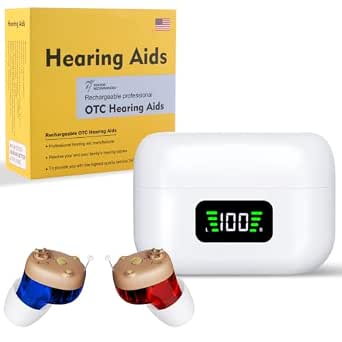 | Best for Simple Daily Handling | Fit type: In-ear | Dimensions: 2.5 × 0.5 inches | Weight: 22.68 g | VIEW ON AMAZON | See Our Full Breakdown |
| Karthus Hearing Aids for Seniors with Noise Reduction, Rechargeable In-Ear |  | Best for Clearly Specified Controls | Fit type: In-ear | Intended hearing loss: Mild to moderate | Battery: Included lithium polymer battery | VIEW ON AMAZON | See Our Full Breakdown |
| Rechargeable Hearing Aids for Seniors – Digital Sound Processing, Noise Cancelling & Feedback Suppression, Invisible In-Ear Design with Comfort Fit, 7-Day Battery & Portable Charging Case |  | Best for Feedback and Noise Control | Design: Invisible in-ear; hypoallergenic silicone | Sound features: Digital sound processing, noise reduction, and feedback suppression | Battery life: Up to 16 hours per charge | VIEW ON AMAZON | See Our Full Breakdown |
| in the canal hearing aid | Fit | Battery |
|---|---|---|
| Chosgo Mini Rechargeable In-Ea | In-ear | Included lithium-ion |
| Maleous Mini Rechargeable In-t | — | — |
| Flaygo Rechargeable Hearing Ai | In-ear | Included lithium-ion |
| CIC Invisible Hearing Aid for | In-ear | — |
| Audien Atom One OTC Hearing Ai | In-ear | Rechargeable lithium-ion |
| ZAVYVAZ GM-922 Rechargeable OT | In-ear; universal for either ear | Rechargeable lithium-ion |
| BlaidsX Micro ITC Rechargeable | In-ear, completely-in-canal (ITC) | Rechargeable lithium-ion |
| Audien Atom X Rechargeable OTC | In-ear; pair for both ears | — |
| MDHearing NEO XS Rechargeable | In-ear, completely-in-canal | — |
| LAMYOO Rechargeable Invisible | In-ear | — |
| Ceretone Core One Pro Recharge | — | — |
| Rechargeable Hearing Aids for | — | 3.7 V lithium polymer; rechargeable |
| Karthus Hearing Aids for Senio | — | Included lithium polymer battery |
| Rechargeable Hearing Aids for | — | — |
More Details on Our Top Picks
Chosgo Mini Rechargeable In-Ear Hearing Amplifiers
The Chosgo is a straightforward choice for buyers who want a small in-ear amplifier without a complex setup. Its one-button control and included silicone dome sizes make daily handling simpler, while the pocket-sized charging case supports use away from home. The stated up-to-18-hour runtime suits a typical day, though it trails the Maleous model’s stated 60 hours between charges. Chosgo’s listing describes active noise cancellation but does not specify listening modes or fine-tuning controls, so it is less suited to people who want to adapt sound for different settings. The two-hour charge is a manageable routine, but the device must be kept dry and away from heat. I’d favor it for uncomplicated, portable amplification rather than detailed sound adjustment.
Pros:- One-button control and LED indicators keep operation simple.
- Portable charging case and compact in-ear fit support on-the-go use.
- Multiple silicone dome sizes allow a more tailored fit.
- Up to 18 hours of stated use per charge.
Cons:- A two-hour charge is needed before use.
- No listening modes or detailed adjustment options are specified.
- Needs protection from moisture and heat.
Best for: Adults with mild to moderate hearing loss who want simple controls, a compact charging case, and replaceable-size silicone domes.
Not ideal for: People who need selectable listening programs, extensive customization, or a device for wet or sweaty conditions.
- Fit:In-ear
- Intended hearing loss:Mild to moderate
- Noise control:Active noise cancellation
- Battery:Included lithium-ion
- Stated use time:Up to 18 hours
- Charging time:2 hours
- Controls:One-button control with LED power indicators
- Included fit options:Multiple silicone ear dome sizes
Our verdict“Choose Chosgo if you value simple controls and a portable in-ear setup more than multiple sound modes or a longer stated runtime.”
Maleous Mini Rechargeable In-the-Ear Hearing Aids with Noise Cancellation, Beige
Among these five, Maleous makes the clearest case for buyers who want fewer charging interruptions: the manufacturer states up to 60 hours of operation, well beyond the Chosgo’s 18-hour figure. Its completely-in-canal style, silicone sleeves, and beige finish prioritize a discreet fit, while Normal and Restaurant modes offer a basic way to shift listening environments. That is more situational control than the Chosgo specifies, but still limited compared with a device offering broader customization. Adaptive noise cancellation and speech enhancement are claimed, though the listing gives little detail about how the modes differ. The stated IP64 rating adds a defined level of dust and water resistance, but it should not be read as permission for immersion. This is a better match for buyers who value runtime and simple presets over extensive tuning.
Pros:- Manufacturer states up to 60 hours of operation.
- CIC-style design with soft silicone sleeves.
- Normal and Restaurant modes plus adjustable volume.
- IP64 rating is specified.
Cons:- Only two listening modes are specified.
- The stated runtime is manufacturer-provided and may vary with use.
- IP64 does not indicate protection for immersion.
Best for: Adults seeking a discreet CIC-style aid with basic environment presets and a long manufacturer-stated interval between charges.
Not ideal for: Listeners who want more than two listening modes, detailed sound personalization, or a device suitable for swimming or submersion.
- Style:Completely-in-canal (CIC)
- Color:Beige
- Weight:2 g
- Noise control:Adaptive noise cancellation
- Listening modes:Normal and Restaurant
- Stated operation:Up to 60 hours
- Recharge time:2 hours
- Water resistance:IP64
Our verdict“Pick Maleous over Chosgo if the stated longer runtime and two preset modes matter more to you than broad sound customization.”
Flaygo Rechargeable Hearing Aid for Seniors with Clear Sound
Flaygo puts its emphasis on automatic processing rather than hands-on tuning. Its 16-channel digital chips and intelligent noise cancellation are intended to help separate speech from background sound, while the compact in-ear form keeps the device discreet. That processing claim gives it a different angle from Audien Atom One, which provides separate dials for volume and frequency instead of relying on a mostly automatic approach. The tradeoff is that Flaygo’s controls are described as limited, and automatic on/off may take time to activate. Its stated 16 hours per charge is suitable for day use, with seven days of standby listed, but the product still needs regular charging. I’d choose it for a wearer who prefers a low-interaction routine, not someone who wants precise manual adjustment or clear information about multiple listening programs.
Pros:- 16-channel digital chips are specified.
- Intelligent noise cancellation is designed to support speech clarity.
- Compact in-ear design is intended for discreet wear.
- Stated battery life includes up to 16 hours per charge and seven days standby.
Cons:- Customization options are limited according to the product details.
- Automatic on/off may take time to activate.
- Requires charging every few days with regular use.
Best for: Older adults who prefer an automatic in-ear aid with noise processing and do not want to adjust separate sound controls often.
Not ideal for: People who want manual frequency and volume tuning, fast automatic activation, or more detailed control information.
- Fit:In-ear
- Digital processing:16-channel digital chips
- Noise feature:Intelligent noise cancellation
- Battery:Included lithium-ion
- Battery voltage:3.7 volts
- Stated use time:Up to 16 hours per charge
- Standby:Up to 7 days
- Charging time:1–2 hours
Our verdict“Choose Flaygo if you want automatic sound processing and minimal manual adjustment, rather than Audien Atom One’s separate tuning dials.”
CIC Invisible Hearing Aid for Seniors with Rechargeable UV Cleaning Case
This CIC-style option stands out for pairing a rechargeable UV cleaning case with a discreet in-ear design. That combination may appeal to buyers who want case-based care as part of their routine, a feature not specified for the Chosgo or Maleous models. The listing also describes an AI chip for sound filtering, feedback control, and two listening modes, giving it more environment-focused claims than Flaygo, whose emphasis is automatic processing with limited user controls. However, the product information does not explain the modes, battery runtime, charging time, or level of water resistance. Those gaps make it harder to judge day-to-day reliability and fit for active use. I’d put it on the shortlist for discreet wear and a cleaning-case feature, while favoring better-documented alternatives if measurable battery details are a priority.
Pros:- Discreet in-ear design is described as lightweight and comfortable.
- Rechargeable case includes UV cleaning.
- Two modes are specified for different environments.
- AI sound filtering and whistle control are claimed.
Cons:- Battery runtime and charging time are not provided.
- Water and sweat resistance are unspecified.
- No app support or detailed customization options are described.
Best for: Seniors who prioritize a discreet CIC-style fit and want a UV cleaning case included in their charging routine.
Not ideal for: Buyers who need published runtime and recharge figures, app-based customization, or confirmed sweat and water protection.
- Fit:In-ear
- Style:CIC
- Color:Apricot
- Sound processing:AI chip for sound filtering
- Listening modes:Dual modes
- Case:Rechargeable UV cleaning case
- Feedback feature:No irritating whistle, according to product details
Our verdict“Consider this model if a UV cleaning case matters more than the detailed battery information available for Chosgo and Maleous.”
Audien Atom One OTC Hearing Aids
Audien Atom One is the strongest fit here for buyers who want direct control over how their in-ear aids sound. Its separate analog dials for volume and frequency allow adjustments without an app, unlike Flaygo’s more automatic approach or the Chosgo’s one-button operation. A USB-C dock and up to 24 hours of stated use add convenience, while three dome sizes and an expert-guided setup session support a more tailored start. The cost of that control is a roughly three-hour recharge, longer than the two hours stated for Chosgo and Maleous. It is intended for adults with mild to moderate hearing loss, so it is not a fit for every level of hearing difficulty. The included one-year warranty is useful context, but buyers should still choose it for its manual tuning rather than expect extensive digital modes.
Pros:- Separate analog dials adjust volume and frequency.
- Up to 24 hours of stated use per charge.
- USB-C charging dock and three ear dome sizes are included.
- Expert-guided setup session and one-year warranty are provided.
Cons:- Charging takes about three hours, longer than the two-hour times stated for Chosgo and Maleous.
- Designed for mild to moderate hearing loss.
- Manual dials may be less appealing to buyers who prefer automatic adjustments.
Best for: Adults with mild to moderate hearing loss who want separate, hands-on volume and frequency adjustment without using an app.
Not ideal for: People seeking a fast recharge, app-based controls, or an aid intended for hearing loss beyond the stated mild-to-moderate range.
- Fit:In-ear
- Intended hearing loss:Mild to moderate
- Controls:Separate analog volume and frequency dials
- Battery:Rechargeable lithium-ion
- Stated battery life:Up to 24 hours per charge
- Charging time:About 3 hours
- Charging connector:USB-C
- Ear dome sizes:Small, medium, and large
- Warranty:1 year
Our verdict“Choose Audien Atom One if hands-on volume and frequency control is your priority and a longer recharge time is acceptable.”
ZAVYVAZ GM-922 Rechargeable OTC Hearing Aids, 32-Channel, In-Ear
The GM-922 suits buyers who want rechargeable in-ear aids with simple physical controls and no phone setup. Its 32-channel processing, noise reduction, and feedback control are intended to support speech in everyday settings, while the washable domes and universal-ear fit give buyers several ways to adjust placement. The stated 18–20 hours per charge is longer than the Audien Atom X’s up-to-16-hour claim, and the case holds more than 100 hours of backup power. That makes the ZAVYVAZ a better fit for long days away from an outlet. The tradeoff is its lack of Bluetooth: unlike the BlaidsX Micro ITC, it cannot pair with a smartphone for app-based sound adjustments or audio streaming. Its stated use is also limited to mild-to-moderate hearing loss.
Pros:- Up to 18–20 hours of stated use per charge, with more than 100 hours of backup capacity in the charging case.
- 32-channel processing, noise reduction, and feedback control are designed to support speech in everyday listening.
- Universal fit for either ear and seven silicone dome sizes allow fit adjustments.
- Automatic on/off, memory settings, and physical button controls avoid app setup.
Cons:- No Bluetooth connection for phone or TV audio and no app-based sound adjustment.
- The product is specified for mild-to-moderate hearing loss, limiting its stated suitability.
- An in-ear fit can be uncomfortable or unstable for buyers whose ear canals do not suit the included domes.
Best for: People with mild-to-moderate hearing loss who want a rechargeable pair, physical button controls, and extended backup charging without smartphone features.
Not ideal for: Buyers who want Bluetooth streaming, app-based tuning, or support for hearing loss outside the stated mild-to-moderate range.
- Fit:In-ear; universal for either ear
- Processing:32-channel digital processing
- Intended hearing loss:Mild to moderate
- Battery:Rechargeable lithium-ion
- Use per charge:18–20 hours
- Charging time:2 hours
- Charging case backup:100+ hours
- Connectivity:No Bluetooth
- Included ear domes:7 silicone domes
Our verdict“Choose the GM-922 if long daily battery life and straightforward controls matter more than Bluetooth or app customization.”
BlaidsX Micro ITC Rechargeable Bluetooth Hearing Aids
The BlaidsX Micro ITC is the most connected choice in this group: its Bluetooth, smartphone app, and remote fitting give users more ways to adjust sound than the button-controlled ZAVYVAZ GM-922 or the app-free Audien Atom X. Dual directional microphones, noise reduction, feedback suppression, and WDRC processing are intended to help speech stand out in everyday environments, while audiogram matching and customizable profiles offer more personalization than preset listening modes. Its completely-in-canal design is aimed at buyers who prefer a discreet profile. There is a data caveat, though: the listing gives conflicting channel counts, with 32 in the title and 48 in the description. Battery life is also given as an 18–24-hour range, so buyers seeking unambiguous specifications may prefer a simpler option.
Pros:- Bluetooth and app control provide sound adjustment and smartphone compatibility.
- Custom profiles and audiogram matching allow more individualized tuning than preset-only options.
- Dual directional microphones, noise reduction, feedback suppression, and WDRC support speech-focused processing.
- Completely-in-canal fit is designed for a discreet appearance.
Cons:- The product listing conflicts on DSP channel count, stating both 32 and 48.
- Battery life is presented as an 18–24-hour range rather than a single runtime.
- App-based controls may be less convenient for buyers who want simple physical adjustments.
Best for: Smartphone users with mild-to-moderate hearing loss who want discreet in-canal placement and app-based sound profiles or audiogram matching.
Not ideal for: Buyers who prefer device controls without an app, need fully consistent technical specifications, or want a clearly stated battery runtime.
- Fit:In-ear, completely-in-canal (ITC)
- Intended hearing loss:Mild to moderate
- DSP channels:32 in title; 48 in description
- Frequency range:250–8000 Hz
- Connectivity:Bluetooth; smartphone compatible
- Battery:Rechargeable lithium-ion
- Battery life:18–24 hours, as stated in the title
- Sound features:Dual directional microphones, noise reduction, feedback suppression, and WDRC
Our verdict“Pick the BlaidsX if app-driven personalization and Bluetooth matter more to you than perfectly consistent specs or simple standalone controls.”
Audien Atom X Rechargeable OTC Hearing Aids with Touchscreen Charging Case
The Atom X makes adjustments through its touchscreen charging case, a useful middle ground for buyers who want more control than a one-button aid but do not want a smartphone app. Four preset modes—Conversation, Crowd, TV, and Comfort—let users choose a setting for common situations, though they do not offer the custom profiles available with the BlaidsX Micro ITC. The case also guides setup and carries replacement wax guards and cleaning tools, which may help first-time OTC users handle routine care. Its main limitation is runtime: the aids are rated for up to 16 hours per charge, shorter than the ZAVYVAZ GM-922’s stated 18–20 hours. The case adds up to 48 hours of use, but buyers who need longer stretches between charging will have a stronger case for the ZAVYVAZ.
Pros:- Touchscreen case provides controls without relying on a smartphone app or small aid buttons.
- Four preset modes address conversation, crowds, TV, and comfort settings.
- Case provides up to 48 hours of hearing aid use and is portable.
- Includes multiple ear domes, replacement wax guards, cleaning tools, and guided setup.
Cons:- Up to 16 hours per charge is shorter than the stated runtime of the ZAVYVAZ GM-922.
- Listening modes are preset rather than individually customizable.
- Adjustments depend on the touchscreen case rather than controls directly on the hearing aids.
Best for: First-time OTC buyers who want app-free access to a few clearly labeled listening modes and guided setup.
Not ideal for: People who need a full day or more from each hearing aid charge, or who want individually customizable sound profiles.
- Fit:In-ear; pair for both ears
- Control:Touchscreen on charging case
- Listening modes:Conversation, Crowd, TV, and Comfort
- Battery life:Up to 16 hours per charge
- Charging case capacity:Up to 48 hours of hearing aid use
- Power source:Rechargeable lithium-ion batteries
- Prescription required:No
- Included maintenance items:Multiple ear domes, replacement wax guards, and cleaning brush
Our verdict“Choose the Atom X if you want app-free, touchscreen mode selection and can work with its shorter per-charge runtime.”
MDHearing NEO XS Rechargeable In-Ear OTC Hearing Aids
The NEO XS is a practical pick for buyers who want a compact, contoured in-ear fit and a charger that can stay useful over several days away from a wall outlet. Its portable case can recharge the aids up to six times, a stronger backup claim than the Audien Atom X’s stated 48 hours of hearing aid use. Preset audio settings are designed to reduce feedback and background noise, while adjustable controls provide some flexibility without the app-centered customization of the BlaidsX Micro ITC. The listing describes a full day of use per charge but does not give an exact number of hours, making direct runtime comparisons difficult. It also notes that users may need time to adapt to processed sound. Buyers who want detailed personalization or precise battery figures may prefer a better-documented alternative.
Pros:- Compact, contoured in-ear design is intended to be discreet.
- Portable charger can recharge the aids up to six times before it needs to be plugged in.
- Preset audio settings are designed to reduce feedback and background noise.
- Adjustable controls provide an alternative to relying solely on app-based adjustments.
Cons:- Battery life is described as a full day without an exact number of hours.
- Preset settings offer less stated personalization than the BlaidsX Micro ITC’s custom profiles and audiogram matching.
- The product notes an adjustment period as users adapt to processed sound.
Best for: Adults with mild-to-moderate hearing loss who travel or spend long periods away from outlets and value a compact fit with multi-charge case backup.
Not ideal for: Buyers who want a precise published runtime, extensive app-based tuning, or a device intended for hearing loss beyond the stated range.
- Fit:In-ear, completely-in-canal
- Intended hearing loss:Mild to moderate
- Power source:Rechargeable lithium-ion battery
- Battery life:Full day per charge; exact hours not specified
- Charger capacity:Up to 6 charges
- Noise control:Active noise cancellation
- Controls:App control and button for volume and program settings
- Color:Tan
Our verdict“The NEO XS fits buyers who prioritize discreet wear and several backup charges, provided they can accept an unspecified daily runtime and preset-focused sound settings.”
LAMYOO Rechargeable Invisible Hearing Aids for Seniors, Digital Noise Reduction, One-Button Control, Ergonomic Fit, 100H Battery Life with Charging Case
LAMYOO centers its appeal on one-button operation and a nearly invisible in-ear design, making it the least complicated control scheme in this set. That simplicity may suit seniors who do not want app menus or touchscreen navigation; by comparison, the Audien Atom X offers more preset listening choices, while the BlaidsX adds app-based tuning. The listing claims up to 100 hours of use and a 100-minute charge, which would reduce charging interruptions if those figures match a buyer’s use. However, it does not clarify whether the 100-hour figure refers to one charge or includes the case, even though the title mentions a charging case. Buyers should treat that runtime claim cautiously. One-button control also limits adjustment options, and the in-ear shape may not suit every ear.
Pros:- One-button control keeps operation straightforward.
- Lightweight, nearly invisible in-ear design is intended for discreet everyday wear.
- The listing claims up to 100 hours of use and a 100-minute charge.
- Digital noise reduction and active noise cancellation are listed as sound features.
Cons:- The listing does not clearly explain whether the 100-hour runtime is per charge or includes the case.
- One-button operation provides fewer adjustment options than the Audien Atom X’s four modes or BlaidsX app controls.
- The stated ergonomic fit may not work for every ear shape.
Best for: Seniors who want a discreet in-ear device with a single-button control and minimal reliance on apps or complex menus.
Not ideal for: Buyers who need tailored sound settings, a fit known to suit a particular ear shape, or clearly specified battery runtime and case capacity.
- Fit:In-ear
- Control:One-button
- Noise reduction:Active noise cancellation
- Claimed battery life:Up to 100 hours; listing does not clarify whether this includes the case
- Charge time:100 minutes
- Battery type:Lithium polymer
- Weight:1 g
- Material:ABS
Our verdict“Choose LAMYOO if straightforward one-button use is your priority, but verify the 100-hour battery claim and fit expectations before buying.”
Ceretone Core One Pro Rechargeable OTC Hearing Aids
The Ceretone Core One Pro makes the most sense for buyers who want a discreet, skin-tone in-ear style and a few fit options rather than a long list of listening modes. Its 30° ergonomic shape and S, M, and L medical-grade ear tips give wearers room to find a more secure, comfortable fit; that matters because an uncomfortable tip can make an in-canal-style device hard to wear consistently. Rechargeable operation, auto on/off, and a charging case keep daily handling simple, while wind noise reduction may help in breezy settings. Compared with the Karthus, which specifies two listening modes and six volume levels, Ceretone provides less detail about sound adjustment. Its stated fit is for mild to moderate hearing loss, so it is not a substitute for a professional assessment or a solution for more severe loss.
Pros:- Skin-tone in-ear design keeps the device visually discreet.
- Three ear-tip sizes support a more individualized fit.
- Rechargeable design includes a charging case.
- Auto on/off and wind noise reduction support straightforward daily use.
Cons:- Intended only for mild to moderate hearing loss.
- The provided details do not specify battery runtime or distinct listening modes.
- Fit still depends on whether an in-ear tip is comfortable for the wearer.
Best for: Adults with mild to moderate hearing loss who prioritize a discreet look and want three ear-tip sizes to adjust the fit.
Not ideal for: People with severe hearing loss or buyers who want clearly specified listening modes and multiple volume levels.
- Intended users:Adults with mild to moderate hearing loss
- Design:Skin-tone in-ear with ergonomic 30° shape
- Ear tip sizes:S, M, L
- Power:Rechargeable
- Sound features:Digital chip and wind noise reduction
- Controls:Volume control and auto on/off
- Included charging:Charging case
Our verdict“Choose Ceretone if discreet styling and three fit options matter more to you than detailed sound-mode controls.”
Rechargeable Hearing Aids for Adults, Discreet In-Ear Assistive Devices
This model focuses on uncomplicated routine use: it pairs a compact in-ear fit with push-button volume adjustment, automatic power on/off, and a digital battery indicator. The indicator is a practical advantage over the Ceretone Core One Pro, whose supplied details do not specify a battery display; it gives users a quick way to check charge before heading out. Interchangeable ear tips and a charging case round out the everyday setup, while the listed one-year free replacement warranty adds a defined support period. Its two-channel digital processing and environmental noise cancellation are described in broad terms, not as a range of selectable listening programs. Compared with the Karthus, it also lacks stated runtime and listening-mode details. It is not waterproof, and the manufacturer notes that battery life varies with use, so careful cleaning and charging remain part of ownership.
Pros:- Digital battery indicator makes charge status easier to check.
- Push-button volume control and automatic on/off keep operation simple.
- Interchangeable ear tips allow fit adjustments.
- Includes a charging case and a one-year free replacement warranty.
Cons:- Not waterproof and requires careful cleaning and maintenance.
- Battery life may vary with usage, with no runtime specified in the supplied data.
- Noise cancellation and two-channel processing are described without further adjustment details.
Best for: Seniors who want a compact rechargeable in-ear device with a visible battery indicator and simple push-button controls.
Not ideal for: People who need waterproof hearing aids, detailed listening-mode choices, or a clearly stated runtime per charge.
- Fit type:In-ear
- Dimensions:2.5 × 0.5 inches
- Weight:22.68 g
- Battery:3.7 V lithium polymer; rechargeable
- Audio sensitivity:110 dB
- Sound processing:Two-channel digital processing and environmental noise cancellation
- Controls:Push-button volume control; automatic power on/off
- Included components:Hearing amplifiers, charging case, and ear tips
- Warranty:One-year free replacement
Our verdict“Pick this model for basic, easy-to-monitor daily use, but choose the Karthus if specified listening modes and runtime matter more.”
Karthus Hearing Aids for Seniors with Noise Reduction, Rechargeable In-Ear
Karthus earns a place for making its everyday listening controls more concrete than many basic in-ear options: it lists two listening modes and six volume levels, so buyers have a clearer idea of the adjustments available. The manufacturer also states up to 24 hours of use per charge and a case with 96 hours of charging capacity, useful details for planning between charges. Unlike the Rechargeable Hearing Aids for Adults, which highlight a digital battery indicator but leave runtime unspecified, Karthus gives a stated use duration. The tradeoff is a straightforward feature set: there is no Bluetooth connectivity for streaming, and its mild-to-moderate-loss target does not cover more severe hearing needs. Its in-ear fit and need for a charging case may also be less appealing to anyone who prefers a different style or wants to avoid managing a case.
Pros:- Two listening modes and six volume levels are clearly specified.
- Up to 24 hours of use per charge is stated.
- Discreet in-ear design and auto on/off support daily wear.
- No app or Bluetooth setup is required.
Cons:- No Bluetooth connectivity for phone, tablet, or television streaming.
- Designed for mild to moderate hearing loss, not severe cases.
- Extended charging capacity depends on keeping the charging case available.
Best for: Seniors with mild to moderate hearing loss who want simple physical controls, specified listening options, and a stated daily runtime.
Not ideal for: Buyers who want Bluetooth audio streaming, support for severe hearing loss, or a hearing aid that does not rely on a charging case.
- Fit type:In-ear
- Intended hearing loss:Mild to moderate
- Battery:Included lithium polymer battery
- Use per charge:Up to 24 hours
- Listening modes:2
- Volume levels:6
- Charging case capacity:96 hours
- Other features:Noise reduction and auto on/off
- Connectivity:No Bluetooth; compatible-device listing includes smartphone, tablet, and television
Our verdict“Choose Karthus if you want clearly stated listening adjustments and runtime without app-based controls or streaming features.”
Rechargeable Hearing Aids for Seniors – Digital Sound Processing, Noise Cancelling & Feedback Suppression, Invisible In-Ear Design with Comfort Fit, 7-Day Battery & Portable Charging Case
This option stands out for naming two specific sound-processing aims—noise reduction and feedback suppression—alongside digital sound processing. That combination may appeal to wearers who find unwanted noise or whistling distracting, although the supplied details do not explain how the processing can be adjusted. Its portable case provides over 110 hours of backup, and each charge is listed for up to 16 hours. Compared with Karthus, which offers two stated listening modes and six volume levels, this model emphasizes automatic operation and a larger stated case reserve rather than user-selected settings. The claimed seven-day battery framing should be read alongside the more specific figures: up to 16 hours per charge and over 110 hours of case backup. Its in-ear-only fit will not suit everyone, and it requires recharging every one to two days depending on use.
Pros:- Digital processing includes noise reduction and feedback suppression.
- Portable case provides over 110 hours of backup.
- Automatic activation reduces the need for manual startup.
- Lightweight, hypoallergenic silicone in-ear design is intended for discreet comfort.
Cons:- Requires charging every one to two days depending on use.
- In-ear fit may not suit people who find canal-style devices uncomfortable.
- The supplied details do not specify selectable listening modes or volume levels.
Best for: Seniors who want an in-ear device with stated feedback suppression, automatic operation, and substantial charging-case backup.
Not ideal for: People who need multiple selectable listening modes, dislike in-ear devices, or want to avoid frequent charging.
- Design:Invisible in-ear; hypoallergenic silicone
- Sound features:Digital sound processing, noise reduction, and feedback suppression
- Battery life:Up to 16 hours per charge
- Charging case:Portable case with over 110 hours of backup
- Operation:Automatic activation and smart noise cancellation
- Charging frequency:Every 1–2 days depending on use
- Material:ABS
- Weight:1 g
- Warranty:2 years
Our verdict“Choose this model if feedback suppression and charging-case reserve matter more than manual sound-mode control.”

How We Picked
I compared the 14 listed models by the factors that affect daily use of an in-the-canal device: how the product is positioned for fit and discretion, its charging approach, the clarity of its controls and care routine, and any stated listening or connectivity features. I also looked for details that help buyers judge practical claims, such as battery runtime, noise processing, feedback control, and case functions, rather than treating feature labels as proof of better hearing.
The ranking gives more weight to a clear buyer fit and useful day-to-day design than to broad claims such as “invisible” or “noise cancelling.” The NEO XS leads as a balanced compact rechargeable choice; Atom X and BlaidsX earn distinct places for the case interface and Bluetooth, respectively. Models with limited distinguishing information remain useful alternatives, but I rank them below options with a more specific reason to choose them. These are OTC products, not substitutes for a professional assessment or a custom-fitted prescription device.
| in the canal hearing aid | Fit |
|---|---|
| Chosgo Mini Rechargeable In-Ea | In-ear |
| Maleous Mini Rechargeable In-t | — |
| Flaygo Rechargeable Hearing Ai | In-ear |
| CIC Invisible Hearing Aid for | In-ear |
| Audien Atom One OTC Hearing Ai | In-ear |
| ZAVYVAZ GM-922 Rechargeable OT | In-ear; universal for either ear |
| BlaidsX Micro ITC Rechargeable | In-ear, completely-in-canal (ITC) |
| Audien Atom X Rechargeable OTC | In-ear; pair for both ears |
| MDHearing NEO XS Rechargeable | In-ear, completely-in-canal |
| LAMYOO Rechargeable Invisible | In-ear |
| Ceretone Core One Pro Recharge | — |
| Rechargeable Hearing Aids for | — |
| Karthus Hearing Aids for Senio | — |
| Rechargeable Hearing Aids for | — |
Factors to Consider When Choosing In The Canal Hearing Aids
Choosing an in-the-canal hearing aid is not only a question of how small it looks. I would start with the hearing problem you want to address, then check whether the device’s fit, controls, and upkeep match your hands, ears, and routine. These broader points can help prevent a discreet design from becoming an inconvenient one.
Match the device to your hearing needs
OTC hearing aids are intended for adults with perceived mild to moderate hearing loss, not every cause or degree of hearing difficulty. A device that amplifies sound may not solve problems caused by earwax, infection, or another condition that needs clinical care. Seek a hearing assessment if the change is sudden, affects one ear much more than the other, or comes with pain, drainage, dizziness, or ringing. For gradual difficulty, consider whether speech in quiet, group conversation, or television is the main challenge. Choose based on that listening situation rather than assuming a product’s “noise reduction” label covers every environment.
Treat fit and visibility as separate decisions
“Invisible” is a marketing description, not a guarantee that a device will disappear in every ear. Ear canal shape and size differ, so a compact model can feel secure for one person and uncomfortable or loose for another. Ask what tip sizes are included and whether replacement tips are available before committing. A deeper fit may reduce visibility, but it can also make insertion, removal, and cleaning harder. If possible, check the return policy and trial terms, and stop wearing a device that causes pain or persistent irritation.
Compare controls with your dexterity and vision
Small devices often require careful placement and a steady grip, so control design matters as much as the hearing features. A simple button may be easier to operate than a sequence of taps, while a touchscreen case may offer clearer status information but add steps. Think through the full routine: removing the aid, changing a setting, storing it, and putting it back in. If you have reduced finger sensitivity or eyesight, look for obvious controls, clear instructions, and a case that is easy to open. Do not assume that a small body is automatically easier to use.
Check charging claims against your daily routine
Rechargeable models can reduce the need to handle tiny disposable batteries, but case capacity and charging habits still shape convenience. Confirm how the aids charge, how long a full charge is claimed to last, and whether the case itself needs a cable or a separate power source. Large figures such as multi-day runtime may refer to a case plus device rather than continuous use, so read the manufacturer’s explanation. A charging case is useful when you can keep it nearby and remember to recharge it. If you travel often or cannot charge daily, plan for what happens when the case runs low.
Separate useful sound processing from broad claims
Noise reduction, feedback suppression, and multiple channels describe different processing approaches; none guarantees natural sound or clear speech in every setting. More settings can help some listeners tailor sound, but extra controls may also make adjustment confusing. Pay attention to whether you can change volume easily and whether the instructions explain what each setting does. Give any new device a gradual adjustment period rather than raising amplification sharply to compensate for every missed word. Persistent whistling, discomfort, or distorted sound is a reason to seek help instead of simply turning the volume up.
Factor in follow-up, returns, and ongoing care
A low-profile device still needs regular cleaning, tip replacement, and troubleshooting. Compare the manufacturer’s support channels, warranty terms, return window, and access to fitting guidance before buying; these services can matter more than a feature list when sound needs adjustment. Keep the case and aids dry, follow the stated cleaning instructions, and avoid pushing tools deep into the canal. A product with UV cleaning claims does not remove the need to clean ear tips or follow the maker’s care directions. For a first-time buyer, a clear support path may be worth choosing over a less expensive device with little guidance.
Frequently Asked Questions
Are in-the-canal OTC hearing aids suitable for every kind of hearing loss?
No. OTC hearing aids are meant for adults who perceive mild to moderate hearing loss, and an in-canal design does not make a device suitable for severe or unusual hearing problems. Sudden loss, one-sided changes, pain, drainage, dizziness, or a major difference between ears calls for medical assessment rather than a mail-order purchase. A hearing professional can help identify whether amplification is appropriate and whether a custom device would fit better. If you are unsure about the degree or cause of your hearing difficulty, get it assessed before choosing from this lineup.
How can I tell whether an in-the-canal model will fit my ears?
You usually cannot know from the product name or a photo alone, since ear canals vary in shape and size. Check the included tip sizes, the maker’s fit instructions, and whether replacement tips are available. Review the return and trial conditions before opening or using the product, since hygiene rules may limit returns. A fit should feel secure without pain or strong pressure, and insertion should not require force. Persistent discomfort or a device that repeatedly slips out is a poor fit, not a problem to solve by wearing it longer.
Should I choose a Bluetooth model or a simpler rechargeable hearing aid?
Choose Bluetooth when streaming or wireless control is a real part of your routine, and confirm that the specific functions work with your phone and operating system. Bluetooth support can differ: a product may offer app control, audio streaming, or only limited connectivity. If you mainly need amplification for conversation and prefer fewer setup steps, a simpler rechargeable option may be easier to manage. Also consider battery use, pairing support, and what happens if the connection drops. Do not pay attention to the word “Bluetooth” alone; check the manufacturer’s feature details.
Do rechargeable hearing aids with charging cases last for several days?
Runtime depends on the device, how many hours you wear it, settings, and whether a stated figure includes extra charges stored in the case. A claim such as several days may describe occasional use or combined case capacity rather than continuous operation. Check the product documentation for the runtime per charge and the case’s own charging method. If you rely on the aids throughout the day, plan to charge the case regularly and bring its cable when traveling. A case adds convenience, but it does not remove the need to monitor power.
When should I choose a professional hearing aid instead of an OTC in-canal device?
A professional evaluation is a better path if your hearing loss seems severe, is changing quickly, is much worse in one ear, or comes with other ear symptoms. It can also help when OTC devices remain uncomfortable or fail to make speech clearer after careful adjustment. A clinician can check for medical causes and recommend a fitting suited to your hearing profile and ear shape. OTC devices may appeal to adults with mild to moderate perceived loss who want a self-directed option, but they do not provide the same individualized assessment. Consider professional support if daily communication remains difficult.
Conclusion
For the broadest balance of discreet design and rechargeable convenience, I would start with the MDHearing NEO XS as best overall, while checking fit and support terms before buying. The best value depends on which basic features you need; among the less specialized choices, compare the Chosgo, Flaygo, and Karthus models by included tips, controls, and care instructions rather than by broad claims. For a more feature-led choice, the Audien Atom X is my premium-style pick for buyers who want a touchscreen case, while the BlaidsX Micro ITC suits shoppers who specifically need Bluetooth. Beginners may prefer a simpler rechargeable model with clear instructions and easy returns over a device with more settings. If discretion is your priority, compare the CIC and other compact designs for comfort and manageability first; for complex or significant hearing difficulty, choose professional assessment over any OTC pick.