
Inner ear hearing aids vary in fit, controls, charging routines, and the listening features they advertise, so the right choice depends on what you need day to day. My best overall pick is the HEARO Rechargeable CIC OTC Hearing Aids for shoppers who want a clearly identified in-canal pair. The Audien Atom One is another standout for buyers focused on a compact OTC option, while the 16-channel DSP model with 80+ hours of advertised battery life suits those who value multiple listening modes and longer intervals between charges. The main tradeoffs are discretion versus ease of handling, simple controls versus customization, and compact size versus battery convenience. Read on for the full comparison, selection criteria, and advice on choosing a style that fits your ears and routine.

Get everyday helpers delivered free with Prime
- Fast, free delivery on millions of items
- Prime Video, Amazon Music and more included
- Member-only deals all year
Complete the kit


Key Takeaways
- HEARO CIC stands out as the clearest pair-style in-canal pick; product listings with less precise fit details make it harder to judge how discreet or secure they will feel.
- Audien Atom One and Audien Atom Air offer recognizable compact OTC options, but their advertised features and battery-life claims differ, so shoppers should compare the exact model rather than assume they are interchangeable.
- 16-channel DSP models advertise more sound-processing controls than basic one-button options, but channel count alone does not show how well a device will suit an individual hearing profile.
- Long-use claims range from 24 hours to 100 hours or more, and some listings mix standby time with use time; check what each battery figure actually describes before choosing.
- Several products advertise noise reduction or cancellation, while only some mention feedback suppression, UV cleaning, or environment modes; those additional features may matter more to particular routines than a long feature list.




| inner ear hearing aid | Battery life |
|---|---|
| Karthus Rechargeable In-Ear He | — |
| OTC Hearing Aids for Seniors | Listed 120 hours |
| HEARO Rechargeable CIC OTC Hea | Up to 12 hours per charge |
| Rechargeable Hearing Aids for | 35 hours with charging case |
| Rechargeable OTC Hearing Aids | — |
| Audien Atom One OTC Hearing Ai | Up to 24 hours per charge |
| Oricle Standard 3.0 Rechargeab | Up to 60 hours per charge |
| OTC Hearing Aids for Seniors & | 80+ hours |
| Flaygo Hearing Aids for Senior | 80 hours standby |
| Audien Atom Air In-Ear Hearing | Up to 24 hours |
| Maleous Mini Rechargeable CIC | Up to 60 hours |
| Rechargeable OTC Hearing Aids | Up to 100 hours total |
| NOLGESK Rechargeable OTC Heari | — |
| Flaygo Rechargeable Hearing Ai | Up to 16 hours per charge |
More Details on Our Top Picks
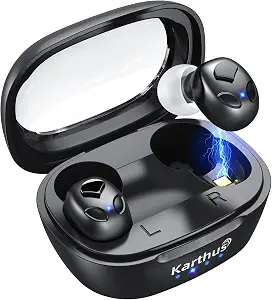
Karthus Rechargeable In-Ear Hearing Aids for Seniors with Noise Reduction
The Karthus is a straightforward pick for someone who wants in-ear fit and rechargeable convenience without app setup or Bluetooth features. Its two listening modes and six volume levels give users basic ways to adjust sound while keeping operation simple. The charging case is listed for up to 96 hours, which can reduce how often the case itself needs recharging; that figure is not the same as a stated single-charge listening time. Compared with the HEARO CIC, Karthus offers more listed volume steps, while HEARO provides a clearly specified completely-in-canal shape and includes different-size domes. Karthus is aimed at mild to moderate hearing loss, and its no-app design also means less fine-tuning. Skip it if Bluetooth streaming or detailed personalization is a priority.
Pros:- Two listening modes and six volume levels provide simple adjustments without an app.
- Rechargeable design avoids routine disposable-battery replacement.
- In-ear fit is designed to be discreet and comfortable for extended wear.
- Charging case is listed for up to 96 hours.
Cons:- No Bluetooth connectivity or app for customization.
- Intended for mild to moderate hearing loss, not more severe needs.
- The product information does not specify listening time per charge.
Best for: Adults or seniors with mild to moderate hearing loss who want basic in-ear controls, a charging case, and no app-based setup.
Not ideal for: Buyers who want Bluetooth audio streaming, app-based adjustments, or a clearly specified single-charge listening duration.
- Fit:In-ear
- Intended hearing loss:Mild to moderate
- Listening modes:2
- Volume levels:6
- Charging case:Listed for up to 96 hours
- Controls:No-app controls; auto on/off
- Battery:Lithium polymer, included
- Color:White
Our verdict“Choose Karthus if you want simple in-ear operation and a long-listed case runtime, but skip it if streaming or detailed sound control matters.”
OTC Hearing Aids for Seniors, Rechargeable Amplifier with Noise Cancelling, Lightweight and Beginner-Friendly
This option has the strongest listed total runtime in this group: 120 hours with its charging case. Its 16-channel digital processing and AI noise cancellation may appeal to listeners who want help separating speech from surrounding sound, while the one-button controls keep daily operation approachable. The tradeoff for this roundup is fit: these are behind-the-ear aids with silicone tips, not the fully in-ear style offered by Karthus or the HEARO CIC. That placement may be easier for some people to handle, but it is less discreet for buyers specifically seeking an inner-ear device. Three listening modes offer some choice, though there is no app for further tuning. I would shortlist it for runtime and ease of use, not for an invisible in-ear appearance.
Pros:- Listed 120-hour battery life with a charging case.
- 16-channel digital processing with AI noise cancellation.
- One-button controls and three listening modes simplify routine use.
- Multiple silicone ear-tip sizes support fit adjustment.
Cons:- Behind-the-ear design does not match the discreet in-ear focus of this roundup.
- No app or advanced personalization is listed.
- Water and sweat resistance are not specified.
Best for: Seniors who prioritize a long listed case-supported runtime, simple one-button operation, and a behind-the-ear fit.
Not ideal for: Buyers set on completely in-ear or canal-style hearing aids, or those who want app-based sound adjustments.
- Fit:Behind-the-ear with silicone ear tips
- Digital processing:16 channels
- Noise control:AI noise cancellation
- Battery life:Listed 120 hours
- Charging case:Included
- Controls:One-button
- Listening modes:3
- Ear tips:Soft silicone tips in multiple sizes
Our verdict“Pick this model for straightforward controls and its listed 120-hour runtime if a behind-the-ear fit is acceptable.”
HEARO Rechargeable CIC OTC Hearing Aids, Beige, Pair
HEARO is the clearest choice here for buyers who specifically want a completely-in-canal (CIC) design rather than a general in-ear device. Its beige finish, three dome sizes, and included cleaning tool make the fit and upkeep details more explicit than the Karthus listing. Two programs, feedback reduction, and a single-button control keep operation simple, though they offer less adjustment breadth than Karthus’s six volume levels. The main compromise is runtime: HEARO lists up to 12 hours per charge, so users may need to plan around regular charging more carefully than with the case-runtime claims on Karthus or the 35-hour listing on the DSP in-ear model. Its sweatproof designation is useful for everyday wear, but the product is still intended for perceived mild to moderate hearing loss.
Pros:- Completely-in-canal design is the most specifically described canal fit in this group.
- Three silicone dome sizes help users find a more suitable fit.
- Feedback reduction and two listening programs support everyday listening.
- USB-C charging case, cable, and cleaning tool are included.
Cons:- Up to 12 hours of use per charge is less than the longer case-runtime claims elsewhere in the roundup.
- Only two programs and a single button are listed, with no app-based control.
- Designed for perceived mild to moderate hearing loss.
Best for: Adults seeking a clearly specified CIC device, discreet canal placement, and a kit with multiple dome sizes and cleaning tools.
Not ideal for: People who need longer stated listening time between charges, more volume steps, or support beyond perceived mild to moderate hearing loss.
- Design:Completely-in-canal, in-ear
- Intended users:Adults 18+ with perceived mild to moderate hearing loss
- Listening programs:2
- Battery life:Up to 12 hours per charge
- Charging:USB-C charging case and cable
- Controls:Single button for volume and program selection
- Fit accessories:Soft silicone domes in S, M, and L
- Special features:Rechargeable, sweatproof, feedback reduction
- Color:Beige
Our verdict“Choose HEARO for a specified CIC fit and useful fitting accessories, but look elsewhere if longer per-charge use is your priority.”
Rechargeable Hearing Aids for Seniors, 16-Channel DSP Noise Reduction, Invisible In-Ear Design, Volume Control, 35 Hours Battery Life with Charging Case
This model pairs a listed 16-channel DSP system with an in-ear design, giving it a more processing-focused pitch than the simpler Karthus, which lists two listening modes and six volume levels but no channel count. The stated 35-hour battery life with the charging case is also more specific than Karthus’s case figure, which does not state listening time per charge. Button controls and volume adjustment keep operation direct, but the available details do not name listening programs, fit accessories, or the degree of noise reduction control. Compared with HEARO, this aid emphasizes DSP and runtime rather than a clearly specified CIC shape and included dome sizes. Its white color listing may not suit buyers seeking a less visible shade, and anyone needing detailed fit guidance may prefer a product with more accessories described.
Pros:- 16-channel DSP noise reduction is listed for sound processing.
- In-ear design aims for a less visible fit.
- Button controls include volume adjustment.
- 35-hour battery life with charging case is specified.
Cons:- Only white is listed, limiting color choice for a discreet match.
- Listening programs and included fit accessories are not specified.
- The battery-life description does not clarify how much use comes from one charge versus the case.
Best for: Seniors who want an in-ear aid with listed 16-channel processing, button volume control, and a stated case-supported runtime.
Not ideal for: Buyers who need multiple color choices, detailed fit accessories, or clearly documented listening programs and per-charge runtime.
- Fit:In-ear
- Digital processing:16-channel DSP
- Noise control:Noise reduction
- Battery life:35 hours with charging case
- Power source:Rechargeable battery
- Controls:Button control with volume adjustment
- Color:White
Our verdict“Choose this model if 16-channel DSP and an in-ear form matter more than extensive fit details or color options.”
Rechargeable OTC Hearing Aids for Seniors with Auto UV Cleaning and Noise Cancellation
The distinguishing feature here is the case’s automatic cleaning cycle, paired with battery-level indicators. That adds a maintenance cue absent from the Karthus and HEARO listings, which instead emphasize simple controls or included cleaning tools. The aids also list automatic environment adaptation and digital noise reduction, potentially reducing the need to change settings as surroundings shift. Battery life is given as 15–20 hours per charge and up to 120 hours total, making the distinction between device runtime and case-supported total clearer than some competing listings. The tradeoff is that volume still requires manual adjustment, and the product information cautions that its cleaning cycle may not remove all debris. Its nearly invisible in-ear design suits buyers who value discretion, but not those who prefer behind-the-ear placement.
Pros:- Charging case includes battery-level indicators and an automatic cleaning cycle.
- Automatic environment adaptation and digital noise reduction are listed.
- 15–20 hours per charge and up to 120 hours total are specified.
- Nearly invisible in-ear design suits buyers prioritizing discretion.
Cons:- Volume adjustment is manual.
- The automatic cleaning cycle may not remove all debris.
- The in-ear design will not suit people who prefer behind-the-ear devices.
Best for: Seniors who want a discreet in-ear aid with charging-status indicators and a case that runs an automatic cleaning cycle.
Not ideal for: Buyers who prefer behind-the-ear aids, need detailed manual cleaning to be replaced entirely, or want hands-free volume changes.
- Type:Rechargeable OTC hearing aids
- Design:Nearly invisible, in-ear
- Noise control:Advanced digital noise reduction
- Environment adaptation:Automatic
- Battery life per charge:15–20 hours
- Total battery life:Up to 120 hours
- Charging case:Battery-level indicators and automatic cleaning cycle
- Eligibility:FSA/HSA eligible
Our verdict“Choose this model if case-based cleaning and battery indicators are your priorities, while keeping manual volume adjustment and routine upkeep in mind.”
Audien Atom One OTC Hearing Aids
The Audien Atom One is the clearest fit here for buyers who want to adjust sound directly on the device rather than rely on an app. Its separate analog dials let wearers change volume and frequency, offering more control than the basic volume dial on the Audien Atom Air. A setup session with an expert also gives first-time OTC users a source of guidance while choosing among the three included dome sizes.
The tradeoff is a narrower stated use case: it is intended for mild to moderate hearing loss, and its rechargeable battery takes about three hours to refill for up to 24 hours of use. The Oricle Standard 3.0 claims longer use between charges and adds noise reduction, but provides only five sound levels. I’d favor the Atom One when manual tuning and setup help matter more than longer battery claims or simpler controls.
Pros:- Separate analog dials adjust volume and frequency without an app.
- Includes an expert-guided setup session for added help getting started.
- Three silicone dome sizes allow some choice in fit.
- Rechargeable battery offers up to 24 hours of use per charge.
Cons:- Designed for mild to moderate hearing loss, limiting its stated audience.
- A full charge takes about three hours.
- Manual dials may be less convenient than simpler one-button controls for some users.
Best for: Adults with mild to moderate hearing loss who want physical volume and frequency controls plus guided setup.
Not ideal for: People seeking longer stated use between charges, app-based adjustment, or hearing support beyond the product’s stated mild-to-moderate range.
- Fit:In-ear
- Intended users:Adults with mild to moderate hearing loss
- Controls:Analog volume and frequency dials
- Battery:Rechargeable lithium-ion
- Battery life:Up to 24 hours per charge
- Charging time:About 3 hours
- Charging connector:USB-C
- Included ear dome sizes:Small, medium, and large
- Warranty:1 year
Our verdict“Choose the Atom One if you want hands-on sound adjustment and setup guidance, and can work with its 24-hour battery and stated hearing-loss range.”
Oricle Standard 3.0 Rechargeable In-the-Canal Hearing Aids with Noise Reduction
The Oricle Standard 3.0 stands apart for its stated up to 60 hours of use per charge, making it the strongest choice in this group for buyers who want fewer charging interruptions. Its completely-in-canal fit and soft silicone tips aim for a discreet, gentle-wearing option, while noise reduction is intended to help in conversation settings. Automatic on/off with the charging case also cuts down on daily control steps.
That long-use claim comes with less tuning flexibility than the Audien Atom One, which has separate volume and frequency dials. Oricle offers five sound levels and button controls, so buyers who want finer manual adjustment may find it limiting. The deep canal fit may also be uncomfortable or unsuitable for some ears. I’d pick it for a compact routine and long intervals between charges, not for customizable sound controls.
Pros:- Claims up to 60 hours of use per charge.
- Noise reduction is aimed at supporting conversation in noisy settings.
- Automatic on/off with the charging case simplifies daily handling.
- Soft silicone tips are designed for a secure, gentle fit.
Cons:- Only five sound levels are available.
- Completely-in-canal fit may not suit every ear.
- Provides less manual sound adjustment than the Audien Atom One’s separate volume and frequency dials.
Best for: Adults who prefer a discreet in-the-canal fit, want noise reduction for conversations, and value long stated use between charges.
Not ideal for: Wearers sensitive to completely-in-canal devices or buyers who want detailed frequency adjustment rather than five sound levels.
- Model:Standard 3.0 (HA-JHA490-3.0)
- Fit:In-ear, completely-in-canal
- Material:Silicone
- Battery life:Up to 60 hours per charge
- Battery type:Lithium-ion
- Sound levels:5
- Controls:Button control
- Special features:Noise reduction, automatic on/off, and smart memory
Our verdict“Choose Oricle if long stated battery life and a compact canal fit matter more than detailed sound tuning.”
OTC Hearing Aids for Seniors & Adults, Rechargeable, Noise Cancelling, 16-Channel DSP, 2 Environment Modes
This 16-channel digital model is the pick in this group for buyers who want sound processing paired with a simple choice of listening modes. Its two settings—Quiet Mode and Noise-Canceling Mode—give wearers a direct way to adapt between calmer surroundings and places with more background noise, without the many manual adjustments offered by the Audien Atom One. The stated 80-plus-hour battery life and two-hour charging time also make it appealing for people who want less frequent charging and a relatively quick refill.
Compared with the Oricle Standard 3.0, this option provides more stated processing channels and longer claimed use, but its product details give less information about fit, controls, and materials. That makes it harder to judge how well it will suit a particular ear. There is also no supplied detail on water or sweat resistance. I’d choose it for mode switching and battery claims, while treating fit as a key unknown.
Pros:- 16-channel digital processing is specified.
- Two environment modes offer a simple way to change listening settings.
- Claims more than 80 hours of battery life.
- Two-hour charging time is shorter than the Audien Atom One’s stated charging time.
Cons:- Product details do not specify the fit style or control method.
- No detailed water- or sweat-resistance information is provided.
- May require adjustment to achieve a comfortable fit.
Best for: Adults who move between quiet rooms and noisier conversation settings and want two clear environment modes with long stated battery life.
Not ideal for: Buyers who need detailed fit or control information before purchase, or who require stated water or sweat resistance.
- Digital processing:16 channels
- Battery life:80+ hours
- Charging time:2 hours
- Environment modes:2: Quiet Mode and Noise-Canceling Mode
- Noise features:Noise cancelling and feedback elimination
- Power:Rechargeable
- Intended users:Adults aged 18 and older
Our verdict“Choose this model if two listening modes and long stated battery life are priorities, but look elsewhere if you need clear fit and control details.”
Flaygo Hearing Aids for Seniors, Sound Quality Restoration, Noise Reduction, 80h Standby, One-Button Operation
The Flaygo is the simplest-control pick in this set: one button steps through four volume levels, so wearers do not need to manage separate frequency and volume dials like they do on the Audien Atom One. Its listed 16-channel digital chip and noise reduction give it more specified processing detail than the Audien Atom Air, which lists a basic volume dial but no channel count. The lightweight 3.5-gram design may also appeal to people who want a less noticeable device.
Its battery specification needs careful reading: the listing says 80 hours standby, not 80 hours of continuous use per charge. USB-C charging is listed at two hours, but the supplied data does not clarify actual operating time or water resistance. Four volume steps are also less flexible than the Atom One’s separate controls. I’d choose Flaygo for straightforward adjustment, not for buyers who need precise tuning or clear run-time expectations.
Pros:- One-button operation keeps volume adjustment straightforward.
- Four volume levels allow basic changes for different listening situations.
- Listed 16-channel digital chip includes noise reduction.
- Lightweight design is specified at 3.5 grams.
Cons:- The 80-hour figure is specified as standby time, not continuous use.
- Four volume levels may not provide enough adjustment for some users.
- No detailed water- or sweat-resistance information is provided.
Best for: Seniors who prefer a lightweight device with one-button volume changes and do not need fine-grained sound adjustment.
Not ideal for: Buyers who need clearly stated continuous battery runtime, more than four volume steps, or detailed water-resistance information.
- Digital chip:16-channel with noise reduction
- Battery life:80 hours standby
- Charging:USB-C fast charging
- Charging time:2 hours per charge
- Weight:3.5 g
- Operation:One button with four volume levels
- Design:Lightweight, invisible, ergonomic
Our verdict“Choose Flaygo for a light device and simple button-based volume changes, but not if you need precise tuning or confirmed continuous battery life.”
Audien Atom Air In-Ear Hearing Aids for Seniors & Adults
The Audien Atom Air makes the most sense for adults who want a discreet rechargeable aid with few controls to learn. Its turn dial adjusts volume, and the product does not require an app, making it a more straightforward option than the Flaygo’s button-based four-level adjustment or the Audien Atom One’s separate volume and frequency dials. The nearly invisible, lightweight design is aimed at everyday wear, while its rechargeable battery is listed for up to 24 hours.
Simplicity also limits customization: the Atom Air offers basic volume adjustment, with no app connectivity or additional sound controls specified. By comparison, the Atom One gives buyers frequency adjustment and an expert-guided setup session, so it is the stronger choice for those who want more help tailoring sound. The Atom Air’s listing also does not specify charging time or ear dome sizes. I’d select it for discreet, basic operation, not detailed personalization.
Pros:- Nearly invisible, lightweight design is intended for discreet everyday wear.
- Simple turn dial adjusts volume without an app.
- Rechargeable battery is listed for up to 24 hours of use.
- Designed for both seniors and adults.
Cons:- Controls are limited to basic volume adjustment.
- No app connectivity for more advanced customization.
- Charging time and ear dome sizes are not specified.
Best for: Adults and seniors who want a discreet in-ear aid with a simple physical volume dial and no app requirement.
Not ideal for: Buyers who want frequency adjustment, app-based customization, guided setup, or more detailed fit and charging specifications.
- Design:Nearly invisible and lightweight
- Battery life:Up to 24 hours
- Rechargeable:Yes
- Control:Easy turn dial for volume adjustment
- App connectivity:No app required
- Intended users:Seniors and adults
- Regulatory detail:FDA registered
Our verdict“Choose the Atom Air if discreet design and simple app-free volume control matter more than the Atom One’s extra tuning and setup support.”
Maleous Mini Rechargeable CIC Hearing Aids with Noise Cancellation, Beige
The Maleous JH-A490 is a compact CIC choice for buyers who want a little more environmental flexibility than a single-setting aid offers. Its Normal and Restaurant modes, adjustable volume, speech enhancement, and adaptive noise cancellation give it a clearer use-case split than the simpler one-button Rechargeable OTC model in this group. A charging case supports up to 60 hours of operation, while the aids themselves recharge in about two hours. At 2 g, the listed weight favors a low-profile fit, and several silicone sleeve sizes help with placement. The tradeoff is limited customization: two presets cannot match the four volume levels on the NOLGESK, and the CIC fit may take trial and error. Its IP64 rating is a useful stated protection detail, but it is not a substitute for careful fit and cleaning.
Pros:- CIC in-ear design weighs a listed 2 g
- Normal and Restaurant modes provide two distinct listening presets
- Adaptive noise cancellation and speech enhancement are included
- Charging case supports up to 60 hours of operation
Cons:- Only two listening modes, fewer adjustment levels than the NOLGESK
- Choosing a comfortable and secure fit may require trying the included sleeve sizes
- The listed 60-hour figure does not specify use per charge versus total case-supported operation
Best for: People seeking a discreet CIC aid with separate everyday and restaurant listening presets and adjustable volume.
Not ideal for: Buyers who need several fine-grained volume settings, Bluetooth, or a fit that does not require testing multiple ear sleeves.
- Style:Completely-in-canal (CIC), in-ear
- Model:JH-A490
- Weight:2 g
- Listening modes:Normal, Restaurant
- Noise control:Adaptive noise cancellation
- Battery life:Up to 60 hours
- Recharge time:2 hours
- Water resistance:IP64
Our verdict“Choose the Maleous if you want a lightweight CIC aid with two useful presets, and skip it if you need more detailed sound adjustments.”
Rechargeable OTC Hearing Aids for Seniors, Digital Hearing Aids with Noise Cancellation & Feedback Suppression, Mini In-Ear Design, Magnetic Charging Case, 100H Use
This mini in-ear model prioritizes straightforward operation over tailoring. Its one-button control suits buyers who would rather avoid a menu of settings, while noise cancellation and feedback suppression are intended to make amplified listening less distracting. The standout claim is up to 100 hours total with the magnetic charging case, which lists four full charges; that is more case-supported use than the Maleous advertises, though neither figure describes every listener’s real-world routine. The discreet, ergonomic design and skin-friendly medical-grade materials also target extended wear. The limitation is the same simplicity that makes it appealing: there are no listed listening modes or adjustable volume details, unlike the NOLGESK’s four volume levels. I would favor this for basic, low-fuss use, not for someone who wants to tune sound across different environments.
Pros:- One-button operation keeps controls simple
- Magnetic case is listed as providing four full charges
- Up to 100 hours of total battery life is claimed
- Mini in-ear design uses skin-friendly medical-grade materials
Cons:- Limited control options may not suit listeners who need tailored adjustments
- No waterproof or sweat-resistance rating is provided
- Support details beyond a one-year warranty are not specified
Best for: Seniors who want a discreet in-ear aid with one-button operation and a case that provides multiple recharges.
Not ideal for: Listeners who need selectable environment modes, clearly specified volume adjustments, or stated water and sweat resistance.
- Design:Mini in-ear
- Control:One-button operation
- Battery life:Up to 100 hours total
- Charging case:Magnetic case with 4 full charges
- Noise features:Noise cancellation and feedback suppression
- Materials:Skin-friendly medical-grade materials
- Warranty:1 year
Our verdict“Pick this model for discreet wear and simple controls with substantial case-supported runtime, but choose the NOLGESK if adjustable volume matters more.”
NOLGESK Rechargeable OTC Hearing Aids for Adults
The NOLGESK GM-901T is the strongest fit here for listeners who want simple but explicit volume control. Four levels give more room to adapt than the Maleous’s two preset environments, without adding a complicated control scheme. Noise reduction and feedback suppression aim to keep speech clearer, and the case is listed for 80–100 hours of total use; the listing cautions that actual runtime varies with volume and settings. Six pairs of silicone tips make fit experimentation easier than with a product whose sleeve sizes are not specified, and a tuning rod is included. The tradeoffs are clear: it is intended for mild to moderate hearing loss, has no Bluetooth, and its battery details are less tidy, listing rechargeable lithium-ion alongside three AAA batteries. I’d choose it for fit options and basic adjustment, not wireless features.
Pros:- Four volume levels offer more adjustment than the Maleous two-mode setup
- Six pairs of silicone tips support a wider range of fit trials
- Noise reduction and feedback suppression are included
- Charging case is listed for up to 80–100 hours of total use
Cons:- No Bluetooth connectivity
- Designed for mild to moderate hearing loss rather than every hearing need
- Battery-life claims vary with settings, and the listed battery information is unclear
Best for: Adults with mild to moderate hearing loss who want four straightforward volume levels and several ear-tip sizes to try.
Not ideal for: Buyers seeking Bluetooth streaming, a highly discreet color option, or unambiguous battery specifications.
- Model:GM-901T
- Fit:In-ear
- Intended hearing loss:Mild to moderate
- Volume control:4 levels
- Total use with case:Up to 80–100 hours; varies by volume and settings
- Ear tips:6 pairs of silicone tips in different sizes
- Connectivity:No Bluetooth
- Noise control:Environmental noise cancellation and feedback suppression
Our verdict“Choose the NOLGESK if four volume levels and a broad selection of ear tips matter more than Bluetooth or polished battery specifications.”
Flaygo Rechargeable Hearing Aid for Seniors with 16-Channel Digital Chips, Noise Cancellation, and Ultra Mini Design
The Flaygo stands apart from the manual-control emphasis of the NOLGESK and Maleous with automatic on/off and noise-reduction features. That approach may suit someone who wants fewer routine button adjustments, while its super-mini in-ear shape and medical-grade silicone focus on discreet, close-fitting wear. The 16-channel digital chip is a stated technical feature, but the listing does not describe user-adjustable channel settings, so I would not treat the number alone as a promise of greater personalization. Battery life is listed at up to 16 hours per charge, with a one-to-two-hour recharge and seven days of standby. That is a different tradeoff from the longer case-supported totals claimed by the Rechargeable OTC model above: Flaygo gives a clearer per-charge figure, but regular charging remains part of the routine. Automatic features may also take time to get used to.
Pros:- Automatic on/off reduces routine control steps
- Super-mini in-ear design is intended for discreet wear
- 16-channel digital chip and intelligent noise reduction are specified
- Recharge time is listed at 1–2 hours
Cons:- Up to 16 hours per charge means regular recharging for many users
- Automatic features may require an adjustment period
- No user-selectable listening modes or detailed volume controls are listed
Best for: Seniors who prefer a discreet in-ear aid with automatic on/off operation and do not mind charging it regularly.
Not ideal for: People who want many days of active use from one charge, manual control over several listening modes, or an aid that avoids in-ear placement.
- Digital channels:16
- Battery life:Up to 16 hours per charge
- Recharge time:1–2 hours
- Standby time:Up to 7 days
- Design:Super-mini, invisible in-ear
- Material:Medical-grade silicone
- Noise cancellation:Intelligent noise reduction
- Operation:Automatic on/off
Our verdict“Choose Flaygo if automatic operation and a small in-ear profile are your priorities, but favor a case-supported option for longer stated total runtime.”

How We Picked
I compared the 14 listed models through the needs specific to inner ear hearing aids: how clearly each listing describes its in-ear style, whether it is sold as a pair, how the controls and charging are presented, and which listening features are claimed. I also looked at practical use signals such as advertised battery duration, cleaning provisions, and whether the product appears aimed at first-time OTC buyers or shoppers seeking more control. Product titles do not establish clinical performance, a personalized fit, or suitability for every degree of hearing loss, so I treat those as unknown rather than infer them from marketing language.
The ranking favors options with clearer model identity and useful, specific buyer information, followed by products whose advertised features fit a defined need such as simple operation or longer claimed runtime. Models with broad or sparse descriptions rank lower because a buyer has fewer details to judge before purchase. I do not treat channel counts, noise-reduction labels, or battery claims as proof of better hearing; they are comparison points that shoppers should verify against manufacturer documentation and their own needs.
Factors to Consider When Choosing Inner Ear Hearing Aids
For an in-ear device, the label alone does not tell you whether it will be comfortable, manageable, or suitable for your hearing. I would compare the complete wearing and support experience, not just the number of advertised features. These factors can help narrow the field before you choose a model or decide to seek professional advice.
Match the fit style to your ears and dexterity
CIC and in-canal labels describe placement, not guaranteed comfort or invisibility. Ear canals vary, and a shell that sits securely for one person may create pressure or loosen for another. Check which dome sizes or other fit pieces are supplied and whether replacements are available. If small objects are difficult to handle, a tiny device may be less convenient even when its controls are simple. Do not choose solely by the word “invisible”; prioritize a fit you can insert, remove, and clean reliably. Persistent soreness, irritation, or a device that will not stay in place is a reason to stop wearing it and seek guidance.
Read battery claims as a routine, not a headline
Battery figures are not always directly comparable: a listing may describe active use, standby time, or combined use with a charging case. Look for the manufacturer’s explanation of the test conditions and whether the stated duration applies to a single charge. A case can reduce the need to find an outlet during the day, but it also adds an item to keep charged and carry. Buyers who wear aids for long waking hours should check charging time and whether a short charge provides useful runtime. If you depend on hearing assistance for work or safety, consider what happens when the device or case runs out of power.
Choose controls you can manage without strain
Simple controls can be a real advantage for someone who wants minimal setup, while multiple modes may help a buyer switch between quieter rooms and noisier settings. More choices also mean more buttons or steps to learn, and a small in-ear body can make adjustments difficult for limited dexterity or vision. Check whether volume changes are made on the device, through an app, or with another accessory; the product title may not answer that. Ask whether settings remain after charging or removal if that matters to your routine. The best control scheme is the one you can adjust consistently, not the one with the longest feature list.
Treat sound-processing labels as claims to verify
Noise reduction, noise cancellation, and feedback suppression are not interchangeable descriptions, and none alone predicts speech clarity in your everyday surroundings. A channel count indicates a stated processing design, not proof that a device is programmed for your hearing thresholds. If possible, review the manufacturer’s explanation of modes and adjustment range, along with the return policy and support options. A low-cost OTC amplifier may not be appropriate for every hearing concern, particularly when symptoms are sudden, one-sided, painful, or accompanied by dizziness. In those cases, seek clinical advice rather than trying to solve the issue by choosing a model with more processing claims.
Plan for cleaning, supplies, and after-purchase support
Small in-ear devices need regular care because earwax and moisture can affect fit and sound. An advertised UV-cleaning feature may appeal to buyers seeking a set cleaning routine, but it does not replace following the maker’s cleaning instructions or checking whether the case itself needs maintenance. Find out how to obtain filters, domes, chargers, and replacement parts before committing to a model. Confirm the warranty, return window, and access to customer support, since fit problems may only become clear after regular wear. A device with fewer advertised extras can be the better choice if its care instructions and replacement supplies are easier to manage.
Know when OTC convenience is not enough
OTC hearing aids are intended for adults with perceived mild to moderate hearing loss, but a product listing cannot confirm that your hearing falls in that range. Consider an audiology appointment if you are uncertain about the cause or degree of hearing difficulty, or if speech remains unclear despite amplification. A professional evaluation can identify issues that an over-the-counter device will not address and can help set realistic expectations. Do not assume that the smallest or most powerful-sounding model is the right match. Convenience matters, but so do an appropriate hearing assessment and a clear way to get help if the fit or sound is not working.
Frequently Asked Questions
How can I tell whether an in-ear OTC hearing aid is suitable for my hearing loss?
A product description cannot diagnose hearing loss or confirm that an OTC aid is suitable for you. OTC hearing aids are intended for adults with perceived mild to moderate hearing loss, so a hearing assessment can help clarify whether that applies. Seek prompt clinical advice for sudden changes, hearing loss in one ear, ear pain, drainage, dizziness, or a marked difference between ears. If you already have an audiogram, ask a hearing professional whether the device’s adjustment options are likely to address your needs. Do not use louder volume as a substitute for an assessment when speech remains unclear.
Is a CIC hearing aid always more discreet and comfortable than a larger in-ear model?
CIC placement can reduce how much of a device is visible, but it does not guarantee a comfortable fit or a secure hold. Ear canal shape, dome size, and how far the device sits in the canal all affect comfort. Very small devices can also be harder to insert, remove, or adjust, particularly for people with limited dexterity or vision. Ask what fit pieces are included and whether the maker offers guidance or replacement sizes. If a device causes persistent pressure or irritation, stop wearing it and ask a qualified professional for advice.
Should I prioritize a high channel count or extra listening modes?
Neither a high channel count nor a list of modes guarantees clearer speech. Channel count describes one aspect of the advertised processing, while modes may provide different preset responses to listening environments. What matters is whether you can understand speech comfortably and adjust the device without frustration. Compare how the manufacturer explains each setting and whether the controls are practical for your hands and eyesight. If you need substantial customization or still struggle after reasonable adjustments, professional fitting advice may be more useful than choosing a model with a bigger number.
How should I compare battery claims such as 24 hours, 80 hours, or 100 hours?
Check whether each figure means active use, standby, or total time with a charging case before comparing models. A longer claim may use different assumptions from another listing, so the numbers may not describe the same routine. Look for charging time, the runtime per charge, and whether the case can recharge the aids away from an outlet. Think about your own wearing hours and whether you can charge equipment overnight. If the listing does not define its figure, treat it as an estimate rather than a dependable guarantee.
What should I check before buying a pair if only one ear seems affected?
One-sided hearing difficulty deserves an assessment before you select a pair, especially if it began suddenly or comes with pain, ringing, or dizziness. A two-device package may not be the right solution when the cause and hearing level in each ear are unknown. Ask a clinician whether amplification is appropriate and whether both ears need support. If you proceed with an OTC device after getting guidance, confirm that its settings can be adjusted for your actual needs rather than assuming both sides should be treated identically. Also verify the seller’s return terms in case the fit or sound does not work for you.
Conclusion
For a clearly identified in-canal pair, I would start with the HEARO Rechargeable CIC OTC Hearing Aids as my best overall choice in this lineup. My best value pick is the Oricle Standard 3.0 for shoppers who want a named rechargeable in-the-canal option without relying on a long list of vague claims. Beginners may prefer the Flaygo one-button model for its stated simple operation, while buyers seeking a compact branded OTC alternative can compare the Audien Atom One and Atom Air. For longer claimed runtime and multiple environment modes, the 16-channel DSP model advertised with 80+ hours is the most targeted option; for a cleaning-focused routine, look at the UV-cleaning model. I would treat “best premium” cautiously here: the supplied product details do not establish a premium support or clinical-fitting advantage, so verify warranty, fit support, and return terms before paying more. Choose by fit, usable controls, and credible support—not by small size or headline battery claims alone.