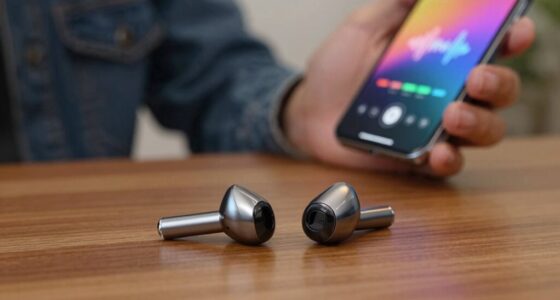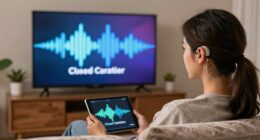
By 2025, embedded AI chips will make your hearing aids smarter and more adaptive than ever. They will automatically adjust to your environment, filter noise, and focus on voices, giving you clearer conversations in busy places. Voice control and virtual assistant integration will become seamless, so you can manage your device hands-free. These advances mean less effort and more natural sound experiences. Continue exploring to discover how these innovations can transform your hearing and daily interactions.
Key Takeaways
- Hearing aids in 2025 feature advanced AI chips enabling real-time environment detection and automatic sound adjustments.
- Enhanced noise cancellation filters unwanted sounds dynamically, improving clarity across diverse settings.
- Voice recognition supports seamless hands-free control and integration with virtual assistants like Siri and Google Assistant.
- Devices learn user habits over time, offering personalized sound profiles and adaptive features.
- Overall, AI integration transforms hearing aids into intelligent, intuitive communication devices with improved user experience.

Embedded AI chips are transforming hearing aids by enabling smarter, more responsive performance. This technology allows your hearing device to adapt instantly to different environments, making conversations clearer and background noise less distracting. With AI-driven voice recognition, your hearing aid can distinguish between multiple voices, focusing on the one you want to hear and reducing the effort it takes to follow conversations. This feature is especially helpful in crowded places like restaurants or social gatherings, where multiple conversations happen simultaneously. Instead of manually adjusting settings or relying on simple algorithms, your device learns from your environment and adapts on the fly, offering a more natural listening experience.
Embedded AI chips enable hearing aids to adapt instantly, improving clarity and reducing background noise automatically.
Noise cancellation has become a game-changer with embedded AI chips. These chips analyze environmental sounds in real-time, filtering out unwanted noise while amplifying important sounds like speech. Unlike traditional hearing aids that rely on static settings, AI-powered devices continuously optimize noise cancellation based on your surroundings. For example, if you move from a quiet room to a busy street, the hearing aid automatically adjusts its noise suppression levels to maintain clarity without sacrificing comfort. This dynamic noise management reduces listening fatigue and helps you stay engaged in conversations without straining to hear.
The integration of voice recognition in hearing aids also means you can control your device more seamlessly. Many models now support voice commands, allowing you to adjust volume, switch programs, or even activate specific features simply by speaking. This hands-free approach enhances convenience, especially when you’re on the go or unable to reach for your device. The AI chip processes these commands instantly, ensuring that your hearing aid responds promptly and accurately. Additionally, some devices can connect to virtual assistants like Siri or Google Assistant, further expanding their functionality and making everyday tasks easier.
As we approach 2025, embedded AI chips in hearing aids are expected to become even more sophisticated. Manufacturers are working on improving voice recognition accuracy, especially in noisy environments, and refining noise cancellation algorithms to deliver more natural sound quality. These advancements aim to make hearing aids more intuitive and personalized, catering to individual preferences and lifestyles. The increased processing power of AI chips also means that future devices could learn from your habits, automatically adjusting settings based on your daily routines. Another notable development is the influence of market demand, which drives innovation and adoption of these advanced technologies. Overall, these innovations promise a future where hearing aids are not just assistive devices but intelligent partners that enhance your communication and overall quality of life.

Bigprot OTC Hearing Aids for Seniors, 2026 Rechargeable Digital Sound Amplifier with Noise Cancelling for Adults, Lightweight Beginner-Friendly Hearing Aids for People Hard of Hearing (Black)
【Behind-the-ear Hearing Aids】 They deliver reliable amplification and are ideal for most first-time users with mild to moderate…
As an affiliate, we earn on qualifying purchases.
As an affiliate, we earn on qualifying purchases.
Frequently Asked Questions
How Do Embedded AI Chips Impact Hearing AId Battery Life?
You might notice that embedded AI chips in hearing aids can affect battery life due to increased power consumption. However, manufacturers focus on battery optimization techniques, such as efficient processing and low-power components, to minimize this impact. While AI features enhance sound quality and user experience, they’re designed to balance performance with longer battery life, so you can enjoy smarter hearing aids without frequent recharging.
What Are the Privacy Concerns With Embedded AI in Hearing AIds?
Imagine your hearing aid constantly learning from your conversations. Privacy concerns arise because embedded AI collects sensitive data, which could be vulnerable without proper security. You should make certain data encryption is in place and that you give informed user consent. Without these safeguards, your personal information might be exposed or misused, raising serious ethical questions about how your data is stored, shared, or analyzed by the device.
Can Users Customize AI Features in Their Hearing AIds?
You can often customize AI features in your hearing aids through user control options, allowing you to personalize sound settings and preferences. Manufacturers are increasingly offering feature personalization, so you can adjust amplification levels, noise reduction, and even directionality. This helps you tailor your hearing experience to your environment and needs, making your hearing aids more effective and comfortable. Always check your device’s app or controls for available customization options.
How Durable Are AI Chips in Everyday Use Environments?
A stitch in time saves nine, and that applies to AI chips in hearing aids too. You’ll find they undergo durability testing to guarantee environmental resilience against moisture, dust, and everyday shocks. While technology improves constantly, it’s wise to remember that no device is indestructible. Still, most AI chips are designed to withstand daily wear and tear, giving you confidence in their longevity and reliable performance over time.
What Are the Costs Associated With Ai-Enabled Hearing Aid Upgrades?
When considering AI-enabled hearing aid upgrades, you should look at pricing considerations, which can vary widely based on features and brands. Keep in mind that insurance coverage may help offset costs, but it’s not always all-inclusive. You might also encounter additional expenses for maintenance or future updates. Ultimately, comparing options and understanding your insurance policy will help you make a sound decision on upgrading to AI-powered hearing aids.

Audien Atom One OTC Hearing Aids – Wireless, Rechargeable, and Comfortable | Clear Sound in a Small, Discreet Design for Seniors & Adults with Hearing Loss
Hear What Matters Most: Hearing isn’t one-size-fits-all. That’s why our adjustable frequency system lets you personalize your sound…
As an affiliate, we earn on qualifying purchases.
As an affiliate, we earn on qualifying purchases.
Conclusion
By 2025, embedded AI chips in hearing aids are transforming the way you experience sound, much like a skilled conductor guiding an orchestra. These tiny chips work seamlessly to enhance clarity, reduce background noise, and personalize your listening experience. As technology advances, you’ll find your hearing aids becoming smarter and more intuitive—making everyday conversations feel as natural as if you’re right there. Embrace this innovation, and let it bring a new harmony to your world.

Hearing Aids for Seniors and Adults,Hearing Aids with Bluetooth,Rechargeable Hearing Aids with Noise Cancelling ,Hearing Amplifiers with LED Digital Display,FSA&HSA Eligible,8 Level Volume Control&3 Environment Modes,Easy to Use and Comfortable Fit
Enjoy Natural Hearing Experience:Built-in intelligent recognition and voice enhancement provide clearer,more natural sound and a superior listening experience…
As an affiliate, we earn on qualifying purchases.
As an affiliate, we earn on qualifying purchases.

Rechargeable Hearing Aids for Seniors – Compact In-the-Ear Hearing Amplifiers with Adaptive Noise Reduction & Easy Controls | Long-Lasting Battery Discreet Invisible Design for Adults & Elderly
【AI-Driven Noise Suppression】Advanced hearing aids equipped with proprietary noise cancellation technology reduce ambient noise by 90% while enhancing…
As an affiliate, we earn on qualifying purchases.
As an affiliate, we earn on qualifying purchases.