A TV for hearing aids may mean a streamer that sends sound straight to compatible hearing aids, or a separate headset or speaker for private or shared listening. My best overall pick is the Phonak TV Connector for people with compatible Phonak hearing aids; the ReSound Unite TV Streamer 2 is a standout for supported ReSound models, while the SIMOLIO 621D suits listeners who want a nearby speaker without wearing headphones. The main tradeoff is compatibility: hearing-aid streamers can offer a direct, discreet connection, but they only work with supported devices, while headphones and speakers serve more people but add another piece of equipment. Connection options, independent volume control, and setup complexity also separate these choices. Read on for the full breakdown of all 13 options and how to match one to your hearing aids and living room.

Get everyday helpers delivered free with Prime
- Fast, free delivery on millions of items
- Prime Video, Amazon Music and more included
- Member-only deals all year
Complete the kit

Key Takeaways
- Hearing-aid compatibility determines the shortlist: the Phonak TV Connector and ReSound Unite TV Streamer 2 are brand-specific choices, while general-purpose transmitters depend on the hearing aids supporting the relevant Bluetooth or Auracast features.
- Direct streaming is not the same as universal compatibility: a transmitter with Bluetooth or Auracast does not automatically pair with every hearing aid; check the exact hearing-aid model and supported connection method.
- Headphones and speakers fill a different need: TV Ears, LEVN, Swiitech, Mutbam, and SIMOLIO headphone systems offer a dedicated listening device, while the SIMOLIO 621D provides sound from a speaker near the listener.
- Connection flexibility separates the transmitter options: the Avantree Audikast 4T, Avantree Audikast 4, HomeSpot BA210 v2, and SUNITEC BT618T focus on transmitter-based connections, but their feature names alone do not establish hearing-aid compatibility.
- The best choice depends on the listening arrangement: one person seeking discreet hearing-aid audio should start with a compatible brand streamer; someone sharing a room or avoiding headphones may prefer a speaker or a TV audio setup with separate personal volume control.
| ReSound Unite™ TV Streamer 2 |  | Best for ReSound Hearing Aid Owners | Brand: ReSound | Model: Unite TV Streamer 2 | Connection type: Wireless TV audio streaming | VIEW ON AMAZON | See Our Full Breakdown |
| ELEHEAR TV Streamer for Compatible Hearing Aids |  | Best for Auracast Hearing Aid Households | Brand: ELEHEAR | Wireless compatibility: Auracast-enabled hearing aids | Inputs: Optical, coaxial, 3.5 mm AUX | VIEW ON AMAZON | See Our Full Breakdown |
| TV Ears Improved Digital Wireless Headset System, Model 11741 |  | Best for Simple Dialogue-Focused Listening | Brand: TV Ears | Model: 11741 | Wireless technology: Infrared | VIEW ON AMAZON | See Our Full Breakdown |
| SIMOLIO 621D Wireless TV Speaker for Seniors and Hard of Hearing |  | Best for Shared-Room Listening | Brand: SIMOLIO | Model: 621D | Wireless technology: 2.4 GHz | VIEW ON AMAZON | See Our Full Breakdown |
| LEVN Wireless TV Headphones with Transmitter Charging Base |  | Best for Long Listening Sessions | Brand: LEVN | Model: LE-HS018 | Connectivity: Bluetooth 5.2, optical, 3.5 mm AUX, RCA | VIEW ON AMAZON | See Our Full Breakdown |
| Avantree Audikast 4T Auracast TV Transmitter |  | Best for Auracast Flexibility | Connectivity: Bluetooth and Auracast | Bluetooth version: 5.4 | Audio inputs: Optical TOSLINK and 3.5 mm AUX | VIEW ON AMAZON | See Our Full Breakdown |
| Phonak TV Connector Wireless Audio Streamer for Hearing Aids |  | Best for Compatible Phonak Hearing Aids | Compatible hearing aids: Phonak Marvel, Paradise, Lumity, Audéo, Naída, and Bolero | Audio connections: Optical TOSLINK and 3.5 mm AUX | Wireless range: Up to 15 meters (50 feet) | VIEW ON AMAZON | See Our Full Breakdown |
| Swiitech CH-211 Wireless TV Headphones with Charging Dock |  | Best for Headphone-Based Listening | Model: CH-211 | Bluetooth version: 5.3 | Wireless range: Up to 100 ft (30 m) | VIEW ON AMAZON | See Our Full Breakdown |
| Avantree Audikast 4 Auracast and Bluetooth TV Transmitter |  | Best for Firmware-Updatable Streaming | Connectivity: Bluetooth and Auracast | Audio inputs: Optical TOSLINK and 3.5 mm AUX | Supported standards: aptX Adaptive, aptX HD, aptX, SBC, LC3 | VIEW ON AMAZON | See Our Full Breakdown |
| HomeSpot BA210 v2 Auracast Bluetooth Transmitter |  | Best for Multiple Audio Inputs | Connectivity: Bluetooth A2DP and Auracast | Audio codecs: LC3, aptX Lossless, aptX HD | Inputs: 3.5 mm AUX, RCA, and Toslink optical | VIEW ON AMAZON | See Our Full Breakdown |
| Mutbam M1 Wireless TV Headphones with Charging Dock |  | Best for Long, Simple Listening | Model: M1 | Headphone style: Over-ear | Driver size: 40 mm | VIEW ON AMAZON | See Our Full Breakdown |
| SUNITEC BT618T Auracast and Bluetooth 5.4 TV Audio Transmitter |  | Best for Auracast-Ready Hearing Aids | Model: BT618T | Bluetooth version: 5.4 | Chip: Qualcomm QCC3086 | VIEW ON AMAZON | See Our Full Breakdown |
| SIMOLIO SM-823D Pro Wireless TV Headphones for Seniors |  | Best for Personalized Dialogue Controls | Model: SM-823D Pro | Wireless technology: 2.4 GHz FHSS | Transmission range: Up to 164 ft (50 m) | VIEW ON AMAZON | See Our Full Breakdown |
| tv for hearing aid | Warranty | Model | Wireless range |
|---|---|---|---|
| ReSound Unite™ TV Streamer 2 | 30 days against defects and workmanship | Unite TV Streamer 2 | — |
| ELEHEAR TV Streamer for Compat | 1 year | — | 65+ ft |
| TV Ears Improved Digital Wirel | 5-year limited warranty | 11741 | — |
| SIMOLIO 621D Wireless TV Speak | — | 621D | — |
| LEVN Wireless TV Headphones wi | 18 months | LE-HS018 | Up to 100 ft |
| Avantree Audikast 4T Auracast | 24 months | — | — |
| Phonak TV Connector Wireless A | — | — | Up to 15 meters (50 feet) |
| Swiitech CH-211 Wireless TV He | 1 year | CH-211 | Up to 100 ft (30 m) |
| Avantree Audikast 4 Auracast a | 24 months | — | — |
| HomeSpot BA210 v2 Auracast Blu | 1 year | — | Up to 165 ft (50 m) line of sight in standard mode; up to 330 ft (100 m) in open air in Auracast mode |
| Mutbam M1 Wireless TV Headphon | 1 year | M1 | Up to 100 ft |
| SUNITEC BT618T Auracast and Bl | — | BT618T | Up to 100 m (330 ft) in open areas |
| SIMOLIO SM-823D Pro Wireless T | 1 year | SM-823D Pro | — |
More Details on Our Top Picks
ReSound Unite™ TV Streamer 2
The ReSound Unite TV Streamer 2 is the most targeted choice here: it sends TV audio directly to compatible wireless ReSound hearing aids, avoiding the separate headset used by the TV Ears Model 11741 or LEVN Wireless TV Headphones. That can suit viewers who already wear ReSound aids and want to listen through their own devices. Its main limitation is also its defining feature: the listing specifies ReSound compatibility, so this is not a general-purpose streamer for other hearing-aid brands or ordinary Bluetooth headphones. The product information provided does not list inputs, range, or detailed setup requirements, so I would verify compatibility with the hearing-aid model and TV connection before buying. A stated 30-day warranty against defects and workmanship is also more limited than the coverage listed for some alternatives.
Pros:- Streams TV audio directly to compatible wireless ReSound hearing aids.
- Avoids wearing a separate TV headset.
- A brand-specific option for people already using ReSound hearing aids.
Cons:- Compatibility is limited to supported ReSound hearing aids.
- The supplied product information does not specify TV inputs or wireless range.
- Includes a 30-day warranty against defects and workmanship.
Best for: People who own compatible wireless ReSound hearing aids and want TV sound streamed directly to them without wearing a separate headset.
Not ideal for: Owners of hearing aids from other brands, or shoppers who need clearly documented TV inputs and broad device compatibility.
- Brand:ReSound
- Model:Unite TV Streamer 2
- Connection type:Wireless TV audio streaming
- Compatible devices:Compatible wireless ReSound hearing aids
- Purpose:Direct TV sound connection for hearing aids
- Warranty:30 days against defects and workmanship
Our verdict“Choose this if you have compatible ReSound hearing aids and prefer direct streaming over the separate headset supplied with TV Ears or LEVN.”
ELEHEAR TV Streamer for Compatible Hearing Aids
The ELEHEAR streamer stands out for households with Auracast-enabled hearing aids: it can send the same TV audio to multiple compatible listeners, rather than limiting sound to one supplied headset as with the TV Ears Model 11741. Optical, coaxial, and 3.5 mm AUX inputs offer useful ways to connect different TVs, and the included cables reduce the need to source basic accessories separately. Its 65+ ft wireless range gives listeners room to move, though the listing does not promise that TV speakers will play at the same time. That matters when one person uses hearing aids and others rely on the room audio. Unlike the ReSound Unite, it is built around Auracast compatibility rather than a single hearing-aid brand; buyers still need to confirm their aids support Auracast.
Pros:- Can stream TV audio to multiple compatible hearing aids at once.
- Optical, coaxial, and 3.5 mm AUX inputs support a range of TV connections.
- Includes optical, coaxial, AUX, and USB-C power cables.
- Wireless range is listed as 65+ feet.
Cons:- Requires Auracast-enabled hearing aids.
- Simultaneous playback through TV speakers is not guaranteed.
- Using the TV’s AUX or headphone output may mute its built-in speakers.
Best for: Households with two or more listeners who own Auracast-enabled hearing aids and want direct TV streaming with multiple input choices.
Not ideal for: People whose hearing aids do not support Auracast, or families who need guaranteed simultaneous sound from the TV speakers.
- Brand:ELEHEAR
- Wireless compatibility:Auracast-enabled hearing aids
- Inputs:Optical, coaxial, 3.5 mm AUX
- Power:USB-C
- Wireless range:65+ ft
- Dimensions:4.72 x 2.76 x 0.87 in
- Weight:3.36 oz
- Included cables:AUX, coaxial, optical, and USB-C power cables
- Warranty:1 year
Our verdict“Pick ELEHEAR for a multi-listener Auracast household, but choose a headset system such as SIMOLIO 621D if you need a self-contained listening option.”
TV Ears Improved Digital Wireless Headset System, Model 11741
The TV Ears Model 11741 is a straightforward choice for viewers who want a dedicated headset rather than audio routed through their hearing aids. Its infrared system needs no pairing or app, while speech-focused amplification is intended to make dialogue easier to follow amid background sound. Large volume dials and indicator lights also make adjustment more direct than managing a hearing-aid streamer such as the ReSound Unite TV Streamer 2, whose use depends on compatible aids. The headset weighs 2 ounces, and its listed connections cover optical, coaxial, AUX, and RCA/analog audio. The tradeoff is that infrared depends on a compatible transmitter setup and is less flexible than a portable speaker such as the SIMOLIO 621D. It also requires wearing its own headset rather than using personal hearing aids.
Pros:- Speech-focused amplification is designed to make dialogue stand out.
- Lightweight 2-ounce headset has adjustable volume controls.
- Large dials and indicator lights support simple operation.
- Supports optical, coaxial, 3.5 mm AUX, and RCA/analog connections.
Cons:- Infrared operation depends on a compatible transmitter setup.
- Requires wearing a dedicated headset rather than using hearing aids directly.
- TV compatibility depends on having a supported audio connection.
Best for: Viewers who want a lightweight, dedicated headset with simple controls and dialogue-focused sound, without pairing it to hearing aids.
Not ideal for: People who prefer to listen through their own hearing aids, need to move freely beyond an infrared transmitter setup, or want speaker-based listening.
- Brand:TV Ears
- Model:11741
- Wireless technology:Infrared
- Maximum volume:120 dB
- Headset weight:2 oz
- Frequency range:20 Hz–20 kHz
- Compatible connections:Optical, coaxial, 3.5 mm AUX, RCA/analog
- Included items:Headset and charging station
- Warranty:5-year limited warranty
Our verdict“Choose TV Ears if clear dialogue and simple headset controls matter more than direct hearing-aid streaming or a portable speaker.”
SIMOLIO 621D Wireless TV Speaker for Seniors and Hard of Hearing
Unlike the TV Ears Model 11741, which puts sound in a personal headset, the SIMOLIO 621D brings TV audio to a portable speaker that can sit near the listener. That makes it a better fit for someone who wants dialogue closer and louder without keeping headphones on, and its independent volume control lets that listener adjust sound separately from the room setup. Voice clarity and EQ adjustment target dialogue, while optical, RCA, and AUX inputs cover many TVs. The included lightweight headset offers another personal-listening option. It runs for up to eight hours per charge and can recharge on its base or use a wall adapter. The main catch is TV compatibility: HDMI-only sets need a separately purchased HDMI ARC converter, and it does not stream directly to hearing aids like ELEHEAR or ReSound.
Pros:- Portable speaker can bring TV audio closer without requiring headphones.
- Voice clarity features and EQ adjustment help emphasize dialogue.
- Independent volume control supports personal listening levels.
- Up to 8 hours of battery life with charging-base or wall-adapter charging.
Cons:- HDMI-only TVs require a separately purchased HDMI ARC converter.
- Does not stream directly to hearing aids.
- The battery is recommended to be removed during extended periods of non-use.
Best for: Viewers who want a portable speaker near their seat, with the option of using an included headset for more private listening.
Not ideal for: People seeking direct audio streaming to hearing aids, or owners of HDMI-only TVs who do not want to add an ARC converter.
- Brand:SIMOLIO
- Model:621D
- Wireless technology:2.4 GHz
- Audio outputs supported:Optical, RCA, AUX
- Maximum range:100 ft
- Battery life:Up to 8 hours
- Charging options:Charging base or wall adapter
- Audio mode:Stereo
- Included accessory:Lightweight headset
Our verdict“Choose the SIMOLIO 621D if a nearby speaker is more comfortable than wearing a headset, and your TV has a compatible audio output.”
LEVN Wireless TV Headphones with Transmitter Charging Base
The LEVN system is a practical pick for viewers who want conventional over-ear headphones and long stretches between charges. Its listed up to 65-hour battery life is a clear advantage over the SIMOLIO 621D speaker’s up to eight hours, while the LEVN’s transmitter doubles as a charging and storage base. Optical, 3.5 mm AUX, and RCA cables make TV hookup flexible; Bluetooth 5.2 adds another connection route for compatible devices. The specified under-40 ms latency is intended to keep speech and on-screen action closely synchronized. This is not a direct-to-hearing-aid streamer like the ELEHEAR or ReSound options, so it makes more sense for someone comfortable wearing headphones. Its listed wireless range is up to 100 feet, and a full charge takes 2.5 hours.
Pros:- Battery life is listed at up to 65 hours.
- Optical, AUX, and RCA cables support several TV audio connections.
- Transmitter base serves as both charger and storage stand.
- Under-40 ms listed latency is designed to keep audio synchronized with TV action.
Cons:- Requires wearing over-ear headphones rather than listening through hearing aids.
- A full battery charge takes 2.5 hours.
- The listed wireless range is up to 100 feet, which may not suit every large or obstructed layout.
Best for: Viewers who prefer over-ear headphones, watch for long periods, and want a charging base that also stores the headset.
Not ideal for: People who need TV sound streamed directly to hearing aids, dislike over-ear headphones, or want simultaneous TV-speaker playback confirmed.
- Brand:LEVN
- Model:LE-HS018
- Connectivity:Bluetooth 5.2, optical, 3.5 mm AUX, RCA
- Audio latency:<40 ms
- Wireless range:Up to 100 ft
- Battery life:Up to 65 hours
- Charge time:2.5 hours
- Earpiece design:Over-ear, oval
- Warranty:18 months
Our verdict“Choose LEVN for long headphone sessions and a convenient charging dock; pick ELEHEAR instead if your priority is direct streaming to Auracast hearing aids.”
Avantree Audikast 4T Auracast TV Transmitter
The Audikast 4T suits households that want a path to shared listening through Auracast while keeping a standard Bluetooth option available. With a compatible hearing aid or receiver, Auracast can send the TV broadcast to multiple listeners; classic Bluetooth, by contrast, connects to just one regular headphone or speaker. That makes it more adaptable than the Phonak TV Connector, which is designed around compatible Phonak hearing aids rather than a mix of receiver types. Optical and AUX inputs cover many TVs, and aptX Adaptive and aptX HD are available when the receiving device supports them. The catch is compatibility: only selected hearing aids support Auracast, and this transmitter cannot solve an HDMI-only connection. I’d choose it for flexibility, not for a guaranteed plug-and-play route with any hearing aid.
Pros:- Auracast broadcast mode can serve multiple compatible receivers.
- Classic Bluetooth provides an alternative for one regular headphone or speaker.
- Optical and 3.5 mm AUX inputs suit many TV audio outputs.
- Supports aptX Adaptive and aptX HD with compatible receivers.
Cons:- Auracast support is limited to selected hearing aid models and receivers.
- Requires a TV with optical or AUX audio output.
- Classic Bluetooth mode connects to only one regular device.
Best for: Households with Auracast-compatible hearing aids or headphones that want the option to broadcast TV audio to multiple listeners.
Not ideal for: Owners of hearing aids without Auracast support, or people whose TV has only HDMI audio output.
- Connectivity:Bluetooth and Auracast
- Bluetooth version:5.4
- Audio inputs:Optical TOSLINK and 3.5 mm AUX
- Supported codecs:aptX Adaptive, aptX HD, aptX, SBC, LC3
- Power source:USB-C
- Compatible devices:Bluetooth headphones, earbuds, and Auracast-compatible hearing aids
- Dimensions:2.7 × 2.9 × 2.6 inches
- Warranty:24 months
Our verdict“Choose the Audikast 4T if you have compatible Auracast receivers and want more shared-listening flexibility than the Phonak-specific TV Connector offers.”
Phonak TV Connector Wireless Audio Streamer for Hearing Aids
For someone with a supported Phonak model, the TV Connector keeps the setup focused: it sends stereo TV audio directly to compatible hearing aids and reconnects automatically. That avoids the separate headphones required by the Swiitech CH-211, and it removes routine manual pairing once the streamer is set up. Optical and 3.5 mm inputs let it work with a range of TVs, computers, and stereos; the stated range reaches 15 meters. The tradeoff is a narrow compatibility list. Unlike the Avantree Audikast 4T, it is not presented as a general Auracast or standard Bluetooth transmitter, so it is a poor fit for mixed-brand hearing aid households. It also needs a wired audio connection and corded power. I’d put it ahead of more flexible transmitters only when the hearing aids are confirmed compatible.
Pros:- Streams stereo audio directly to compatible Phonak hearing aids.
- Automatic reconnection reduces repeated setup.
- Optical and 3.5 mm AUX inputs support common audio outputs.
- Wireless range is specified up to 15 meters (50 feet).
Cons:- Compatibility is limited to specified Phonak hearing aid families.
- Requires a wired connection to the TV or other audio source.
- Uses corded power rather than a portable battery.
Best for: Phonak hearing aid owners with a listed Marvel, Paradise, Lumity, Audéo, Naída, or Bolero model who want direct TV streaming.
Not ideal for: People using other hearing aid brands, or households seeking a transmitter for multiple types of Bluetooth and Auracast receivers.
- Compatible hearing aids:Phonak Marvel, Paradise, Lumity, Audéo, Naída, and Bolero
- Audio connections:Optical TOSLINK and 3.5 mm AUX
- Wireless range:Up to 15 meters (50 feet)
- Audio output:Stereo, 2 channels
- Power source:Corded electric
- Color:Black
- Package includes:TV Connector, power adapter, optical cable, 3.5 mm audio cable, and user manual
Our verdict“Pick the TV Connector for direct, automatic streaming if your Phonak hearing aids are on its compatibility list; choose the Avantree Audikast 4T for broader receiver options.”
Swiitech CH-211 Wireless TV Headphones with Charging Dock
The Swiitech CH-211 is the straightforward choice for someone who would rather wear dedicated TV headphones than check hearing aid streaming compatibility. Its over-ear design, charging dock, and claimed 45-hour battery life make it more suited to long viewing sessions than a small transmitter alone. Less than 40 ms latency is intended to keep dialogue closer to lip movement, while optical, AUX, and RCA connections offer alternatives when a TV’s Bluetooth support is absent. That distinguishes it from the Phonak TV Connector, which streams to compatible hearing aids but does not provide headphones. The key limitation for this roundup is that it is not a hearing aid streamer: listeners must wear its headset, and direct Bluetooth pairing to a TV depends on the TV supporting Bluetooth. I’d skip it if wearing headphones over hearing aids is uncomfortable.
Pros:- Up to 45 hours of playback per charge.
- Optical, AUX, RCA, and Bluetooth connection options.
- Less than 40 ms stated audio latency for closer dialogue synchronization.
- Charging dock and soft, breathable earcups support regular use.
Cons:- Does not stream directly to hearing aids.
- Bluetooth connection to a TV requires Bluetooth support on the TV.
- Over-ear headphones may not suit listeners who wear hearing aids or glasses.
Best for: Viewers who prefer a dedicated over-ear TV headset, want a charging dock, and do not need audio streamed directly into hearing aids.
Not ideal for: People who need direct hearing aid streaming or dislike wearing over-ear headphones for extended periods.
- Model:CH-211
- Bluetooth version:5.3
- Wireless range:Up to 100 ft (30 m)
- Audio latency:Less than 40 ms
- Battery life:Up to 45 hours
- Connections:Optical, AUX, RCA, and Bluetooth
- Ear placement:Over-ear
- Warranty:1 year
Our verdict“Choose the CH-211 if you want a long-running personal TV headset rather than direct hearing aid streaming like the Phonak TV Connector provides.”
Avantree Audikast 4 Auracast and Bluetooth TV Transmitter
The Audikast 4 combines Auracast broadcasting with classic Bluetooth, giving compatible hearing aids and headphones different ways to receive TV sound. Auracast can serve multiple compatible receivers, while classic Bluetooth is limited to one device at a time. That is broadly similar to the newer Audikast 4T, whose listing also includes Auracast and classic Bluetooth; the Audikast 4’s useful distinction is its specified upgradeable firmware. Optical and AUX inputs cover common TV outputs, and USB-C power keeps the unit compact. Neither Avantree model fixes an HDMI-only setup, and this one also lists soundbar passthrough setups as unsupported. Buyers should check hearing aid compatibility before choosing Auracast: the feature name alone does not mean every hearing aid can receive the broadcast. This is a sensible pick for users who want both modes and value firmware updates, but it is not a universal hearing aid streamer.
Pros:- Offers both Auracast broadcasting and classic Bluetooth.
- Optical and 3.5 mm AUX inputs support common TV outputs.
- Upgradeable firmware offers a way to update the transmitter.
- Can stream privately to compatible headphones or broadcast to compatible Auracast receivers.
Cons:- Requires optical or AUX audio output; HDMI-only TVs are unsupported.
- Classic Bluetooth connects to one device at a time.
- Soundbar passthrough setups are not supported, and hearing aid compatibility varies.
Best for: Owners of Auracast-compatible hearing aids or headphones who want both broadcast and one-device Bluetooth modes, plus upgradeable firmware.
Not ideal for: People with HDMI-only TVs, unsupported soundbar passthrough arrangements, or hearing aids without Auracast compatibility.
- Connectivity:Bluetooth and Auracast
- Audio inputs:Optical TOSLINK and 3.5 mm AUX
- Supported standards:aptX Adaptive, aptX HD, aptX, SBC, LC3
- Classic Bluetooth connections:One device at a time
- Power source:USB-C
- Audio output:Stereo, 2 channels
- Dimensions:2.7 × 2.9 × 2.6 inches
- Firmware:Upgradeable
- Warranty:24 months
Our verdict“Choose the Audikast 4 if you need Auracast plus single-device Bluetooth and value firmware upgrades, but compare TV connection limits with the Audikast 4T before buying.”
HomeSpot BA210 v2 Auracast Bluetooth Transmitter
The HomeSpot BA210 v2 is the most connection-flexible transmitter in this group: its inputs include AUX, RCA, and optical, so it can serve more than a TV with optical output. Its app adds broadcast-name and volume controls, while Auracast mode can send audio to multiple compatible receivers. Compared with the Avantree Audikast 4, HomeSpot lists RCA input and app controls; both still depend on receiver compatibility for Auracast, so neither guarantees direct streaming to every hearing aid. The stated range is extensive, but those figures describe line-of-sight or open-air conditions rather than every living room. There is also a setup detail to catch before buying: optical audio must be set to PCM, since Dolby and DTS are unsupported. I’d favor this transmitter for varied source connections, but not for a user who wants a no-adjustment TV hookup.
Pros:- AUX, RCA, and Toslink optical inputs cover several source types.
- Supports standard Bluetooth streaming and Auracast broadcast mode.
- App controls allow broadcast-name and volume adjustments.
- Auracast mode supports multiple compatible receivers.
Cons:- Optical input requires PCM; Dolby and DTS audio are unsupported.
- Auracast requires compatible headphones or other receivers.
- Stated range depends on line-of-sight or open-air conditions.
Best for: People connecting a TV or other audio sources through optical, RCA, or AUX who want app controls and multi-receiver Auracast broadcasting.
Not ideal for: Buyers who cannot change their TV’s optical output to PCM, or whose hearing aids and headphones lack Auracast support.
- Connectivity:Bluetooth A2DP and Auracast
- Audio codecs:LC3, aptX Lossless, aptX HD
- Inputs:3.5 mm AUX, RCA, and Toslink optical
- Wireless range:Up to 165 ft (50 m) line of sight in standard mode; up to 330 ft (100 m) in open air in Auracast mode
- Controls:App and buttons
- Display:LED
- Supported media formats:MP3, WAV, AAC, FLAC
- Warranty:1 year
Our verdict“Choose the BA210 v2 over the Avantree Audikast 4 if RCA input and app controls matter, provided your TV can output PCM and your receivers support Auracast.”
Mutbam M1 Wireless TV Headphones with Charging Dock
The Mutbam M1 is a practical choice for someone who wants private TV audio without relying on hearing-aid compatibility. Its pre-paired headphones and transmitter dock avoid the app setup and device matching that can complicate options such as the SUNITEC BT618T, which is built around Bluetooth and Auracast connections. The dock also keeps the headphones charged and stored, while up to 65 hours of battery life suits frequent viewing with fewer charging interruptions. Low-latency audio helps keep speech aligned with faces on screen, and independent headphone volume lets one listener turn up dialogue without changing the room’s TV level. The tradeoff is that this is a headphone system, not a streamer that sends sound directly to hearing aids. It also needs an optical, RCA, or AUX output, and optical setup may require selecting PCM or stereo in the TV menu.
Pros:- Up to 65 hours of battery life reduces how often the headset needs charging
- Transmitter dock provides a dedicated place to store and recharge the headphones
- Low-latency audio helps keep dialogue synchronized with on-screen action
- Pre-paired setup avoids manual Bluetooth pairing
Cons:- Does not provide direct audio streaming to hearing aids
- Requires an optical, RCA, or AUX output from the TV
- Optical use may require changing the TV’s digital audio setting to PCM or stereo
Best for: TV viewers who want a straightforward private-listening headset, long battery life, and simple dock-based storage rather than direct streaming to hearing aids
Not ideal for: People who need sound sent directly to compatible hearing aids, or whose TV has no optical, RCA, or 3.5 mm audio output
- Model:M1
- Headphone style:Over-ear
- Driver size:40 mm
- Battery life:Up to 65 hours
- Wireless range:Up to 100 ft
- Connections:Optical, 3.5 mm AUX, RCA, Bluetooth
- Weight:1.6 lb
- Warranty:1 year
Our verdict“Choose the Mutbam M1 if you want long-running, easy-to-store TV headphones; skip it if direct hearing-aid streaming is the priority.”
SUNITEC BT618T Auracast and Bluetooth 5.4 TV Audio Transmitter
The SUNITEC BT618T earns its place for buyers whose hearing aids or other listening devices support Auracast or Bluetooth LE Audio. Instead of wearing a separate headset like the Mutbam M1, compatible listeners can receive a broadcast on their own devices; it can also connect to one conventional Bluetooth device. Its HDMI ARC, optical, and AUX inputs make it more adaptable to different TV setups than transmitters limited to a single connection type. A Vocal Boost EQ mode gives dialogue-focused listening a useful adjustment, and wired soundbar passthrough lets other viewers keep using the room’s audio. The main limitation is compatibility: Auracast is not a universal hearing-aid feature, and setup may involve enabling broadcast audio in a companion app or joining through a QR code. The stated long range applies to open areas, not every home layout.
Pros:- Auracast can broadcast to multiple compatible listening devices
- HDMI ARC, optical, and AUX inputs suit a range of TV connections
- Wired soundbar passthrough allows shared room audio during wireless listening
- Vocal Boost mode can emphasize dialogue
Cons:- Auracast listening requires compatible devices and may need setup in a companion app
- Joining a broadcast can involve extra steps, including QR-code pairing in some cases
- Does not include headphones or guarantee compatibility with a particular hearing-aid model
Best for: People with Auracast- or Bluetooth LE Audio-compatible hearing aids who want TV audio streamed to their devices while a soundbar can remain connected
Not ideal for: Hearing-aid users whose devices lack Auracast or LE Audio support, or anyone seeking a simple, ready-to-wear headphone kit
- Model:BT618T
- Bluetooth version:5.4
- Chip:Qualcomm QCC3086
- Audio inputs:HDMI ARC, optical TOSLINK, 3.5 mm AUX, microphone
- Supported codecs:LC3, aptX Adaptive, aptX HD, AAC, SBC
- Maximum audio resolution:24-bit/96 kHz
- Wireless range:Up to 100 m (330 ft) in open areas
- EQ modes:Vocal Boost, Balanced, Bass Boost
- Passthrough:Wired AUX/optical and wireless audio
Our verdict“Pick the BT618T when your hearing aids support Auracast and you want flexible TV connections; choose a dedicated headset such as the Mutbam M1 if they do not.”
SIMOLIO SM-823D Pro Wireless TV Headphones for Seniors
The SIMOLIO SM-823D Pro stands apart from the Mutbam M1 by giving listeners more ways to tune what they hear: tone and left/right balance controls, mono or stereo modes, and an ambient sound mode. That flexibility can help a viewer who needs more than a single volume adjustment, while the ambient mode makes it easier to stay aware of nearby conversation without taking the headphones off. Optical bypass is another practical advantage for households that want headphone audio and a connected soundbar or receiver at the same time. Unlike the SUNITEC BT618T, this is a dedicated 2.4 GHz headphone system rather than an Auracast transmitter for compatible hearing aids. Its up-to-14-hour battery life is considerably shorter than the Mutbam’s 65 hours, and it lacks stated Bluetooth support, so it is a less flexible fit for users who want to connect other wireless devices.
Pros:- Tone and left/right balance controls allow more personalized listening
- Mono and stereo modes offer different ways to hear TV audio
- Ambient sound mode helps listeners hear nearby sounds without removing the headphones
- Optical bypass supports simultaneous headphone and soundbar or receiver audio
Cons:- Up to 14 hours of battery life is shorter than the Mutbam M1’s stated runtime
- HDMI ARC-only TVs need a separate converter
- Bluetooth support is not specified, and the product is not presented as a direct hearing-aid streamer
Best for: Older TV viewers who want adjustable tone and balance, ambient awareness, and the option to keep a soundbar playing
Not ideal for: People seeking direct Bluetooth or Auracast streaming to hearing aids, HDMI ARC-only TV owners, or listeners who need very long battery life
- Model:SM-823D Pro
- Wireless technology:2.4 GHz FHSS
- Transmission range:Up to 164 ft (50 m)
- Battery life:Up to 14 hours
- Battery charge time:3 hours
- Audio connections:Optical, RCA, 3.5 mm
- Audio modes:Mono and stereo
- Controls:Tone and left/right balance
- Warranty:1 year
Our verdict“Choose the SM-823D Pro for headset-based listening with useful tone, balance, and ambient controls, but not for Auracast hearing-aid streaming.”
How We Picked
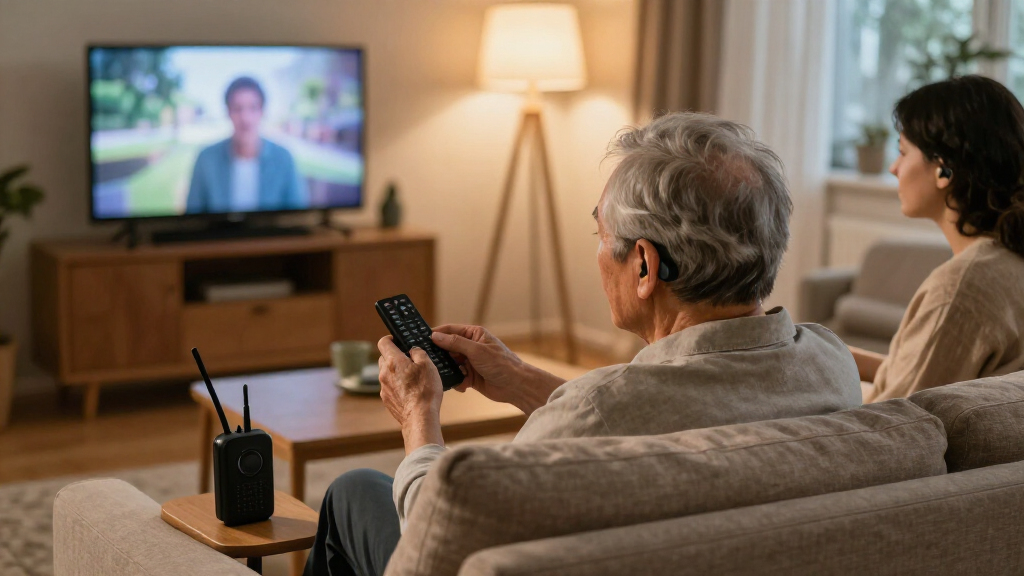
I ranked these products by how directly they address the question behind “TV for hearing aids”: whether they can send audio to a specific hearing aid, or provide a practical alternative when direct streaming is unavailable. Compatibility and connection method carry the most weight, followed by setup demands, individual volume control, and whether the device supports private or shared listening. A product name that mentions Bluetooth or Auracast is not enough to confirm it will pair with a given hearing aid, so I treat model-level compatibility as a check buyers must make before purchase.
The ranking favors hearing-aid streamers for buyers who already own supported hearing aids, then considers general transmitters and dedicated wireless listening systems for broader use. I also weigh the tradeoffs: brand-specific streamers can be simple but restrictive, while general transmitters can offer more connection choices but may require extra pairing steps or compatible hearing aids. Headphones and speakers rank as alternatives rather than direct hearing-aid solutions when they do not stream to the hearing aids themselves. Each pick is judged by its best-fit listener, not by treating all 13 devices as interchangeable.
Factors to Consider When Choosing Tv For Hearing Aids
Before choosing a device, I would start with the hearing aids and the way you watch TV, rather than with a feature list. The biggest buying mistake is assuming that any wireless TV transmitter will connect to any hearing aid. These questions help separate direct hearing-aid streaming from useful alternatives.
Check the Exact Hearing-Aid Model First
Look up the full model name of each hearing aid and confirm which TV accessories or wireless standards it supports. Brand-specific streamers can be a straightforward match, but a streamer made for one hearing-aid family may not work with another, even if the products share a brand name. Do not rely on Bluetooth support alone: hearing aids may use a proprietary connection or support only certain Bluetooth audio functions. If two people in the household use different hearing aids, check whether one accessory can serve both. When compatibility information is unclear, ask the hearing-care provider or manufacturer before buying, and keep the package unopened until the pairing question is settled.
Choose Direct Streaming or a Separate Listening Device
Direct streaming sends TV audio to the hearing aids, which can reduce the need for headphones and keep the listening setup discreet. A dedicated wireless headset can be more useful when the hearing aids lack a compatible streamer, or when a listener wants a separate device with its own controls. A TV speaker placed nearby is another option for someone who dislikes wearing anything, though it may also be audible to others in the room. These are different solutions, not interchangeable versions of the same product. Decide whether the priority is private audio, simpler personal volume control, or sound that everyone can hear before comparing devices.
Match the TV’s Audio Outputs to the Accessory
Check the TV’s available audio outputs and compare them with the inputs on the transmitter or listening system. Optical audio, analog connections, and HDMI-based audio are not interchangeable, and some televisions require a setting change before sound reaches an external device. A connection that fits physically may still need a compatible audio format or a specific TV menu selection. If the TV is also connected to a soundbar or receiver, confirm whether sound can go to both outputs at once. This check can prevent a common frustration: buying a compatible accessory that cannot receive audio from the way the TV is currently configured.
Think About Shared Listening and Volume Control
For one viewer, independent volume control may matter more than adding a second speaker or headset. In a shared room, look for a setup that lets the hearing-aid wearer adjust their listening level without forcing everyone else to listen at the same volume. A headphone system can keep TV sound private, while a speaker works better when conversation and shared audio are part of the routine. If more than one person needs personal audio, check how many receivers or compatible listeners the system supports rather than assuming the transmitter can serve everyone. Also ask whether the TV’s built-in speakers remain active, since that can shape how easily other viewers follow along.
Weigh Pairing Convenience Against Flexibility
A dedicated streamer matched to a hearing-aid brand may involve fewer steps once it is set up, but it can tie the accessory to particular hearing aids. A general-purpose transmitter may have broader uses, yet its extra connection options can mean more setup and more chances for an unsupported pairing. Auracast and Bluetooth labels describe connection capabilities; they do not guarantee that a specific hearing aid can receive the signal. If the TV is used by several people or devices, flexibility may matter, but only when the receiving equipment supports the same method. Favor the simplest confirmed connection for everyday use, rather than paying for features that the hearing aids cannot use.
Plan for Charging, Placement, and Daily Use
For a headset or portable listening device, consider where it will be stored and how often it will need charging; a charging dock can make the routine easier, but it still occupies space near the TV. A transmitter generally stays connected to the television, so cable reach and a clear location matter more than portability. Think through who will operate the system, especially if the listener needs large, simple controls or wants to avoid changing TV settings each time. Keep the hearing-aid streamer, transmitter, and TV remote functions distinct in your plan, since adding devices can complicate an otherwise familiar setup. The best fit is the one the intended listener can use consistently, not merely the one with the longest feature list.
Frequently Asked Questions
Will any Bluetooth TV transmitter work with my hearing aids?
No. Hearing aids vary in the Bluetooth audio functions and wireless standards they support, and some require a manufacturer-specific streamer. A transmitter’s Bluetooth label does not confirm that it can send TV audio to your particular hearing aids. Check the exact hearing-aid model and the transmitter’s supported connection profiles or compatibility list before buying. If that information is unavailable, ask the hearing-aid provider or manufacturer to confirm the pairing.
Should I buy a hearing-aid streamer or wireless TV headphones?
Choose a hearing-aid streamer if it is confirmed to work with your hearing aids and you want TV sound sent directly to them. Wireless headphones make more sense when direct streaming is unsupported, or when you prefer a dedicated listening device with separate controls. Headphones do not necessarily send audio through the hearing aids, so they may not be suitable for every wearer. Consider comfort, how often the listener already wears their hearing aids, and whether private listening matters to the rest of the household.
Can a TV transmitter send sound to both my hearing aids and the TV speakers?
That depends on the television, its audio settings, and the transmitter connection. Some TVs can keep their built-in speakers active while sending audio to an external output; others may mute the speakers when an output is selected. Check the TV manual for simultaneous audio output and confirm whether volume can be controlled separately for the speaker and hearing aids. If shared listening is a priority, verify this before choosing a transmitter rather than assuming the feature is available.
What should I check if the transmitter pairs but I still hear no TV audio?
First, confirm that the TV is sending audio through the output connected to the transmitter. Then check the selected digital audio format, since some accessories may not accept every format a TV can send. Make sure the hearing aids or receiver are set to the correct streaming input and that the transmitter is paired with the intended device. If the TV is connected to a soundbar or receiver, test whether that setup changes which outputs stay active. Follow the manuals for both devices, as menu names and pairing steps vary.
Is Auracast a safe reason to buy a transmitter for my hearing aids?
Only if your hearing aids support Auracast reception and the transmitter’s specific mode fits your setup. The feature name by itself does not confirm compatibility, and a product may support other connection modes that your hearing aids do not use. Check both manufacturers’ documentation for the exact models, including how audio is selected and paired. If your hearing aids do not support Auracast, a compatible brand streamer or a dedicated wireless headset may be a more suitable route.
Conclusion
For most buyers who already own compatible hearing aids, I would start with the Phonak TV Connector as the best overall choice in this lineup, with the ReSound Unite TV Streamer 2 as the brand-specific alternative for supported ReSound models. My best value direction is the SIMOLIO 621D for listeners who want nearby speaker audio rather than direct hearing-aid streaming, provided its connection setup suits the TV. For a best premium-style choice among flexible transmitters, compare the Avantree Audikast 4 and Avantree Audikast 4T against your hearing aids’ confirmed connection support rather than paying for a feature that may go unused. Beginners should favor the simplest verified match: a compatible brand streamer for direct listening, or a dedicated headset system such as TV Ears Model 11741 when headphones are the preferred route. For specific needs, choose the SIMOLIO 621D to avoid wearing headphones, or a dedicated headset from the LEVN, Swiitech, Mutbam, or SIMOLIO SM-823D Pro lineup for personal listening; verify the exact TV connection and hearing-aid requirements before deciding.