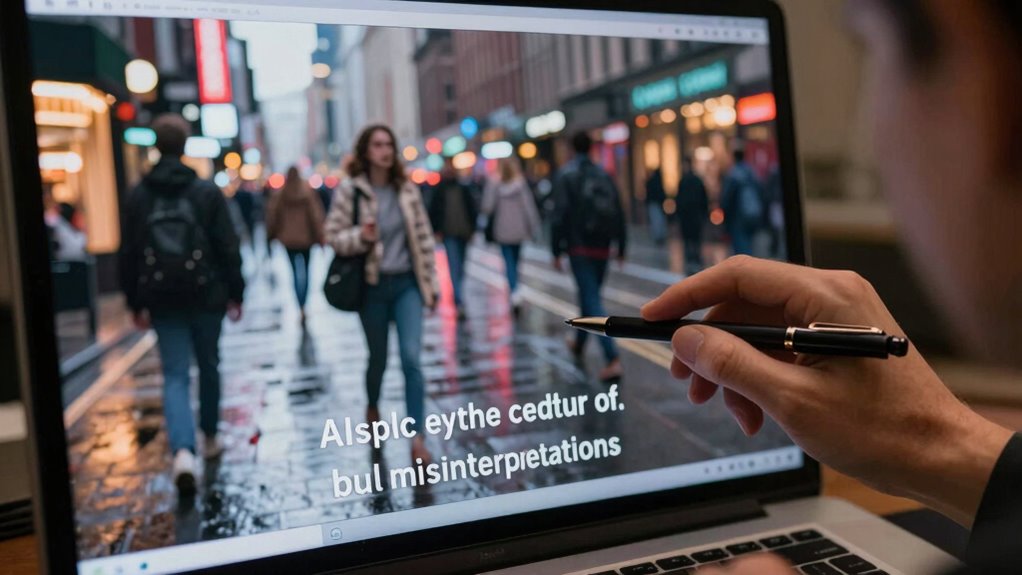

AI captioning often misses biases, misinterprets complex contexts, and struggles with sensitive or rare situations, which can lead to inaccurate or inappropriate descriptions. Human review is essential to catch these issues, guarantee cultural and emotional nuances are respected, and handle high-stakes content responsibly. Without human oversight, AI may reinforce stereotypes or overlook critical details. If you want to understand how combining AI with human judgment improves caption accuracy and fairness, there’s more to explore ahead.

Get everyday helpers delivered free with Prime
- Fast, free delivery on millions of items
- Prime Video, Amazon Music and more included
- Member-only deals all year
Key Takeaways
- Human review ensures bias detection and prevents stereotypes in sensitive or diverse content.
- It improves context accuracy by interpreting complex visual scenes that AI may overlook.
- Human oversight safeguards against insensitivity or inaccuracies in critical areas like medical or legal images.
- It addresses ambiguity and rare scenarios that AI struggles to interpret reliably.
- Human judgment adds emotional, cultural, and ethical nuance, enhancing caption relevance and respectfulness.

Artificial intelligence has revolutionized the way we generate captions for images and videos, making the process faster and more scalable than ever before. But even with advanced algorithms, AI isn’t perfect. You need human review, especially in key situations, to catch errors that AI might miss. One major reason is bias detection. AI systems are trained on large datasets, but those datasets can contain biases that influence caption accuracy. If an AI model isn’t carefully monitored, it might produce captions that unintentionally reinforce stereotypes or overlook nuances. Human reviewers can spot these biases, guaranteeing that captions are fair, respectful, and appropriate for diverse audiences.
AI-generated captions need human review to identify biases and ensure fairness and nuance.
Another essential aspect is context accuracy. AI can generate descriptions based on visual cues, but it often struggles with understanding subtle or complex contexts. For example, an AI might identify a person in a picture but fail to grasp the significance of the scene or the relationships between objects and people. Without human oversight, these captions can be misleading or incomplete. Human reviewers bring a level of contextual understanding that AI lacks, helping to correct inaccuracies and add meaningful details that enhance the caption’s relevance and clarity.
You might think AI can handle all captioning tasks automatically, but key situations demand human judgment. In sensitive contexts—such as medical images, legal evidence, or cultural representations—precision is vital. An AI might generate a caption that’s technically correct but insensitive or inappropriate. Human review ensures captions respect privacy, cultural nuances, and ethical considerations, reducing the risk of miscommunication or offense.
Furthermore, AI models can struggle with ambiguity and rare scenarios. When an image includes unusual objects or events, AI might either ignore them or produce vague descriptions. Humans, however, can interpret these unusual elements and craft accurate, detailed captions. This human intervention helps maintain the quality and reliability of captioning, especially in specialized fields where accuracy impacts understanding greatly. Understanding these limitations is crucial for ensuring responsible and effective AI captioning. Additionally, ongoing human oversight can help identify and correct emerging issues as AI models evolve and encounter new types of content.
AI-generated content can sometimes lack the nuance and emotional insight that human judgment offers, which is especially important in storytelling or entertainment content. Humans can interpret tone, mood, and cultural significance more effectively, ensuring captions resonate appropriately with audiences.
In the end, AI captioning is a powerful tool, but it’s not a complete solution. You need human review to detect biases, verify context accuracy, and handle complex or sensitive situations. Combining AI’s speed with human insight ensures that captions are not only fast but also accurate, respectful, and meaningful. This partnership guarantees that your content reaches audiences with integrity and clarity, making AI-assisted captioning an effective, responsible approach.
As an affiliate, we earn on qualifying purchases.
Frequently Asked Questions
How Does AI Captioning Handle Regional Dialects?
AI captioning struggles with regional dialects because it often lacks the nuance to accurately interpret dialect diversity. You might notice misinterpretations or missed words when regional nuances are involved, especially with accents or slang. While AI improves over time, it still can’t fully grasp dialect diversity, making human review essential to guarantee captions are accurate and culturally sensitive. Your understanding of regional variations helps improve caption quality.
Can AI Captioning Accurately Interpret Sarcasm or Humor?
Coincidentally, AI captioning struggles with sarcasm detection and humor recognition, making it hard to interpret tone accurately. You might find it misreads playful teasing or subtle jokes, missing the intended humor or sarcasm. Human review becomes essential here because people understand context, cultural nuances, and irony better than AI. This helps guarantee captions truly reflect the speaker’s tone, maintaining clarity and preserving the speaker’s original intent.
How Quickly Can Human Review Correct AI Captioning Errors?
Human review can correct AI captioning errors almost instantly, providing real-time accuracy and enhanced contextual understanding. When you spot mistakes, you can quickly update captions, ensuring clarity and precision. This swift intervention is essential for situations requiring nuanced interpretation, like sarcasm or humor, where AI might struggle. Your prompt feedback helps improve overall caption quality, making content more accessible and understandable for everyone, especially in dynamic or complex conversations.
What Are the Costs Associated With Human Review?
Cost considerations creep into your captioning process, creating a cycle of costly corrections and continuous review. The review process demands dedicated personnel, time, and training, which can escalate expenses. You face the financial implications of labor, technology, and potential delays, making it essential to balance budget with quality. While human review boosts accuracy, it also complicates costs, requiring careful planning to manage these ongoing, often substantial, cost implications effectively.
How Does AI Captioning Perform in Noisy or Low-Quality Audio?
AI captioning struggles with noisy or low-quality audio, especially when there’s significant noise interference or poor audio clarity. You might notice inaccuracies or missed words because the algorithms can’t fully distinguish speech from background sounds. In such situations, human review becomes essential to correct errors, ensuring the captions are accurate and understandable. This way, you get reliable captions even when audio conditions aren’t ideal, maintaining accessibility and comprehension.
Conclusion
You might think AI captioning is flawless, but in reality, it’s like trusting a robot to write a novel—sure, it can do a lot, but it still misses those subtle nuances and essential details. When it comes to important situations—like legal content or medical info—human review isn’t just helpful; it’s life-saving. Without human oversight, you risk catastrophic misunderstandings that could change everything. Never underestimate the power of human judgment—your safety depends on it.
Halloween Picks
halloween
As an affiliate, we earn on qualifying purchases.