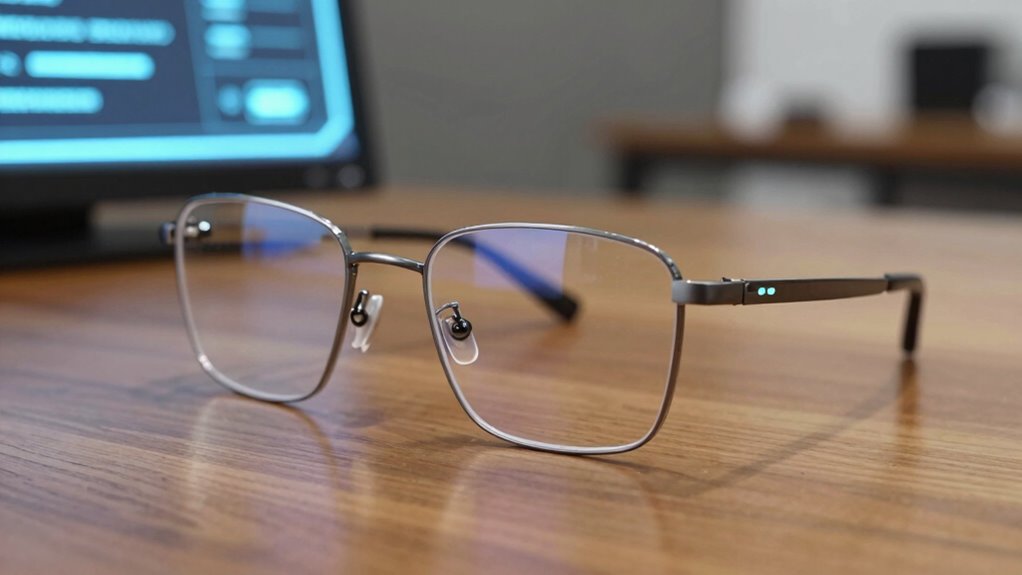

AI reading glasses can recognize printed text, digital screens, and some handwritten notes by using cameras and image recognition technology. They work well in good lighting but struggle with low light, glare, or textured surfaces like braille. Fancy fonts, ornate styles, or heavily damaged documents can pose challenges. Supporting multiple languages and scripts, they’re evolving but still have limits. To discover how these devices can help you navigate various materials, see what’s possible—keep exploring further.

Get everyday helpers delivered free with Prime
- Fast, free delivery on millions of items
- Prime Video, Amazon Music and more included
- Member-only deals all year
Key Takeaways
- AI reading glasses can scan and recognize printed text, handwritten notes, and digital screens in real-time using advanced cameras and OCR technology.
- They effectively interpret multiple languages and scripts, including Latin, Cyrillic, Chinese, and Arabic, with ongoing improvements.
- Limitations include difficulty reading embossed or textured surfaces like braille, and challenges in low-light or glare-prone environments.
- Recognition accuracy varies with font style, layout complexity, and physical damage, often struggling with ornate, decorative, or irregular texts.
- Compatibility depends on device hardware and software support; older or non-standard devices may hinder functionality.
As an affiliate, we earn on qualifying purchases.
How AI Reading Glasses Detect and Read Printed Text

AI reading glasses use advanced cameras and sensors to capture printed text in real-time. With augmented reality, they overlay digital information directly onto your visual field, providing seamless visual enhancement. When you look at a page or sign, the glasses’ camera scans the text instantly, analyzing it with sophisticated algorithms. These algorithms identify characters, words, and sentences, then convert them into digital data. Using optical character recognition (OCR), the glasses interpret the text and display it clearly within your view. This process allows you to read effortlessly, as the glasses enhance the clarity and contrast of the printed material. Thanks to augmented reality, you see the digital version of the text superimposed on the physical, making reading faster and more intuitive without distraction. Additionally, the integration of European cloud infrastructure ensures secure and reliable data processing for optimal performance. The accuracy of text recognition can be affected by factors such as ear wax odor, which can interfere with visual clarity in some cases.
Recognizing Digital Screens and Devices With AI Reading Glasses
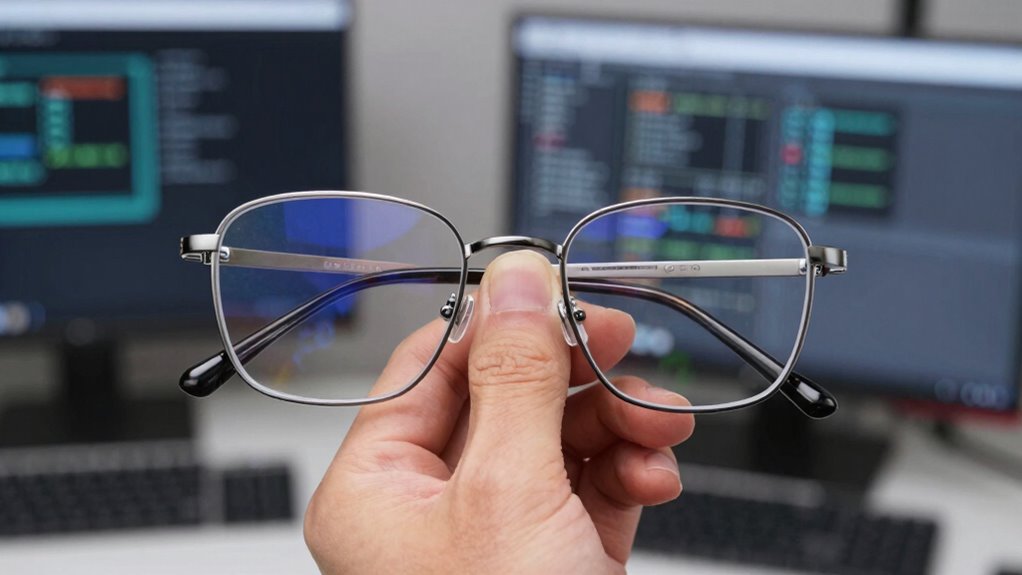
AI reading glasses can identify digital screens and devices in your environment, helping you navigate technology more easily. However, their screen recognition capabilities vary depending on the device type and lighting conditions. Keep in mind that compatibility limits may affect how well these glasses work with certain screens or gadgets. Additionally, understanding modern kitchen technology can enhance your overall experience with smart appliances and connected devices. Recognizing the contrast ratio of screens can also improve the glasses’ ability to distinguish between different display qualities under various lighting scenarios. Being aware of lighting conditions can further optimize the performance of AI reading glasses when identifying screens in diverse environments. Factors like screen brightness and display resolution can also play a significant role in how effectively these glasses interpret digital displays. For optimal performance, it’s helpful to consider how ambient lighting impacts screen visibility and recognition accuracy.
Screen Recognition Capabilities
Thanks to advanced image recognition algorithms, reading glasses equipped with AI can now identify digital screens and devices in real-time. They analyze visual context to distinguish screens from other objects, enabling accurate recognition even amid complex backgrounds. Ambient lighting plays a pivotal role, as AI adjusts its detection methods to compensate for glare, shadows, or low-light conditions, ensuring reliable identification. This capability allows you to quickly verify the presence of digital screens, whether on smartphones, tablets, or monitors, without manual input. The glasses recognize screen boundaries, icons, and layouts, helping you navigate digital environments seamlessly. Overall, their screen recognition capabilities enhance your ability to engage with digital content efficiently, regardless of lighting or surrounding visual clutter.
Device Compatibility Limits
While AI reading glasses are highly effective at recognizing many digital screens, their device compatibility still faces certain limitations. The glasses rely on specific device hardware, such as cameras and sensors, to scan screens, and not all hardware setups are supported. Additionally, software limitations can hinder recognition; some operating systems or app environments may block or interfere with the glasses’ ability to access screen content. Older or non-standard devices often lack the necessary hardware features, making recognition unreliable or impossible. Updates and compatibility patches are essential, but they don’t always keep pace with new device releases. As a result, you might find certain screens or devices simply won’t work with your AI reading glasses, limiting their overall utility in diverse digital environments. Device interoperability remains a key factor influencing the effectiveness of AI-powered assistive technologies. Moreover, hardware compatibility issues can arise when devices lack the required specifications to support the glasses’ scanning functions.
Can AI Reading Glasses Read Handwritten and Cursive Notes?

You might wonder if AI reading glasses can accurately recognize handwritten and cursive notes. While they have made progress in handwriting recognition, cursive styles still pose significant challenges. Understanding these limitations helps you evaluate their effectiveness for reading personalized notes.
Handwriting Recognition Capabilities
AI reading glasses are increasingly capable of recognizing handwritten and cursive notes, allowing you to digitize your written content quickly and accurately. They adapt to various handwriting styles, from neat print to messy scribbles, making them versatile tools. However, cursive challenges can still affect recognition accuracy, especially with complex or inconsistent styles. The software uses advanced algorithms to analyze strokes, letter connections, and context, improving its ability to interpret different handwriting forms. While some systems excel at standard printing, cursive remains more difficult due to fluid letter connections. Overall, your AI glasses can handle a wide range of handwriting styles, but the clarity and consistency of your notes influence how well they’re recognized. With ongoing improvements, recognizing handwritten and cursive notes continues to become more reliable.
Challenges With Cursive Styles
Cursive handwriting presents a significant challenge for AI reading glasses because of its fluid and connected letterforms. Unlike standard print, cursive involves continuous strokes that can vary greatly between writers, making it difficult for AI to distinguish individual characters. Stylized fonts, whether artistic or decorative, also pose problems because they often prioritize aesthetics over clarity, confusing recognition algorithms. The variability in cursive handwriting and stylized fonts means that AI must adapt to numerous unique styles, which is complex and resource-intensive. Current models struggle with these forms because they rely heavily on consistent letter shapes. Overcoming these challenges requires advanced training on diverse handwriting samples and improved algorithms that can interpret the nuances of cursive and stylized scripts effectively.
Do AI Reading Glasses Handle Decorative or Unusual Fonts?
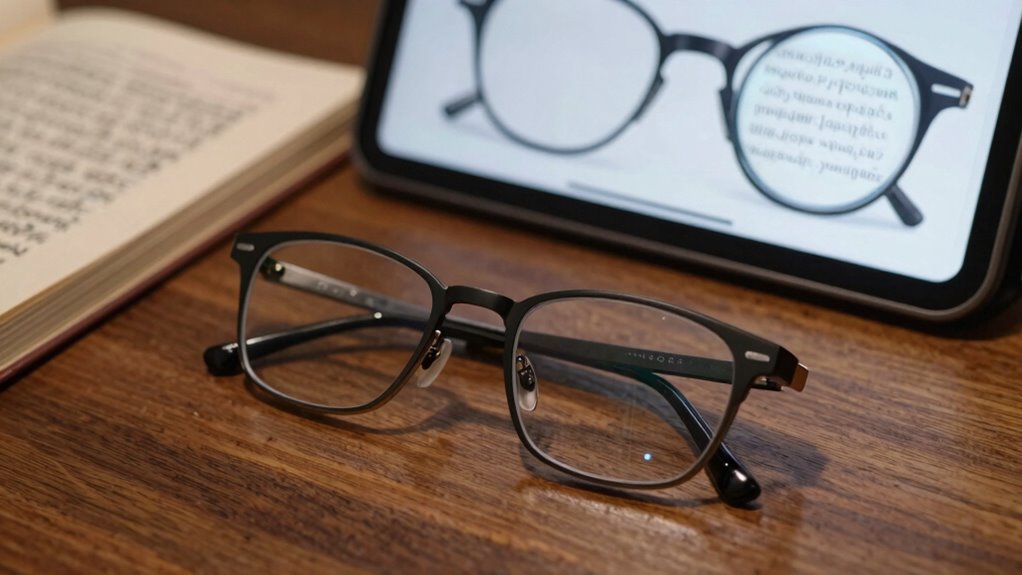
Wondering if AI reading glasses can reliably recognize decorative or unusual fonts? The answer varies depending on the device’s capabilities. Many AI reading glasses excel at standard fonts but struggle with decorative fonts, which often feature elaborate designs that confuse recognition algorithms. Unusual characters, like symbols or stylized letters, can also pose challenges because they aren’t always part of the training data. Advanced models equipped with deep learning and extensive font databases perform better, but even they may falter with highly ornate or custom fonts. If you frequently encounter decorative fonts or unusual characters, expect some inaccuracies. Overall, while AI reading glasses have improved, they still face limitations in reliably handling highly stylized or unconventional fonts.
Can AI Reading Glasses Read in Low Light or Glare?

Reading in low light or glare can be challenging for most glasses, and AI reading glasses are no exception. Low light conditions reduce the camera’s ability to capture clear images, making text harder to read. Glare issues, from bright lights or reflections, can wash out details and cause discomfort. Some AI glasses include built-in enhancements, like brighter sensors or adaptive contrast, to help improve visibility in dim environments. However, they still struggle in extreme low-light situations or when glare is intense. While these glasses can often compensate moderately, they aren’t foolproof. If you frequently read in poorly lit areas or spaces with strong glare, expect some limitations. Ultimately, AI reading glasses offer improved reading in many settings, but low light and glare remain significant hurdles.
Which Documents and Materials Are Tough for AI Reading Glasses?

AI reading glasses excel at processing standard printed text and digital screens, but certain documents and materials still pose challenges. Braille translation remains difficult because AI struggles to interpret tactile reading accurately, especially when braille is embossed or damaged. Texts with complex layouts, handwritten notes, or faded ink can also confuse AI systems. Materials like textured or embossed surfaces, such as braille or raised diagrams, are hard for AI to decipher because they rely on tactile cues rather than visual ones. Additionally, documents with poor contrast, irregular fonts, or physical damage hinder accurate reading. While AI continues to improve, tactile reading materials and braille texts still require specialized techniques beyond current AI capabilities. Understanding these limitations is essential for developing more inclusive assistive technologies, and ongoing research aims to enhance AI’s ability to interpret tactile cues more effectively. For example, advancements in image recognition technology may eventually help AI better interpret embossed or textured surfaces. Recognizing the limitations of visual processing is key to advancing AI’s role in accessibility.
Why Do Some Texts Challenge AI Reading Glasses?

What makes some texts difficult for AI reading glasses to interpret? It often comes down to visual perception and text complexity. When the visual structure is irregular or cluttered, the AI struggles to distinguish characters. Complex fonts, unusual layouts, and decorative elements can confuse the system. Handwritten texts with inconsistent strokes present additional challenges. Additionally, texts with low contrast or background noise reduce clarity. These factors hinder the AI’s ability to accurately recognize and process the content. As a result, certain visual features and intricate layouts can cause misinterpretation. Moreover, the limitations of current content recognition systems mean that even well-printed texts may sometimes be misread or overlooked. These challenges are especially pronounced when the reading environment has poor lighting or glare, further complicating recognition. Limited visual perception capabilities can also impact the system’s performance in recognizing diverse text styles. Furthermore, environmental factors like dust or moisture can further impair recognition accuracy, making it harder for the system to function reliably. A deeper understanding of technological limitations helps explain why some texts remain difficult for AI reading glasses, especially when the visual perception required exceeds the system’s current capabilities.
How Do AI Reading Glasses Support Different Languages and Scripts?
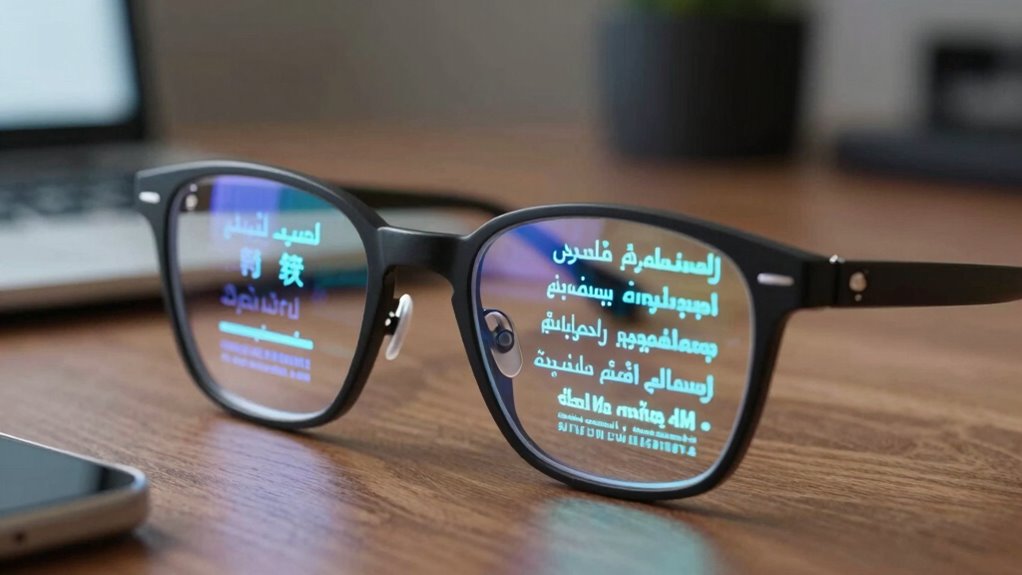
Ever wondered how AI reading glasses handle the diversity of languages and scripts around the world? They achieve this through advanced multilingual support and script recognition technologies. These glasses use sophisticated algorithms to identify different writing systems, such as Latin, Cyrillic, Chinese characters, or Arabic scripts, in real-time. By training on vast datasets, they learn to distinguish subtle differences between scripts and adapt quickly. Optical character recognition (OCR) models are optimized for multiple languages, allowing seamless translation and reading across diverse texts. This multilingual support guarantees you can read signs, menus, or documents in various languages without hassle. Ultimately, their ability to recognize and process multiple scripts makes AI reading glasses versatile tools, bridging language gaps effortlessly.
Tips for Getting the Most Out of Your AI Reading Glasses
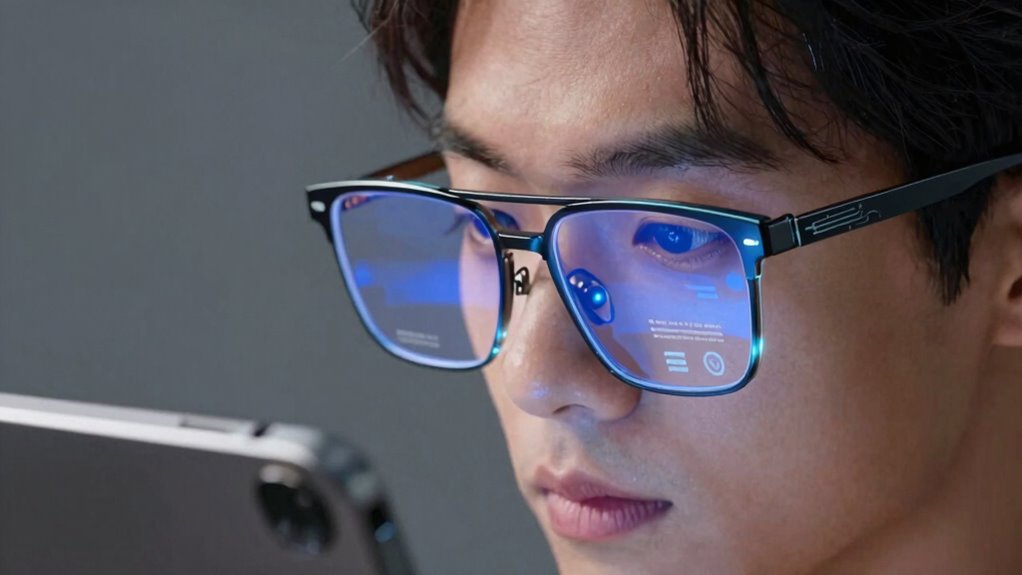
To get the most out of your AI reading glasses, start by familiarizing yourself with their features and settings. This helps you leverage augmented reality capabilities and customize your experience. Adjust the display brightness and contrast for ideal reading in different environments. Explore user customization options, like font size and language preferences, to enhance comfort and usability. Keep the glasses updated with the latest firmware for improved accuracy and new features. Practice using voice commands for hands-free adjustments, making multitasking easier. Regularly clean the lenses to maintain clarity. Finally, experiment with different AR overlays to see which assistive features boost your reading efficiency best. Staying proactive with these tips ensures you maximize your AI glasses’ potential.
Frequently Asked Questions
How Accurate Are AI Reading Glasses With Complex or Damaged Text?
AI reading glasses can struggle with complex or damaged text due to optical distortion and text complexity. You might find they misread or skip over unclear fonts, smudged areas, or intricate layouts. Although they excel with clean, simple text, their accuracy drops when faced with challenging visuals. Although they excel with clean, simple text, their accuracy drops when faced with challenging visuals. For best results, guarantee the text is clear and straightforward, as optical distortion and complexity considerably impact their reading precision.
Can AI Reading Glasses Identify and Interpret Images or Graphics?
Think of AI reading glasses as your digital detective, skilled in image recognition and graphic interpretation. They can identify and interpret images or graphics, turning visual clues into understandable data. With keen analysis, they decipher complex symbols or charts, much like unraveling a mystery. While not perfect, they serve as your eyes in the digital domain, bridging the gap between what’s visible and what’s understood, making visual information accessible and meaningful.
Do AI Reading Glasses Require Internet Connectivity to Function Properly?
AI reading glasses typically need internet connectivity for advanced features, but some models can operate offline, relying on onboard processing. You should consider privacy concerns, as constant online access might expose your data. Battery life also matters; prolonged use without Wi-Fi can drain batteries faster. If you prioritize privacy and longer usage, choose glasses with offline capabilities and efficient battery performance to avoid unnecessary connectivity.
Are AI Reading Glasses Effective for Visually Impaired Users?
A picture is worth a thousand words, and AI reading glasses can substantially aid those with visual impairment. They’re effective as assistive technology, helping users read text and identify objects. While they may not replace all vision needs, they enhance independence and daily functioning. Keep in mind, their effectiveness varies per individual, but for many, these glasses are a promising tool to bridge the gap caused by visual impairment.
How Do AI Reading Glasses Perform in Multilingual Environments Simultaneously?
AI reading glasses handle multilingual environments well by leveraging real-time translation and multilingual recognition. You’ll notice they quickly identify multiple languages and translate text instantly, allowing seamless communication. However, accuracy can vary depending on the complexity of the language or handwriting. While they excel in common languages, rare dialects might pose challenges. Overall, these glasses greatly enhance your experience in multilingual settings, making reading and understanding easier on the spot.
Conclusion
Just like the wise Odysseus relied on his cunning to navigate treacherous waters, your AI reading glasses can guide you through a world of printed and digital text. While they’re powerful tools, they have their limits—certain fonts, handwriting, or lighting can still challenge them. Embrace their strengths and understand their boundaries, much like a sailor trusting his compass. With patience and awareness, you’ll chart a course through words, revealing knowledge with confidence.
Halloween Picks
halloween
As an affiliate, we earn on qualifying purchases.