
The best personal amplified telephones for hearing loss make calls easier to hear without adding more complexity than you need. My best overall pick is the Panasonic KX-TGM450S, which pairs amplification with Slow Talk to help make conversations easier to follow. The Hamilton CapTel 2400iSPNBT is a standout for people who benefit from reading captions, while the Clarity P-300 suits callers who want a simple corded phone with photo speed-dial buttons. The main tradeoffs are corded reliability versus cordless freedom, basic amplification versus extra speech-support features, and a single handset versus coverage around the home. Read on for the full breakdown and help matching a phone to your hearing needs and calling habits.

Get everyday helpers delivered free with Prime
- Fast, free delivery on millions of items
- Prime Video, Amazon Music and more included
- Member-only deals all year
Key Takeaways
- The Panasonic KX-TGM450S stands out as the strongest all-around fit because it combines amplification with Slow Talk, while the simpler Clarity cordless models focus more directly on amplified calling.
- Captioning addresses a different need from louder audio: the Hamilton CapTel 2400iSPNBT displays conversation text, making it a distinct option for callers who still miss speech even with amplification.
- Corded models favor simplicity and predictable placement, while cordless options such as the Sonic Alert AMPLIDECT350X and Panasonic multi-handset systems suit people who want to move between rooms.
- Photo and big-button speed dialing can matter as much as volume for callers who find small keys or remembering numbers difficult; the Clarity P-300 and Serene Innovations model emphasize this kind of access.
- More handsets and features are not automatically better: the right choice depends on where calls are taken, how many rooms need coverage, and whether the user will benefit from features such as an answering system or caption display.
| Clarity P-300 Amplified Corded Photo Telephone, White |  | Best for Photo Speed Dial | Phone type: Corded | Incoming sound amplification: Up to 26 dB | Photo memory buttons: 9 programmable | VIEW LATEST PRICE | See Our Full Breakdown |
| Sonic Alert AMPLIDECT350X Amplified Digital Cordless Phone with Extra Charging Base |  | Best for Two-Location Cordless Coverage | Amplification: Up to 40 dB | Hearing aid compatibility: T-position | Phonebook capacity: 50 numbers | VIEW LATEST PRICE | See Our Full Breakdown |
| Clarity 53714 DECT 6.0 Amplified Cordless Phone with Digital Answering System |  | Best for Straightforward Answering-Message Access | Phone type: Cordless | Technology: DECT 6.0 | Maximum sound amplification: 40 dB | VIEW LATEST PRICE | See Our Full Breakdown |
| Panasonic KX-TGM450S Amplified Cordless Phone with Slow Talk, Silver |  | Best for Following Fast Speech | Call volume boost: Up to 50 dB | Ringer volume: Up to 112 dB | Tone settings: 6 voice tone settings | VIEW LATEST PRICE | See Our Full Breakdown |
| Clarity XLC8 DECT 6.0 Amplified Cordless Phone |  | Best for Assistive-Device and Mobile Connections | Phone type: DECT 6.0 amplified cordless | Incoming volume amplification: Up to 50 dB | Outgoing speech amplification: Up to 15 dB | VIEW LATEST PRICE | See Our Full Breakdown |
| Clarity XLC3.4+ Cordless Phone Bundle with Two XLC3.6+ Handsets |  | Best for Multi-Room Coverage | Phone type: Cordless | Technology: DECT 6.0 (1.9 GHz) | Bundle contents: XLC3.4+ phone and two XLC3.6+ handsets | VIEW LATEST PRICE | See Our Full Breakdown |
| Clarity AltoPlus Amplified Corded Phone, Black |  | Best for Maximum Incoming Volume | Phone type: Corded | Incoming sound amplification: Up to 53 dB | Outgoing speech amplification: Up to 15 dB | VIEW LATEST PRICE | See Our Full Breakdown |
| Hamilton CapTel 2400iSPNBT Captioned Telephone with Large Touchscreen |  | Best for Captioned Conversations | Phone type: Corded | Captioning: Automated or assisted with live operator support | Amplification: Up to 40 dB | VIEW LATEST PRICE | See Our Full Breakdown |
| Panasonic KX-TGM420W Amplified Cordless Phone System with Digital Answering Machine and Two Handsets |  | Best for Clearer Speech and Expandability | Included handsets: 2 | Maximum handsets: 6 | Maximum caller volume boost: 40 dB | VIEW LATEST PRICE | See Our Full Breakdown |
| Clarity D704 Amplified Cordless Phone with Caller ID |  | Best Simple Cordless Pick | Phone type: Cordless | Amplification: Up to 40 dB | Technology: DECT 6.0 | VIEW LATEST PRICE | See Our Full Breakdown |
| Serene Innovations Amplified Big-Button Corded Landline Phone with Photo Speed-Dial Buttons |  | Best for Photo-Based, One-Touch Calling | Telephone type: Corded landline | Audio amplification: 26 dB | Ringer volume: 85 dB | VIEW LATEST PRICE | See Our Full Breakdown |
| Clarity E814CC Amplified Corded Phone for Hearing Impaired Users |  | Best for Adjustable Amplification and Call Management | Phone type: Corded base phone with cordless handset expansion | Maximum sound amplification: Up to 40 dB | Tone settings: 4 | VIEW LATEST PRICE | See Our Full Breakdown |
| personal amplified telephones for hearing loss | Phone type |
|---|---|
| Clarity P-300 Amplified Corded | Corded |
| Sonic Alert AMPLIDECT350X Ampl | — |
| Clarity 53714 DECT 6.0 Amplifi | Cordless |
| Panasonic KX-TGM450S Amplified | — |
| Clarity XLC8 DECT 6.0 Amplifie | DECT 6.0 amplified cordless |
| Clarity XLC3.4+ Cordless Phone | Cordless |
| Clarity AltoPlus Amplified Cor | Corded |
| Hamilton CapTel 2400iSPNBT Cap | Corded |
| Panasonic KX-TGM420W Amplified | — |
| Clarity D704 Amplified Cordles | Cordless |
| Serene Innovations Amplified B | — |
| Clarity E814CC Amplified Corde | Corded base phone with cordless handset expansion |
More Details on Our Top Picks
Clarity P-300 Amplified Corded Photo Telephone, White
The Clarity P-300 makes the most sense for someone who wants a straightforward amplified phone and benefits from recognizing callers by photo rather than finding a name on a small screen. Its nine programmable photo buttons provide a direct route to frequently called people, while incoming amplification up to 26 dB and an extra-loud ringer address hearing access in different ways. Compared with the cordless Sonic Alert AMPLIDECT350X, this model gives up greater amplification, mobility, and a larger phonebook in favor of simple, visible dialing without handset charging. The bright visual ring indicator is useful when sound alone may not alert the user. The tradeoff is fixed placement: this corded, single-line phone is less adaptable around the home, and its amplification is lower than several cordless picks here.
Pros:- Up to 26 dB incoming sound amplification
- Nine programmable photo memory buttons make frequent contacts easy to identify and dial
- Adjustable ringer pitch and volume, with a 75 dB-or-higher ringer
- Visual ring indicator adds a non-audio call alert
Cons:- Corded design limits where the phone can be used
- Lower maximum amplification than the 40 dB and 50 dB cordless options in this lineup
- Single-line operation
Best for: People who call a small set of family members regularly and prefer photo-based speed dialing on a stationary phone.
Not ideal for: Callers who need stronger amplification, cordless mobility, or room-to-room use; the P-300 is corded and offers up to 26 dB amplification.
- Phone type:Corded
- Incoming sound amplification:Up to 26 dB
- Photo memory buttons:9 programmable
- Ringer:Adjustable pitch and volume; 75 dB or higher
- Ring alert:Visual indicator
- Hearing aid compatible:Yes
- Line operation:Single line
- Dimensions:10.5 x 9.8 x 2.8 inches
Our verdict“Choose the P-300 if photo speed dialing and a loud, stationary phone matter more than cordless range or higher amplification.”
Sonic Alert AMPLIDECT350X Amplified Digital Cordless Phone with Extra Charging Base
For someone who wants amplified calls in more than one part of the home, the AMPLIDECT350X has a practical advantage: its two charging bases let the handset be kept where it is most useful without relying on a single docking spot. Up to 40 dB amplification, T-position hearing aid compatibility, large keys, and a flashing incoming-call alert make it more adaptable than the corded Clarity P-300. Its 50-number phonebook and one-touch dialing also suit users who call a wider circle than the P-300’s photo-button layout supports. The tradeoff is that it does not offer the 50 dB amplification and Slow Talk found on the Panasonic KX-TGM450S or Clarity XLC8. Talk time is listed at six hours, so frequent callers may need to return it to a base between longer conversations.
Pros:- Up to 40 dB amplification and T-position hearing aid compatibility
- Two charging bases offer more flexibility for keeping the handset accessible
- Flashing incoming-call alert, loud ringer options, large keys, and backlit caller ID display
- 50-number phonebook, one-touch dialing, and three-way calling
Cons:- Six-hour talk time may be limiting for frequent or extended calls
- Lower maximum amplification than the Panasonic KX-TGM450S and Clarity XLC8
- Plastic enclosure
Best for: People who want a cordless amplified phone with a second charging location, hearing-aid compatibility, and room for many saved contacts.
Not ideal for: Users who need the strongest listed amplification or routinely have long calls; other cordless models reach 50 dB, while this phone lists six hours of talk time.
- Amplification:Up to 40 dB
- Hearing aid compatibility:T-position
- Phonebook capacity:50 numbers
- Charging bases:2
- Indoor range:Up to 164 ft
- Outdoor range:Up to 900 ft
- Talk time:6 hours
- Conference calls:3-way
Our verdict“Pick the AMPLIDECT350X if cordless access from two locations and a substantial contact list matter more than maximum amplification or extended talk time.”
Clarity 53714 DECT 6.0 Amplified Cordless Phone with Digital Answering System
The Clarity 53714 is a relatively direct choice for someone who wants cordless calling, strong incoming amplification, and a built-in way to retrieve missed calls. Its 40 dB amplification matches the Sonic Alert AMPLIDECT350X on maximum volume, while four tone settings let the listener tailor the sound rather than relying on volume alone. The digital answering system is the distinguishing feature for people who want messages handled by the phone itself. Compared with the more feature-rich Panasonic KX-TGM450S, the 53714 does not list Slow Talk, call blocking, a talking caller ID, or the same higher amplification; its appeal is a simpler feature set, not a broader suite of accessibility tools. It is single-line and has a short 30-day warranty, so buyers seeking expanded call management or a longer stated warranty should look elsewhere.
Pros:- Up to 40 dB incoming sound amplification
- Four tone settings allow listening preferences to be adjusted
- Digital answering system handles messages
- DECT 6.0 cordless technology and compatibility with VoIP services and PSTN networks
Cons:- Single-line operation
- No Slow Talk feature is listed, unlike the Panasonic KX-TGM450S and Clarity XLC8
- Listed warranty is 30 days
Best for: People who want a cordless handset with 40 dB amplification, adjustable tone, and a digital answering system without needing an extensive call-management feature set.
Not ideal for: Buyers who need Slow Talk, call blocking, higher amplification, or a longer stated warranty; the Panasonic KX-TGM450S offers more of those listed features.
- Phone type:Cordless
- Technology:DECT 6.0
- Maximum sound amplification:40 dB
- Tone settings:4
- Answering system:Digital
- Line operation:Single line
- Rechargeable batteries:2 AAA included
- Warranty:30 days
Our verdict“Choose the 53714 if you want a cordless amplified phone with tone adjustment and an answering system, but do not need the richer accessibility controls of the Panasonic or XLC8.”
Panasonic KX-TGM450S Amplified Cordless Phone with Slow Talk, Silver
The Panasonic KX-TGM450S stands out when hearing loss makes the pace of conversation as difficult as its volume. Alongside up to 50 dB call-volume boost and six voice tone settings, Slow Talk reduces speech speed during live calls and message playback, helping listeners follow words without relying only on louder sound. The listed ringer volume reaches 112 dB, and a backlit display, talking caller ID, and visual ringers add alerts beyond the handset’s audio. Compared with the Clarity 53714, this Panasonic offers higher amplification and more call-management tools, including call blocking for up to 250 numbers. The Clarity XLC8 also reaches 50 dB and adds assistive-device connections and Bluetooth mobile pairing, which the Panasonic’s provided specs do not list. This remains a single-line phone with a plastic enclosure.
Pros:- Up to 50 dB call-volume boost and six voice tone settings
- Slow Talk can reduce speech speed during live calls and message playback
- Ringer volume up to 112 dB, plus visual ringers and talking caller ID
- Call blocking for up to 250 numbers and expansion to six handsets
Cons:- Single-line operation
- Does not list Bluetooth mobile pairing or assistive-listening-device connections, unlike the Clarity XLC8
- Plastic enclosure
Best for: People who struggle to follow rapid speech or recorded messages and want strong amplification plus call-blocking and accessible alerts.
Not ideal for: People who need Bluetooth pairing with a mobile phone or listed connections for assistive listening devices; the Clarity XLC8 provides those options.
- Call volume boost:Up to 50 dB
- Ringer volume:Up to 112 dB
- Tone settings:6 voice tone settings
- Slow Talk:Slows speech during live calls and message playback
- Display:1.8-inch LCD
- Call blocking:Up to 250 numbers
- Expandable handsets:Up to 6
- Talk time:13 hours
Our verdict“Choose the KX-TGM450S if slower speech, strong call volume, and extensive call blocking matter more than Bluetooth or assistive-device connections.”
Clarity XLC8 DECT 6.0 Amplified Cordless Phone
The Clarity XLC8 is the most flexible fit here for someone who wants a home phone to work alongside other listening tools or a Bluetooth-enabled mobile phone. It combines up to 50 dB incoming amplification with up to 15 dB outgoing speech amplification, four tone settings, and live conversation and message slowdown. Hearing-aid compatibility and 2.5 mm or 3.5 mm connections for a headset or assistive listening device give it a broader connection mix than the Panasonic KX-TGM450S, which is a stronger match for buyers prioritizing its listed 112 dB ringer and 250-number call block. The XLC8 also offers talking caller ID and keypad prompts. Its compromises are practical: expansion supports up to four handsets, fewer than the Panasonic’s six, and the added handsets are not included. It also requires four AA batteries.
Pros:- Up to 50 dB incoming and 15 dB outgoing speech amplification
- Live conversation and message slowdown, with four tone settings
- Hearing aid compatible and connects to headsets or assistive listening devices
- Bluetooth mobile pairing, talking caller ID, and talking keypad
Cons:- Additional handsets are not included
- Expansion is limited to four handsets, compared with up to six for the Panasonic KX-TGM450S
- Requires four AA batteries
Best for: People who use hearing aids or assistive listening devices and want a home phone that can also pair with a Bluetooth-enabled mobile phone.
Not ideal for: Households that need more than four handsets or want expansion handsets included; the Panasonic KX-TGM450S supports up to six handsets.
- Phone type:DECT 6.0 amplified cordless
- Incoming volume amplification:Up to 50 dB
- Outgoing speech amplification:Up to 15 dB
- Tone control:4 settings
- Hearing aid compatibility:Yes; TIA-1083 compliant
- Connectivity:Bluetooth-enabled mobile phones; 2.5 mm or 3.5 mm headset or assistive listening device
- Expandable handsets:Up to 4
- Power:4 AA batteries required
Our verdict“Pick the XLC8 if Bluetooth pairing and assistive-listening connections are central to your setup; choose the Panasonic instead for a larger handset expansion limit and listed call blocking.”
Clarity XLC3.4+ Cordless Phone Bundle with Two XLC3.6+ Handsets
This bundle makes the most sense when one amplified phone is not enough: the XLC3.4+ base comes with two XLC3.6+ handsets, so calls can be answered from more than one room. It is also listed as designed for severe hearing loss and hearing aid compatible, giving it a more accessibility-focused role than the simpler Clarity D704. Talking caller ID can announce who is calling without requiring the user to read a display, while dual-power battery backup adds resilience during a power interruption. The tradeoff is a larger, multi-piece setup with a plastic enclosure and nine AAA batteries required. Choose this over the single-handset D704 for household coverage; skip it if a basic cordless phone is all you need.
Pros:- Bundle includes the XLC3.4+ base phone and two additional XLC3.6+ handsets.
- Designed for severe hearing loss and compatible with hearing aids.
- Talking caller ID can announce incoming caller information aloud.
- Dual-power battery backup provides an additional power option.
Cons:- Requires nine AAA batteries.
- Plastic enclosure may feel less substantial than a more durable housing.
- Three-device bundle takes more setup and space than a single-handset phone.
Best for: Households with severe hearing loss that need amplified calling and answering access in several rooms.
Not ideal for: Single-user households seeking a compact, simple cordless phone or buyers who want to minimize battery requirements.
- Phone type:Cordless
- Technology:DECT 6.0 (1.9 GHz)
- Bundle contents:XLC3.4+ phone and two XLC3.6+ handsets
- Hearing aid compatible:Yes
- Caller ID:Talking
- Battery backup:Dual power
- Batteries required:9 AAA
Our verdict“Choose this bundle if severe hearing loss and answering calls across multiple rooms matter more than a simpler, smaller setup.”
Clarity AltoPlus Amplified Corded Phone, Black
The AltoPlus is the strongest fit here for buyers whose main challenge is hearing incoming speech at a very high volume: it offers amplification up to 53 dB, above the 40 dB listed for the Clarity D704 and Panasonic KX-TGM420W. Digital sound processing incorporates hearing aid technology, and the ringer reaches up to 100 dBA, so both calls and conversations can be easier to catch. Its large tilting LCD and three speed-dial buttons help with viewing and frequent calls, while the corded design avoids relying on a cordless handset connection. The tradeoff is a single-line setup with four AA batteries required, and its corded format limits where it can be used compared with the cordless D704. It is a volume-first choice, not the most flexible one.
Pros:- Incoming sound amplification reaches up to 53 dB.
- Outgoing speech amplification reaches up to 15 dB.
- Ringer volume reaches up to 100 dBA.
- Large tilting LCD and three speed-dial memory buttons support easier everyday use.
Cons:- Corded design restricts phone use to the connected location.
- Requires four AA batteries.
- Supports single-line operation only.
Best for: People who need very strong incoming-volume amplification, an extra-loud ringer, and a phone that stays in one location.
Not ideal for: Callers who need to move around during conversations or want multiple phone lines and cordless convenience.
- Phone type:Corded
- Incoming sound amplification:Up to 53 dB
- Outgoing speech amplification:Up to 15 dB
- Ringer volume:Up to 100 dBA
- Display:Large tilting LCD
- Speed-dial memory:3 buttons
- Batteries required:4 AA
Our verdict“Pick the AltoPlus if maximum listed incoming amplification is your priority and a fixed, corded phone suits your routine.”
Hamilton CapTel 2400iSPNBT Captioned Telephone with Large Touchscreen
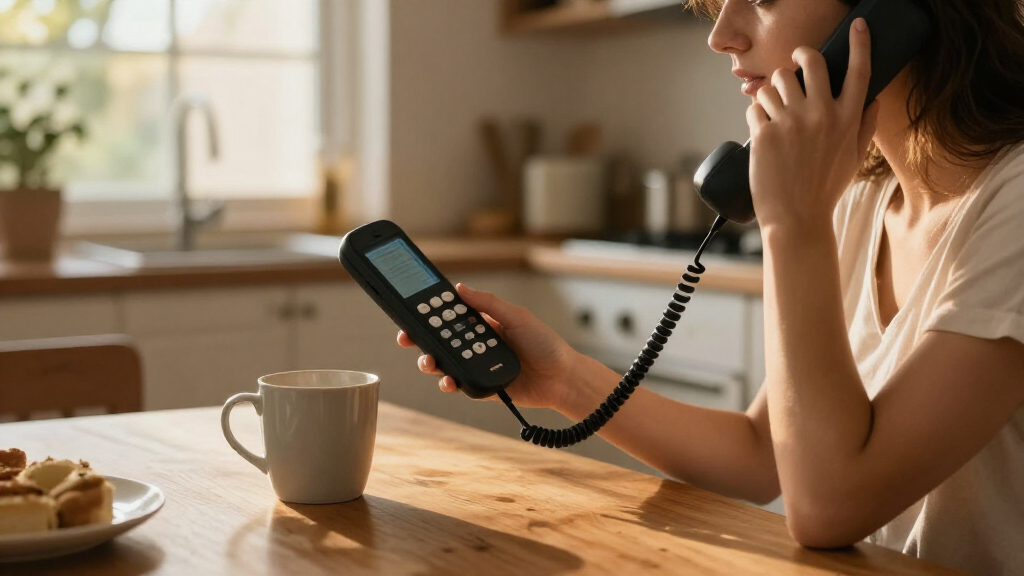
For callers who miss words even when volume is raised, the CapTel 2400iSPNBT adds real-time captions for incoming and outgoing calls—a different kind of assistance from the amplification-first Clarity AltoPlus. Its large touchscreen shows captions, allows adjustment of caption size and tone, and displays captioned voicemail, giving users a visual fallback during conversations and when checking messages. Sound amplification reaches up to 40 dB, and the phone is hearing aid compatible. The key tradeoff is setup: captioning needs high-speed internet and may also require telephone service, plus registration is limited to eligible U.S. residents with hearing loss. Compared with the Panasonic KX-TGM420W, this model adds text support but is less suitable for someone seeking a straightforward cordless phone.
Pros:- Displays real-time captions for incoming and outgoing calls.
- Offers automated captioning or live operator assistance.
- Caption size and tone can be adjusted, with sound amplification up to 40 dB.
- Digital answering system displays captions for voicemail.
Cons:- Requires high-speed internet and may also require telephone service.
- Captioning service requires registration and is limited to eligible U.S. residents with hearing loss.
- Corded design does not offer the mobility of the Panasonic KX-TGM420W.
Best for: Eligible U.S. residents with hearing loss who benefit from reading call captions as well as hearing amplified speech.
Not ideal for: Buyers without reliable high-speed internet, people outside the eligible U.S. service area, or anyone seeking cordless portability.
- Phone type:Corded
- Captioning:Automated or assisted with live operator support
- Amplification:Up to 40 dB
- Hearing aid compatible:Yes
- Display:Large touchscreen
- Connectivity requirements:High-speed internet; telephone service in some cases
- Recording capacity:18 minutes
Our verdict“Choose the CapTel if reading captions during calls is more helpful to you than having a cordless handset.”
Panasonic KX-TGM420W Amplified Cordless Phone System with Digital Answering Machine and Two Handsets
The Panasonic KX-TGM420W is a flexible choice for households that need more than a volume boost. Along with up to 40 dB caller-volume amplification, it offers six voice-tone settings, noise reduction, and Slow Talk to make speech easier to follow. Those listening controls give it a more adjustable approach than the Clarity D704, which lists adjustable tone control but not Slow Talk or noise reduction. Two handsets are included, and the system can expand to six, making it useful across a larger home. Large backlit controls and visual ringers add non-audio cues, while its digital answering system records up to 17 minutes. The tradeoffs are six AAA batteries and a recording limit; unlike the Hamilton CapTel, it does not provide on-screen captions.
Pros:- Boosts caller volume up to 40 dB with six voice-tone settings and custom adjustment.
- Slow Talk and noise reduction offer extra ways to follow conversations.
- Includes two handsets and supports expansion to six.
- Large backlit controls and bright red visual ringers add visual call cues.
Cons:- Requires six AAA batteries.
- Answering machine recording capacity is limited to 17 minutes.
- Does not offer the real-time captions available on the Hamilton CapTel 2400iSPNBT.
Best for: Households wanting cordless access in multiple rooms, adjustable speech clarity, and room to add more handsets.
Not ideal for: Callers who need visual captions to follow speech or who want to avoid managing multiple handset batteries.
- Included handsets:2
- Maximum handsets:6
- Maximum caller volume boost:40 dB
- Voice tone settings:6-level and custom
- Base ringer volume:Up to 100 dB
- Answering system:Digital; 17-minute recording capacity
- Talk time:13 hours
Our verdict“Choose the Panasonic for adjustable speech support and multi-room cordless use, but choose the CapTel if captions are necessary.”
Clarity D704 Amplified Cordless Phone with Caller ID
The Clarity D704 suits buyers who want a straightforward amplified cordless phone rather than a multi-handset bundle or a captioning system. It raises incoming sound up to 40 dB and includes adjustable tone control, so users can tailor the sound without the more elaborate speech tools found on the Panasonic KX-TGM420W, which adds Slow Talk and noise reduction. DECT 6.0 technology is specified for the cordless connection, while the handset speakerphone and easy-to-read Caller ID display cover everyday calling needs. The main compromise is simplicity: it is a single-line phone and the listed data does not specify an included extra handset. It also requires two AAA batteries. Choose it for basic amplified cordless calling; choose the Panasonic for broader listening adjustments and room-to-room expansion.
Pros:- Incoming sound amplification reaches up to 40 dB.
- Adjustable tone control lets users tailor the sound.
- DECT 6.0 technology is specified for cordless operation.
- Handset speakerphone and Caller ID display support hands-free calling and caller identification.
Cons:- Designed for single-line operation.
- Requires two AAA batteries.
- Offers fewer speech-following features than the Panasonic KX-TGM420W.
Best for: Individuals seeking a basic single-line cordless phone with adjustable amplification, Caller ID, and a handset speakerphone.
Not ideal for: Households needing several handsets, advanced speech tools such as Slow Talk, or captioned calls.
- Phone type:Cordless
- Amplification:Up to 40 dB
- Technology:DECT 6.0
- Tone control:Adjustable
- Caller ID:Display
- Speakerphone:Handset
- Batteries required:2 AAA
Our verdict“Pick the D704 for uncomplicated amplified cordless calling, but step up to the Panasonic if you need more listening controls or expandable handsets.”
Serene Innovations Amplified Big-Button Corded Landline Phone with Photo Speed-Dial Buttons
The Serene Innovations HD40P puts simple, recognizable calling ahead of extra phone features. Its large keypad helps with dialing, while photo speed-dial buttons let a user reach familiar contacts without remembering numbers. That makes it a more direct choice for memory or vision challenges than the Clarity E814CC, which offers stronger amplification and an answering machine but relies on a conventional keypad and screen.
For hearing support, the HD40P combines 26 dB audio amplification with an 85 dB ringer, and its phone-line power means it does not need household electricity for basic operation. The tradeoff is limited flexibility: it is a single-line corded phone that needs a standard landline, and its amplification is lower than the E814CC’s. Choose it for straightforward, photo-guided calls rather than extensive sound controls or cordless placement.
Pros:- Photo speed-dial buttons make familiar contacts easier to call without recalling phone numbers.
- Large keypad supports users who have difficulty seeing or pressing small buttons.
- 26 dB amplification and an 85 dB ringer provide added hearing support.
- Phone-line powered operation does not rely on household electrical power.
Cons:- Its 26 dB amplification is lower than the Clarity E814CC’s stated maximum of 40 dB.
- Requires a standard landline connection and offers only single-line operation.
- Corded design limits where the phone can be used.
Best for: Landline users who benefit from large buttons and photo labels for calling a small set of familiar contacts.
Not ideal for: People who need stronger amplification, tone adjustment, an answering machine, multiple lines, or cordless freedom.
- Telephone type:Corded landline
- Audio amplification:26 dB
- Ringer volume:85 dB
- Dialing aids:Large buttons and photo speed-dial buttons
- Line operation:Single-line
- Power source:Phone line
- Dimensions:7 x 5 x 3 inches
- Weight:1.9 pounds
Our verdict“Choose the HD40P if photo-based one-touch dialing and phone-line power matter more than stronger amplification or advanced call features.”
Clarity E814CC Amplified Corded Phone for Hearing Impaired Users
The Clarity E814CC is the more feature-rich choice for hearing support in this pair. It offers up to 40 dB amplification and four tone settings, giving listeners more ways to tailor incoming sound than the Serene Innovations HD40P, which provides 26 dB amplification without listed tone controls. Its amplified answering machine can also make recorded messages easier to hear, while the high-contrast caller ID display adds a visual cue for incoming calls.
Those additions suit someone who wants more than basic dialing, but they bring a less minimal setup. The base is corded, and adding cordless handsets requires purchasing compatible units separately. Five speed-dial buttons are useful, though less visually personalized than the HD40P’s photo buttons. I’d choose the E814CC for adjustable listening and message access; skip it if photo-based dialing or a fully cordless phone is the priority.
Pros:- Up to 40 dB amplification and four tone settings allow more listening adjustment than the HD40P.
- Amplified digital answering machine helps make recorded messages easier to hear.
- Large, high-contrast keypad and caller ID display support visual use.
- Can support up to four cordless handsets with compatible expansion units.
Cons:- Corded base restricts calling to the phone’s location unless compatible cordless handsets are added.
- Handsets for expansion are not included as part of the stated base-phone setup.
- Five speed-dial buttons are less visually personalized than the HD40P’s photo buttons.
Best for: Landline users who need stronger adjustable amplification, an audible answering machine, and visual caller ID in one base phone.
Not ideal for: People who want photo-labeled speed dialing, a fully cordless setup without expansion, or a simpler phone with fewer features.
- Phone type:Corded base phone with cordless handset expansion
- Maximum sound amplification:Up to 40 dB
- Tone settings:4
- Answering machine:Amplified digital answering machine
- Display:Large, high-contrast caller ID; lights up as a visual ringer
- Speed-dial buttons:5
- Speakerphone:Yes
- Maximum expandable handsets:4 (D703HS)
- Dimensions:5.5 x 7.5 x 9 inches
Our verdict“Pick the E814CC if adjustable amplification and an amplified answering machine matter more than photo dialing or cordless convenience out of the box.”
How We Picked
I compared these phones by asking how directly each one helps with the real task of following and placing calls. The main factors were hearing support and conversation clarity, the ease of adjusting and using controls, and whether the design suits a fixed location or movement around the home. I also weighed practical differences such as handset count, answering features, visible dialing aids, and the extra setup or service considerations that can come with captioned calling.
The ranking favors options that balance useful hearing support with everyday usability, rather than treating the longest feature list as a win. That puts the Panasonic KX-TGM450S ahead as a broadly capable cordless choice, while the Hamilton CapTel ranks for a more specific need: seeing spoken conversation as text. Corded photo-dial models rank higher for users who prioritize straightforward operation, but lower for callers who need room-to-room freedom. A model can be the right pick for a particular user without being the best match for every household.
| personal amplified telephones for hearing loss | Phone type |
|---|---|
| Clarity P-300 Amplified Corded | Corded |
| Sonic Alert AMPLIDECT350X Ampl | — |
| Clarity 53714 DECT 6.0 Amplifi | Cordless |
| Panasonic KX-TGM450S Amplified | — |
| Clarity XLC8 DECT 6.0 Amplifie | DECT 6.0 amplified cordless |
| Clarity XLC3.4+ Cordless Phone | Cordless |
| Clarity AltoPlus Amplified Cor | Corded |
| Hamilton CapTel 2400iSPNBT Cap | Corded |
| Panasonic KX-TGM420W Amplified | — |
| Clarity D704 Amplified Cordles | Cordless |
| Serene Innovations Amplified B | — |
| Clarity E814CC Amplified Corde | Corded base phone with cordless handset expansion |
Factors to Consider When Choosing Personal Amplified Telephones For Hearing Loss
Before choosing, I would start with the caller’s hardest part of phone use: hearing speech, understanding fast conversation, finding the right button, or taking calls away from one spot. Those needs point to different designs, and a louder handset alone may not address every difficulty.
Match the support to the hearing difficulty
Amplification makes the incoming voice louder, but increased volume does not always make speech clearer. If the main problem is keeping up with rapid speech, a feature such as Slow Talk may be more useful than choosing a phone on volume alone. Captioned calling offers another approach by showing words on a screen, though it depends on a display and may involve setup or service requirements. Think about whether the caller struggles with quiet voices, fast speech, or missed words before comparing features. A common mistake is assuming every hearing-related phone solves the same problem. When possible, check whether the phone’s support features can be adjusted to the user’s needs.
Choose corded or cordless around real calling habits
A corded phone stays in one place and avoids the routine of returning a handset to its charging base. That can suit someone who wants a familiar, fixed calling spot or prefers not to manage a rechargeable handset. Cordless models give more freedom to answer calls in different rooms, but that convenience depends on charging, handset placement, and signal coverage at home. Multi-handset systems can help when calls are taken in several areas, yet extra handsets add equipment to manage. Consider where the user actually spends time instead of buying extra coverage that may go unused. If mobility around the home matters, cordless freedom may outweigh the simplicity of a corded design.
Make controls usable before adding features
Small buttons, dense menus, and hard-to-read labels can make a capable phone frustrating to use. Large buttons and photo speed-dial keys may reduce the steps needed to call familiar people, especially for someone who has difficulty remembering numbers. A simpler corded model can be a better fit than a feature-rich cordless system if the caller mainly needs reliable access to a few contacts. On the other hand, a household that uses an answering system or several handsets may welcome those added functions. Ask the intended user to try the control layout if a return or demonstration option is available. Ease of dialing is part of hearing-friendly design because missed or delayed calls can undermine the value of better audio.
Decide whether captions, an answering system, or extra handsets matter
Added features are useful only when they solve a regular problem. Captions may help when louder audio still leaves parts of a conversation unclear, while an answering system can help callers retrieve missed messages. Extra handsets make sense when the user needs to answer from multiple rooms, but a single handset may be simpler for a small home or fixed phone location. Captioned phones can have additional setup or service considerations, so check the current requirements before choosing one. Do not pay in complexity for features the intended caller will not use. Start with the most frequent calling situation, then add functions only when they improve that routine.
Check home compatibility and ongoing upkeep
Before buying, confirm that the phone suits the home’s landline setup and that the intended calling service supports the model’s functions. Captioning, in particular, may rely on service arrangements that differ from ordinary amplified calling. Cordless systems need charging and a sensible place for each base or handset, while corded phones need a suitable connection point and reachable placement. Also consider who will handle setup, save contacts, and adjust settings if the user needs help. Product names and feature descriptions do not replace checking the included instructions and current service conditions. This quick check can prevent choosing a phone whose core feature is difficult to use in the household.
Frequently Asked Questions
Is a louder amplified phone enough if I still miss parts of conversations?
Not always. Amplification raises incoming sound, but some callers still find speech hard to follow when people talk quickly or words are unclear. A phone with speech-slowing support may help with fast conversation, while a captioned phone can provide text as another way to follow a call. The Hamilton CapTel 2400iSPNBT is the roundup’s caption-focused choice, whereas the Panasonic KX-TGM450S pairs amplification with Slow Talk. Consider which problem causes the most missed information, and check any setup or service requirements before choosing captions.
Should I choose a corded phone or a cordless phone for an older caller?
Choose based on where the caller takes calls and how comfortable they are managing a handset. A corded model can stay in a familiar location and does not need to be returned to a charging base, while cordless designs make it easier to answer from different rooms. If remembering to charge equipment is a concern, a corded phone may be the simpler routine. If reaching the phone quickly around the home matters more, cordless freedom may be worth that upkeep. Also check whether the caller can comfortably use the controls and place the handset on its base.
Do photo speed-dial buttons make a meaningful difference?
They can, especially for someone who calls the same people often and finds small number keys or memorized sequences difficult. Photo buttons can make familiar contacts easier to identify, but they do not replace checking that the labels are readable and the dialing steps are comfortable. The Clarity P-300 and Serene Innovations corded phone put this kind of direct dialing at the center of their appeal. A caller who mainly needs better conversation support may get more benefit from another feature instead. Think about whether placing a call or hearing the other person is the larger obstacle.
Do I need more than one handset?
Extra handsets help when the caller regularly answers in different rooms or wants a phone within reach in more than one area. They can be unnecessary if the caller uses a single, reliable phone location. More handsets also mean more places to charge and keep track of equipment. The Sonic Alert AMPLIDECT350X includes an extra charging base, and the Clarity XLC3.4+ bundle provides additional handsets, so those designs address a different household need from a single corded phone. Map the home’s calling spots before choosing a multi-handset system.
What should I check before buying a captioned telephone?
Check how the captioning service works, whether it is available for the user’s calling setup, and what registration or network requirements apply. Confirm that the display is easy for the caller to read and that they are comfortable following text while listening. A captioned model can help when amplification alone does not make every word clear, but it adds a screen-based interaction that a basic amplified phone does not require. The Hamilton CapTel 2400iSPNBT is the roundup’s option for this need. Verify current setup details with the provider and product documentation before making it the household’s main phone.
Conclusion
For most buyers seeking a versatile cordless phone with added speech support, I would start with the Panasonic KX-TGM450S as the best overall pick. The Clarity D704 is a sensible value-oriented choice for someone who wants amplified cordless calling with Caller ID without prioritizing the more specialized features found on the Panasonic. For a premium, text-assisted approach, the Hamilton CapTel 2400iSPNBT is best suited to callers who need captions and are prepared to check its service and setup requirements. Beginners who want direct, familiar operation should look at the Clarity P-300, while the Serene Innovations photo speed-dial phone is a strong fit for callers who rely on large, recognizable contact buttons. Choose the Sonic Alert AMPLIDECT350X if an extra charging base suits the home, or a multi-handset Panasonic or Clarity system if calls need to be answered in more than one room. My final choice would depend on whether the greatest barrier is hearing speech, following fast conversation, dialing contacts, or reaching a phone around the house.
Fall Picks

DJI Osmo Action 4 Essential Combo Waterproof 4K Action Camera
As an affiliate, we earn on qualifying purchases.