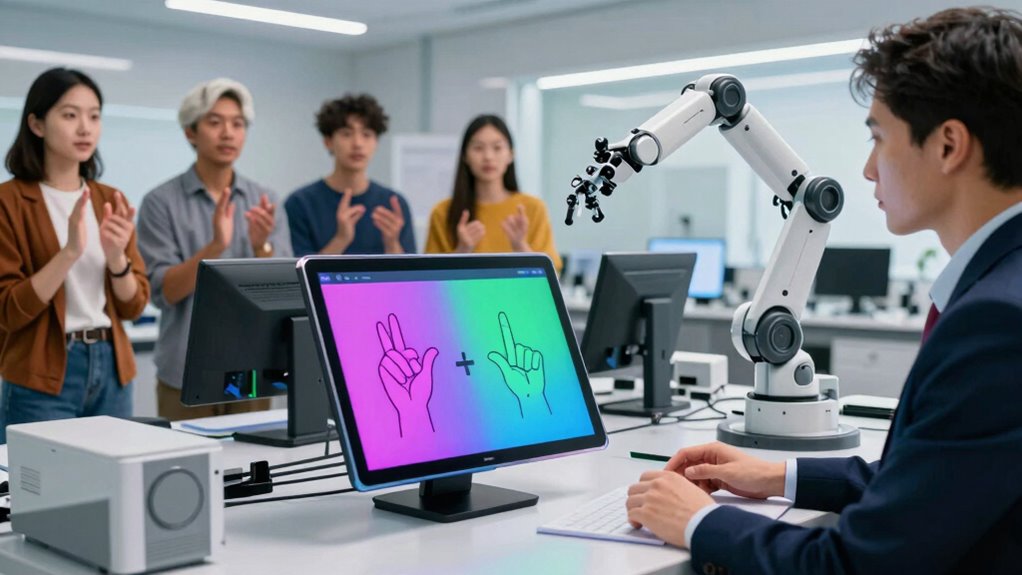

Today, AI can recognize many sign language gestures using cameras and sensors, helping you communicate more naturally and quickly in real time. It can translate common signs into spoken or written words, providing useful support when human interpreters aren’t available. However, AI still struggles with complex, subtle, or context-dependent signs and varies in accuracy across different signing styles and environments. If you want to understand how these tools are evolving and what limitations remain, stay with us to find out.
Key Takeaways
- AI can interpret many common sign language gestures in real-time, facilitating smoother communication.
- It struggles with subtle, complex, or context-dependent signs, leading to potential misinterpretations.
- Translation accuracy varies due to dialects, individual signing styles, and environmental conditions.
- AI serves as a helpful supplement but does not fully replace human interpreters in sign language communication.
- Ongoing research aims to improve adaptability, contextual understanding, and robustness of gesture recognition systems.
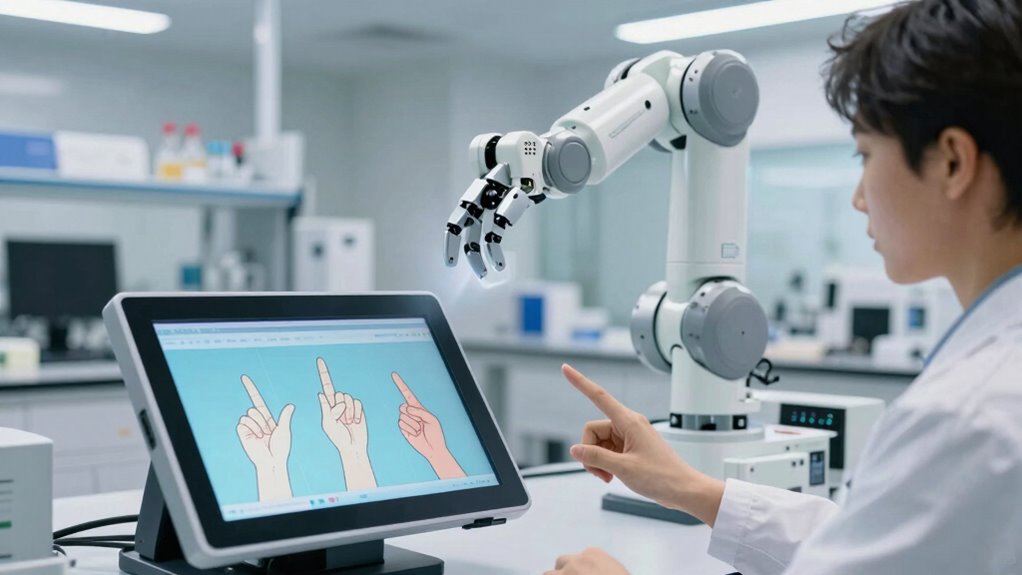
Advancements in artificial intelligence are transforming how we communicate with and support the deaf and hard-of-hearing communities. One of the most exciting developments is in gesture recognition, where AI systems can interpret sign language movements with increasing precision. These systems use cameras and sensors to track hand shapes, movements, and facial expressions, aiming to convert signs into spoken or written words seamlessly. As a result, you might find AI-powered devices that can understand many common signs in real-time, making conversations more fluid and natural. However, despite these technological strides, gesture recognition still faces challenges, especially in accurately capturing complex or subtle signs. Mistakes in recognition can lead to miscommunication, which underscores the importance of translation accuracy. While AI has made significant progress, it’s not yet perfect at translating every nuance of sign language, especially across different dialects, regional signs, or individual signing styles. The goal is to reach a level of translation accuracy that can support meaningful, everyday conversations without frustration or misunderstandings.
You should know that current AI tools excel at recognizing straightforward, well-defined signs, but they often struggle with context-dependent signs or signs performed in less-than-ideal conditions, such as poor lighting or cluttered backgrounds. This means that while AI can be a helpful supplement, it’s not yet reliable enough to replace human interpreters entirely. For many in the deaf community, this technology offers an additional means of communication rather than a complete replacement. It provides a bridge that can help you connect more easily in situations where human interpreters aren’t available, like quick exchanges or in noisy environments. Still, the effectiveness of these systems depends heavily on how well they can interpret gestures and how accurately they translate those gestures into spoken language. Additionally, the accuracy of gesture recognition can vary depending on environmental factors and the complexity of signs, highlighting the ongoing need for improvements. Researchers are also exploring machine learning techniques to improve the system’s ability to adapt to diverse signing styles and environments. Furthermore, ongoing research aims to address these limitations by incorporating contextual understanding, which could significantly enhance translation precision in the future. Developing robust algorithms capable of functioning across different conditions remains a key focus in this field.

AI Wearable Translator English Spanish Voice Translation Device,Black
- Real-Time Voice Translation: English-Spanish with 165 language support
- AI Language Learning Support: Practice conversations and pronunciation guidance
- Compact & Portable Design: Fits in pocket or bag for easy travel
As an affiliate, we earn on qualifying purchases.
As an affiliate, we earn on qualifying purchases.
Frequently Asked Questions
How Accurate Are Current AI Sign Language Translations?
Current AI sign language translations are fairly accurate, thanks to advances in gesture recognition and language modeling. You’ll find that AI can interpret many signs correctly, especially with clear gestures and good lighting. However, accuracy can drop with complex signs or fast movements. While these systems are improving, they still struggle with nuances and context, so they’re best used as supporting tools rather than perfect substitutes for human interpretation.
Can AI Interpret Sign Language in Noisy Environments?
You might think AI struggles with noisy environments, but surprisingly, advancements help it interpret sign language amid environmental challenges. Noise interference can hinder accuracy, yet sophisticated sensors and algorithms detect subtle movements even in bustling settings. While not flawless, AI is improving at overcoming environmental challenges, enabling more reliable communication in real-world, noisy situations. So, with ongoing innovation, you can expect AI to get better at understanding sign language despite environmental hurdles.
What Are the Privacy Concerns With AI Sign Language Tools?
You should be aware that AI sign language tools raise privacy concerns, especially around data security. When you use these tools, your sign language data might be stored or shared without your consent, risking misuse or breaches. Additionally, ethical implications come into play if your data is used improperly or if the technology isn’t transparent about how it processes your information. Always check privacy policies and data handling practices before using such tools.
How Affordable Are Ai-Based Sign Language Solutions?
AI-based sign language solutions are becoming quite affordable, especially as technology advances and demand increases. You’ll find that their cost-effectiveness improves, making them more accessible for various users. These tools considerably enhance accessibility by providing real-time translation, helping deaf and hard-of-hearing individuals communicate more easily. While prices vary, many options are now within reach for educational institutions, businesses, and personal use, fostering greater inclusion and understanding.
Will AI Replace Human Sign Language Interpreters?
AI won’t replace human sign language interpreters, as only they grasp cultural nuances and emotional expression fully. Think about this: 65% of communication is non-verbal; AI struggles to interpret those subtle cues. While AI provides valuable assistance, it can’t replicate the empathy, cultural understanding, and emotional depth that human interpreters bring, making them irreplaceable in nuanced conversations and sensitive situations.
Conclusion
While AI can bridge communication gaps and translate sign language with impressive speed, it still struggles with nuance and cultural context. You might rely on these tools for basic understanding, yet they can’t replace the human touch that captures emotion and intent. Just as a photograph captures a moment but not its soul, AI’s translations can lack the depth only human connection provides. In this balance, technology assists, but true understanding still requires human empathy.