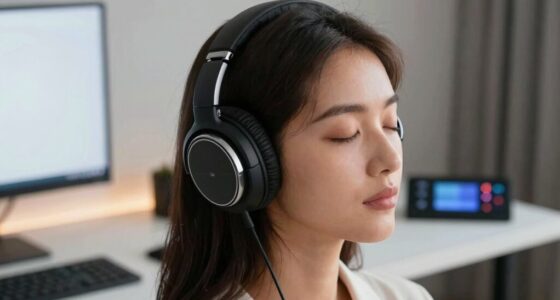

AI speech recognition faces major challenges in noisy rooms. Background sounds, unpredictable noises, and multiple speakers often cause errors or missed words. Its ability to adapt quickly drops with sudden changes in environment. Noise filtering isn’t always effective, especially with complex sounds, and processing delays can make real-time understanding difficult. If you keep exploring, you’ll discover more about how these limits are shaping the future of voice tech and possible solutions.

Get everyday helpers delivered free with Prime
- Fast, free delivery on millions of items
- Prime Video, Amazon Music and more included
- Member-only deals all year
Key Takeaways
- Background noise causes AI speech recognition to misinterpret or miss words, especially in crowded or unpredictable environments.
- Rapid environmental changes and multiple speakers reduce AI’s ability to adapt and maintain accuracy.
- Noise filtering effectiveness varies with background complexity and can be confused with speech, leading to errors.
- Real-time processing constraints and hardware limitations introduce delays, affecting immediate understanding.
- Ongoing algorithm improvements are incremental, with current systems still struggling in chaotic, noisy settings.
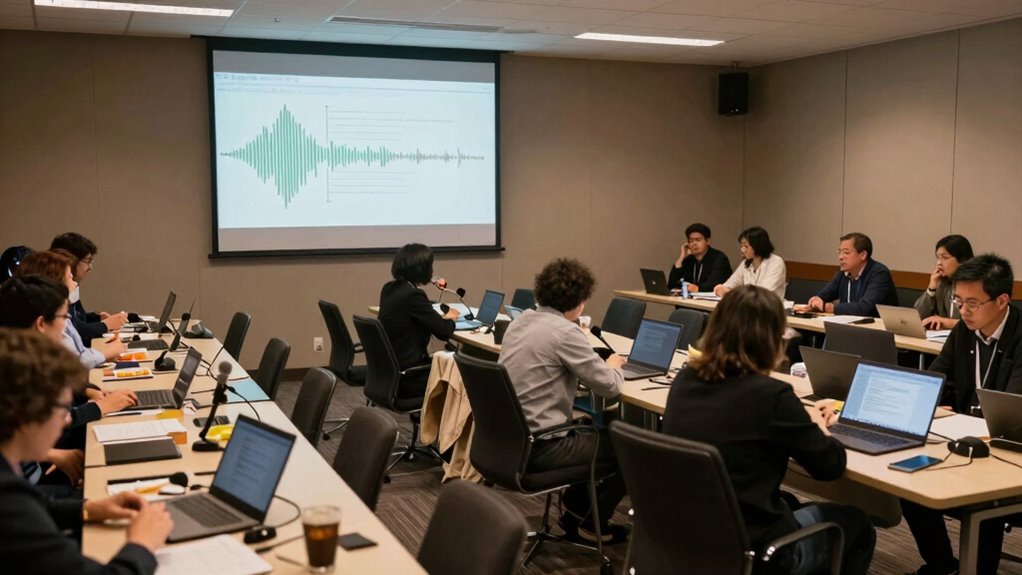
AI speech recognition systems still struggle to accurately transcribe speech in noisy environments. When you’re in a crowded room or a bustling café, these systems often falter, misinterpreting words or missing critical parts of your speech. The challenge lies in how AI can adapt to unpredictable sounds and background noise, especially when it needs to do so quickly. That’s where the concepts of contextual adaptation and real-time processing come into play. While these technologies are designed to improve accuracy, they aren’t foolproof in chaotic settings. You might find that even the most sophisticated systems get overwhelmed when the noise level spikes or when multiple people speak simultaneously.
Contextual adaptation is supposed to help AI better understand your speech based on the situation. For example, if you’re talking about cooking, the system should prioritize culinary terms and ignore irrelevant background sounds. But in practice, this process isn’t perfect. When the environment shifts suddenly — like a loud clap or music starting in the background — AI struggles to reorient itself quickly. It often gets stuck trying to interpret the noise as part of your speech, leading to errors. The system’s ability to adapt depends heavily on how well it recognizes the context and adjusts its algorithms on the fly. If it can’t do this swiftly, transcription accuracy drops dramatically. Additionally, the effectiveness of noise filtering techniques varies depending on the complexity of the background sounds and the AI’s training. Moreover, background noise can sometimes mimic speech patterns, further confusing the system and causing more errors. Increased training data diversity could potentially help improve these issues over time, making the AI more resilient to different sound environments. The ongoing development of robust algorithms aims to address some of these challenges, but progress remains incremental.
Real-time processing is another critical factor. You expect your voice commands to be understood instantly, whether you’re dictating a message or giving a voice command to your smart device. For AI to work efficiently in noisy rooms, it must process incoming sound, filter out background noise, and produce accurate transcriptions without delay. Unfortunately, processing everything in real time is technically demanding. When the system’s computational resources are stretched, it may lag or produce incomplete results. This delay can be frustrating, especially if you’re relying on the system for immediate actions or communication. Hardware limitations also play a significant role in how well a system can perform under these conditions.
In noisy environments, the combination of poor contextual adaptation and sluggish real-time processing hampers AI’s performance. Even with ongoing improvements, these limitations mean AI speech recognition isn’t yet reliable enough for all noisy settings. You may notice frequent misinterpretations, especially when background sounds are complex or unpredictable. While developers continue to refine algorithms to better handle such conditions, it’s clear that the technology is still catching up with the realities of everyday life. Until then, you might need to speak more clearly or find quieter spots if precise transcription is critical.
noise cancelling Bluetooth headphones
As an affiliate, we earn on qualifying purchases.
As an affiliate, we earn on qualifying purchases.
Frequently Asked Questions
How Do Different Languages Affect Speech Recognition Accuracy in Noisy Environments?
Different languages can impact speech recognition accuracy in noisy environments due to multilingual challenges and accent variability. You might find that AI struggles more with tonal languages or those with complex phonetic structures, especially when accents vary widely. These factors make it harder for systems to distinguish words clearly amidst background noise. As a result, recognition accuracy drops, and you may need tailored models or additional training data to improve performance across diverse languages and accents.
Can AI Adapt to Individual Speaker Accents and Speech Patterns in Noisy Settings?
AI can adapt to individual speaker accents and speech patterns in noisy settings, but personalization challenges remain. Acoustic adaptation helps improve recognition by tuning to your unique voice, yet background noise still hampers accuracy. You might notice better results when the system learns your speech over time, but it’s not perfect. Continuous improvements focus on overcoming these personalization challenges, making AI more responsive to your specific accent and speech style even in noisy environments.
What Hardware Improvements Can Enhance Speech Recognition in Noisy Rooms?
Upgrading your hardware can considerably improve speech recognition in noisy rooms. Invest in advanced microphone technology, like directional or beamforming microphones, which focus on your voice and reduce background noise. Pair this with sophisticated noise-canceling algorithms that filter out ambient sounds. Together, these enhancements help AI systems better capture your speech clearly, even amid chaos, making recognition more accurate and reliable in challenging environments.
How Does Room Acoustics Influence AI Speech Recognition Performance?
Room acoustics considerably impact AI speech recognition, as echoes and reverberations can distort sound. You can improve performance by using echo cancellation technology to reduce reverberations. Additionally, deploying microphone arrays helps focus on the speaker’s voice while minimizing background noise. These tools work together to enhance clarity, making it easier for AI systems to accurately interpret speech even in challenging acoustic environments.
Are There Real-Time Solutions to Improve Recognition During Live Noisy Conversations?
Like a lighthouse guiding ships through fog, real-time noise cancellation can considerably improve speech recognition during live noisy conversations. You can enhance results by adjusting microphone placement—placing mics closer to the speaker reduces background noise and captures clearer audio. Combining advanced algorithms with strategic microphone positioning helps AI systems better distinguish speech from ambient sounds, providing more accurate, immediate recognition even amidst chaos.
Conclusion
You might think AI speech recognition is flawless, but noisy rooms reveal its true limits. The theory that advancements will soon overcome all background noise is optimistic but not entirely accurate. While technology improves, the complexity of real-world sounds still challenges AI’s accuracy. So, don’t assume it’s perfect yet. Instead, recognize that in noisy environments, AI’s listening skills are still catching up, reminding you to be patient and adaptable as these systems continue to evolve.
Halloween Picks
halloween
As an affiliate, we earn on qualifying purchases.