

Even if your audiogram shows the same thresholds as someone else, your hearing can differ because of how your cochlea processes sound and how your brain interprets signals. Factors like cochlear mechanics, hair cell health, neural pathway efficiency, and brain plasticity all influence your perception. Your past experiences and listening habits shape how you understand sounds, especially in noisy environments. Keep exploring to discover the complex reasons behind these subtle differences.

Get everyday helpers delivered free — and shop member deals
- Fast, free delivery on millions of items
- Access to Prime Big Deal Days deals on October 6–7
- Prime Video, Amazon Music and more included
Key Takeaways
- Audiograms only measure hearing thresholds, not the quality or clarity of sound perception.
- Variations in cochlear mechanics affect how sounds are processed, despite similar audiogram results.
- Neural pathway efficiency and synaptic strength influence how sounds are interpreted by the brain.
- Brain plasticity and listening habits can rewire auditory processing, altering perception.
- Individual differences in auditory nerve health and neural processing lead to diverse hearing experiences.
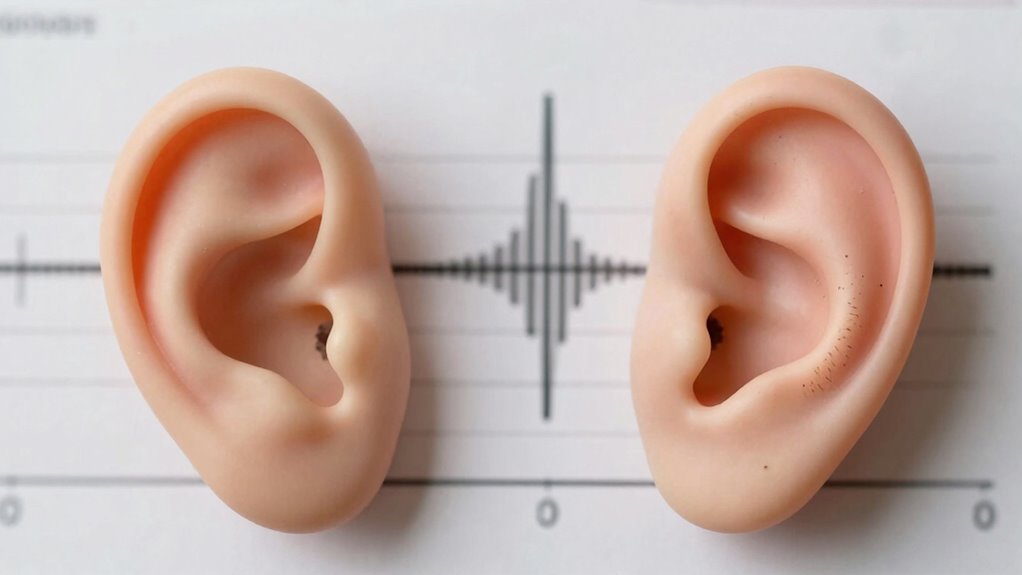
Even if two people have identical audiograms, their hearing experiences can be remarkably different. This is because audiograms mainly measure the faintest sounds you can detect at various pitches, but they don’t capture the full complexity of how your ears and brain process sound. Two individuals might show the same thresholds on paper, yet perceive speech, music, and environmental noises in entirely different ways. This discrepancy comes down to differences in cochlear mechanics and neural processing, which influence how sound signals are translated into meaningful perception.
Your cochlea, a snail-shaped structure in the inner ear, plays a pivotal role in converting sound waves into electrical signals. Variations in cochlear mechanics—such as differences in the stiffness of the basilar membrane or the health of hair cells—can affect how specific frequencies are processed. Even if both of you have similar audiogram results, subtle differences in cochlear function can change the quality of what you hear. For example, one person might have more sensitive hair cells in certain regions, resulting in clearer perception of particular sounds, while the other’s cochlea might process those sounds differently, leading to a muffled or distorted experience. Additionally, cochlear mechanics can vary due to age, genetics, or exposure to noise, further influencing individual hearing.
Differences in cochlear mechanics can alter sound quality, even with identical audiograms.
Beyond the mechanical aspects, neural processing is a key factor that shapes individual hearing. Once the cochlea converts sound into electrical signals, your brain takes over, interpreting and making sense of the information. The efficiency of neural pathways, the strength of synaptic connections, and even your past experiences influence how you perceive sound. Two people with identical cochlear input might interpret the same speech differently because their brains prioritize certain frequencies or have different levels of auditory attention. This neural variability explains why some individuals can pick out speech in noisy environments while others struggle, despite having similar audiogram profiles.
Furthermore, the brain’s ability to adapt and compensate plays a fundamental role. Neuroplasticity allows your neural pathways to reorganize based on your listening habits and experiences. Someone who has spent years in quiet environments may process sound differently than someone regularly exposed to loud or complex acoustic settings. These differences in neural processing aren’t captured by traditional audiograms but are indispensable to understanding why hearing experiences can vary so much. The mechanics of cochlear function and neural processing together create a highly individualized auditory perception, emphasizing that hearing is much more than what an audiogram can reveal. Additionally, individual differences in auditory nerve health can further influence how sound signals are transmitted and perceived.
As an affiliate, we earn on qualifying purchases.
Frequently Asked Questions
How Does Age Affect Hearing Perception Beyond Audiogram Results?
As you age, age-related neural decline and cochlear aging effects can impact your hearing perception beyond what audiogram results show. You might notice difficulty understanding speech in noisy environments, even if your hearing thresholds seem normal. These changes affect how your brain processes sounds, making it harder to distinguish speech or appreciate subtle tones. So, age influences your hearing quality by affecting neural pathways and cochlear health, not just pure-tone sensitivity.
Can Cognitive Factors Influence How We Interpret Sounds?
Cognitive factors are like filters that shape your auditory perception, influencing how you interpret sounds. When you hear something, your brain actively processes and makes sense of it through cognitive interpretation. This means two people with similar hearing abilities might perceive the same sound differently because their cognition, memory, and attention affect what they actually hear and understand. So, your mind plays a crucial role in your hearing experience.
What Role Does Ear Anatomy Play in Hearing Differences?
Your ear anatomy plays a vital role in hearing differences. Variations in the inner ear, especially cochlear differences, affect how sound waves are processed. Even if two people have the same audiogram, differences in cochlear hair cells or overall inner ear structure can lead to distinct hearing experiences. These anatomical variations influence sensitivity and frequency response, making your hearing unique beyond what standard tests reveal.
How Do Emotional States Impact Hearing Experience?
Your emotional states profoundly impact your hearing experience through emotional perception and auditory emotions. When you’re anxious or stressed, your brain may filter sounds differently, making certain noises seem louder or more irritating. Conversely, positive emotions can enhance your auditory perception, allowing you to enjoy music or conversations more fully. These auditory emotions influence how you interpret sounds, demonstrating that your emotional state directly shapes your hearing, beyond just the physical aspects.
Are There Differences in Sound Processing in the Brain?
Yes, there are differences in sound processing in the brain. Your neural pathways vary, affecting how signals travel from your ears to the auditory cortex. This variation influences how you interpret sounds, even with the same audiogram. Your auditory cortex processes these signals uniquely, which explains why two people can perceive the same sound differently. Factors like neural connectivity and individual brain structure play a vital role in this complex processing.
Conclusion
Just like echoes in a canyon, two people with the same audiogram can experience sound differently—one hearing clarity, the other struggle. It’s a reminder that hearing isn’t just about what the ears detect, but how our brains interpret it. As Shakespeare’s words echo, “There are more things in heaven and earth,” so too, are there unseen layers shaping our perception. Your hearing journey is uniquely yours, a melody only you can truly understand.
Halloween Picks
halloween
As an affiliate, we earn on qualifying purchases.